

Why does one Arabic noun end in -u in one phrase and -a or -i in another? In Classical Arabic, a noun’s grammatical role can change its case, and a fully vowelled Quran text may show that change in the word ending. This guide explains the three basic noun cases—nominative, accusative and genitive—through familiar Quran examples. You will learn what to look for without treating every ending as the same short vowel or confusing grammar with stopping at a verse.
What are Arabic case endings?
Case is a grammatical label for how a noun functions in its phrase or sentence. Iʿrāb (إعراب) is the grammatical analysis that identifies these relationships and the changes associated with them. The Quranic Arabic Corpus explains its iʿrāb-based Quran grammar annotation, which helps readers inspect how words relate to one another. In simple terms, first ask what job a noun is doing; then ask which case that job calls for. Do not start by guessing from a vowel alone.
Arabic grammar names three cases for nouns: marfūʿ (مرفوع, nominative), manṣūb (منصوب, accusative), and majrūr (مجرور, genitive). A basic beginner lesson often presents their familiar short-vowel markers as ḍammah (ـُ), fatḥah (ـَ), and kasrah (ـِ). These are useful starting points, not a complete chart of every Arabic noun form.
The three cases at a glance
In many ordinary examples, nominative marks a subject or topic, accusative marks a direct object, and genitive follows a preposition or appears on the second noun in an iḍāfa possessive construction. These descriptions help you begin parsing; real sentences contain additional patterns, and some words have special markers. The visual below gives one common marker and a checked Quranic example for each case.
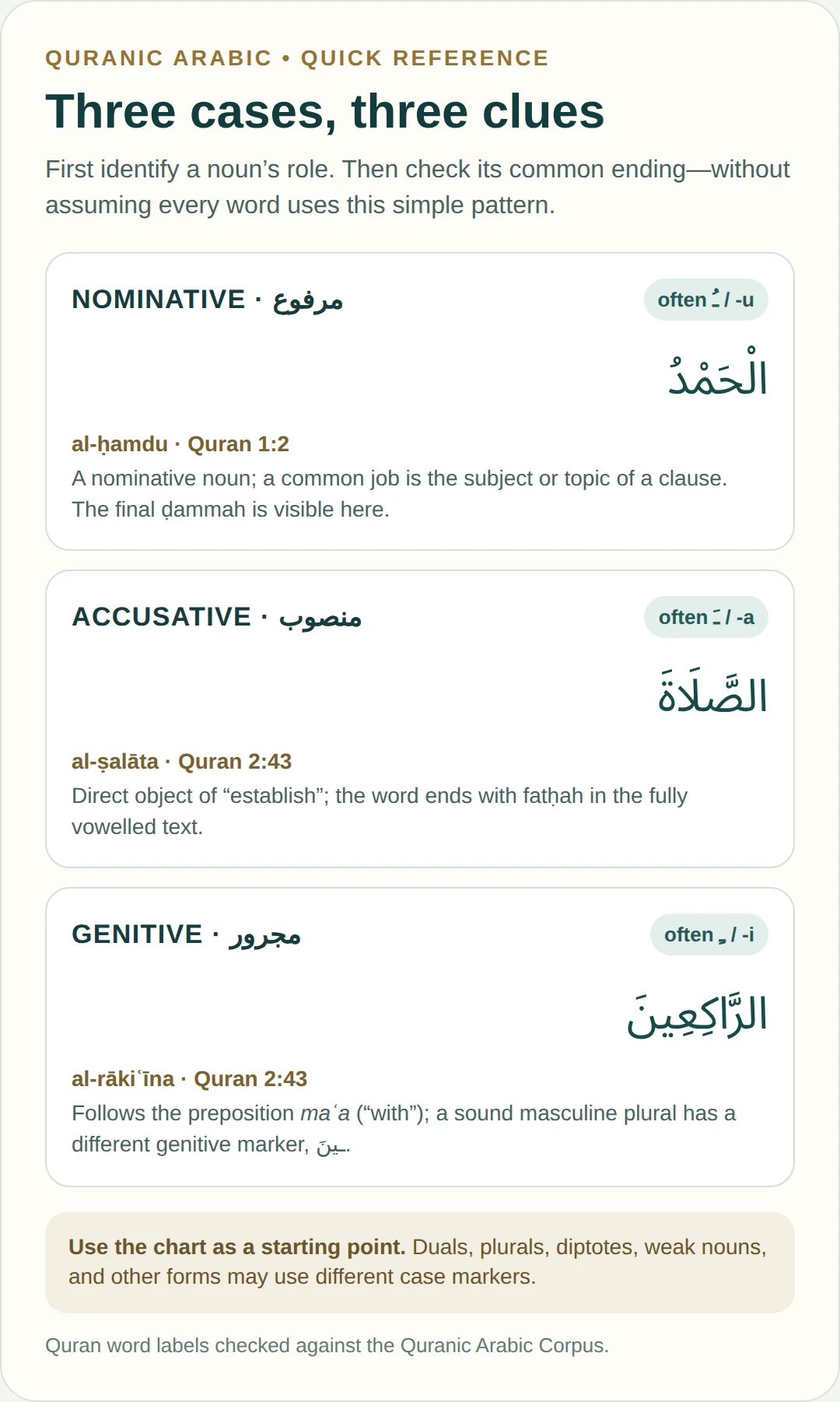
Remember the basic pattern as a first question: nominative often has -u, accusative often has -a, and genitive often has -i on a regular singular noun. Indefinite nouns may show tanwīn, such as -un, -an, or -in. The case is determined by grammar; the visible ending is a clue to that case.
Example 1: Al-Fātiḥah 1:2
The familiar phrase al-ḥamdu lillāhi rabbi l-ʿālamīn (“All praise is for Allah, Lord of all worlds”) places several case relationships close together. In the Quranic Arabic Corpus’s word-by-word analysis, al-ḥamdu (الْحَمْدُ) is a nominative noun. Its ending is written with ḍammah: -du. The noun Allāh in lillāhi (لِلَّهِ) is genitive after the prefixed lām preposition, and rabbi (رَبِّ) and al-ʿālamīna (الْعَالَمِينَ) are also analyzed as genitive in this phrase. The ending changes because of each word’s grammatical relationship, not because the verse is simply being recited with a different melody.
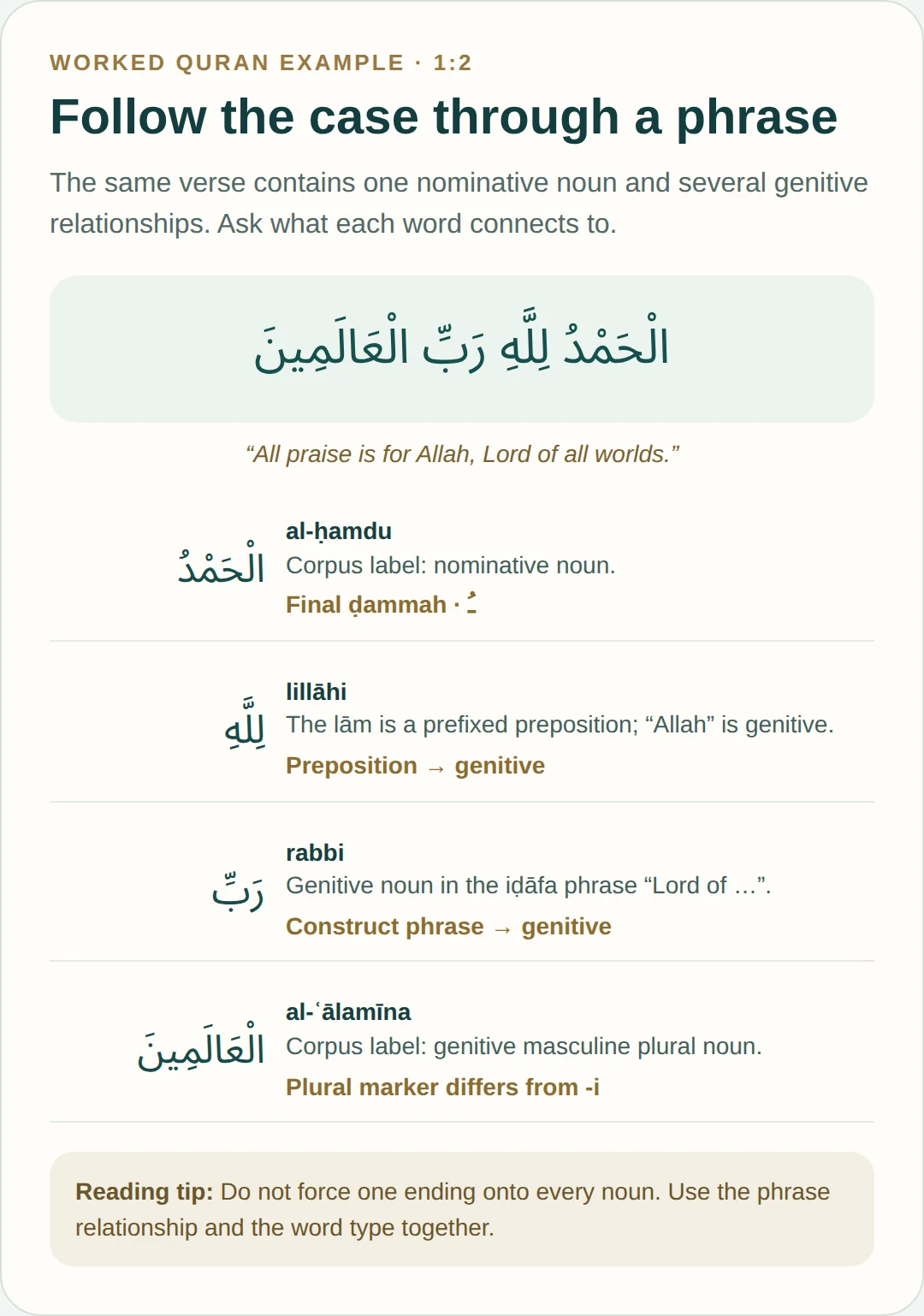
This example also shows why a word-by-word approach is valuable. You do not need to parse the whole verse at once. Begin with one noun, identify any preposition immediately before it, and then look at how it connects to the next noun. If you want more practice seeing how a noun can be followed by its predicate, review Arabic nominal sentences and their mubtada and khabar.
Example 2: Al-Baqarah 2:43
Al-Baqarah 2:43 gives a helpful contrast between accusative and genitive forms. In wa-aqīmū l-ṣalāta (وَأَقِيمُوا الصَّلَاةَ, “establish the prayer”), al-ṣalāta (الصَّلَاةَ) is an accusative noun and direct object of the command. The Corpus also tags al-zakāta (الزَّكَاةَ, “zakah”) as accusative after “give.” Both have a final fatḥah in the fully vowelled text. Later, maʿa l-rākiʿīna (مَعَ الرَّاكِعِينَ, “with those who bow”) contains the preposition maʿa, followed by al-rākiʿīna (الرَّاكِعِينَ), which the same word-by-word analysis labels genitive.
Notice the useful sequence: the verb tells you to establish or give something, so the thing acted upon is an object; the preposition introduces a following noun in the genitive. This is a reading strategy, not a claim that every word after a verb is accusative or that every phrase with maʿa can be parsed without context. The full clause determines the relationship. The site’s guide to Arabic prepositions in Quranic reading can help you recognize another common source of genitive nouns.
How to find the marker without overgeneralizing
Case markers are clearest on regular, fully vowelled singular nouns. A definite singular may show one short vowel, as in al-ḥamdu or al-ṣalāta. An indefinite noun may show tanwīn. But Arabic does not use only these three tiny marks for every noun. The dual and sound masculine plural use different case endings; some plural forms use a kasrah in the accusative; diptotes and weak nouns also have patterns that need their own explanation. Pronouns are often indeclinable, so their grammatical role may not appear as a changing final vowel.
For that reason, learn the simple pattern alongside the phrase that governs it. A preposition makes the next noun genitive; an iḍāfa construction places the second noun in the genitive; a direct object is commonly accusative. These are strong starting points, not substitutes for the full parse. Our articles on Arabic adjective agreement and Arabic verb forms explain two neighboring topics that often appear beside case in a sentence.
A five-step Quran-reading check
When you meet an unfamiliar noun, slow down and work through the relationship instead of memorizing a vowel in isolation. This short routine keeps the grammar connected to meaning:
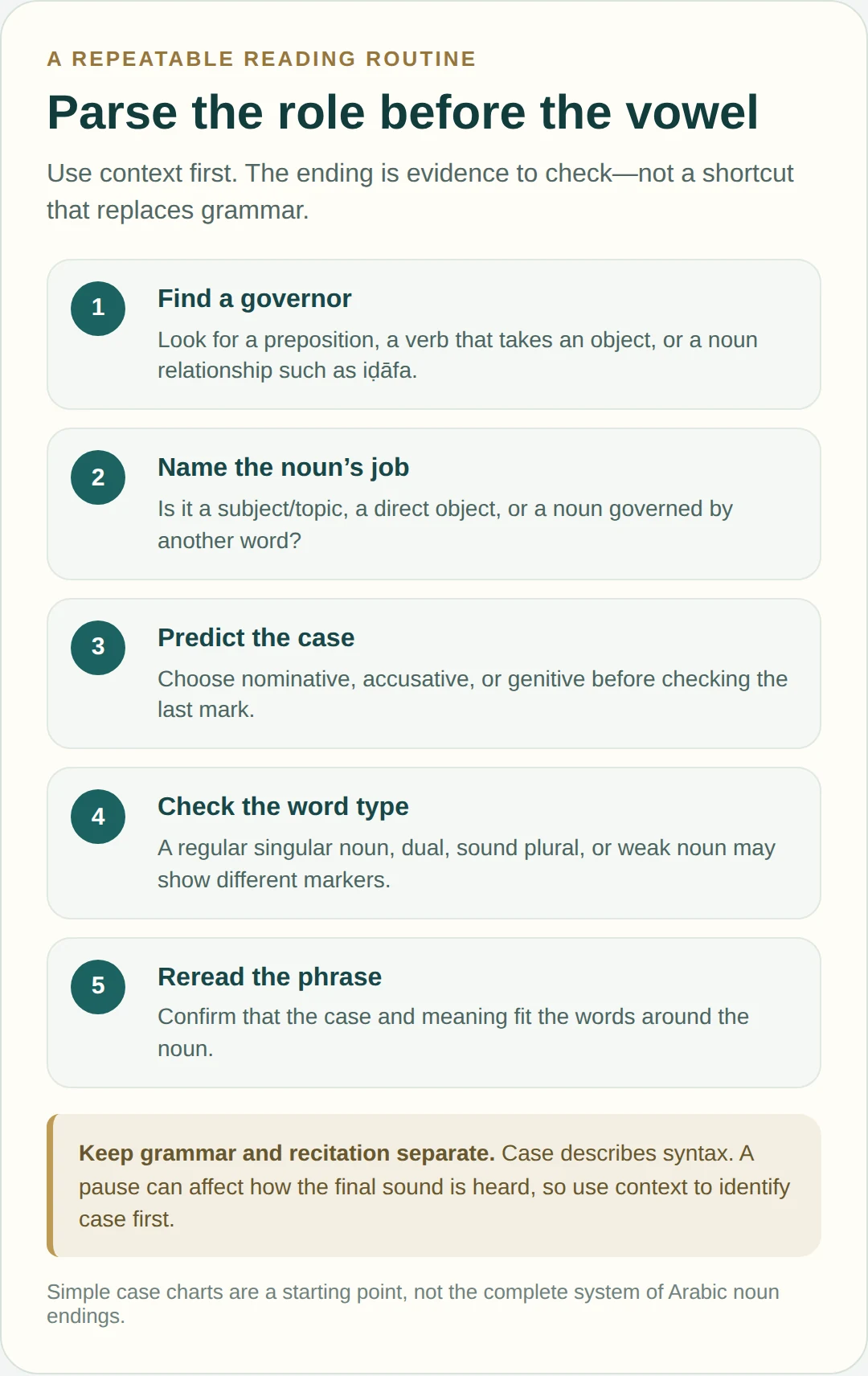
- Find a clue before the noun. Is there a preposition, a verb that takes an object, or an iḍāfa relationship?
- Name the noun’s role. Is it a subject/topic, a direct object, or governed by a preposition or possessive phrase?
- Predict the case. Say “nominative,” “accusative,” or “genitive” before checking the last mark.
- Check the word type. Is this a regular singular noun, a dual, a sound plural, or another form with a different marker?
- Reread the whole phrase. Confirm that the case and meaning fit the words around it.
If you already know how Arabic pronouns work, remember that a pronoun can fill a grammatical role without displaying a case vowel in the same way as a regular noun. The goal is to read the relationship accurately, not to force every word into the same visible ending pattern.
Case is not the same as pausing
Grammar describes a word’s role in the sentence. Recitation also has rules for continuing or stopping. When a reader pauses at the end of a phrase or verse, the final sound may be pronounced differently from connected reading. That audible pause does not erase the grammatical role. If a final vowel is not heard while stopping, do not conclude that the noun has no case. First parse the word in context, then apply the appropriate reading and stopping guidance.
This distinction matters because a learner may hear a reciter pause and assume the written case marker is absent or irrelevant. Instead, keep two questions separate: “What case does the syntax require?” and “How is this ending read when I continue or stop here?” For broader Arabic grammar foundations, the Quranytime Arabic grammar hub links related lessons without turning this guide into a complete grammar course.
Common beginner mistakes
- Guessing from the last letter alone. Some letters can carry more than one short vowel. Look at the diacritic and the word’s role.
- Assuming every subject is marked with a visible ḍammah. Duals, plurals, and other noun types may use different markers.
- Treating every genitive noun as the result of a preposition. The second noun in an iḍāfa is also genitive.
- Calling every fatḥah an accusative case marker. A letter may have a short vowel for another reason; identify the whole word’s grammar.
- Confusing a pause with case. Stopping can affect what you hear, while the syntactic analysis comes from the phrase.
One way to avoid these errors is to write down the clue and the role before the ending: “after a preposition → genitive,” or “object of this command → accusative.” Then compare your prediction with a reliable word-by-word grammar analysis. Treat simplified charts as a first step, not as permission to ignore context or forms that have special endings.
How to practise
Choose a short, familiar passage and mark only the nouns. For each one, underline any preposition or verb that may govern it, write a one-word role label, and predict its case. Then check a word-by-word source and read the whole phrase aloud. Repeat with a new line rather than trying to annotate an entire page at once. If you study with a teacher, ask them to check both your grammatical explanation and your connected recitation; a written case chart cannot replace feedback on pronunciation.
Frequently asked questions
What are the three Arabic cases?
The three cases usually taught for Arabic nouns are nominative (marfūʿ), accusative (manṣūb), and genitive (majrūr). They describe grammatical relationships and are often associated with different word endings.
Is case the same as a Quran stop sign?
No. Case is a grammatical feature; stopping is a recitation decision. A pause can change how the final sound is heard, so analyze the word in its sentence before considering how to stop.
Arabic case endings become easier when you connect each marker to the word’s job. Begin with a clear phrase, use nominative, accusative, and genitive as your three main labels, and let the surrounding grammar guide your reading. With careful practice, the endings become clues to meaning rather than isolated vowel marks.
Complementary video lesson: This lesson introduces Arabic iʿrāb and the common noun cases.