
When you read a fully vowelled Arabic phrase, an ending such as -un can look like a simple “indefinite” label, while al- seems to mean “the.” Those are useful first clues, but Arabic definiteness has more than one route—and it is not the same thing as grammatical case. This guide explains maʿrifah (definite) and nakirah (indefinite) through Quranic Arabic, including the forms that do not follow the easiest shortcut.
The aim is practical: identify whether a noun is treated as known or unspecified, then read its case and meaning separately. That distinction helps you avoid translating every indefinite as “a/an” or assuming every word with tanwīn is indefinite.
What do maʿrifah and nakirah mean?
A maʿrifah is a definite noun: the grammar presents its referent as identifiable or specified. A nakirah is indefinite: it presents a referent without that same identification. English often uses “the” and “a/an” to express this contrast, but the languages do not line up word for word. Arabic has no separate indefinite article corresponding exactly to English “a” or “an,” and a translation may use no article at all.
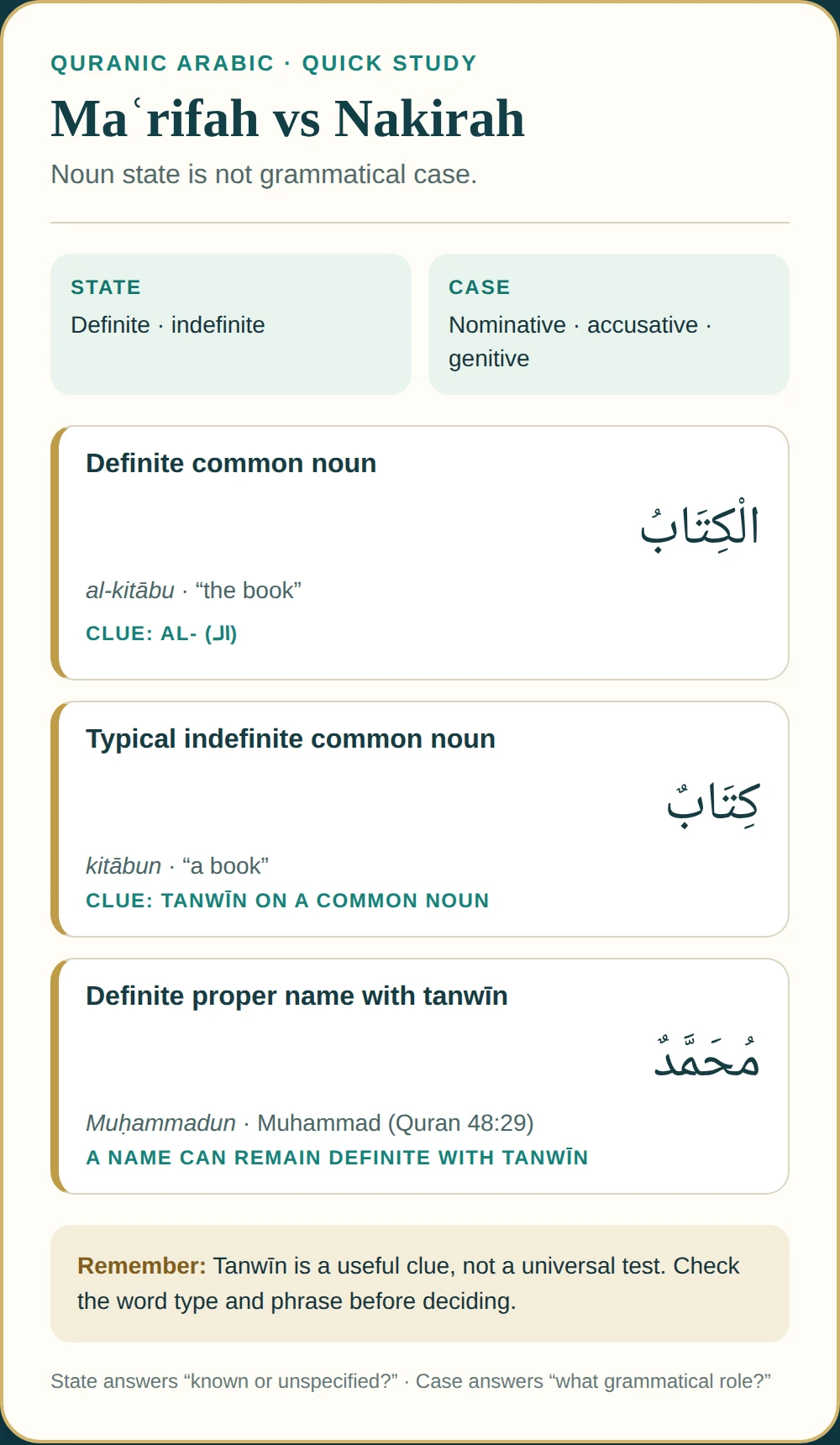
For a simple common noun, compare kitābun (كِتَابٌ, “a book”) with al-kitābu (الْكِتَابُ, “the book”). The prefix al- is the clearest written sign in the second example. In connected speech before a sun letter, the lām may assimilate in pronunciation, though the spelling still contains ال; review the guide to sun and moon letters in Quran reading for that sound change.
These examples are a starting pair, not a universal formula. The Quranic Arabic Corpus’ morphology guide distinguishes the noun’s state—definite or indefinite—from its case—nominative, accusative or genitive. Keeping those labels separate is the key to reading the endings accurately.
Common ways a noun can be definite
Arabic learners often meet a definite noun without seeing al-. Rather than memorize one spelling rule, check what kind of word you are reading and how it connects to its neighbors.
1. A noun with al-
The definite article can turn a common noun into a definite one: kitābun (“a book”) becomes al-kitābu (“the book”) in a nominative example. In Quran 2:2, dhālika al-kitābu (ذَٰلِكَ الْكِتَابُ, “that is the Book”) places two clear definiteness clues together: dhālika is a demonstrative pronoun, and al-kitābu begins with the article. The Quranic Arabic Corpus labels the first as a demonstrative; the following noun also has al-.
2. A proper name
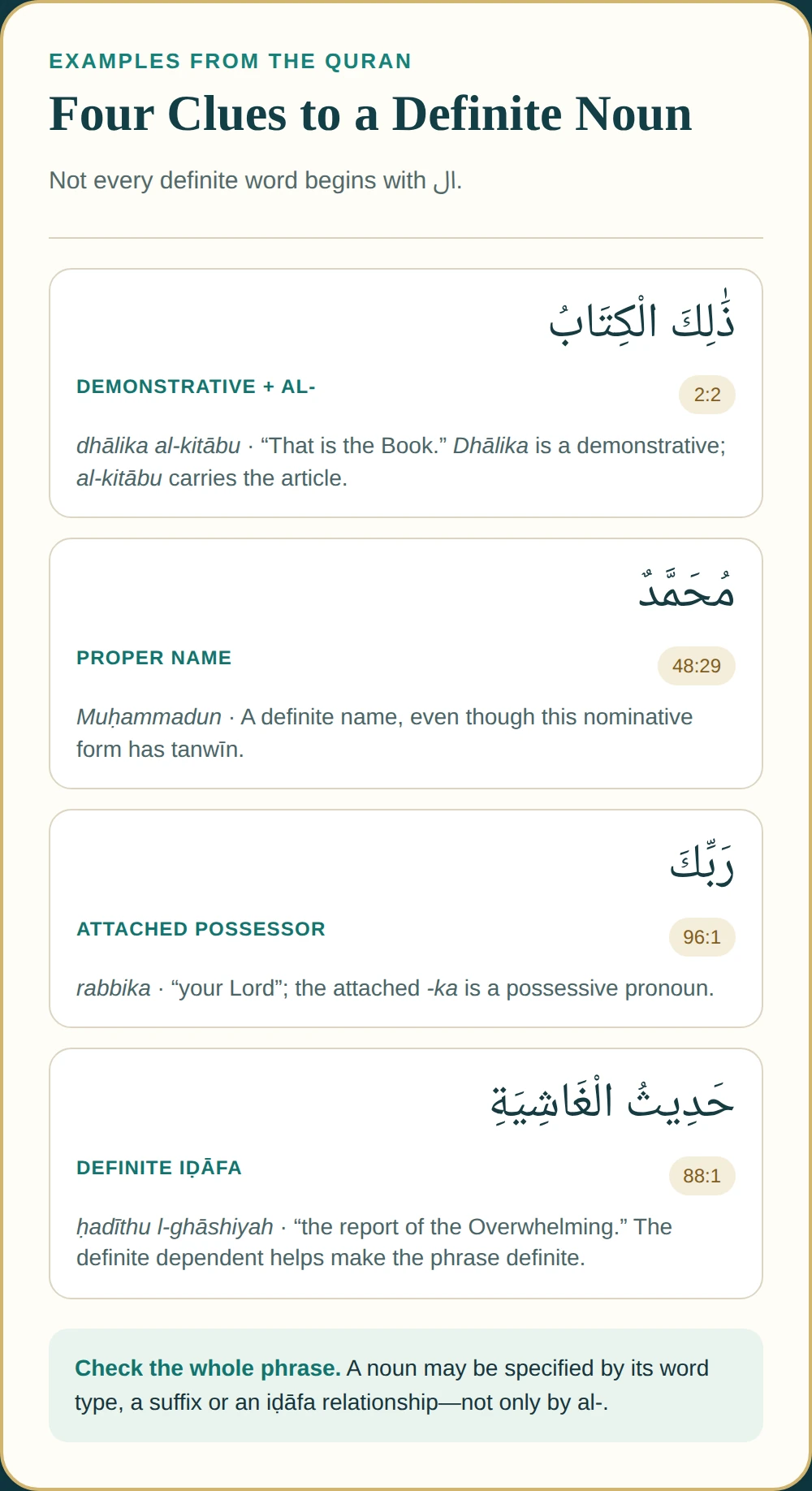
Names are definite by their identity even when they do not carry the article. Quran 48:29 begins with Muḥammadun (مُحَمَّدٌ). The Corpus identifies it as a proper noun in the nominative. Its written ending includes tanwīn, but the name is still definite. This is a useful correction to the beginner shortcut “tanwīn always means indefinite.” In this form, the ending marks the name’s inflected form; it does not turn the person’s name into an unspecified person.
3. A pronoun, demonstrative or relative pronoun
Pronouns are definite references: huwa (“he”), anta (“you”), or hum (“they”) point to participants already identified by the sentence or context. Demonstratives such as hādhā (“this”) and dhālika (“that”) point something out. Relative pronouns such as alladhī (“the one who”) introduce a description of an identifiable person or thing. These forms do not need al- to function as definite words. Quranytime’s references to Arabic pronouns and relative pronouns in Quranic Arabic can help you recognize them in a verse.
4. A noun linked to a possessive suffix
A noun with an attached possessive pronoun is also specified: kitābuhu (كِتَابُهُ, “his book”) and rabbika (رَبِّكَ, “your Lord”) refer to something linked to a particular possessor. In Quran 96:1, bi-smi rabbika (بِاسْمِ رَبِّكَ, “in the name of your Lord”) contains a second-person suffix attached to rabb. The Corpus identifies that ending as a possessive pronoun. It is not a separate written al-, but it narrows the reference.
5. A noun in an iḍāfa to a definite dependent
In an iḍāfa (construct or possessive phrase), the first noun cannot take al- or tanwīn. Whether the whole phrase is definite depends on the second noun, called the dependent. If that dependent is definite, it can make the complete phrase definite. Quran 88:1 contains ḥadīthu l-ghāshiyah (حَدِيثُ الْغَاشِيَةِ, “the report of the Overwhelming”): ḥadīthu has neither al- nor tanwīn, while the dependent al-ghāshiyah is marked with al-. Together they form a definite phrase. If the dependent is indefinite, the construct phrase need not be definite. For more on the structure and genitive dependent, see the separate guide to iḍāfa in Quranic Arabic.
Tanwīn: a clue, not a verdict
Tanwīn is the double vowel sign often written at the end of an Arabic noun: -un, -an, or -in. With many ordinary, fully declinable common nouns, it accompanies an indefinite form—for example kitābun, “a book.” It is a helpful reading clue. But it is not safe to treat every tanwīn as proof that a noun is indefinite: proper names such as Muḥammadun can be definite and still bear tanwīn. Some indefinite nouns also do not show the familiar tanwīn pattern, including diptotes in relevant forms.
Instead, ask three questions: Is the word a name or pronoun? Does it contain al-? Is it part of an iḍāfa or does it carry an attached possessor? Only then use tanwīn as one piece of evidence. When the form is unfamiliar, check the phrase and its grammatical analysis rather than deciding from the last mark alone.
Definiteness and case are different questions
Definiteness asks whether a noun is treated as specified or unspecified. Case asks how a noun functions grammatically, often reflected in its ending. A noun can therefore be definite and genitive, definite and nominative, indefinite and accusative, or many other combinations.
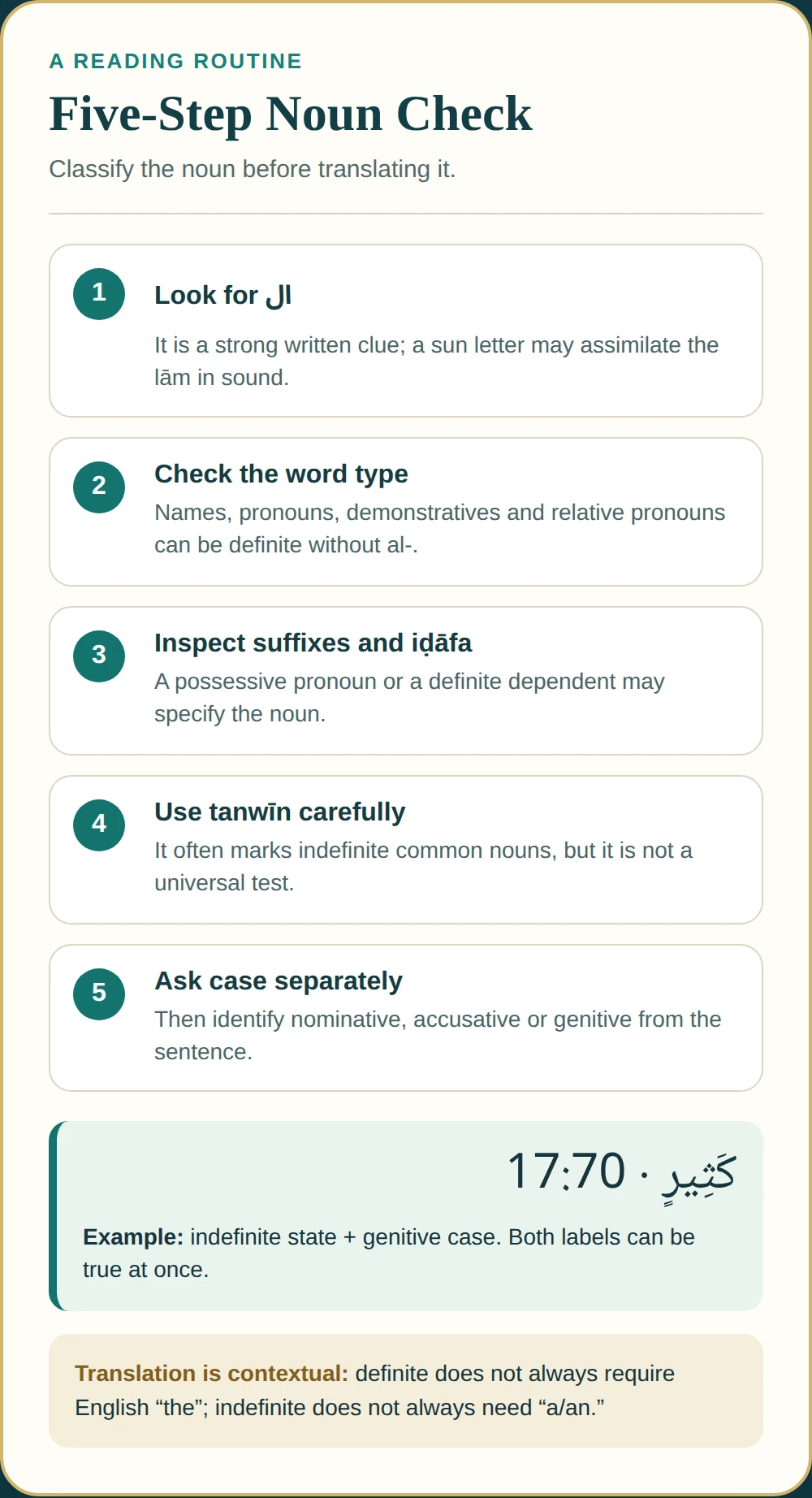
Quran 17:70 provides a clear example: kathīrin (كَثِيرٍ, “many/much”) is classified by the Corpus as an indefinite masculine singular noun in the genitive case. The word’s state and case are both true at the same time. By contrast, the definite noun al-kitābu can change its case ending according to its role in a sentence. The article al- does not freeze the final vowel: a regular singular noun may be al-kitābu in the nominative or al-kitābi in the genitive. For a deeper explanation of nominative, accusative and genitive endings, continue with Arabic case endings in Quranic reading.
This distinction also helps with adjectives. When an adjective describes a definite noun, Arabic agreement often reflects definiteness as well as gender, number and case; the ending is still a separate grammatical clue. See the companion lesson on Arabic adjective agreement for the wider pattern. If you are first learning how a topic and predicate form a clause, the guide to Arabic nominal sentences covers that neighboring question.
A five-step check for a Quranic noun
Use this short sequence when a noun’s state is not obvious:
- Look for ال. It is a strong written clue to a definite noun, even if sun-letter assimilation changes how the prefix sounds.
- Check the word type. Is it a proper name, personal pronoun, demonstrative or relative pronoun? These can be definite without al-.
- Inspect attached material. A possessive suffix can specify a noun, and a noun in an iḍāfa may take its definiteness from the dependent.
- Use tanwīn carefully. It often appears on indefinite common nouns, but names and special noun classes show why it is not a universal test.
- Parse case separately. Identify whether the noun is nominative, accusative or genitive only after considering the phrase’s grammar.
After classifying a noun, reread the whole phrase before choosing an English article. An Arabic definite form does not always require the word “the” in idiomatic English, and an indefinite form does not always translate with “a” or “an.” The grammar identifies the relationship; the surrounding verse guides a natural translation. If you are unsure, compare a word-by-word analysis with the broader clause rather than translating a suffix or ending in isolation.
Watch a related lesson
The lesson below is a separate introduction to Arabic definiteness and indefiniteness. Use it as a second explanation, then return to the Quranic examples and identify the clue in each phrase.
Key takeaway
Maʿrifah and nakirah describe definiteness, not case. The article al- is one clear route to a definite noun, but names, pronouns, demonstratives, relative pronouns, attached possessors and iḍāfa phrases can also give you important clues. Tanwīn is useful, but not conclusive. Check the word’s type and phrase first, then read its case ending and translation in context.