
When you read a Quranic sentence that contains kāna, the familiar nominal sentence has not disappeared. Instead, the verb changes how the two parts are marked and how the sentence is understood in context. This is the doorway to Kana and its sisters, usually called kāna wa akhawātuhā (or kana wa akhawatuha) in Arabic grammar.
This guide is for reading, not for memorising an isolated chart. You will learn to spot the verb, find its ism kana (the noun or pronoun in its grammatical position), find its khabar kana (the predicate), and then let the surrounding verse guide your translation. A useful review of Arabic nominal sentences will make the before-and-after pattern easier to see.
What changes when kāna enters a nominal sentence?
Begin with a simple nominal sentence: الطَّالِبُ مُجْتَهِدٌ (al-ṭālibu mujtahidun), “The student is diligent.” The first part is the topic and the second part describes it. With kāna, it becomes كَانَ الطَّالِبُ مُجْتَهِدًا (kāna al-ṭālibu mujtahidan), “The student was diligent.” In the traditional description, kāna raises its ism (nominative, marfūʿ) and makes its khabar accusative (manṣūb).
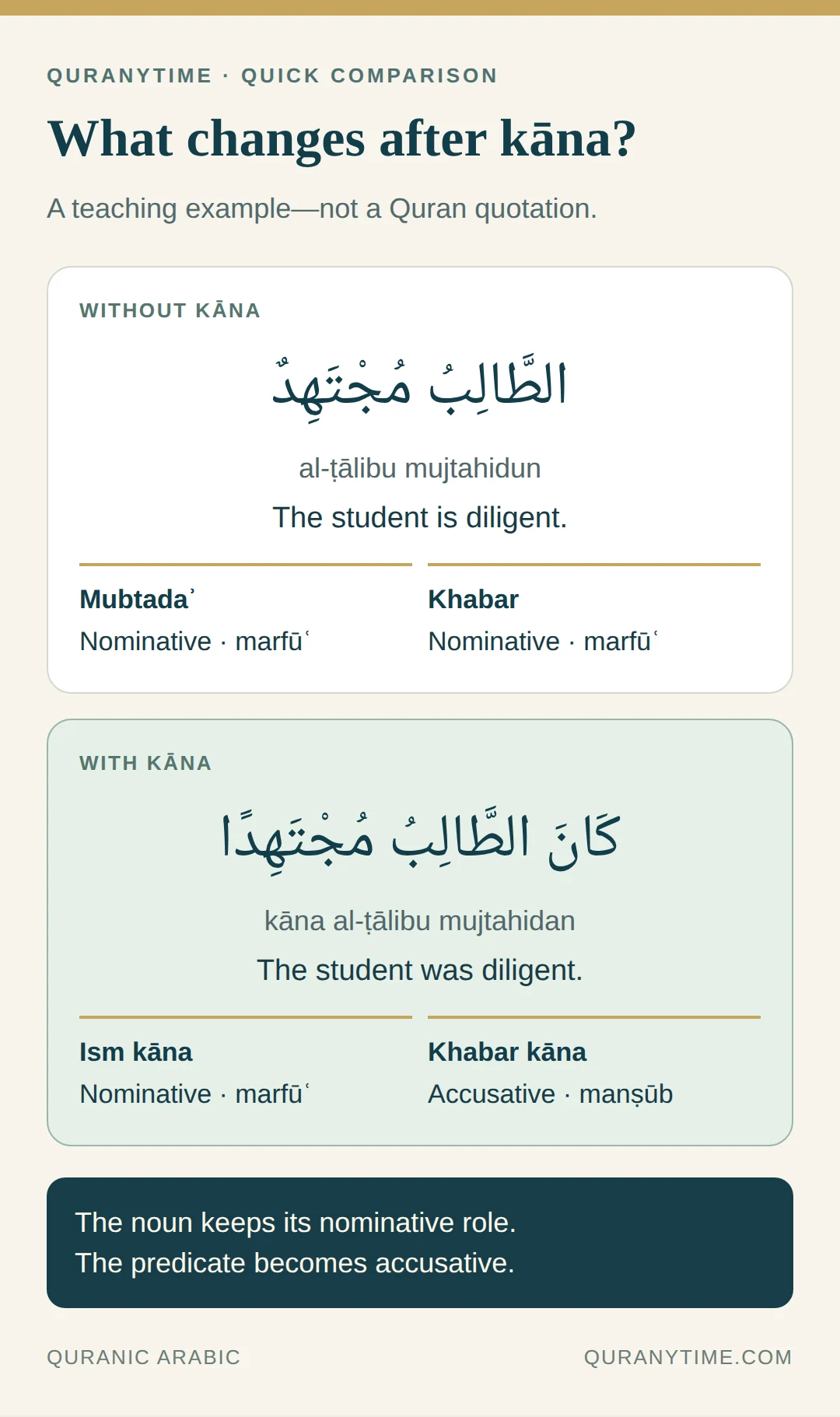
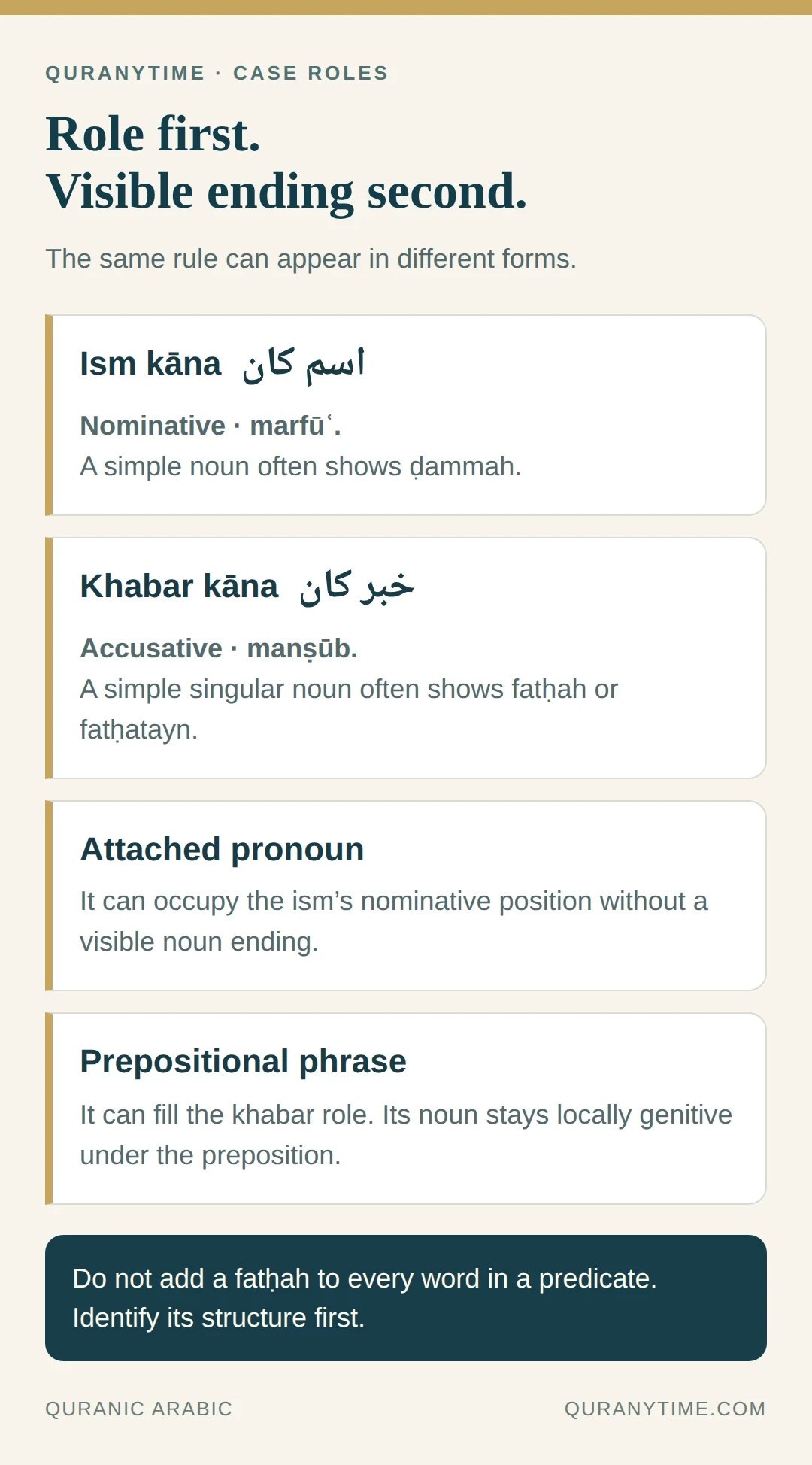
That is a case relationship, not a promise that every word will visibly end in -u or -an. Pronouns may be attached or hidden in the verb; duals and sound plurals have their own signs; and a phrase may serve as a predicate while its noun keeps a local genitive ending after a preposition. For a focused refresher, see Arabic case endings and iʿrāb, then return to the verse rather than trying to force every word into one surface pattern.
The family: similar job, different meanings
“Sisters” describes a family of verbs and expressions that can enter this construction. The common group includes kāna (was), laysa (is not), ṣāra (became), aṣbaḥa (became or came to be in the morning), aḍḥā (came to be in the forenoon), amsā (came to be in the evening), ẓalla (continued or remained by day), and bāta (spent the night). Their precise force depends on context, not on a one-word gloss.
Traditional lists also include the continuity forms mā zāla, mā bariḥa, mā infakka, and mā fatiʾa, normally used with negation or an equivalent negative setting, plus mā dāma, “as long as,” which uses the duration particle mā. These conditions matter. Do not treat all thirteen as interchangeable vocabulary or as one regular conjugation table. Laysa, for example, takes past-form personal endings but has no ordinary present or imperative counterpart. Some of these verbs can also function as complete verbs in other constructions.
In this lesson, “incomplete” means that the verb in this grammatical use expects a predicate to complete the meaning. It does not mean a weak-root or defective verb. This distinction prevents a common reading mistake: changing a verb’s morphology when the real task is simply to locate the missing or delayed predicate.
Three Quranic reading snapshots
1. A clear pair: In 2:213, كَانَ النَّاسُ أُمَّةً وَاحِدَةً (kāna al-nāsu ummatan wāḥidatan) is commonly translated “Mankind was one community.” Al-nāsu is the nominative ism; ummatan is the accusative khabar; and wāḥidatan agrees with it as an adjective. The ending on the adjective is not a second predicate: it follows the noun it describes.
2. A pronoun inside the verb: In 19:31, مَا دُمْتُ حَيًّا (mā dumtu ḥayyan) means “as long as I am alive.” The attached -tu marks the first-person subject in the grammatical position of the ism; ḥayyan is the accusative predicate. A pronoun need not stand as a separate visible noun. A refresher on Arabic pronouns for Quranic reading can help you recognise these compact forms.
3. A fronted phrase and a delayed noun: In 42:11, لَيْسَ كَمِثْلِهِ شَيْءٌ (laysa ka-mithlihi shayʾun) is translated “There is nothing like Him.” The prepositional phrase ka-mithlihi comes first and fills the predicate role; shayʾun is the delayed nominative ism. Notice the local detail: mithli is governed by the preposition ka-, so its ending belongs to that phrase. It is not a visible accusative -a simply because it is near laysa. Review Arabic prepositions when a phrase like this feels difficult.
A fourth reminder is 110:3: إِنَّهُ كَانَ تَوَّابًا (innahu kāna tawwāban). Here, tawwāban is the accusative predicate, while the ism of kāna is an understood “He.” The attached -hu belongs to inna, not automatically to kāna. Do not turn a past-tense label into a theological conclusion about an attribute ending; read a reliable translation or tafsir alongside the Arabic.
A practical way to read the pattern
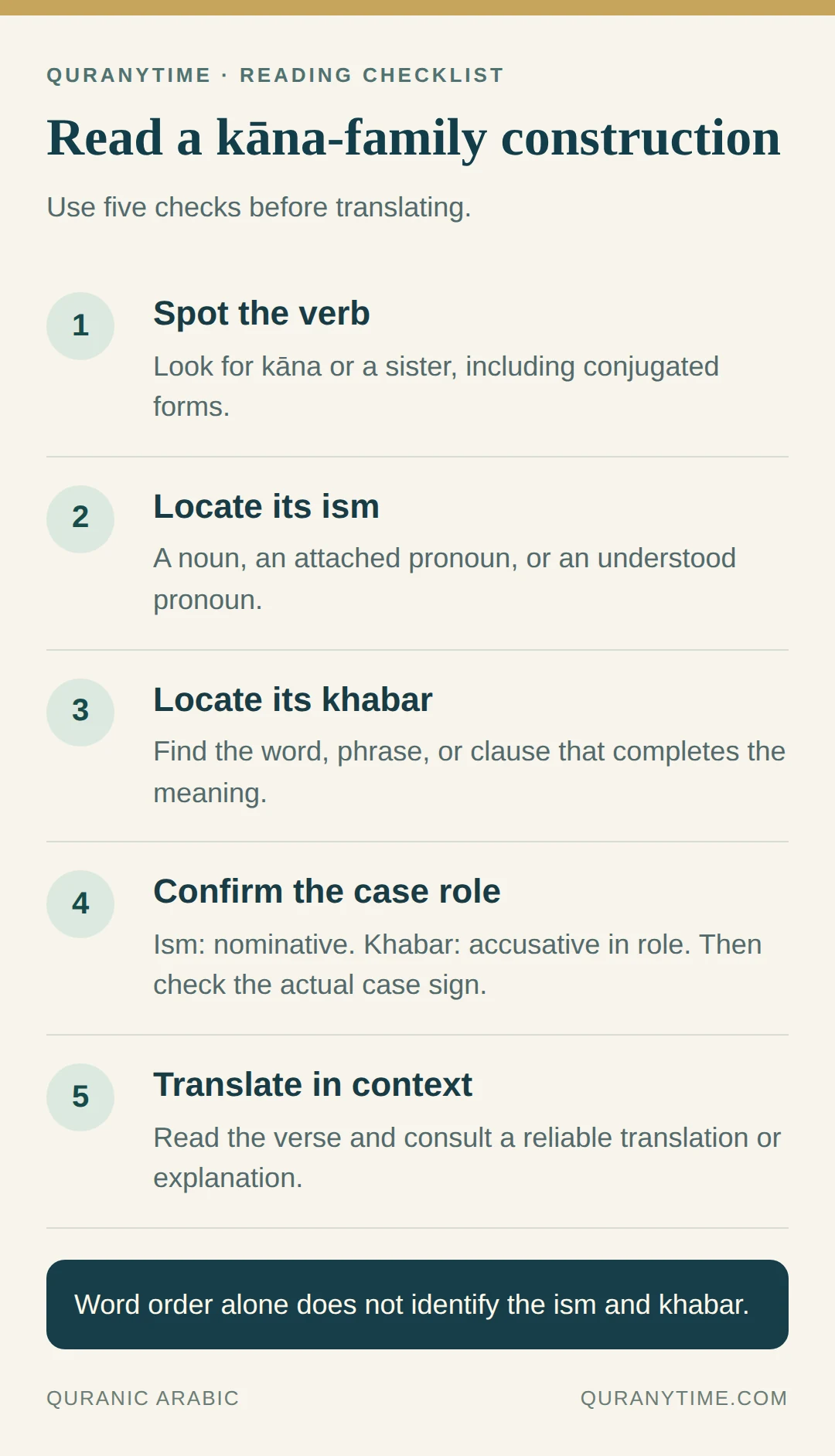
First, circle the family verb and ask what meaning the context gives it: past state, negation, change, continuation, or duration. Second, look for the ism kana. It may be a normal noun after the verb, an attached pronoun, an understood pronoun, or a delayed noun. Third, locate the khabar kana. It may be a single word, an adjective, a prepositional phrase, or a larger clause. Fourth, use case endings as evidence, not as your only evidence. Fifth, read the whole ayah and consult a dependable translation or tafsir. Grammar supports understanding; it does not replace tafsir or tajweed.
Compare this process with a brief contrast: kāna assigns a nominative ism and an accusative khabar, while inna has a different case effect. You do not need a second full tutorial to use the contrast; simply ask which operator you are actually looking at. If verb forms are the obstacle, revisit Arabic verb conjugation. If negation is present, the guide to negation in Quranic Arabic is a useful companion.
Common reading traps
A reader may see kāna and immediately write “was” above it, then stop. That is too quick for Quranic Arabic. First ask whether the form is actually kāna, a related form such as laysa, or a continuity expression. Next ask whether the apparent next noun is truly the ism. A fronted predicate can come first, and a delayed ism can appear later. Word order is a clue, not a rigid rule.
A second trap is treating every final vowel as a complete grammatical diagnosis. In careful recitation, a case ending can be clear, but pauses may hide it. Some endings are marked by letters or longer patterns rather than a short vowel, and some pronouns do not show a separate ending at all. A third trap is assuming that an adjective is automatically the khabar. In ummatan wāḥidatan, the adjective follows the noun it modifies. Agreement helps you keep the pair together.
Finally, do not let the English tense carry more weight than the Arabic sentence can bear. A translation may choose “was,” “has been,” “became,” or “remained” according to context and English style. The family verb contributes grammatical structure and a shade of meaning, while the full verse, discourse, and tafsir establish the intended sense. Your first pass can be grammatical; your final understanding should be contextual.
Short practice: answer by role
Try this original sentence: كَانَ الْبَيْتُ قَرِيبًا (kāna al-baytu qarīban). Which word is the ism, and which is the khabar? Answer: al-baytu is the nominative ism, and qarīban is the accusative khabar, so the meaning is “The house was near.” Then compare كَانَ الْكِتَابُ فِي الْبَيْتِ (kāna al-kitābu fī al-bayti), “The book was in the house.” Here, al-kitābu is the ism; fī al-bayti fills the khabar role, while al-bayti stays genitive after fī. Both follow the same role rule, although only one has visible -an.
Optional video lesson
This short text-and-diagram lesson gives another visual pass through the roles and Quran examples. Watch it after reading the examples, then pause and label the ism and khabar yourself rather than only repeating the translation.
Keep this checklist beside your mushaf
- Identify the kāna-family form and its context.
- Find the ism kana, including attached or understood pronouns and delayed nouns.
- Find the khabar kana, whether it is a word, phrase, or clause.
- Separate grammatical role from the surface ending and local preposition rules.
- Check a reliable translation or tafsir, then recite with your normal tajweed care.
Mastery grows through repeated, modest observations: name the operator, map the two roles, and let context settle the translation. When you want guided feedback on your reading, you can book a free trial class with Quranytime.
For an additional technical reference on the verb’s Quranic usage, see the Quranic Arabic Corpus guide to kāna. Use it as a reference alongside your teacher and tafsir, not as a substitute for understanding the passage as a whole.