
Have you ever remembered what a Quran verse meant, or a few words from it, but not where it appears? A careful search can help you find a likely passage. The important final step is to open the verse and verify its wording and reference before quoting, sharing, memorising, or teaching it. A search result is a lead—not proof that your memory, translation, or interpretation is exact.
This guide gives you a repeatable way to search from an English meaning, a remembered phrase, an Arabic word, or a partial surah-and-ayah reference. It also shows how to check the result without confusing a translation with the Arabic Quran text.
First, name the clue you actually remember
Before opening a search tool, write down the clue in plain language. Is it an exact Arabic phrase, an English translation, a general topic, a distinctive word, a sound you heard, or a possible reference such as “near the end of Al-Baqarah”? Each clue suggests a different search route. Separating what you remember from what you are guessing makes it easier to spot a false match.
Use quotation marks only when you are confident about an exact phrase and the tool supports exact-phrase search. If you remember only the idea, do not put your paraphrase in quotation marks or present it as Quranic wording. Label it as a meaning clue.
Choose the search route that matches your clue
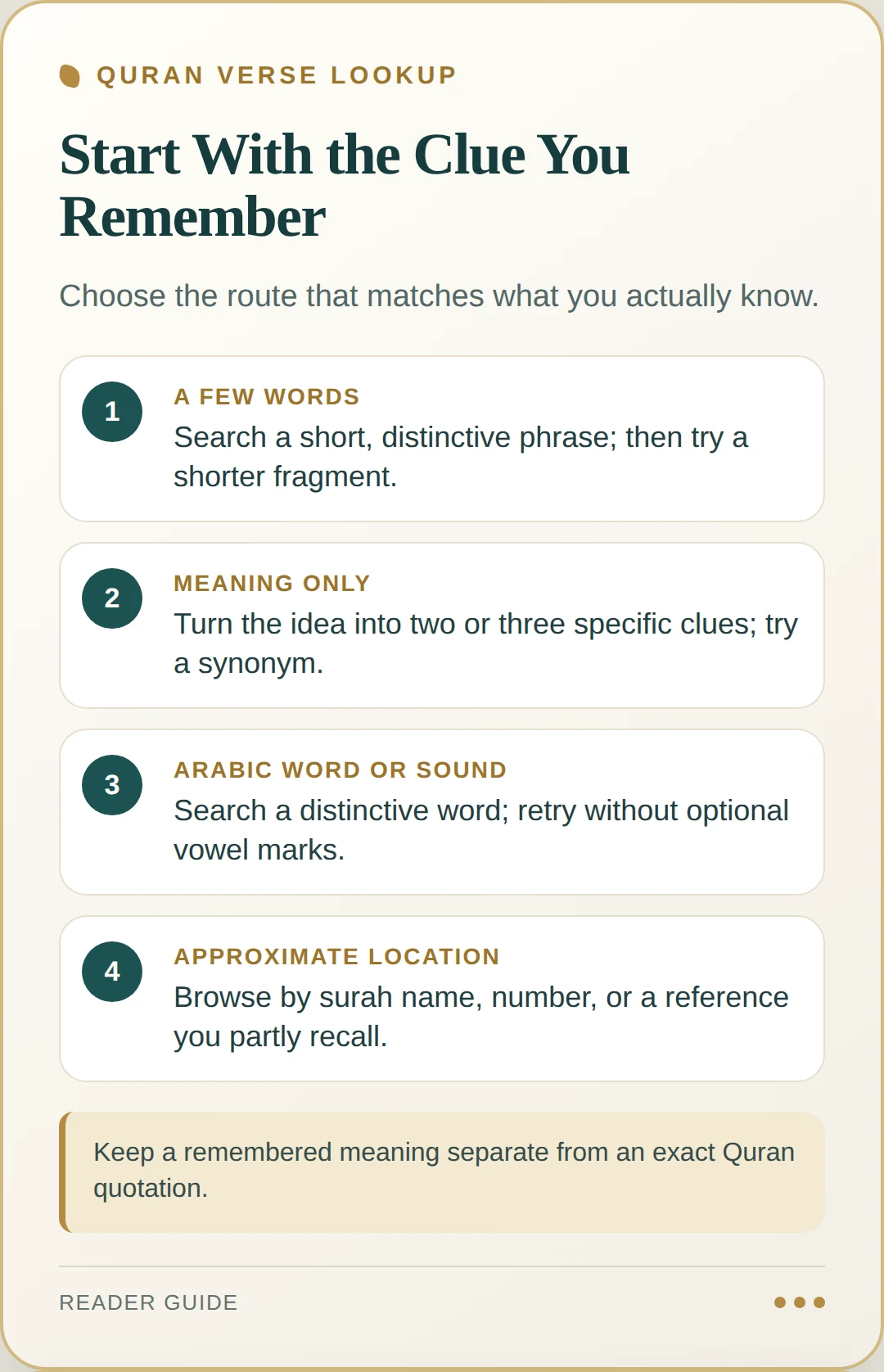
1. A few words in English
Search a short, distinctive phrase rather than a whole sentence. Different translators may choose different English words for the same Arabic expression, and punctuation or word order can vary. If the first search fails, try one synonym, a shorter fragment, or two content words that are likely to appear together. Avoid broad terms such as “mercy” by themselves if they return many results.
Some Quran search tools let you combine words, look for synonyms, search a phrase across verse boundaries, or enter a direct reference. These features are useful for discovery, but their result lists depend on the text and translation being searched. A match in one English translation does not guarantee the wording will appear in another.
2. A meaning or topic, but no remembered wording
Turn the idea into two or three neutral search clues. For example, a memory about patience during hardship might lead you to try “patience,” “difficulty,” and “reward” separately, then compare the results. Search one clue at a time first; combine terms only after you know how the tool handles them. A meaning search may find related passages rather than a verse with your exact remembered idea, so treat every result as a candidate.
Keep the distinction between a verse’s wording and your summary clear. A paraphrase can be a helpful search query, but it should not be placed inside quotation marks or attributed as a direct quotation.
3. An Arabic word or a phrase you heard
If you can type the Arabic, search the most distinctive word or a short sequence. Diacritics, punctuation, alif forms, and spelling conventions can affect whether a search returns a match. If an exact search finds nothing, try the same words without optional vowel marks or test a shorter fragment. Do not “correct” the Quran text based only on a search failure; check the edition or search settings first.
When the word has several grammatical forms, a root-based or morphology-aware search may help you discover related forms. A root is a research clue, not a substitute for checking the actual word in its verse and context. If you are still building a Quran vocabulary, a beginner’s Quranic Arabic vocabulary plan can help you recognise recurring words, while the guide to Arabic roots and patterns explains how related forms can differ.
4. A surah name, number, or approximate location
If you remember a chapter, a nearby verse, or a reading division, search that clue directly. Enter a reference in the format the tool accepts—for example, a surah number followed by a colon and the ayah number. If you only know the approximate location, browse the surrounding passage rather than assuming the first result is correct. The explainer on juz, hizb, and rub divisions can help you navigate when your memory is based on where you were reading.
A simple search sequence
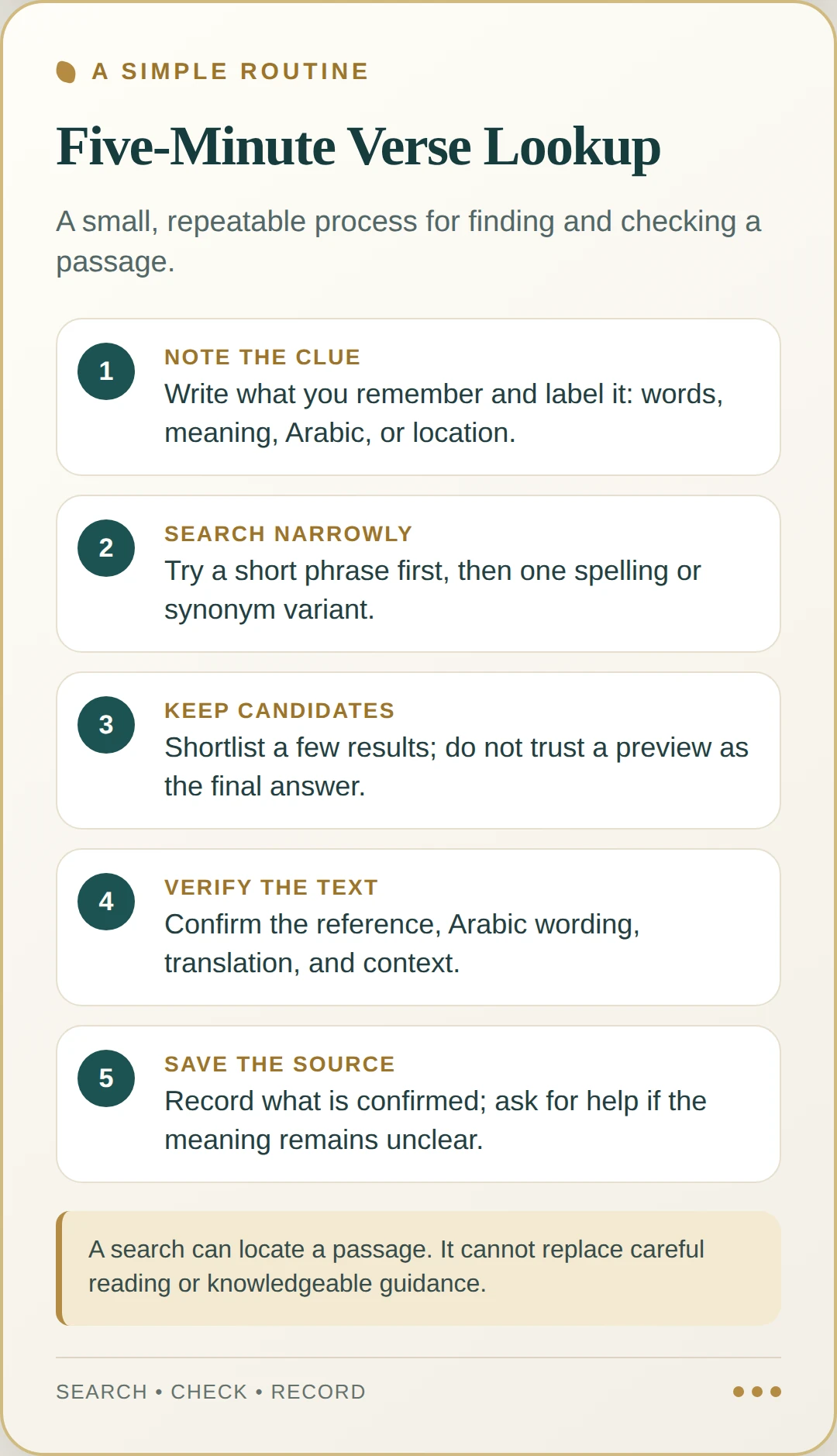
- Write the clue. Mark it as exact words, a translation, a topic, Arabic wording, or an approximate reference.
- Start narrow. Try the most distinctive phrase or content word. For a meaning, use two or three specific terms rather than a full paraphrase.
- Change one thing at a time. Try a shorter phrase, a synonym, a spelling variant, or a direct reference. This makes it easier to see why the results changed.
- Shortlist, then open. Keep a few plausible results, but open each passage in a Quran text rather than relying on the search preview.
- Verify and record. Confirm the surah name, ayah number, Arabic wording, and translation you intend to use. Note your source and whether the match is confirmed or still uncertain.
For example, if you remember a meaning about a soul being burdened only within its capacity, you might suspect Al-Baqarah 2:286. Treat that as a search lead: open the chapter, confirm the reference and Arabic text, then compare the translation you plan to quote. If the wording or reference differs from your memory, record the verified text—not the remembered version.
Verify the result before you share it
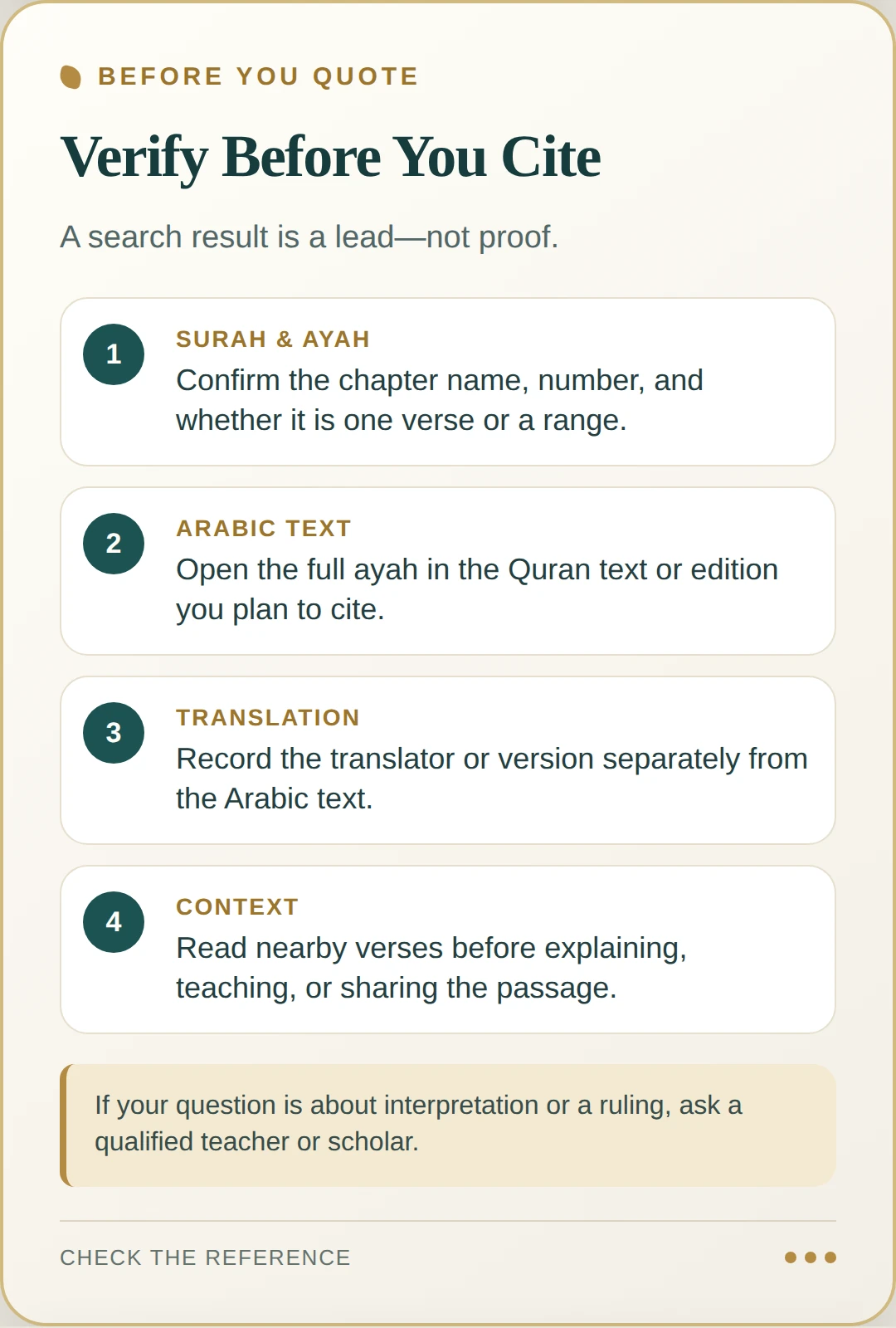
Once a tool returns a likely match, check these items in order:
- Surah and ayah: confirm the chapter name and number, the verse number, and whether the result is one verse or a range.
- Arabic text: open the verse in the Quran text or edition you intend to cite. Compare the whole ayah, not just a few highlighted words.
- Translation: identify the translator or translation version. English wording is a rendering of meaning; it is not the Arabic text itself.
- Nearby context: read the preceding and following verses when needed. A phrase that sounds familiar may occur in more than one passage, and a search snippet may hide the sentence around it.
- Purpose: if you are using the verse to make a religious or legal claim, do not infer a ruling from a keyword match or a translation alone. Consult a reliable tafsir or a qualified teacher or scholar.
Tanzil’s documentation describes its Quran text project and notes that its Uthmani and Imlaei text versions are searchable. It can be one place to investigate a phrase, but no search tool removes the need to verify the result in the text and edition you mean to use. Read Tanzil’s documentation on Quran text and searchability.
Common search mistakes to avoid
Searching an entire remembered sentence. One changed word can block an exact match. Try a short distinctive fragment, then broaden carefully.
Assuming a translation phrase is unique. Similar English phrases can correspond to different Arabic wording or appear in more than one verse. Search results are not a citation check.
Copying the result snippet. Previews may omit the verse number, Arabic text, translation name, or surrounding context. Open the passage itself.
Confusing a topic result with a direct statement. A search engine may return a verse because its translation contains related words. Read the whole verse and consult an explanation before drawing a conclusion about meaning.
Sharing a reference from memory. If you are not sure, write “I am looking for the verse about…” until you have verified it. Do not circulate a guessed surah or ayah number as fact.
Mixing up similar passages. When two verses look alike, compare the complete text and context. Quranytime’s guide to revising similar Quran verses without mixing them up offers a separate practice approach for passages you have already located.
Save the verified reference for next time
When you confirm a verse, record the surah and ayah with the exact translation or Quran edition you used. If the result came from a topic search, label it as a related passage rather than saying it matches your original words exactly. A few careful notes save you from repeating the search or passing on an uncertain citation. For a simple way to keep track of reading progress, see how to keep your place when reading Quran on your phone; for lesson takeaways, use Quran lesson notes you can review later.
If a phrase remains difficult to locate, ask a teacher to help compare the Arabic wording, translation, and reference. You can bring the clue you remember and the candidate results; you do not need to pretend you are certain. A free Quran and Arabic trial class is a place to discuss your reading goals and ask for learning support.
Keep the search honest and useful
The most reliable habit is simple: search from the clue you have, treat the result as a candidate, and verify the surah, ayah, Arabic text, translation, and context before quoting it. A short phrase may be enough to find the passage, while a remembered meaning may only point you in the right direction. Record what you confirmed, note what is still uncertain, and seek knowledgeable guidance when your question is about interpretation rather than location.