
If you are learning Tashahhud in Arabic, it can help to study the prayer text in short meaning groups instead of treating it as one long string of unfamiliar sounds. This guide follows one documented wording, explains its meaning in plain English, and offers a careful practice routine. Tashahhud is a recitation within Salah, not a verse of the Qur’an.
What is the Tashahhud?
Tashahhud refers to the testimony recited while sitting in prayer; many learners also call it at-Tahiyyat, after its opening word. It combines praise and greetings with the testimony of faith. The wording below is the version reported from ʿAbdullah ibn Masʿud in Sahih al-Bukhari 831. Other recognized narrated wordings exist, so do not assume that this one is the only form a Muslim may learn. If your teacher has taught you a particular wording, follow that instruction.
The Arabic text and a readable transliteration
Read the Arabic from right to left. The line breaks here mark meaning groups; they are study aids, not extra pauses that you must add during prayer.
التَّحِيَّاتُ لِلَّهِ وَالصَّلَوَاتُ وَالطَّيِّبَاتُ
السَّلَامُ عَلَيْكَ أَيُّهَا النَّبِيُّ وَرَحْمَةُ اللَّهِ وَبَرَكَاتُهُ
السَّلَامُ عَلَيْنَا وَعَلَى عِبَادِ اللَّهِ الصَّالِحِينَ
أَشْهَدُ أَنْ لَا إِلَهَ إِلَّا اللَّهُ وَأَشْهَدُ أَنَّ مُحَمَّدًا عَبْدُهُ وَرَسُولُهُ
Transliteration: At-taḥiyyātu lillāhi waṣ-ṣalawātu waṭ-ṭayyibāt. As-salāmu ʿalayka ayyuhan-nabiyyu wa raḥmatullāhi wa barakātuh. As-salāmu ʿalaynā wa ʿalā ʿibādillāhiṣ-ṣāliḥīn. Ashhadu an lā ilāha illā Allāh, wa ashhadu anna Muḥammadan ʿabduhū wa rasūluh.
Transliteration is a bridge, not a replacement for listening to accurate Arabic. Spellings vary between systems: for example, you may see tashahhud or tashahud, and at-tahiyyat or attahiyyat. The Arabic letters and a teacher’s model are more reliable than any one Latin spelling.
Notice how the transliteration writes at-taḥiyyātu, waṣ-ṣalawātu, waṭ-ṭayyibātu and as-salāmu. In these words, the Arabic definite article is followed by a “sun letter,” so the lām is not heard as a separate clear l; the next consonant is doubled instead. The spelling still includes the article. This is why the transliteration can look different from a letter-by-letter reading of the Arabic script. Quranytime’s sun-and-moon letters guide explains the wider pattern; follow a teacher’s audio for the connected sounds in this text.
Meaning, phrase by phrase
The translation below is a learning aid rather than a claim that every Arabic word maps neatly to one English word.
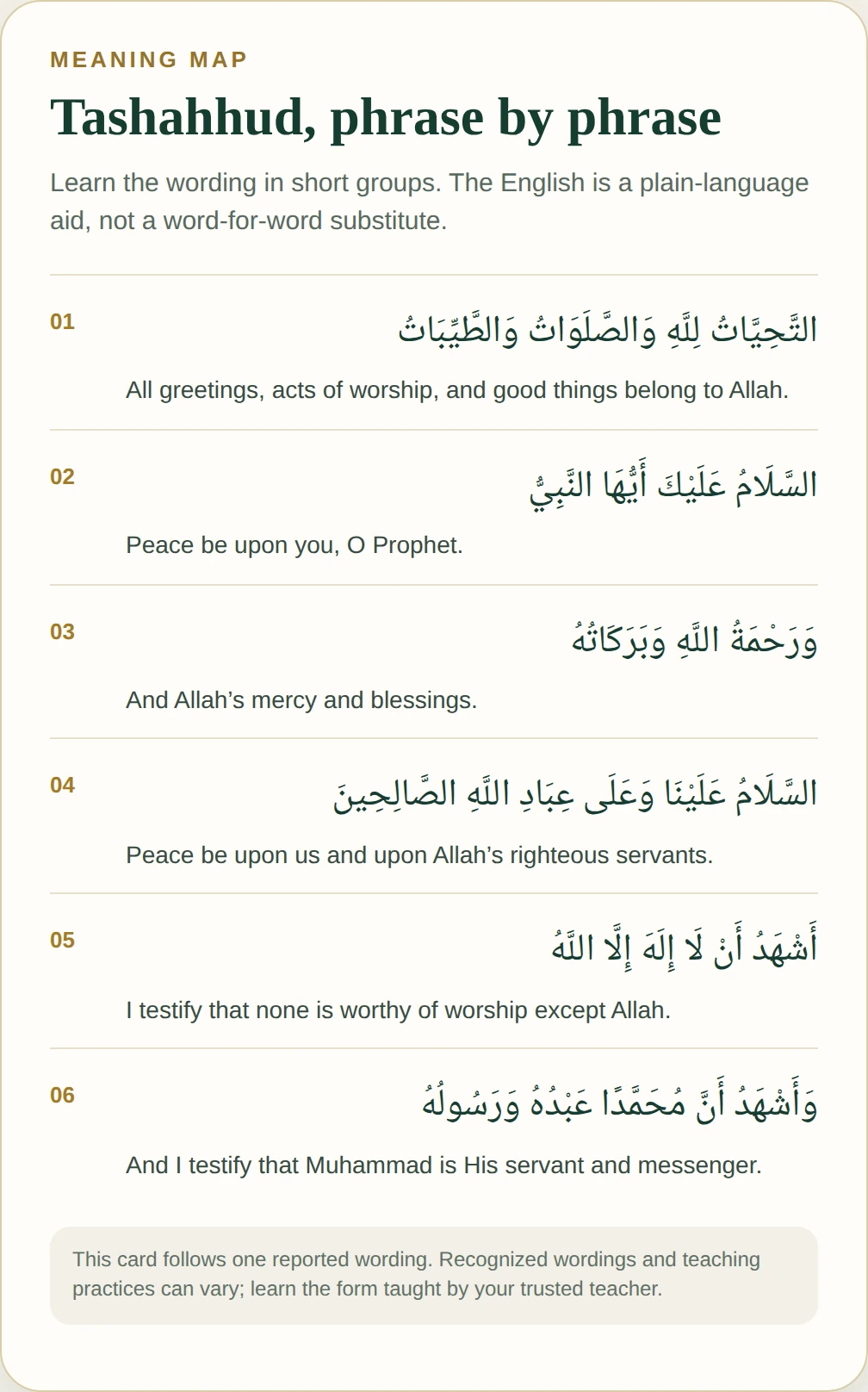
- التَّحِيَّاتُ لِلَّهِ وَالصَّلَوَاتُ وَالطَّيِّبَاتُ — All greetings of reverence, acts of worship, and good things belong to Allah. This opening directs honor and devotion to Allah.
- السَّلَامُ عَلَيْكَ أَيُّهَا النَّبِيُّ وَرَحْمَةُ اللَّهِ وَبَرَكَاتُهُ — Peace be upon you, O Prophet, and Allah’s mercy and blessings. This is a greeting and prayer for the Prophet.
- السَّلَامُ عَلَيْنَا وَعَلَى عِبَادِ اللَّهِ الصَّالِحِينَ — Peace be upon us and upon Allah’s righteous servants. The wording includes the worshipper and righteous servants more broadly.
- أَشْهَدُ أَنْ لَا إِلَهَ إِلَّا اللَّهُ — I testify that none is worthy of worship except Allah.
- وَأَشْهَدُ أَنَّ مُحَمَّدًا عَبْدُهُ وَرَسُولُهُ — And I testify that Muhammad is His servant and messenger.
Try to understand the movement of the meaning: praise, greeting, a prayer for peace, then the testimony. Understanding these groups can support memory, but it does not change the Arabic text or decide a legal ruling about prayer.
Pronunciation checkpoints for English speakers
Some sounds in this text do not have exact English equivalents. Use the following cues to notice what to practise, not as a substitute for a qualified reciter’s model.
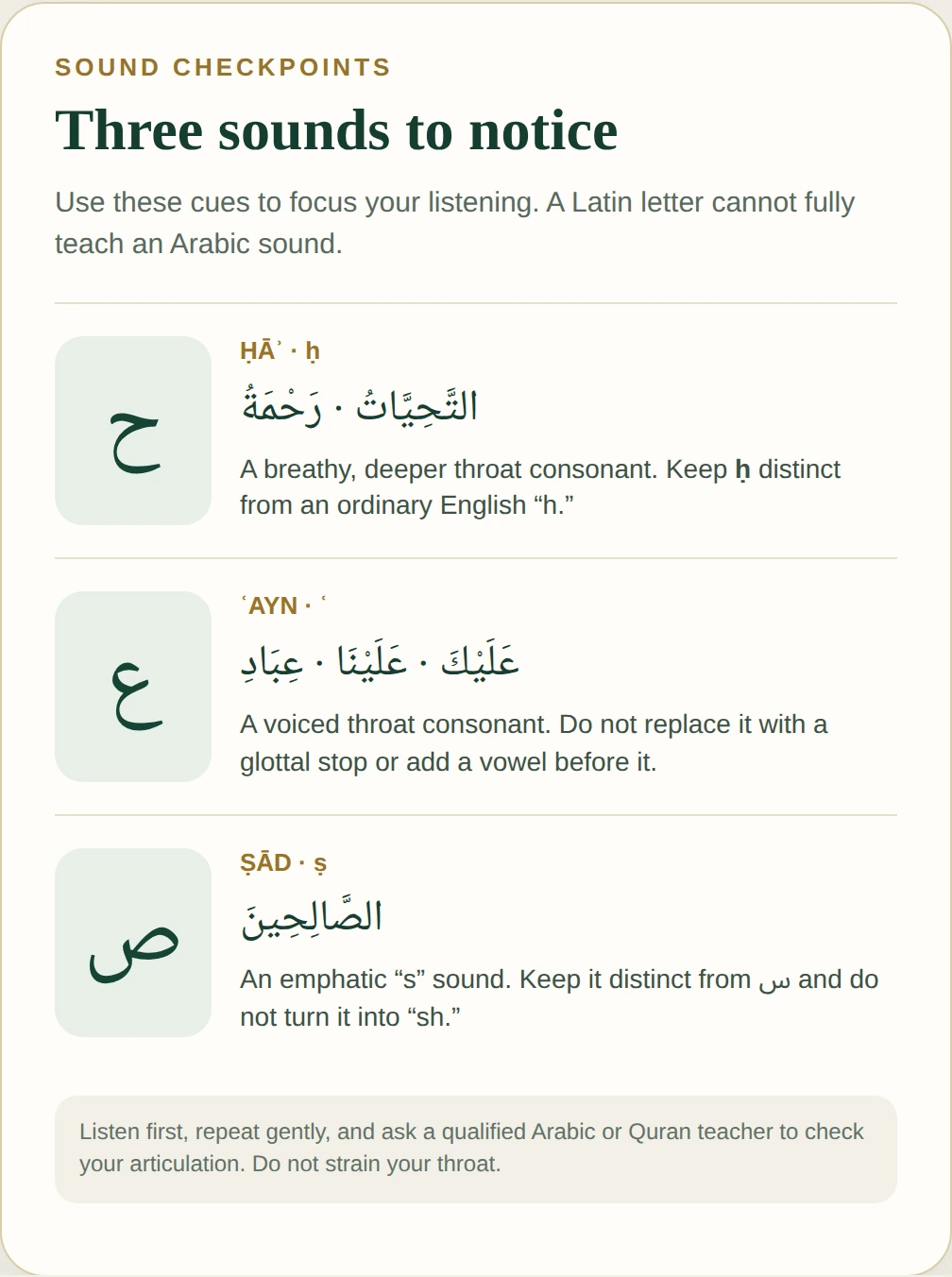
- ḥāʾ (ح) in التَّحِيَّات and رَحْمَة: this is not the ordinary English “h.” It is a breathy, deeper throat sound; keep it distinct from hāʾ (ه).
- ʿayn (ع) in عَلَيْكَ, عَلَيْنَا and عِبَاد: do not add a separate vowel before it or replace it with a glottal stop. Listen to a teacher’s slow model and practise gently.
- Ṣād (ص) in الصَّالِحِينَ: keep it distinct from sīn (س). Its quality is emphatic; avoid changing the word into an English “sh.”
- Shaddah (ّ) and joined sounds: the doubled consonant is held as a consonant, not separated by an invented vowel. For a refresher on the mark, see the site’s Arabic harakat guide.
Start slowly with the sound map below, then listen to the separate lesson embedded farther down. Do not over-stretch throat sounds or strain your voice. For broader practice with Arabic consonants, the Quran pronunciation guide for English speakers offers related learning support, and the site’s listening-first ʿayn lesson focuses on one of the sounds appearing here.
Where it fits in Salah
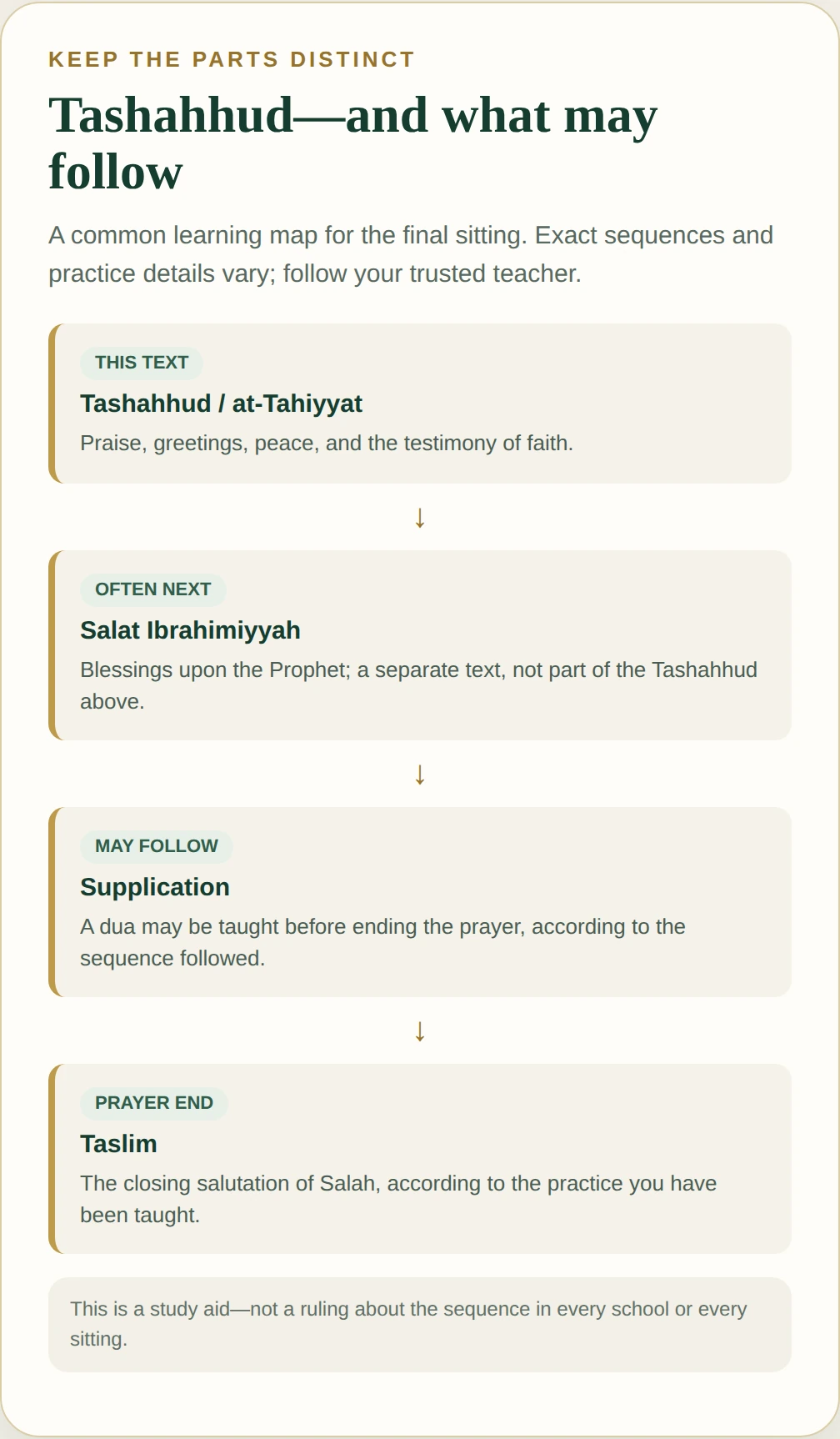
Tashahhud is recited in a sitting within Salah. The number and placement of sittings depend on the prayer being performed, and details about what is recited at each sitting can vary across schools and teaching traditions. This article explains the words and their sounds; it is not a complete Salah manual or a ruling. If you are unsure which wording or sequence to follow, ask a trusted local teacher. Quranytime’s Salah learning guide is another place to review the broader prayer sequence.
A useful distinction is between the Tashahhud text and what may follow it. In many commonly taught sequences for the final sitting, blessings upon the Prophet (often called Salat Ibrahimiyyah) and a supplication may follow before the prayer ends. The middle-sitting sequence can be taught differently. These are related parts of Salah, but they are not lines in the Tashahhud text printed above. Practices differ; learn the sequence from a teacher you trust rather than combining several online versions.
Listen to a line-by-line lesson
The short lesson below presents the Tashahhud with Arabic text, transliteration, meaning, and slow phrase-by-phrase repetition. Follow the Arabic as you listen; use your own qualified teacher for corrections or questions about prayer practice.
Common learning mistakes to avoid
- Memorizing only a Latin spelling: transliteration systems are inconsistent, and they cannot show an exact Arabic sound. Keep the Arabic text visible and let the audio model guide your pronunciation.
- Adding a new vowel between every word: study cards may separate phrases to help memory, but they do not tell you to insert extra sounds or breaks. Practise connected phrases after you know each group.
- Mixing different wordings mid-recitation: online pages may present different narrated forms or transliteration conventions. Learn one complete wording from your teacher instead of stitching lines from several sources.
- Turning an article into a legal ruling: a pronunciation lesson can explain the words, but it cannot settle every school-specific question about the prayer. Ask a trusted teacher when you are unsure which sequence to follow.
A short routine to learn it accurately
- Listen first. Hear one complete, teacher-checked recitation while following the Arabic. Notice the phrase boundaries without trying to copy every sound at full speed.
- Take one meaning group. Read the Arabic, listen again, then explain its meaning in your own English. Repeat each group until you can recognise it without relying only on transliteration.
- Practise the sound contrast. Choose one checkpoint—ḥāʾ, ʿayn, or ṣād. Hear it, repeat gently, and compare your sound with a qualified model. Avoid memorising an inaccurate approximation.
- Join the groups. Read two neighbouring phrases, preserving the actual Arabic sounds. The visual line breaks in a study page are not instructions to insert extra pauses.
- Review with feedback. Recite at a comfortable pace and ask a teacher to correct the Arabic, not just the transliteration. A regular Quran fluency practice routine can help make careful repetition sustainable.
If you are building Arabic reading from the beginning, review the Arabic alphabet guide alongside the vowel marks. When you are ready for personal feedback, you can book a free Quran and Arabic trial class and ask the teacher to listen to the sounds that feel difficult.
At the end of a practice session, close the page and recall the meaning first, then the Arabic words and their sequence. Check the text and correct one sound at a time instead of restarting the entire passage after every small slip. Return to the same phrase after a short break and again the next day. If a transliteration shortcut conflicts with your teacher’s audio, follow the model and ask for clarification. Keep practice brief, regular, and gentle: accuracy comes from careful listening and feedback, not from forcing speed or straining your voice.
Common questions
Is the Tashahhud a Quran verse?
No. It is a recitation in Salah reported in hadith. The Arabic text above is presented as a prayer wording, not as an ayah from the Qur’an.
Does every Muslim use exactly the same wording?
There are recognized narrated wordings and differences in teaching practice. This guide focuses on the wording shown and does not claim it is the only valid one. Follow the form taught by your trusted teacher or school.
Is transliteration enough to learn it?
It can help you remember the sequence, but it cannot show every Arabic sound accurately. Learn from the Arabic text, listen to a qualified reciter, and ask for correction—especially for ḥāʾ, ʿayn, and ṣād.
Is the Tashahhud the same as the blessing that follows?
No. The Tashahhud is the testimony-and-greeting text above. Salat Ibrahimiyyah and any later supplication are separate parts that may follow according to the prayer sequence being taught.