

Quran learning with ADHD does not need to follow one fixed pace or lesson format. A useful starting point is a clear goal, a manageable passage, and a teacher who gives feedback on one step at a time. The learner may also benefit from a visual cue, a movement break, or a quieter space—but only if that support actually helps that person.
This guide is for children and adults who want practical ideas for Quran reading, Tajweed practice, or memorization. It is educational guidance, not a diagnosis or treatment plan. ADHD affects people differently, so treat each suggestion as something to test with the learner rather than a rule that everyone must follow.
Make the lesson clear before making it longer
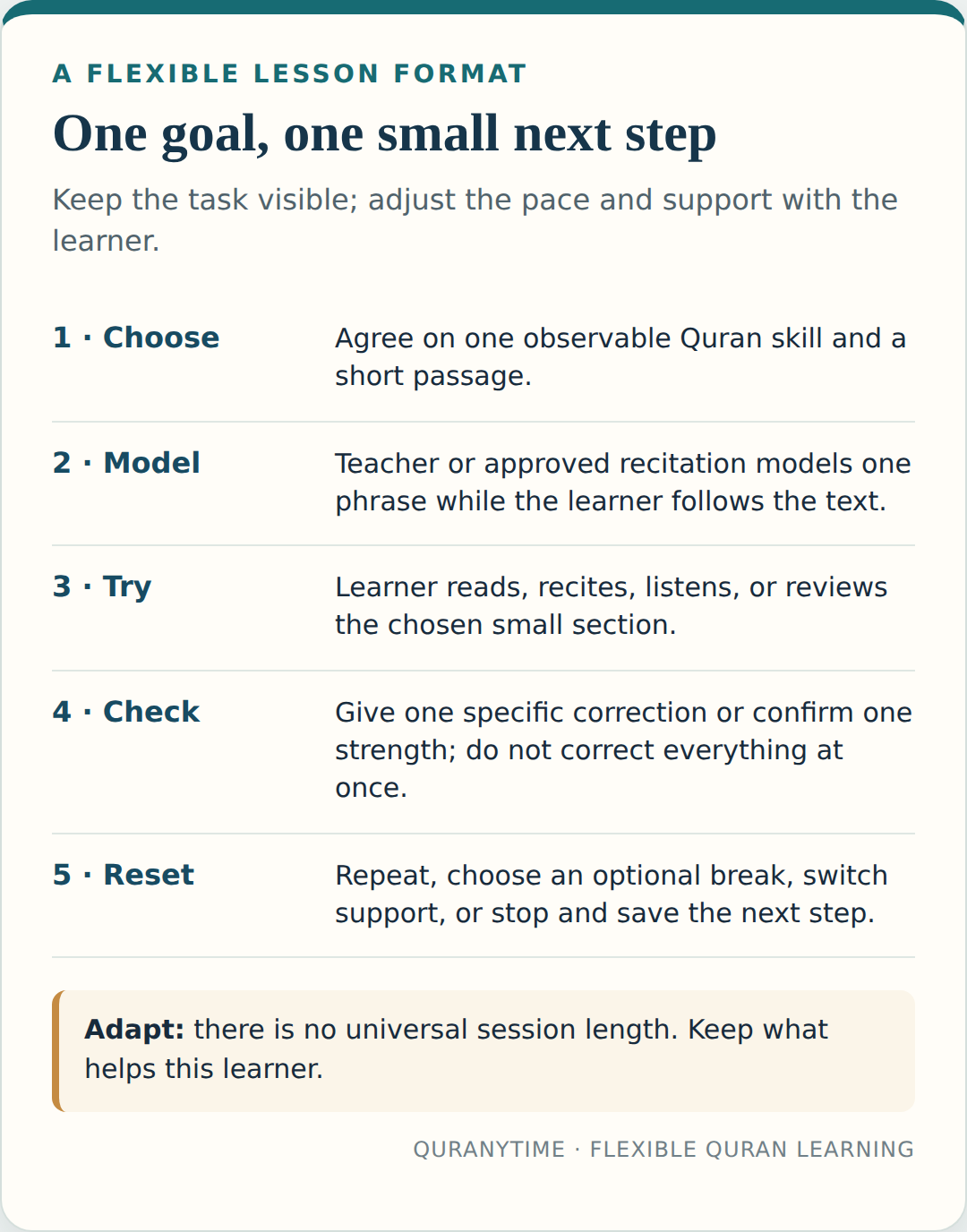
Before opening a mushaf or pressing play, agree on one observable goal. “Do more Quran” is too broad to guide a short lesson. “Read one ayah while keeping the short vowels clear” or “repeat one phrase and ask about its final sound” gives both learner and teacher a finish line. A goal can be adjusted when the passage is unfamiliar, the learner is tired, or the skill needs more support.
Next, choose a small section of text. That might be one line, a phrase, or a single ayah. A learner working on memorization may use a familiar short passage such as Surah Al-Ikhlas (112:1–4), while someone practising a particular reading skill may choose only the relevant phrase. The example is a starting option, not a requirement and not a measure of progress against anyone else.
Keep the study area simple enough for the learner to find the current task. Some people prefer a quiet room; others concentrate better with low background sound or a little movement. Ask what helps, remove what distracts, then try one change at a time so you can tell whether it made a difference.
Use short, adjustable practice chunks
A short practice segment can reduce the effort of getting started. It does not need to last the same number of minutes each day. Begin with a small amount of reading or listening, notice how the learner responds, and make the next segment shorter or longer as needed. A completed phrase with accurate feedback is more useful than pushing through several pages while attention and confidence are fading.
Try a simple loop: the teacher or approved recitation models a phrase; the learner listens or follows the text; the learner tries it; then the teacher gives one specific correction or confirms one strength. Pause before moving to the next phrase. If the learner is ready, continue. If not, repeat the same phrase in a different way or end with a clear next step.
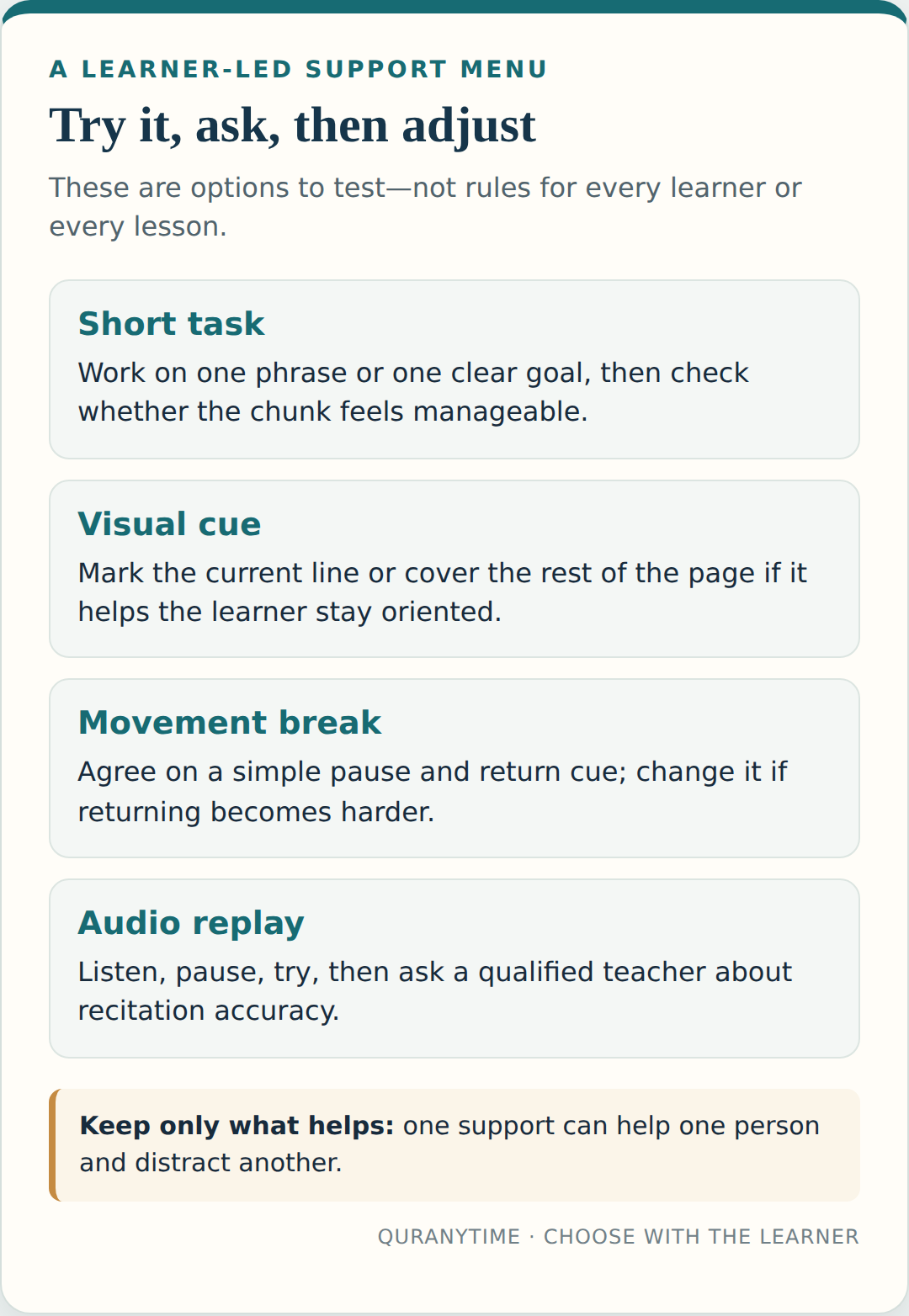
For reading practice, a line marker or a card that covers the rest of the page may help some learners keep their place. For listening, a replay button can make one passage easier to revisit. In either case, ask the learner whether the tool reduces effort or adds another distraction. Do not assume that color, timers, movement, or sound will suit everyone.
Choose supports with the learner
General classroom guidance describes clear tasks, shorter assignments, fewer distractions, positive feedback, organizational aids, and movement breaks as possible supports for students with ADHD. It also notes that evidence is limited on which specific accommodations work best, and recommends observing what helps the individual. Use that guidance as a menu of ideas, not a prescription for Quran lessons. The CDC’s classroom guidance for ADHD is the article’s only external source.
A short movement break can be a planned reset rather than a reward for sitting still. Agree on what the break looks like and how the learner will return—for example, stretch, take a drink of water, then reopen the same page. If the break makes it harder to return, try a different option or finish the session sooner. The goal is a respectful learning environment, not training a child to hide signs of fatigue.
Specific feedback can also make the next action easier to understand. Instead of saying “pay attention,” point to one success or one skill to try again: “You found the right line,” or “Let’s listen once more to that vowel.” Avoid correcting every sound at once. When several things need work, choose the one that matters most for today’s goal and write down the rest for a future lesson.
Adapt the approach without merging different needs
Two learners with the same diagnosis can prefer different lesson formats. One may want the teacher to read first; another may prefer to see the written phrase and try it independently. One may like a visible progress card; another may find tracking stressful. Ask directly, offer a small number of choices, and agree on a pause signal so the learner can say when a task is becoming too much.
ADHD, autism, and dyslexia are not interchangeable. Some teaching tools may overlap, but a guide for one profile should not be treated as evidence about another. Quranytime has separate resources on learning Quran with dyslexia and adapting Quran lessons for an autistic child; each addresses different needs and should be read on its own terms.
For children, a parent and teacher can agree on one goal and a simple way to share what was practised. Keep the child’s choices age-appropriate and avoid using public scores or streaks to create pressure. A realistic weekly routine can be adjusted around school and family commitments; the guide to Quran classes during the school year offers a broader planning reference.
Adults may be balancing work, family, or study. A flexible plan can use a recurring time that already fits the day, but it should not turn a missed session into a debt that must be repaid. Learners choosing online support can compare their needs with Quranytime’s guide to Quran classes for adults with busy schedules.
Keep audio and memorization teacher-checked
Audio can make a passage available for repeated listening, but listening alone cannot confirm whether a learner’s articulation, Tajweed, or memorization is accurate. A useful pattern is listen, pause, recite, then ask a qualified teacher about one point. Quranytime’s listen–pause–check audio method explains how to practise without relying on playback as a certificate. For broader listening routines, see Arabic listening practice for beginners.
For memorization, keep revision visible alongside any new material. A learner who is having a difficult day may review a familiar passage instead of adding more. A Hifz revision schedule can help separate new, recent, and older memorization; a 30-day Quran memorization planner provides another way to organize practice. Neither plan is a fixed quota. Adjust the amount to accuracy, attention, time, and the teacher’s feedback.
A sample flexible session
Here is one example to adapt, not a timetable to copy. The learner and teacher choose a short passage and one goal, such as following the Arabic text while listening. The teacher models a phrase. The learner listens once, pauses, and reads or recites a manageable portion. The teacher responds to one point. The learner then decides whether to repeat, take a short movement break, switch to another support, or stop for the day. A final note records the passage and the next small step.
The video below presents Surah Al-Ikhlas with Arabic text, transliteration, and an English translation. A learner can follow the page while listening, pause between phrases, and return to one short segment with a teacher. The video is an optional practice model; it does not assess attention, replace feedback, or certify recitation.
When the session stops going well
If the learner becomes frustrated or loses the thread, pause and make the next choice small. You might return to a familiar line, reduce the amount of text on screen, listen once without repeating, or end the session and agree when to try again. There is no need to label the day a failure. A shorter, calm lesson can preserve trust and make it easier to return.
If a support is not helping after a fair try, remove it instead of insisting. If reading accuracy, pronunciation, or a Tajweed rule is unclear, ask a qualified Quran teacher to check it. If ADHD-related questions concern diagnosis, treatment, or school accommodations, speak with an appropriate healthcare or education professional. Quran teachers can adapt instruction, but they do not replace clinical care.
Make the next step easy to find
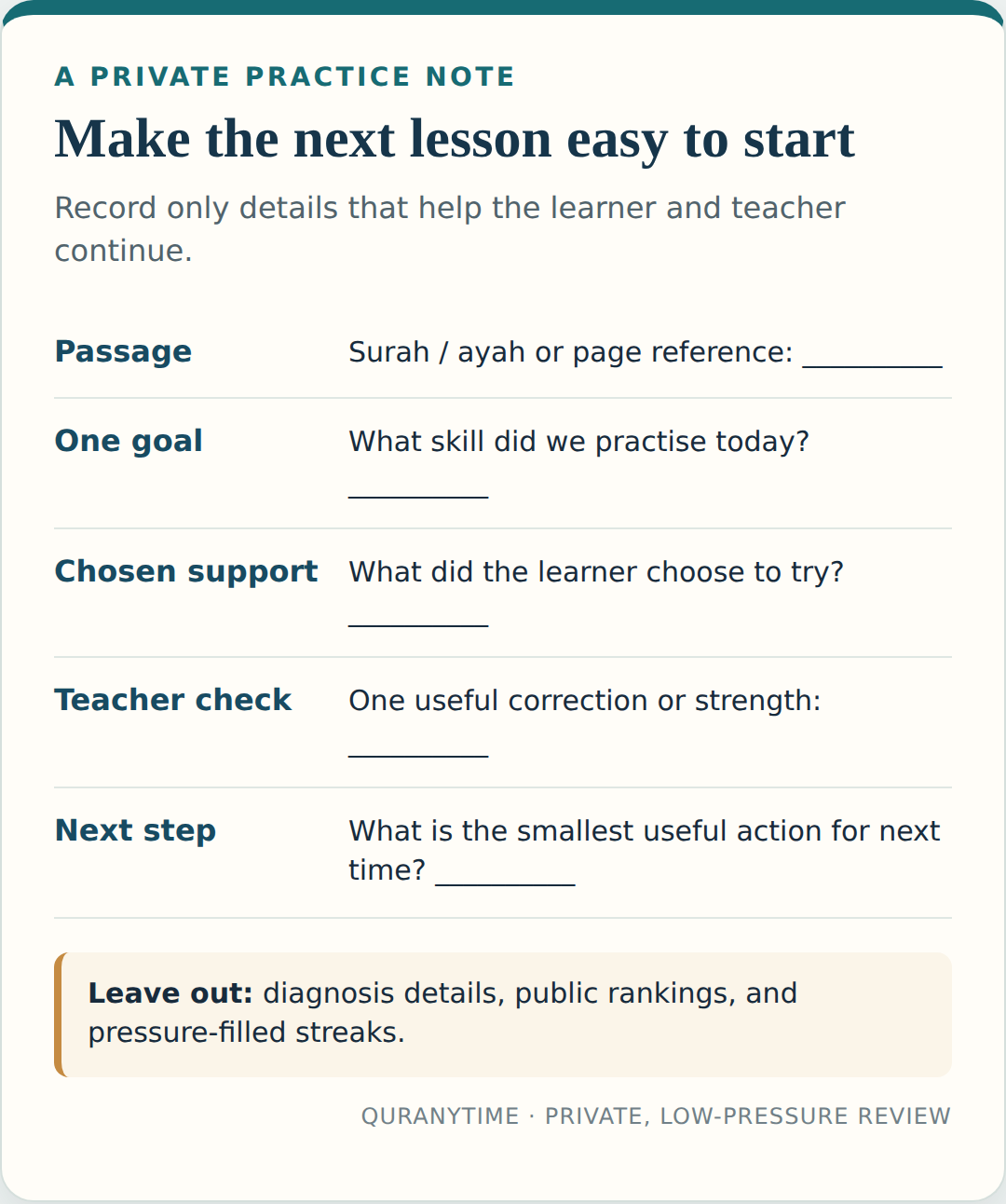
At the end, record only what will help the next lesson: the passage, the one skill practised, a support the learner chose, and the next small action. Do not collect diagnosis details in a public tracker or share recordings without consent. The note should make it easier to begin next time, not create another task to manage.
A supportive Quran lesson is clear, flexible, and built with the learner. Start with one goal, practise a small amount, check one point, and adjust the environment or break when needed. If a personal recitation plan would help, you can book a free Quran and Arabic trial class and discuss the learner’s goals with a teacher.