
If you are wondering how to learn Quran with dyslexia, start with this reassurance: difficulty with one part of reading does not mean a learner lacks effort, interest, or ability to connect with the Quran. Dyslexia describes a range of reading and spelling difficulties; the International Dyslexia Association explains that accuracy, speed, and the way difficulties appear can vary across writing systems and people. Read the International Dyslexia Association’s explanation of its 2025 definition. This article is educational guidance, not a diagnosis or a substitute for individualized advice.
Arabic script, vowel marks, connected letter forms, pronunciation, and recitation rules can create different tasks for different learners. Some may recognize letters but lose their place; others may need more time to connect a written shape with its sound. A helpful Quran-reading plan notices the specific obstacle, keeps accurate Arabic text intact, and adjusts the path—not the learner’s dignity.
Begin with the difficulty the learner notices
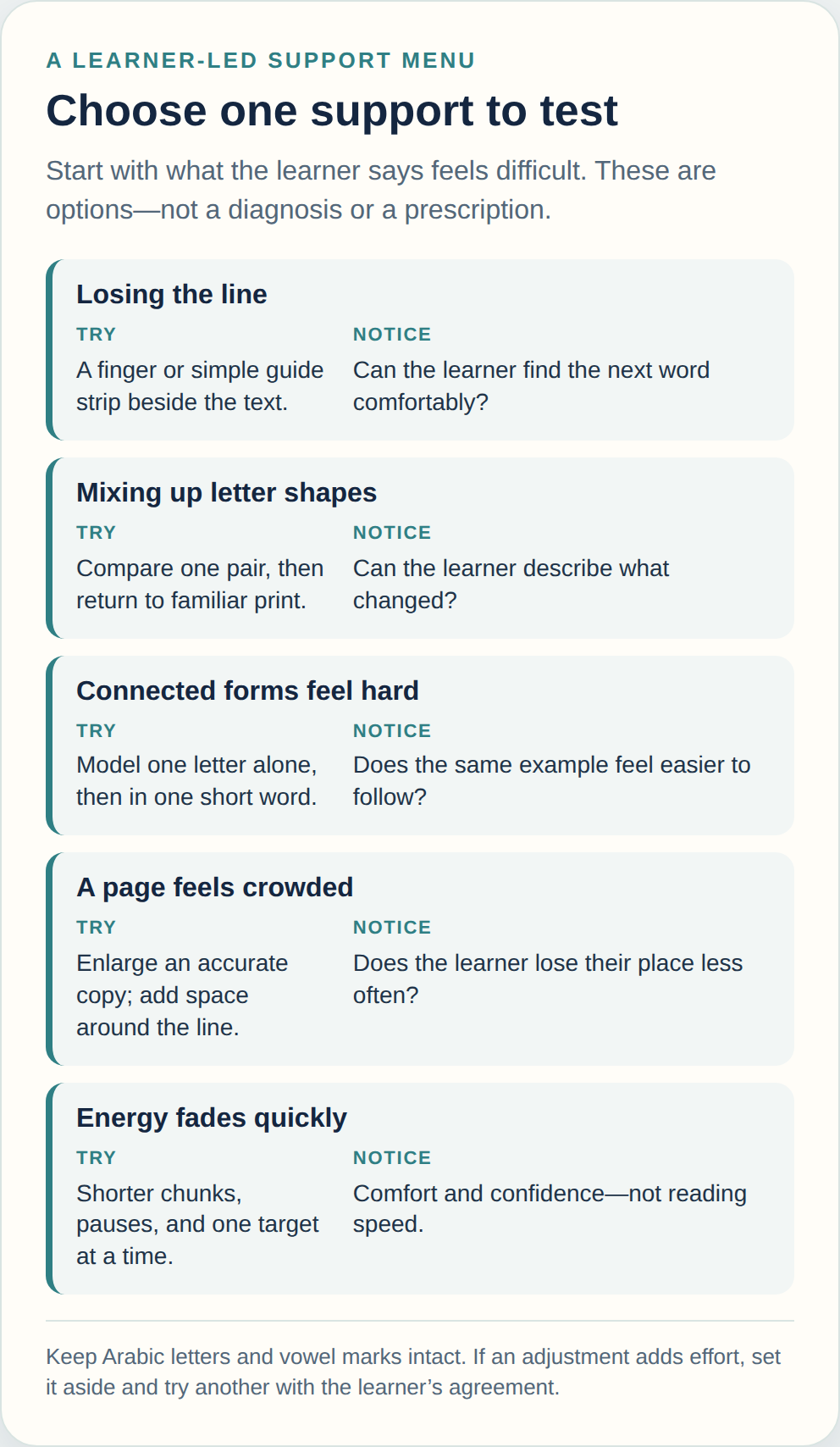
Instead of saying “read better,” ask what feels tiring or confusing today. Is it similar letters, connected shapes, line tracking, or a crowded page? These are examples to explore, not a dyslexia checklist; the learner may name another barrier or prefer different supports on different days.
Listen first, then agree on one observable goal—such as recognizing a connected form or following one line while listening. Keep it small enough to practise briefly. If frustration rises, pause, simplify, or return to a familiar example; the aim is a workable route into the text, not a test of effort.
Build reading in a flexible ladder
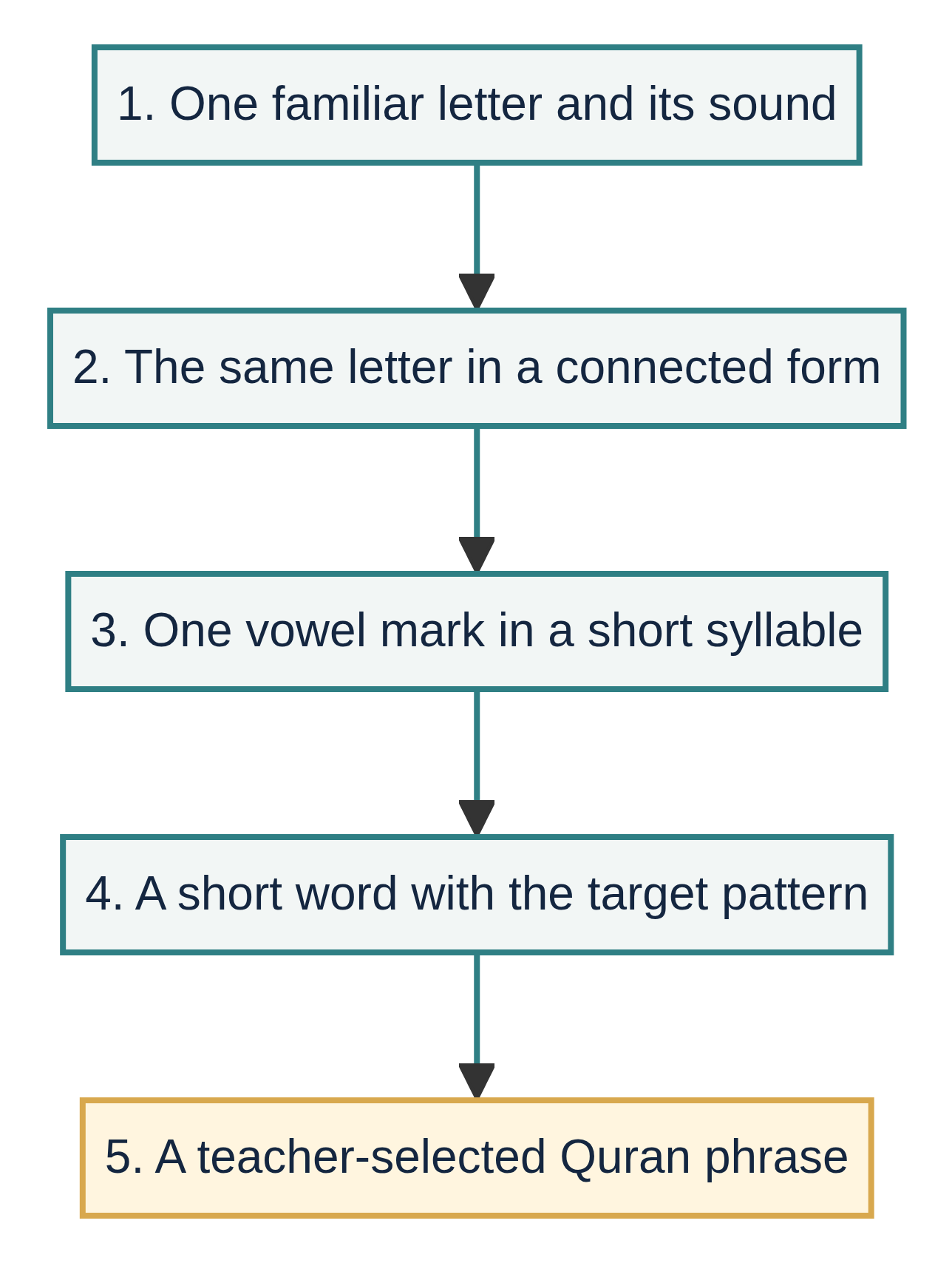
Some readers know individual Arabic letters but need more time when letters connect or carry vowel marks. A flexible route is one familiar letter and sound, its connected shape, one marked syllable, a short word, then a brief teacher-selected Quran phrase. Repeat, pause, or step back as needed; this is not a required sequence. If the alphabet is still new, the step-by-step Arabic alphabet guide can help, while this plan stays focused on reading support.
Practise a small set rather than a long list. A teacher can model one sound, link print to audio, and give one clear correction. Quranytime’s guided Quran pronunciation practice offers a related reference; the learner’s own teacher should select suitable recitation examples.
Make the page easier to follow, not less Quranic
Some readers follow more easily with one line in view, generous spacing, a simple guide strip, or an enlarged approved copy. Keep Arabic words and vowel marks intact; place any guide beside the line, never over or inside it.
Do not assume one font, shade, or overlay suits everyone. Ask whether it makes the script clearer or more distracting. If color helps, test one consistent cue outside the original letters; many colors can add clutter. Quranytime’s color-coded Tajweed guide explains a separate option, not a universal dyslexia solution.
Approved print layouts can look different, and a learner may prefer one over another. Compare them without calling one better for everyone; see the Uthmani and Indo-Pak script comparison. Dyslexia is not low vision, though both can coexist; Quranytime’s guide for blind and low-vision readers covers separate access needs.
Pair Arabic print with clear listening
Audio can turn an unfamiliar word into a listen-and-follow task. Choose a trusted teacher or reciter, keep the same short example in view, and let the learner follow the line with a finger or guide if they prefer. Pause after a word, listen again, and try it at a comfortable pace. A slow, accurate model is more useful than rushing through a longer passage. Transliteration can be a temporary bridge, but it cannot show every Arabic sound or replace learning the Arabic text and listening to a reliable model.
The short video below uses a general Arabic listen-and-repeat alphabet format. It is not a dyslexia-specific intervention; a learner may simply borrow the idea of pairing a visible letter with sound, pausing, and repeating only if that feels helpful.
Choose support by the barrier, not by a label
Try one adjustment at a time so the learner can notice whether it helps. The ideas below are options, not a clinical checklist or a promise that one method works for everyone. Keep what makes the text easier to follow; leave aside what adds effort.
For practice and recitation pacing, the guide to Quran reading fluency without rushing can reinforce a simple principle: the goal is careful, meaningful reading, not a speed record. If the learner already knows a Tajweed rule, practise one rule in a short example instead of layering several new rules onto an unfamiliar passage; the Tajweed rules chart with Quran examples is a reference for that separate skill.
Make practice age-respectful
Adults may want privacy, a self-paced recording, or a routine that fits around work and family. Let them choose the passage, format, and cue; do not assume they need child-focused games. A personal note such as “audio plus a line guide helped with this page” can make the next practice session easier to plan. Adults can also ask a trusted teacher to model one point and give feedback without turning a lesson into a reading test.
For a child, use short, predictable tasks and offer a choice between two familiar activities, such as listening and tracking or building a word with letter cards. Praise the strategy and persistence, not a label or speed. Stop before the learner is exhausted, and avoid comparing siblings or classmates. A parent and Quran teacher can agree on one target so home practice supports the lesson rather than adding a second set of demands.
Try a short session, then adapt it
Here is one example of a ten-minute practice session. It is a starting point, not a prescription; the learner may need a shorter session, more pauses, or no timer at all. Choose a familiar passage and a single goal before starting.
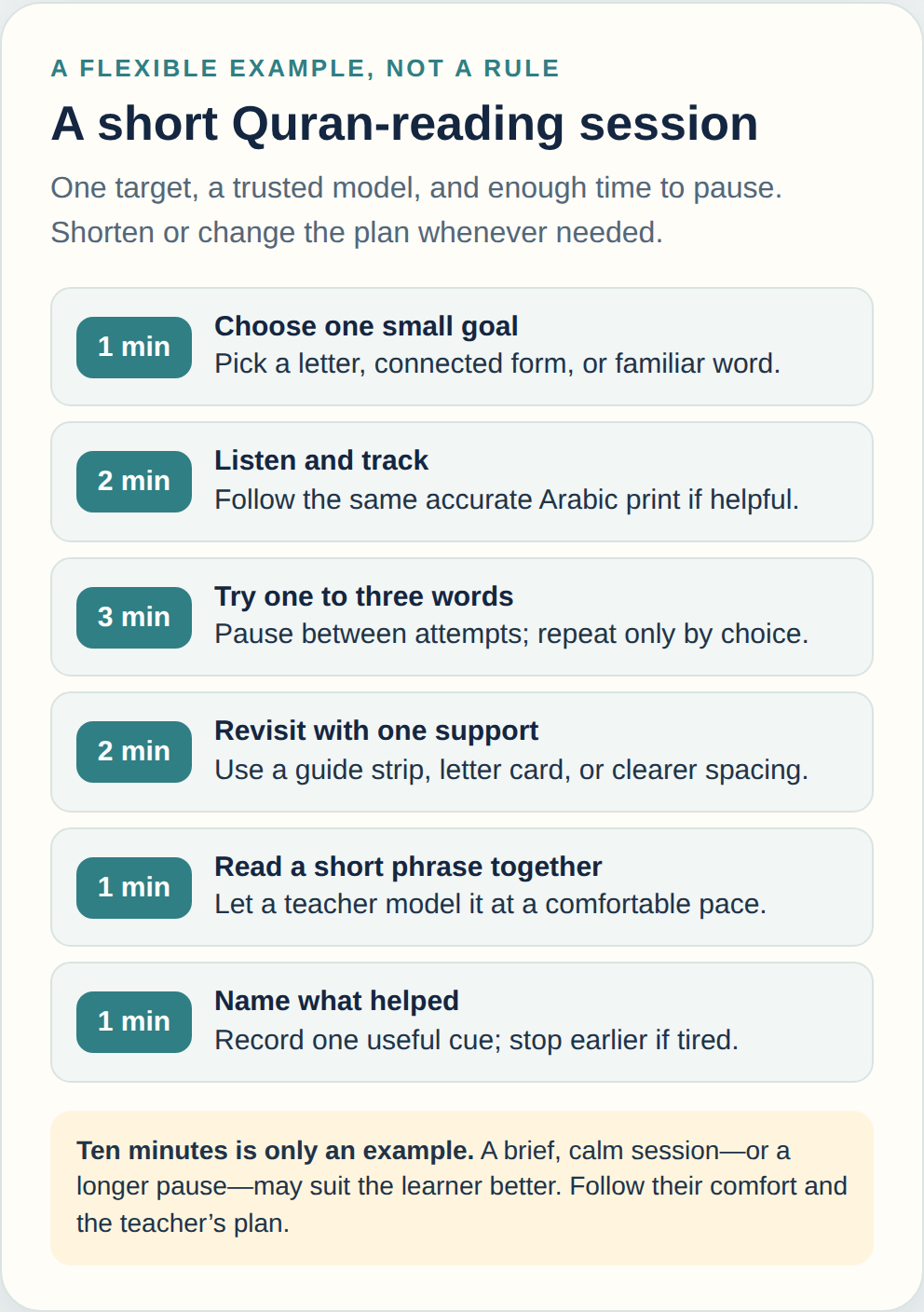
The last minute can be as simple as naming one thing that helped and one thing to change next time. If the learner’s attention or energy is fading, end early. A successful session is not measured by the number of lines completed; it is measured by whether the learner felt safe enough to return.
Work with a teacher, without turning practice into a test
A Quran teacher can help select clear examples, model recitation, correct gently, and separate letter recognition from fluency or Tajweed feedback. Tell the teacher which supports have helped and invite the learner to speak for themselves where possible. Ask for one correction at a time, a short audio model, or a few minutes to revisit the same example. For help with a particular rule, link the reading plan to the learner’s current lesson rather than introducing a full new syllabus.
If you are choosing a class, ask how the teacher adapts pace, text layout, repetition, and feedback. To discuss goals and see whether the approach feels supportive, you can book a free Quran and Arabic trial class. A class should not promise to diagnose dyslexia; it can listen to the learner, adjust the lesson, and communicate respectfully with parents or other teachers.
When to seek more support
A Quran lesson is not a diagnostic assessment. If reading or spelling difficulties persist across learning settings despite suitable instruction, a parent or adult learner may choose to speak with a qualified literacy professional or educational specialist about assessment and support. The International Dyslexia Association notes that difficulties and support needs vary; no single classroom observation, letter mix-up, or slow practice session can establish dyslexia.
Support does not have to wait for a label. Continue with respectful, explicit teaching, brief practice, and learner-chosen tools while seeking guidance if needed. If the learner has other access needs, such as low vision or hearing differences, ask the relevant specialist and Quran teacher how the supports can work together.
Quick questions
Does dyslexia mean someone cannot learn to read Quran?
No. Dyslexia is not a verdict on a person’s ability or faith. People differ in what they find difficult and which supports help. A clear goal, suitable instruction, patient feedback, and time to practise can make Quran learning more accessible, while progress will look different for each learner.
Should a learner use transliteration instead of Arabic?
Transliteration may help someone remember a sound temporarily, but it cannot represent every Arabic distinction. Keep the accurate Arabic text visible, pair it with a trusted pronunciation model, and let the learner gradually connect the sound to the letter and vowel marks with teacher support.
How long should a dyslexic learner practise?
There is no single correct duration. A brief, comfortable session may be more useful than a long one that ends in fatigue. Let the learner’s focus, confidence, and teacher’s plan guide the length; pause or stop when needed, and return later rather than pushing for speed.
Can a Quran teacher diagnose dyslexia?
A Quran teacher can observe reading tasks, adapt a lesson, and share concerns, but diagnosis belongs to qualified professionals. A teacher’s role is to teach and support—not label the learner from one mistake. If difficulties persist, families or adult learners can ask an educational or literacy specialist about next steps.
Learning Quran with dyslexia can begin with one letter, one line, or one welcoming lesson. Ask what the learner notices, choose one practical support, and keep the next step small enough to try again with confidence.