

To teach Quran to an autistic child, begin with the child’s preferences, not a fixed formula. Autistic learners differ in how they communicate, respond to sound and light, and prefer to practise. Ask what helps this learner feel comfortable, choose one realistic Quran-learning goal, and agree on a flexible way to work toward it. Listening, reading, pronunciation, memorisation, and understanding are different goals; one does not have to be a test of another.
Start with the learner, not a checklist
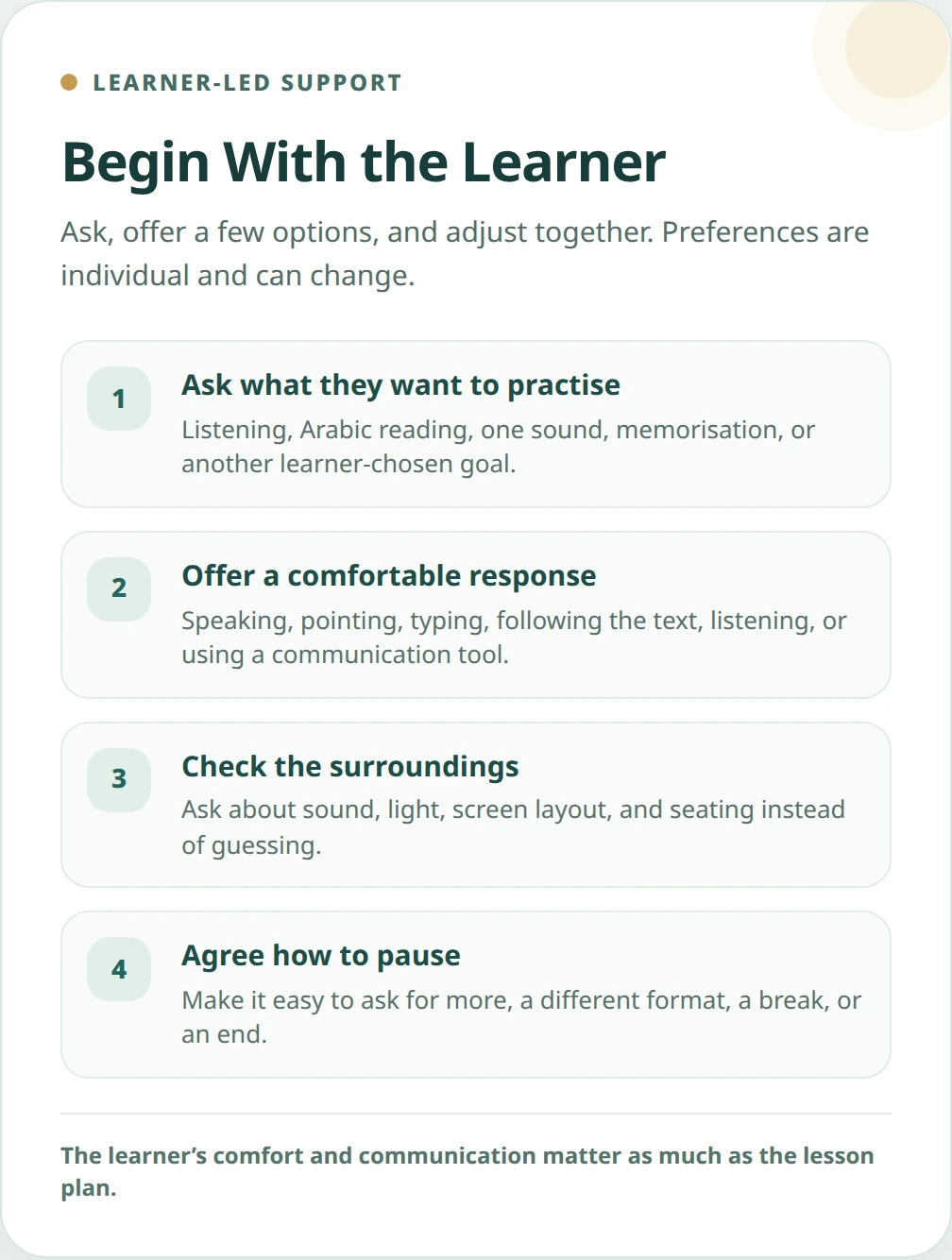
Before a lesson, ask the child or young person what they would like to work on and what would make the session easier. They may answer aloud, point to a choice, type, use pictures or a communication tool, or ask a parent to help explain a preference. Give time for an answer. If the learner cannot or does not want to answer directly, the family may share observations while still making space for the learner’s choices.
Keep the first goal small and observable. It might be listening to a short surah, recognising a familiar Arabic letter, reading one connected phrase, or practising one pronunciation point. These goals are not a hierarchy: listening can be a meaningful learning activity in its own right, while another learner may be ready to read from the Mushaf. A teacher can help identify the learner’s current Quran-reading level without turning a first meeting into a high-pressure test.
Some learners enjoy a repeating routine; others want more choice. Offer a predictable outline, then ask whether it helps. A note such as “listen, practise, break, finish” can make the plan visible, but should be optional and easy to change.
Make the learning environment adjustable
Sound, lighting, screen movement, background noise, and crowded pages can affect a lesson. The National Autistic Society’s sensory-processing guidance explains that sensory experiences can vary between autistic people, across different senses, and from one situation to another. Ask rather than guess: a quiet room may help one learner, while another may prefer a familiar sound or gentle movement.
Try one adjustment at a time. Ask before changing the audio, screen, headphones, lamp, or seating. Do not assume silence, a particular position, or eye contact works for everyone. If the child needs to move or use a familiar comfort item, consider whether that supports safe, comfortable learning instead of treating stillness as the goal.
For online sessions, check that the Arabic text is large enough, the teacher’s voice is clear, and notifications are not competing with the lesson. For in-person sessions, let the learner and family choose a comfortable position and a way to see the text. The aim is access to the recitation—not a perfect-looking classroom.
Offer more than one route into a Quran lesson
Offer a couple of simple options: “Would you like to listen first or look at the Arabic?” or “Shall we practise this sound or review the familiar line?” Too many choices can be tiring, so offer only as many as the learner finds useful. If an answer takes time, pause; waiting can be more helpful than repeating the instruction louder or faster.
For reading practice, keep the Arabic visible and use a teacher-checked model. Transliteration may temporarily help some learners, but it does not show every Arabic sound accurately. If the learner enjoys hearing a phrase again, a brief listen–pause–check approach can offer structure without demanding an immediate spoken response. Quranytime’s Quran audio repeat practice method is one option to adapt with the teacher.
Keep Tajweed teaching concrete and suited to the learner’s goal. A teacher might model one sound, invite listening, then offer a response in the learner’s preferred way. Do not introduce several new rules just because they appear on one page. The guide to practising Tajweed between lessons can help families follow the teacher’s plan without guessing at corrections.
Use a flexible lesson loop
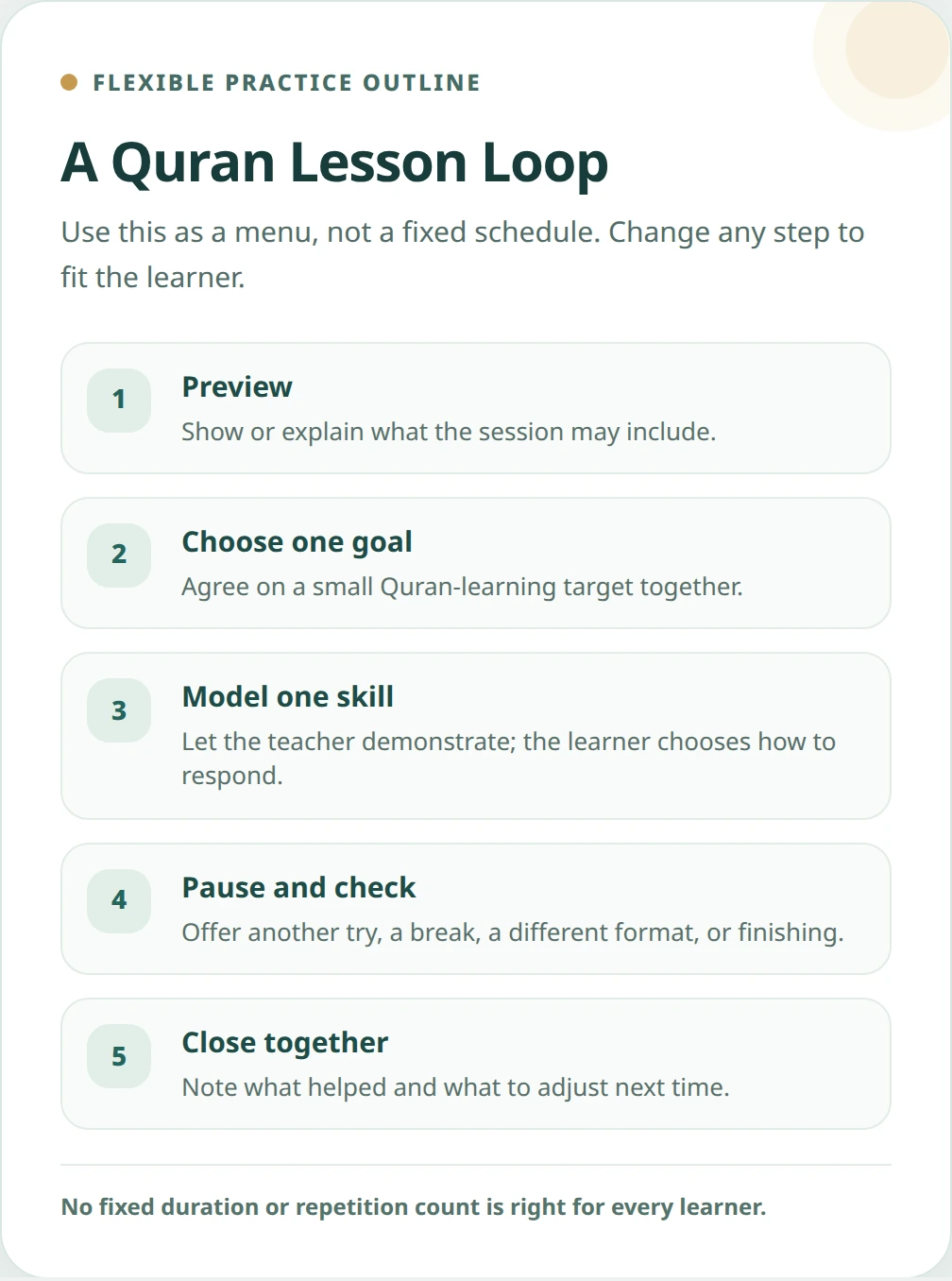
A repeatable outline can help a learner who likes knowing what comes next. Make a break or change of activity an accepted option. For example:
- Preview: show or explain what the lesson may include, using speech, a written list, or a visual cue if useful.
- Choose: agree on one goal, such as listening to a passage or practising a letter.
- Model: let the teacher demonstrate; the learner may listen, follow the text, repeat, point, or use another response.
- Pause and check: offer another try, a break, a different format, or finishing.
- Close: note what worked and what to offer next time.
This is a menu, not a timed programme. If the learner becomes uncomfortable, stops responding, or asks to end, pause and check what they need. A lesson can be useful even if the original target changes.
Agree on communication and feedback
Ask what correction feels helpful. Some learners prefer one direct explanation; others want to hear the model again, see a written cue, or receive feedback after a short passage. A teacher can ask permission before correcting and give one clear point at a time. Avoid treating eye contact, speech, quietness, movement, or repeated phrases as complete measures of understanding.
For a child who communicates in ways other than speech, ask how to offer choices and recognise “yes,” “no,” “more,” “break,” or “finished.” Spoken repetition is not the only way to participate. If the child already has communication or learning supports, coordinate with the family and relevant professionals about how lessons can fit alongside them. A Quran teacher does not replace a clinician, therapist, or school support plan.
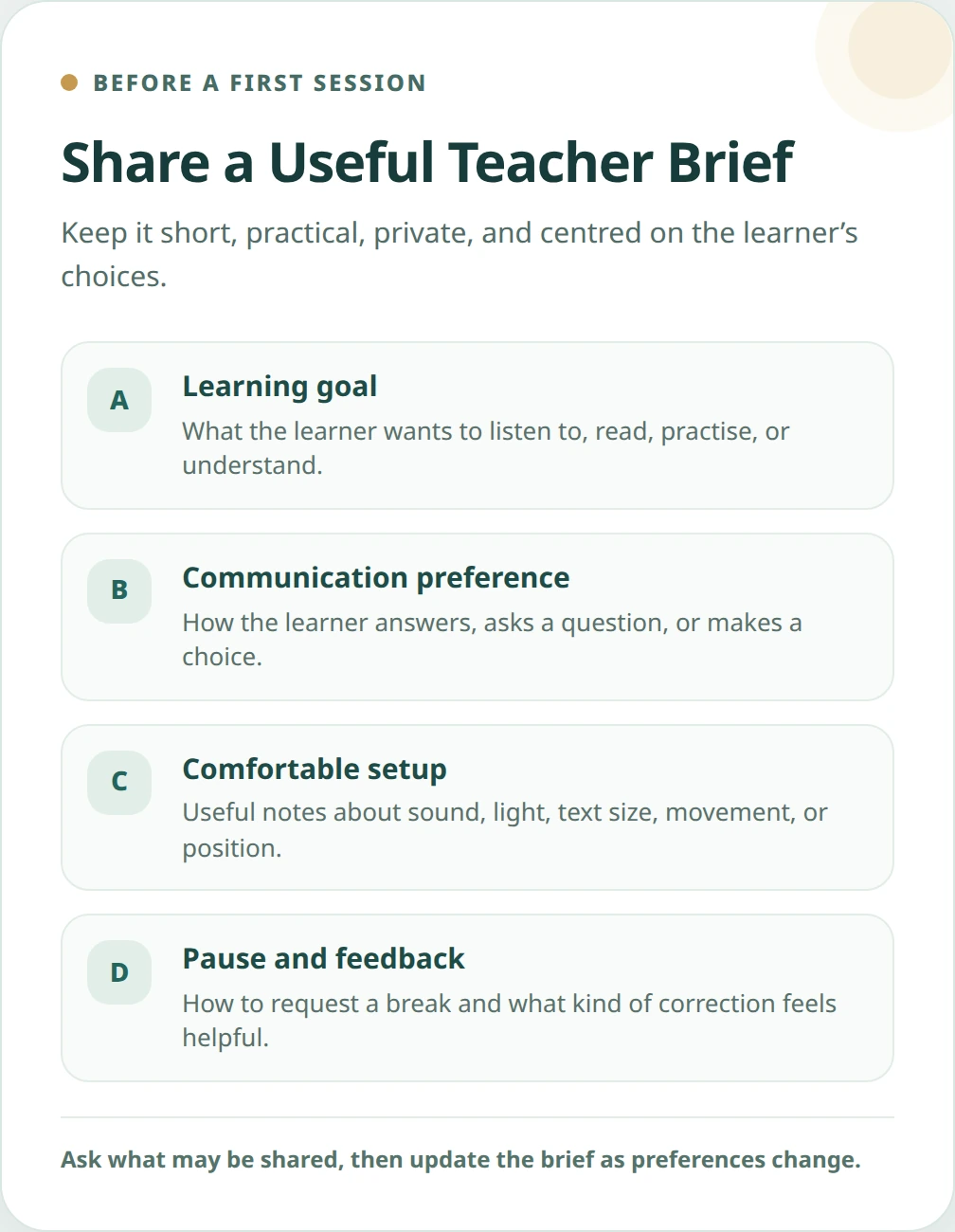
Before a first session, share a short teacher brief: the learner’s goal, preferred communication, what makes audio or screens comfortable, how they request a pause, and their feedback preferences. Keep it practical and private. Ask what the learner wants shared, and update the brief when preferences change.
Choose a teacher and format collaboratively
Look for a teacher who can model correct recitation, welcomes questions, and adapts the lesson rather than assuming one method fits every autistic learner. Discuss goals and useful adjustments beforehand. Ask how the teacher responds to a request for a break, a change of activity, or an early finish.
Online and in-person learning each suit some learners and not others. A familiar home may make an online lesson easier; live teaching can provide feedback recordings cannot. Consider the learner’s response to the actual setup. If they want to try a class, you can book a free Quran and Arabic trial class and ask in advance how the teacher can accommodate their preferences.
Families supporting more than one learning need may also find the guide to learning Quran with dyslexia useful, but dyslexia and autism are not interchangeable. Use the learner’s own profile rather than copying another person’s adjustments.
Choose progress markers that fit the learner
Progress need not mean a set number of verses, lesson length, or memorisation deadline. Agree on useful signs with the learner: choosing a practice format, recognising a sound, following a familiar line, or telling the teacher when a break is needed. A Quran reading fluency routine that avoids rushing may help when connected reading is the goal; it is not a target for someone currently working on listening or letter recognition.
Afterward, ask what felt clear, difficult, or comfortable. Note the passage, the learner’s feedback, one next step, and any change to try. If a recording would help, first check consent and privacy. The guide to recording Quran recitation for teacher feedback explains how to make the practice purposeful.
An optional short-surah model
The example below teaches Surah Al-Ikhlas with Arabic text, transliteration, English meaning, and repeated recitation. It is not designed specifically for autistic learners, and no video suits everyone. Preview the pace, sound, and screen layout together; use only the part the learner wants, pause when needed, and ask their teacher for pronunciation correction.
Common questions
Can an autistic child learn Quran?
Yes. Autistic learners can engage with Quran learning in different ways and at different paces. Start with their interests and goals, and adapt communication, setting, and teaching format to that individual.
Should the child always repeat after the teacher?
No. Repeating aloud is one option when the learner wants to practise it. Listening, following the text, pointing, or taking a break may also be appropriate. Agree on what participation looks like for this learner.
Do Quran lessons need to be shorter?
No universal duration suits every autistic learner. Start with a manageable length, check in, and adjust using the learner’s feedback. Avoid promising outcomes from a fixed number of minutes or repetitions.
A respectful next step
Ask what the learner wants to work on, agree on one flexible goal, and tell the teacher how they communicate and request a pause. Review together what helped. A useful Quran lesson supports accurate learning while respecting the learner’s comfort, communication, and choices.