

Two learners can sit together with a Quran and still spend most of the session uncertain about whose turn it is, whether to interrupt, and who should decide a disputed pronunciation. Paired reading works better when those decisions are made before the first line. The aim is a calm practice partnership that supports teacher-led learning without turning either learner into an unqualified authority.
This guide gives a practical protocol for siblings, adult learners, or a parent-supported pair. It is not a substitute for a qualified Quran teacher. Partners should flag uncertainty and take it back to someone qualified rather than inventing tajweed rules, competing over correctness, or reinforcing a shared mistake.
Decide whether this pair is a good fit
A useful pair can follow turn-taking instructions, tolerate a correction, and stop when uncertain. Equal reading speed is not essential, but a large difference in level changes the activity. Two beginners may be able to follow a teacher-approved recording and identify their place; they should not be expected to diagnose subtle articulation errors for one another.
A more fluent learner may support navigation and the agreed practice routine, but should not automatically become the other learner’s teacher. Expertise in one memorized passage does not establish expertise in every recitation issue. Decide with your teacher what the listener is qualified to notice and what must be referred back.
For children, an adult should set the emotional boundaries and remain available. If one child uses the listener role to mock, dominate, or interrupt repeatedly, change the activity. Partnership is useful only while both learners can participate respectfully. Our positive Quran practice guide for children can support that home environment.
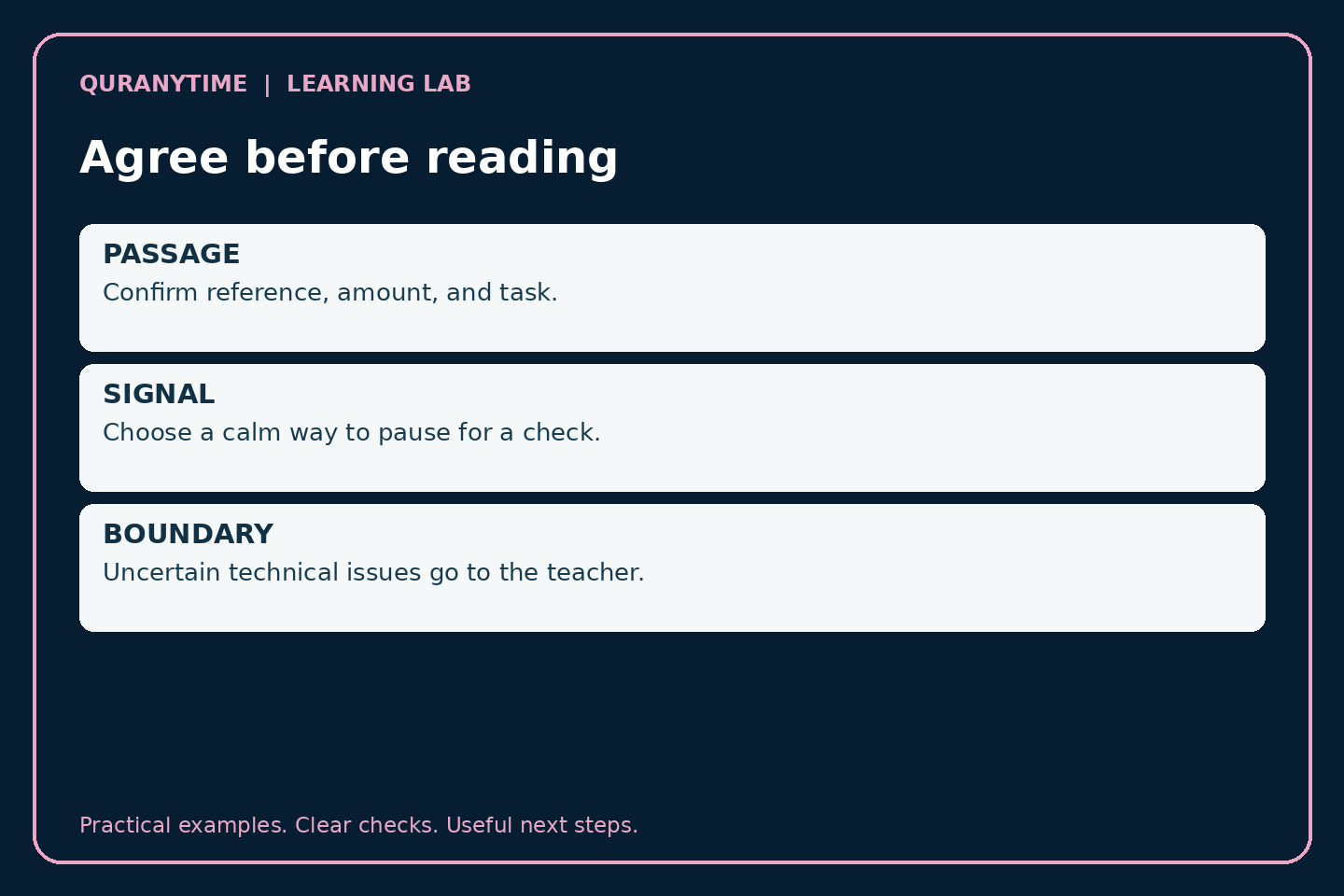
Agree on three roles, even if only two people are present
The reader recites the agreed passage. The listener follows the text and observes only the agreed targets. The teacher or qualified reviewer resolves uncertainties later. Keeping that third role explicit protects the pair from treating a confident guess as a ruling.
Write a one-sentence agreement: “Today the listener will help us keep our place and note teacher-identified targets; uncertain points go on the question list.” The wording can be simpler for children. Avoid an open instruction such as “correct everything,” especially when the listener does not yet know how to do that accurately.
A teacher may assign one specific feature to monitor, such as an already taught word or correction. Use the teacher’s exact explanation. Do not expand that instruction into a new rule based on one example. Our guide to asking better Quran-teacher questions can help turn uncertainty into a useful follow-up.
Choose the passage and the stopping point together
Use a passage both learners can identify in their mushafs, with a teacher-approved scope. Record surah and verse references rather than relying only on a page number when editions differ. Begin with a manageable amount. A short accurate exchange gives you more useful information than a long session dominated by losing the place.
Agree where a turn ends. Do not make turn length depend on whoever reads fastest. A verse boundary may be a suitable organizational point in some exercises, but questions about actual stopping and restarting need proper recitation guidance. Our Quran stopping-rules guide provides background; ask the teacher to select appropriate places for your particular passage.
Check that the pair has the same intended reading context. A learner revising memorized text and a learner reading directly from the mushaf may need different support. Name the task explicitly so the listener does not mistake looking at the text for breaking a memorization test when no test was agreed.
Use a stop signal that does not feel like an alarm
Choose a neutral phrase such as “Let us check that” or a raised hand. Explain when it should be used: a lost place, a teacher-assigned correction, or uncertainty that makes continuing unhelpful. Do not interrupt every hesitant syllable. The listener needs to distinguish the agreed target from a general preference for a different pace.
When the signal occurs, the reader pauses at an appropriate point rather than being startled into an abrupt contest. The pair checks the text or the teacher’s note. If the issue is unresolved, mark the reference and move to a teacher-approved alternative task. Repeating a disputed version ten times is not a sound way to settle it.
The tone matters. Compare “You always get this wrong” with “This is the word we were asked to check.” The second identifies an observable target. It leaves room for the listener to be mistaken and keeps the session focused on learning rather than the reader’s character.
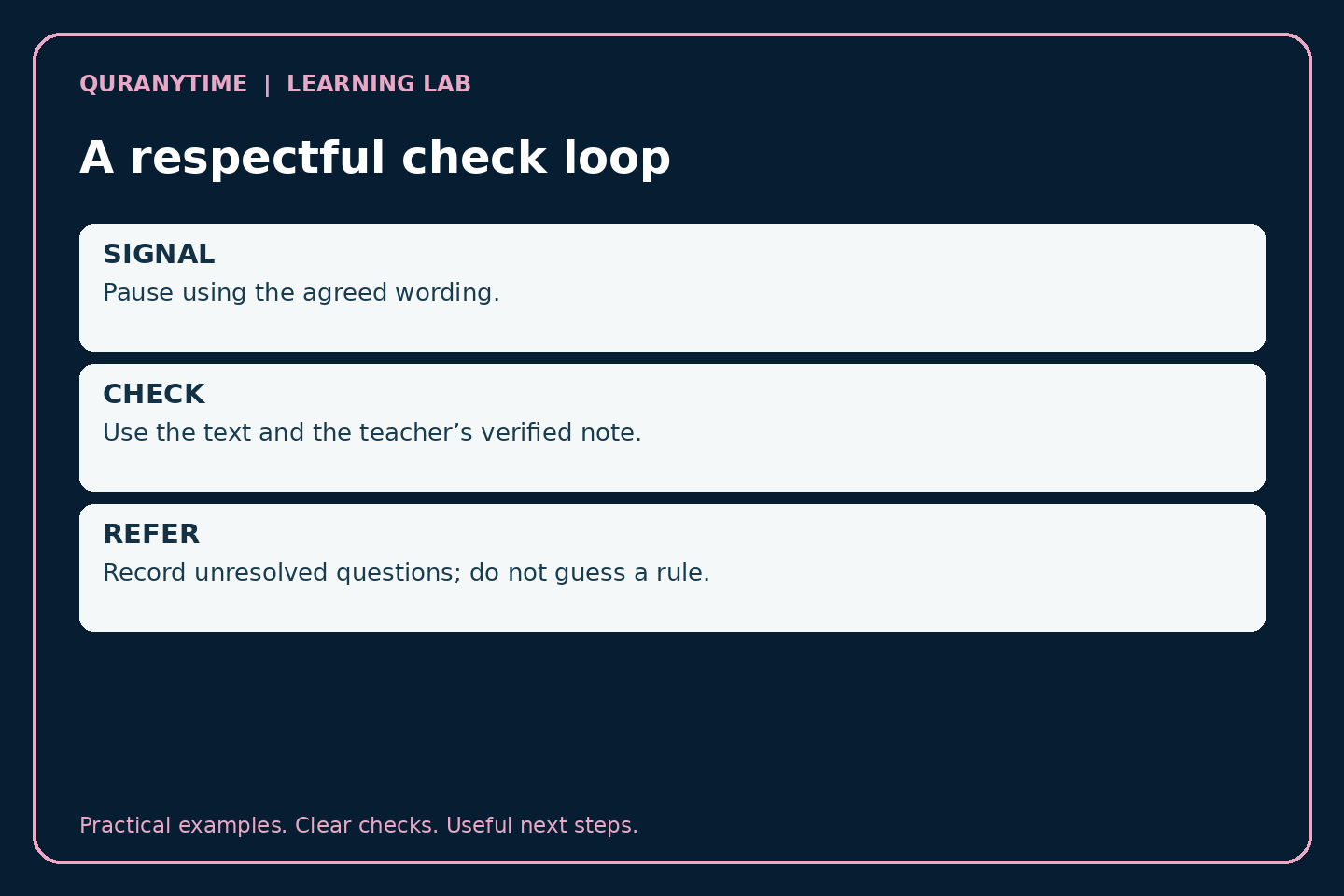
Run a twelve-minute partnership session
Spend two minutes confirming the passage, target, and roles. Give the first reader a short turn, then use one minute for a precise observation. Switch roles for a comparable turn. End with a brief joint check and one question to take to the teacher. These times are a planning model; shorten them for young learners or fatigue.
The listener’s feedback can use three parts: the location, what was observed, and what help is needed. For example: “In the assigned verse, I lost our place after this word; can we point to the next word together?” This is more useful than “It was bad” and safer than inventing a technical explanation the listener cannot support.
If a teacher-approved recording is part of the exercise, both learners should follow the same verified passage. Our Quran audio-repeat practice guide can help organize listening. Audio can provide a model, but merely matching its sound does not prove that every articulation has been mastered.
A sample role card
Reader: identify the start, read the assigned amount, accept the agreed signal, and ask for clarification when needed.
Listener: follow silently, keep a finger or pointer on the place, monitor the limited target, and avoid correcting beyond your competence.
Together: record unresolved points with a reference, keep comments respectful, and finish with a clear next step. Neither partner should secretly turn a practice session into a high-stakes assessment.
Print these roles on a small card or copy them into a notebook. The value is not the card itself but the shared expectation it makes visible. Once the routine is familiar, a quick verbal reminder may be enough.
Make the feedback specific and limited
Choose one successful observation and one next action. A success might be following the assigned section without losing the place, using the stop signal calmly, or applying a correction the teacher had already taught. Do not offer praise for accuracy you are not qualified to judge.
A next action should be concrete: “Ask the teacher about this word,” “Use a shorter passage next time,” or “Practise the agreed restart.” “Be more careful” is too vague to guide the next session. Our Quran lesson-notes guide can help you turn that next action into a record.
If you maintain a Quran recitation mistake log, label partner observations as unconfirmed until reviewed. This prevents a listener’s uncertainty from becoming a permanent “error” entry. The log should support qualified feedback, not manufacture certainty.
Adjust for different pairings
Two adult beginners: emphasize navigation, listening to a verified model, and identifying questions. Keep technical correction with the teacher. A useful session can be successful even when the partners do not resolve a pronunciation issue themselves.
Siblings of different ages: equal dignity matters more than equal difficulty. Give each a suitable passage and use the same respectful turn-taking rules. The older child should not control the younger child’s reward, punishment, or access to the lesson.
Parent and child: the parent can organize the environment and encourage the routine without pretending to know every rule. Saying “I will ask your teacher” models responsible learning. Avoid correcting by volume or comparing the child with a sibling.
Two experienced learners: agree on the riwayah and teacher expectations, and still refer genuine uncertainties. Familiarity does not remove the need for evidence. Do not treat stylistic differences between legitimate models as errors without qualified guidance.
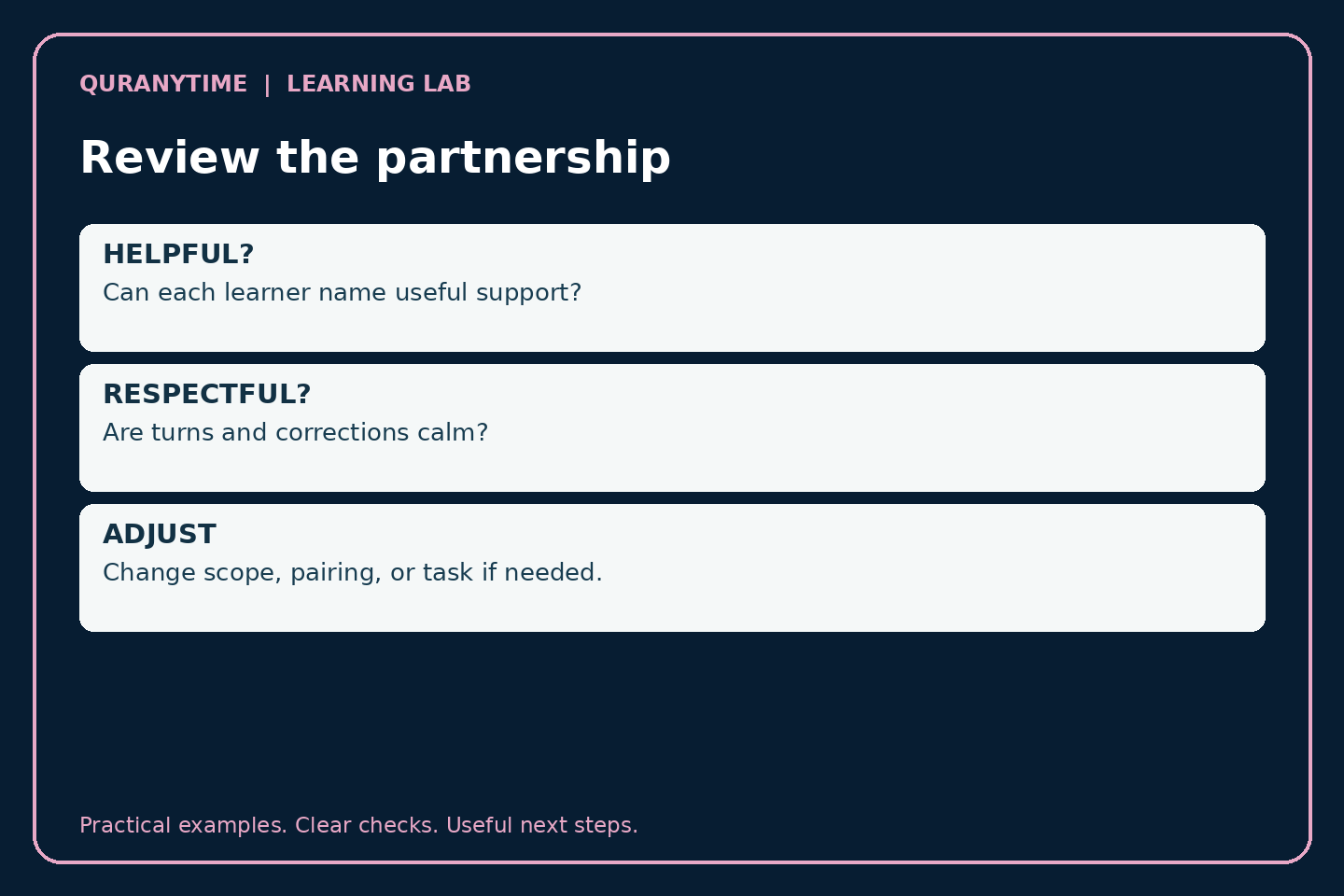
Troubleshoot the partnership rather than blaming the reader
If the listener interrupts constantly, narrow the target and create a note-now-discuss-later option. If the reader becomes defensive, revisit the agreement and reduce the number of corrections. If one partner always dominates, use a visible turn card and a fixed scope. If both keep losing their place, shorten the passage and check edition differences.
If the session becomes competitive, remove timing and scoring. A partner’s purpose is to help a learner notice and practise, not to establish who is better. For children, end an unkind exchange promptly and reset later with adult support. Do not make enduring criticism a condition of Quran practice.
If repeated attempts produce the same unresolved issue, stop rehearsing it and ask the teacher. Our guide to recording recitation for teacher feedback can support a short consensual recording. Obtain permission before recording another person, and use an appropriate private channel rather than posting practice mistakes publicly.
Rehearse the disagreement before it happens
Use a non-recitation role-play first. One partner says, “I think this needs checking,” and the other responds, “Let us write the reference for the teacher.” Then switch roles. This brief rehearsal gives both learners words to use when a real uncertainty feels awkward. It also shows whether the listener understands that a concern is not automatically a confirmed error.
Agree that neither learner will search several recordings until finding one that appears to win an argument. The appropriate next step is the agreed qualified reviewer, with the passage and question clearly identified. Different recordings can introduce additional context a beginner is not equipped to evaluate.
At the end of the session, let each person describe one way the partner helped. Keep the statement factual: “You waited while I found the reference,” or “You reminded me of our agreed target.” This shifts attention toward cooperative behavior that can be repeated. If a learner cannot identify anything helpful after several sessions, reconsider whether the pairing or task is appropriate.
Review whether the routine is helping
After three sessions, ask each learner privately what helped and what made practice harder. Look for observable changes: clearer turn-taking, fewer lost places, better questions for the teacher, or more consistent use of an agreed correction. Do not equate a quieter child with a successful session if the child is simply afraid to speak.
Keep the routine only while it serves learning. A learner may prefer individual practice for a period, or a pair may need different passages. Changing the arrangement is an instructional decision, not a failure of commitment. The teacher can help decide which tasks suit independent, paired, and supervised practice.
For a tailored plan, Book a Free Trial Class and explain who will practise together, their approximate levels, and the difficulty you want the partnership to solve. Ask the teacher to define one appropriate listener target and a safe correction protocol. That gives both learners a practical role and keeps qualified instruction at the center of recitation development.