

“I stood” tells you what happened. “I stood out of respect for the teacher” tells you why. Arabic can express that motive with a verbal noun in the accusative, a construction called الْمَفْعُولُ لِأَجْلِهِ, mafool li ajlih. The same topic is sometimes called the accusative of purpose, reason, or motive.
The useful reading skill is to distinguish an action’s reason from its object, manner, time and result. This workshop follows a learner preparing for a lesson, then revises the same explanation through different Arabic constructions. Its classroom sentences are composed examples, not Quran quotations. The Quran example near the end is clearly referenced and tied to a neutral grammar source.
One action, one reason
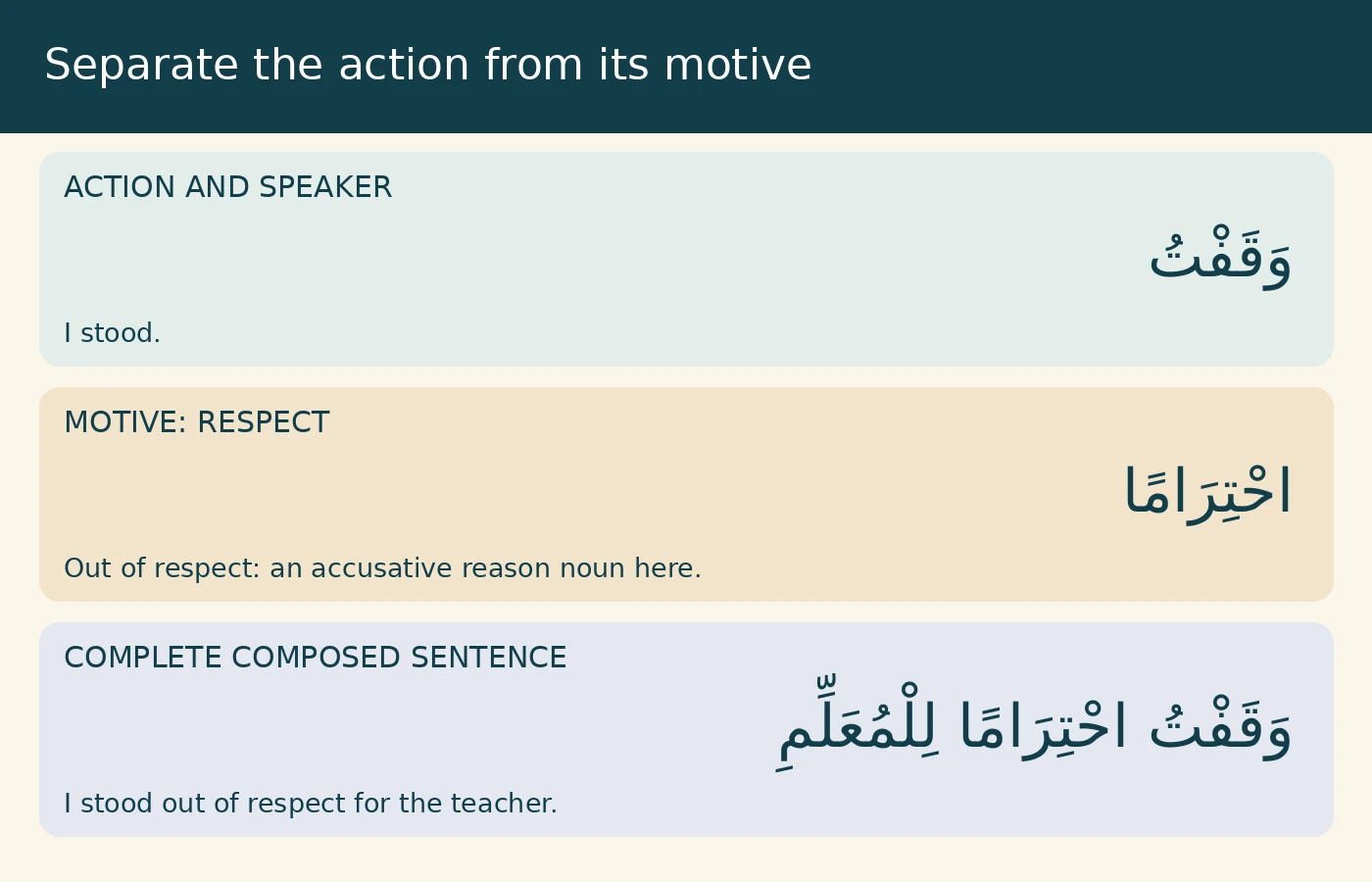
Read وَقَفْتُ احْتِرَامًا لِلْمُعَلِّمِ — “I stood out of respect for the teacher.” The verb وَقَفْتُ gives the action and identifies the speaker as its subject. احْتِرَامًا supplies the motive: respect. لِلْمُعَلِّمِ tells us toward whom that respect is directed.
The teacher is not an object of the standing verb. Respect is not a second action that happened afterward. The phrase explains the speaker’s reason for standing. In a clear example like this, asking “Why did I stand?” helps reveal the relationship. But a meaning question is a diagnostic aid; a complete grammatical explanation still considers the form and construction.
احْتِرَام is a masdar, an action or abstract verbal noun. The masdar lesson explains that word class. Being a masdar does not automatically make a noun an accusative of purpose: a masdar can fill other roles. Here its reason-giving relationship to the standing action is part of the analysis.
Do not read all accusatives as the same kind of information
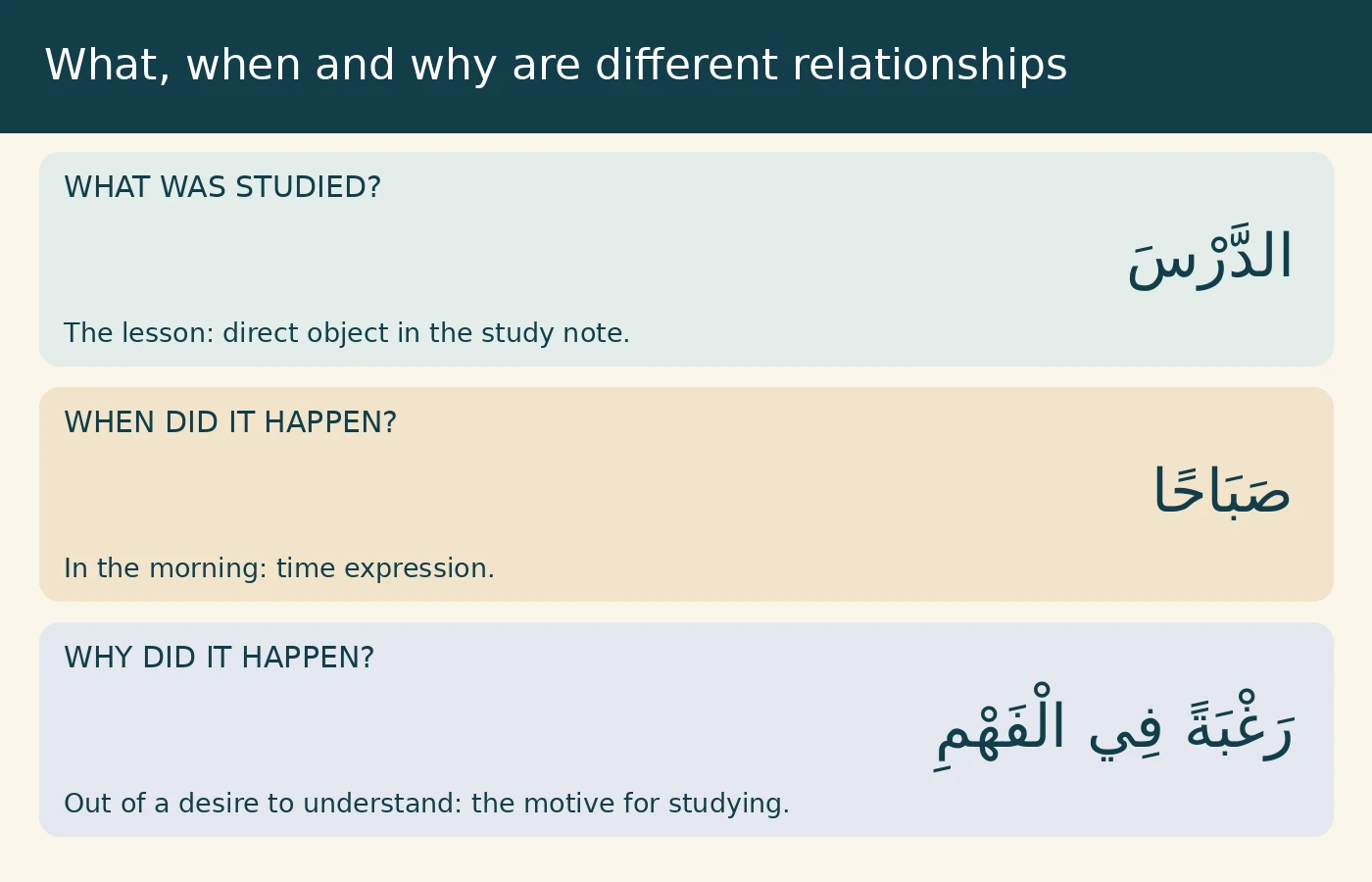
Compare three composed sentences: قَرَأْتُ الدَّرْسَ, “I read the lesson”; قَرَأْتُ صَبَاحًا, “I read in the morning”; and دَرَسْتُ رَغْبَةً فِي الْفَهْمِ, “I studied out of a desire to understand.” The lesson is what was read. The morning gives a time. The desire explains why the studying happened.
The target nouns can all be accusative, yet their relationships differ. A final -an does not mean “purpose” any more than it always means “object.” The case-ending guide separates case from its visible marker. The adverbial-expression lesson distinguishes time, place and state information.
Try paraphrasing each addition without a technical label: “the thing read,” “when the reading happened,” and “the motive for studying.” If your explanation does not match the whole sentence, do not rescue it by pointing to the ending. The grammatical name should summarize an understood relationship rather than replace one.
A reason can be fear, not only a planned goal
The English label “purpose” may suggest a future goal deliberately planned in advance. The Arabic construction can also express a motive or cause such as fear, respect or desire. That is why asking only “What did the speaker intend to achieve later?” can be too narrow.
In the composed sentence ابْتَعَدْتُ خَوْفًا مِنَ الْخَطَرِ, “I moved away out of fear of the danger,” خَوْفًا explains the motive for moving away. The danger is introduced within the fear phrase. The sentence does not say that the speaker successfully eliminated the danger; it states a reason for the action.
Distinguish a motive from an observed result. A student can study out of a desire to understand without the sentence asserting that complete understanding was achieved. Translate what the reason expression actually says. Do not turn an intention or motive into a guaranteed outcome simply because an English “to” phrase sounds natural.
A preposition can express a closely related reason
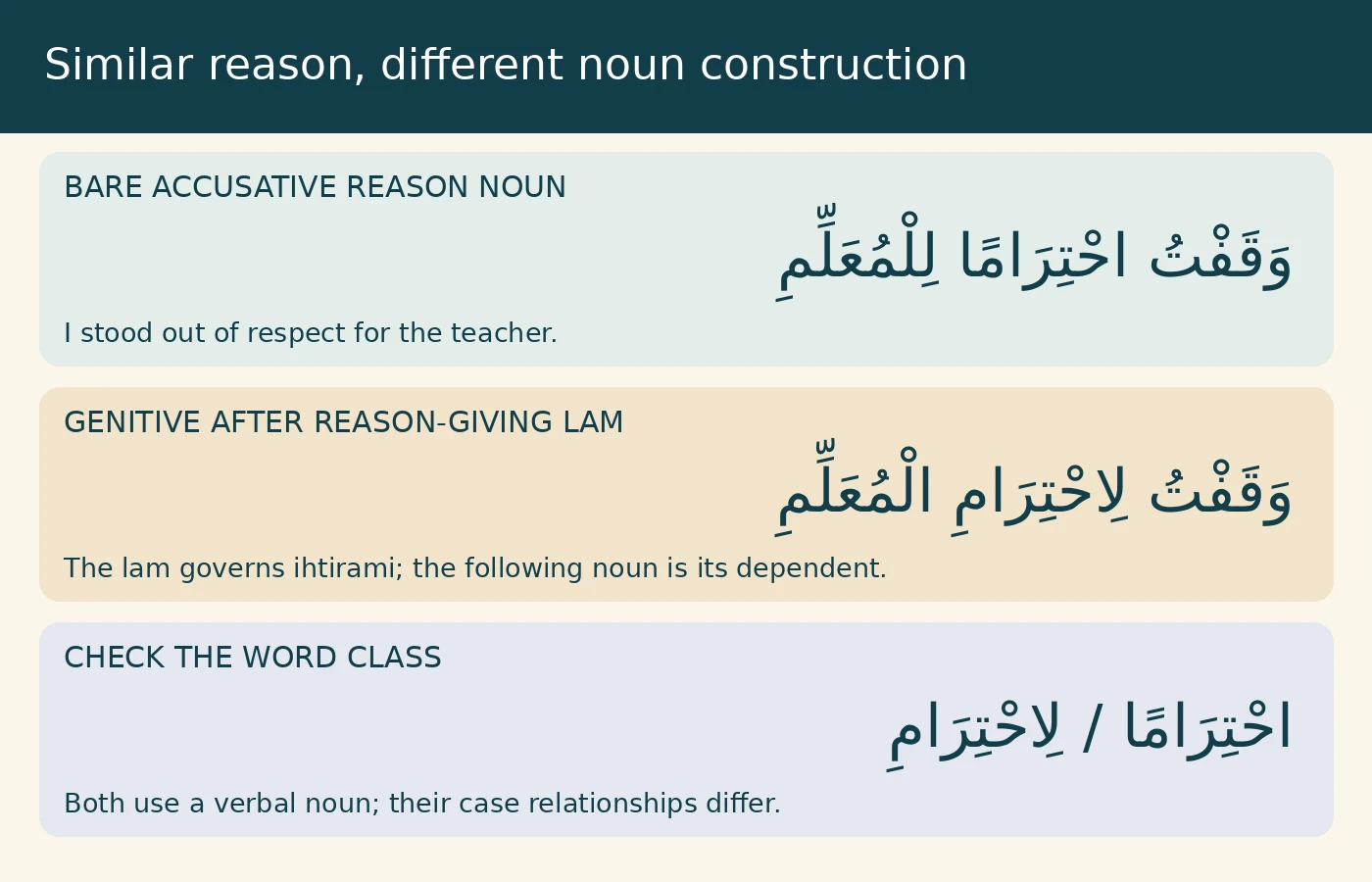
Compare وَقَفْتُ احْتِرَامًا لِلْمُعَلِّمِ with وَقَفْتُ لِاحْتِرَامِ الْمُعَلِّمِ. In a suitable context, both can communicate standing out of respect for the teacher. The first has a bare accusative reason noun; the second has lām followed by a genitive noun phrase. Similar meaning does not create identical word-by-word grammar.
In the second version, احْتِرَامِ is genitive after the reason-giving lām, and الْمُعَلِّمِ is the dependent of the masdar in idafa. In the first, احْتِرَامًا is accusative and the teacher is introduced by لِـ. Inspect the whole construction rather than moving a preposition while leaving every ending unchanged.
The preposition guide provides the genitive relationship. This comparison is useful in editing formal Arabic: if you choose a prepositional version, build that version consistently. Do not leave the noun accusative merely because the earlier sentence expressed the same motive without a preposition.
Why “it answers why” is not the entire rule
Many different Arabic structures can answer a reason question. A prepositional phrase, a clause introduced by a causal expression, and a bare accusative verbal noun can all contribute an explanation. They should not all receive the same syntactic label simply because an English translation begins with “because.”
The traditional bare-noun construction has conditions. Introductory teaching commonly uses a suitable motive-denoting masdar whose experiencer or actor and time are connected with those of the main action. Do not turn any two unrelated events into an accusative reason phrase. When the relationship falls outside the pattern you have learned, a properly formed prepositional or clausal expression may be needed.
This lesson does not attempt to resolve every advanced condition or disputed parse. For a new sentence, identify the main actor, the proposed motive, and how they relate. If they belong to different people or different times, make that a specific question for your teacher. A clear question about the relationship is more useful than guessing an accusative ending from an English paraphrase.
The learner’s explanation: what, when, how and why
Build a fictional study note from four cards. The first names an action: دَرَسْتُ, “I studied.” The second identifies what was studied: الدَّرْسَ, “the lesson.” The third provides time: صَبَاحًا, “in the morning.” The fourth gives the motive: رَغْبَةً فِي الْفَهْمِ, “out of a desire to understand.”
Combine them as دَرَسْتُ الدَّرْسَ صَبَاحًا رَغْبَةً فِي الْفَهْمِ. This composed sentence is intentionally explicit so that you can assign each addition a separate job. The direct object, time expression and reason expression do not compete to be one grammatical category. Each contributes a different kind of information about the same study event.
Use the verbal-sentence lesson to identify the action and object first. Use Arabic question words to ask what information each card supplies. Then remove one card and state exactly what information the shortened sentence no longer gives.
Contrast a purpose noun with a purpose verb clause
In دَرَسْتُ لِأَفْهَمَ, “I studied in order to understand,” the lām is followed by an imperfect verb in a purpose construction. This is not the same word class as رَغْبَةً in the earlier example. The two versions can express related intentions, but one contains a verbal clause and the other a noun-based motive expression.
The subjunctive and jussive lesson explains why the imperfect ending needs attention after relevant governors. Do not give the verb a noun-case analysis because the phrase answers “why.” Conversely, do not call every masdar a finite verb merely because it names an action.
For a translation exercise, compare “out of a desire to understand” with “in order to understand.” State the nuance you intend, then choose a complete Arabic construction. A word-for-word swap can preserve a dictionary meaning while breaking the grammar or shifting the intended reason.
Quran reading: a documented purpose noun
Quran 80:32 includes مَتَاعًا لَكُمْ وَلِأَنْعَامِكُمْ. The Quranic Arabic Corpus documentation on the accusative of purpose uses مَتَاعًا in this verse as its example. The noun expresses provision in relation to the preceding passage’s actions and descriptions.
Read the full preceding verses, rather than treating the three-word phrase as an independent sentence. The example shows that the governing relationship may require looking beyond the nearest word. A word-by-word glossary helps with vocabulary, but a syntactic explanation must identify how the phrase connects to the larger passage.
When noting the example, write the source’s analysis and its scope accurately. You are learning a documented grammatical relation, not claiming that this brief language lesson supplies every interpretive detail. A reliable translation and tafsir provide the broader context for Quran study.
Repair three reason-giving explanations
First, diagnose “رَغْبَةً is the direct object because it follows دَرَسْتُ.” That ignores what the noun contributes: it states the motive, while الدَّرْسَ is the object in the expanded study note. Second, diagnose “صَبَاحًا explains why.” It supplies time, not motive. Third, diagnose “Adding lām never changes the following word’s analysis.” A preposition governs genitive case on a noun, so the construction must be reanalyzed.
Now cover the technical labels and sort four English cards: “the lesson,” “in the morning,” “out of respect,” and “while tired.” Explain the semantic difference before assigning any Arabic role. This prevents the same ending from swallowing the distinctions among object, time, motive and state.
For a final composed writing task, give two explanations of why a fictional learner attended a lesson. Use a noun-based reason in one version and a purpose clause in the other. Keep the main action constant. Ask a teacher to check the form, the governing relationship, and whether the intended actor remains clear in both versions.
Two study notes with the same action but different motives
Suppose two fictional learners both review a lesson. One is motivated by a desire for understanding; the other is worried about forgetting. The action “reviewed” alone cannot tell you which motive belongs to which learner. Supply the motive explicitly in your exercise, then check that the reason expression connects to the intended person’s action. This makes the grammar task depend on information actually present in the story.
For each note, answer two questions: what does the sentence assert happened, and what reason does it give? Keep a third question separate: did the reviewing achieve the intended result? Unless the text supplies that result, leave it unanswered. This three-part record is useful when reading biographies, personal statements and narrative passages, where motivations and outcomes are easy to blur in translation.
Now remove the motive phrase and exchange the notes with a partner. Ask whether the partner can recover the motive from the remaining words. Usually the shorter sentence will not provide enough information. That shows why the reason expression is valuable: it contributes something the action verb alone does not state. Restore the phrase and identify its exact grammatical connection rather than treating it as a decorative extra.
Use the reason accurately, without overclaiming it
A grammatical reason expression reports a motive within the sentence; it does not independently prove that the motive is sincere or that a goal was achieved. In a fictional exercise you can assign the motive explicitly. In real writing, do not invent someone’s intentions merely to make a grammar example sound persuasive.
A neutral further reference is Al Jazeera Learning Arabic’s comparison of objects and cause complements. Its terminology supports the noun-based reason versus prepositional distinction used here. The study cards and revised classroom sentences are original exercises for applying that distinction.
To work through your own examples, Book a Free Trial Class. Bring one sentence where you can identify the action but cannot tell whether the next expression states what happened, when it happened, or why. That is a focused problem a teacher can help you resolve through meaning and syntax together.