
How to Read Handwritten Arabic: Letter Shapes, Connections, and Common Shortcuts
Learning how to read handwritten Arabic is different from recognizing a clean word in a printed lesson. In a note, correction, label, or quick message, familiar letters may be compressed, joined in unexpected ways, or written with faint dots. Do not guess what the writer intended. Identify the visible clues, compare them with Arabic spelling patterns you know, and use context only after checking the letters.
This guide gives you a repeatable method for reading short words and labels. Handwriting is personal; some writing is simply unclear, and a careful reader should be willing to mark a word as uncertain.
Why handwritten Arabic can look unfamiliar
Arabic is cursive even in print: letters may connect to neighbors, and their shapes can change by position. The Unicode Standard’s Arabic-script section explains that the underlying letter identity remains the same when its contextual shape changes. Distinguish the letter from the stroke pattern any one writer uses.
Printed Arabic usually presents consonant letters more consistently than a quick note. Short-vowel marks may be absent; dots can be faint, close to a stroke, or affected by pen movement. A missing-looking dot is not proof that the letter changed. Review the basics of Arabic letters and their dots, then compare them with the different letter forms inside Arabic words.
Do not treat handwriting as one uniform style. People write at different speeds, use different pens, and develop personal habits. Calligraphic examples can show how strokes flow, but everyday notes may be less regular. Practice should make you observant, not teach you to expect one universal handwritten alphabet.
A six-step method for reading handwritten Arabic
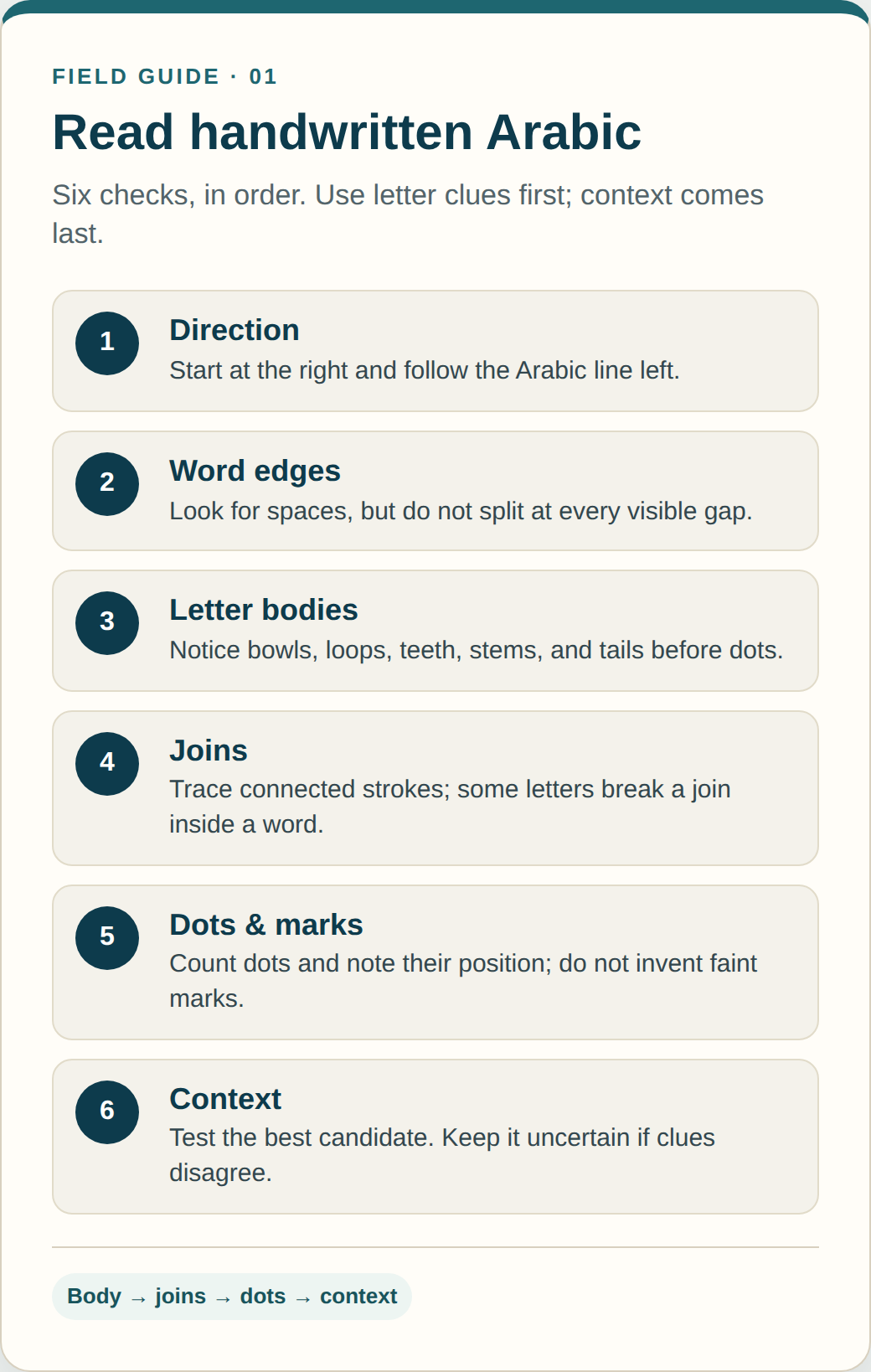
- Set the direction. Begin at the right and move left. If a note mixes Arabic with numbers, English words, or arrows, first isolate the Arabic segment so you do not reverse its letter order.
- Mark possible word boundaries. Look for gaps, pen-pressure changes, and natural breaks. A long stroke may span several letters; a pause may be a space or just a change in rhythm. Keep two segmentations in mind if spacing is unclear.
- Find the stable letter bodies. Ignore dots briefly and note the main bodies: a bowl, loop, short tooth, vertical stroke, or tail. Compare each likely position—beginning, middle, or end—with a printed reference.
- Trace where the line joins. Follow the pen path from right to left and note connections and breaks. Some letters do not join forward, so a gap does not necessarily mean a new word. For more examples, see Quranytime’s guide to split and joined Arabic words.
- Check dots and marks separately. Count visible dots and note whether they sit above or below. ب، ت، ث share a related body but differ by one dot below, two above, or three above; ج، ح، خ make another useful comparison. Short-vowel marks are often omitted, so check them only when written. See how to read Arabic without vowels for more practice.
- Test a candidate in context. Ask whether the letters form a plausible word and whether it fits the phrase or situation. Context can help choose between readings, but should not erase a contradictory dot or stroke. If unsure, record alternatives or ask the writer.
Use dots as evidence, not as a shortcut
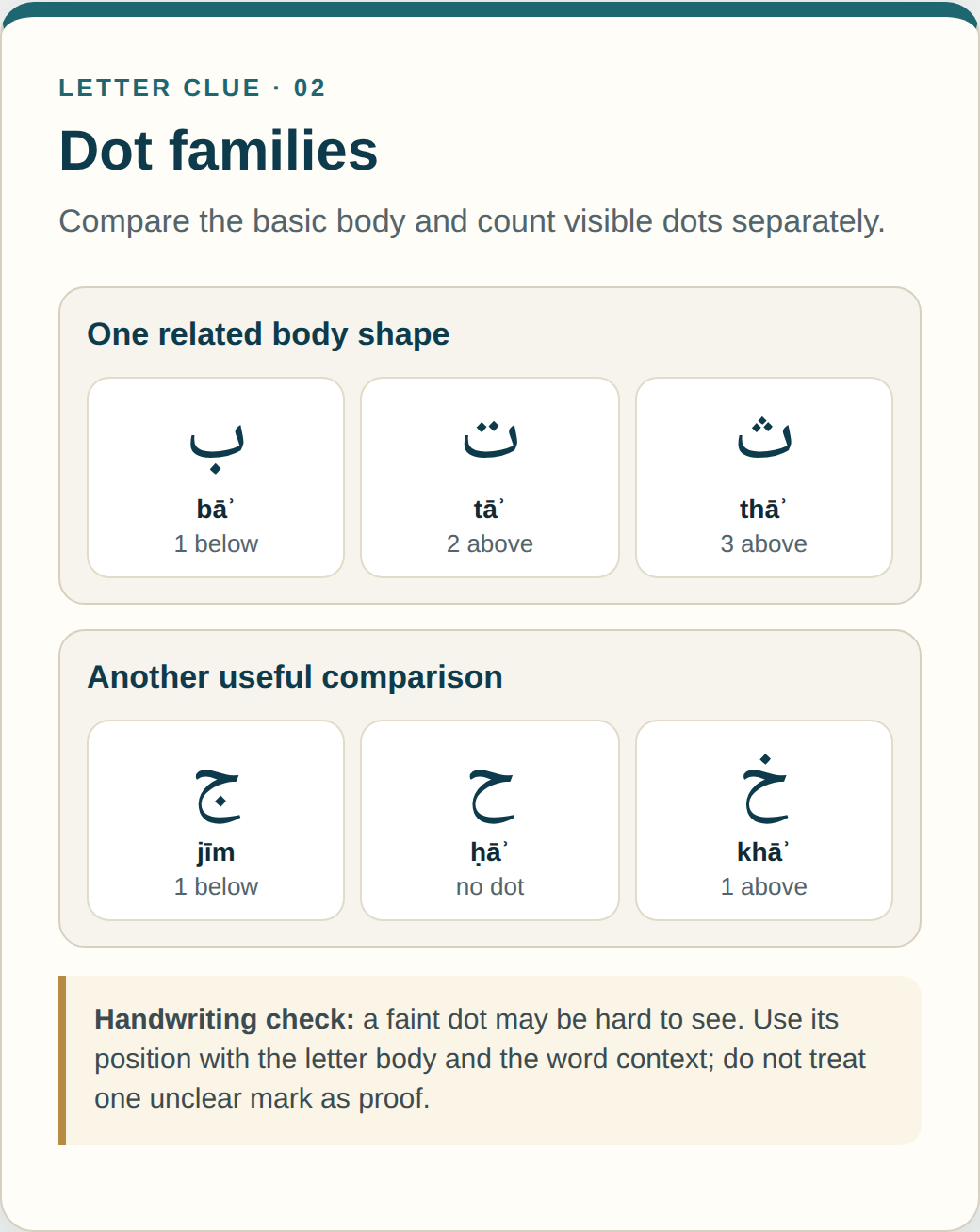
Many Arabic letters are easier to compare when you separate the body from the dots. In a printed chart, the differences look obvious. In a quick note, dots may be faint, touch a nearby line, or sit farther from the body than expected. Read the body and dots as separate clues, then check whether they agree.
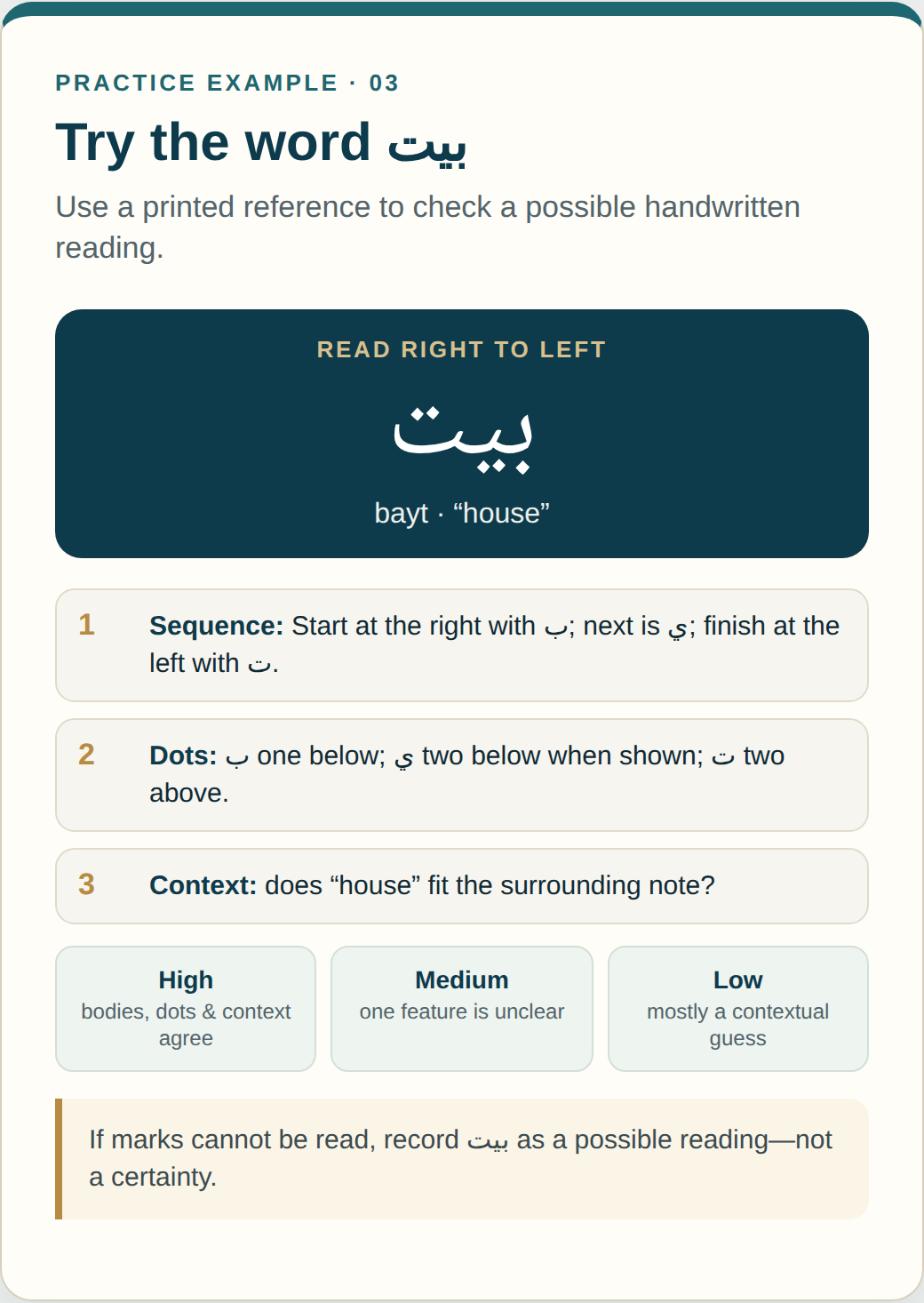
Try the word بيت (bayt, “house”). In clear print, its sequence is ب + ي + ت: ب has one dot below, ت has two dots above, and ي is distinguished by two dots below when fully pointed. If a handwritten sample might be بيت, do not decide from the outline alone. Check the sequence and dot pattern, then ask whether “house” fits the note. If the dots cannot be read, call it a possible reading, not a certainty.
Dots are not the only clue. The joining line, a short vertical stroke, a terminal tail, and the relative length of neighboring letters can help. Yet writers may shorten or merge strokes. Avoid rules such as “this letter always looks like this.” Keep a small personal reference of forms you have actually seen from a particular writer.
Practice with short, checkable samples
Start with a printed word beside a handwritten version of the same word. Cover the printed form, try reading the handwritten one, and then compare. Circle the bodies, mark the joins, and count the dots. This is more useful than copying a page without checking whether you understood it.
Next, use short labels whose meanings you already know: a room name, familiar place, or common item. Record the writer and any uncertainty. Typing Arabic on an English keyboard can help you prepare a clean comparison line; then write that phrase by hand. A beginner-friendly Arabic dictation exercise can connect what you hear, spell, and see.
When you move to real-world materials, decode short sections rather than a full page at once. A printed public notice offers familiar formats and repeated vocabulary; see how to read Arabic public notices for useful preparation. If a teacher marks a correction, compare it with the printed lesson rather than treating either as a perfect model. Quranytime’s guide to improving Arabic writing skills covers the production side, while this guide focuses on reading what someone else wrote.
How to narrow an uncertain word
When two readings seem possible, compare other words by the same writer on the same page. People often repeat the shape of a bowl, the angle of a dot, or the length of a final stroke. A repeated letter in a known word may be a better guide than a printed chart. Use that pattern only for this writer; another hand can form the same letter differently.
Check whether a gap is a real word boundary. Some Arabic letters do not connect forward to the next letter, so a visible break can occur inside one word. Compare the sequence with a printed spelling before inserting a space. If an unfamiliar stroke is unclear, draw two candidate boundaries, read each from right to left, and see which produces the more plausible letter sequence—not just the more convenient translation.
Use a gradual practice ladder: first compare single printed words with known handwritten forms; next hide the printed copy and transcribe a short phrase; finally try an unfamiliar note. For every sample, record the original, your candidate reading, which body or dot supports it, and a confidence mark. This turns practice into evidence you can review later.
Do not begin with the hardest sample. Choose a line with a known topic, one or two words, and repeated letters. Practice the same sample twice: first record what the letter forms suggest without context; then read the surrounding phrase and see whether it confirms or changes your candidate. This keeps context from controlling your first impression and shows where it actually helps.
Common mistakes to avoid
- Reading from left to right. Arabic normally runs right to left, even in a mixed line.
- Guessing from the topic alone. Context is a final check, not permission to ignore the letters.
- Counting a faint dot as absent. Check ink quality and nearby marks before deciding.
- Expecting every mark. Short vowels may be omitted in ordinary writing.
- Assuming a textbook form. Personal handwriting varies; verify a spelling rather than imposing one drawing rule.
- Turning a possible reading into a fact. Preserve two plausible candidates until you can check the original or ask the writer.
What if you are still unsure?
Use a simple confidence scale. Mark a reading “high” when bodies, joins, and dots agree and the word fits. Mark it “medium” when one feature is unclear but the others support a candidate. Mark it “low” when the reading depends mainly on context. Keep the original beside your transcription so another reader can review the same clues.
If you are reading a personal message, ask the writer rather than silently correcting it. For a study note, compare the phrase with a trusted printed source and keep the handwriting separate from your interpretation. A teacher can help you distinguish a letter-form question from a spelling or vocabulary question. For guided feedback, you can book a free Quran and Arabic trial class.
A visual look at Arabic strokes
The video below profiles calligrapher Taha Al-Hiti writing Arabic characters and words with traditional tools. It is a calligraphy demonstration, not a lesson on everyday notes; use it to observe how strokes and connections shape letters.
Read what the marks support
To learn how to read handwritten Arabic, move from line direction to letter bodies, connections, dots, and only then context. Keep a possible reading separate from a confirmed one, especially when the writing is rushed or marks are faint. With short, checked practice, you can become more accurate—and more confident about when not to guess.