
Arabic dictation asks you to travel from sound to writing without seeing the answer first. That is a different task from copying a line neatly or recognizing a word on a flashcard. A learner can have attractive handwriting and still omit long-vowel letters when listening, or read a word comfortably but struggle to decide where one spoken word ends and the next begins.
This workshop gives you a controlled way to diagnose those difficulties. It uses short, checked Modern Standard Arabic examples, not Quranic dictation. Quranic orthography has its own conventions and should be learned from a reliable mushaf with appropriate instruction. Here the goal is a small set of everyday words and sentences that you can hear, write, explain, and correct.
Find out what you are actually testing
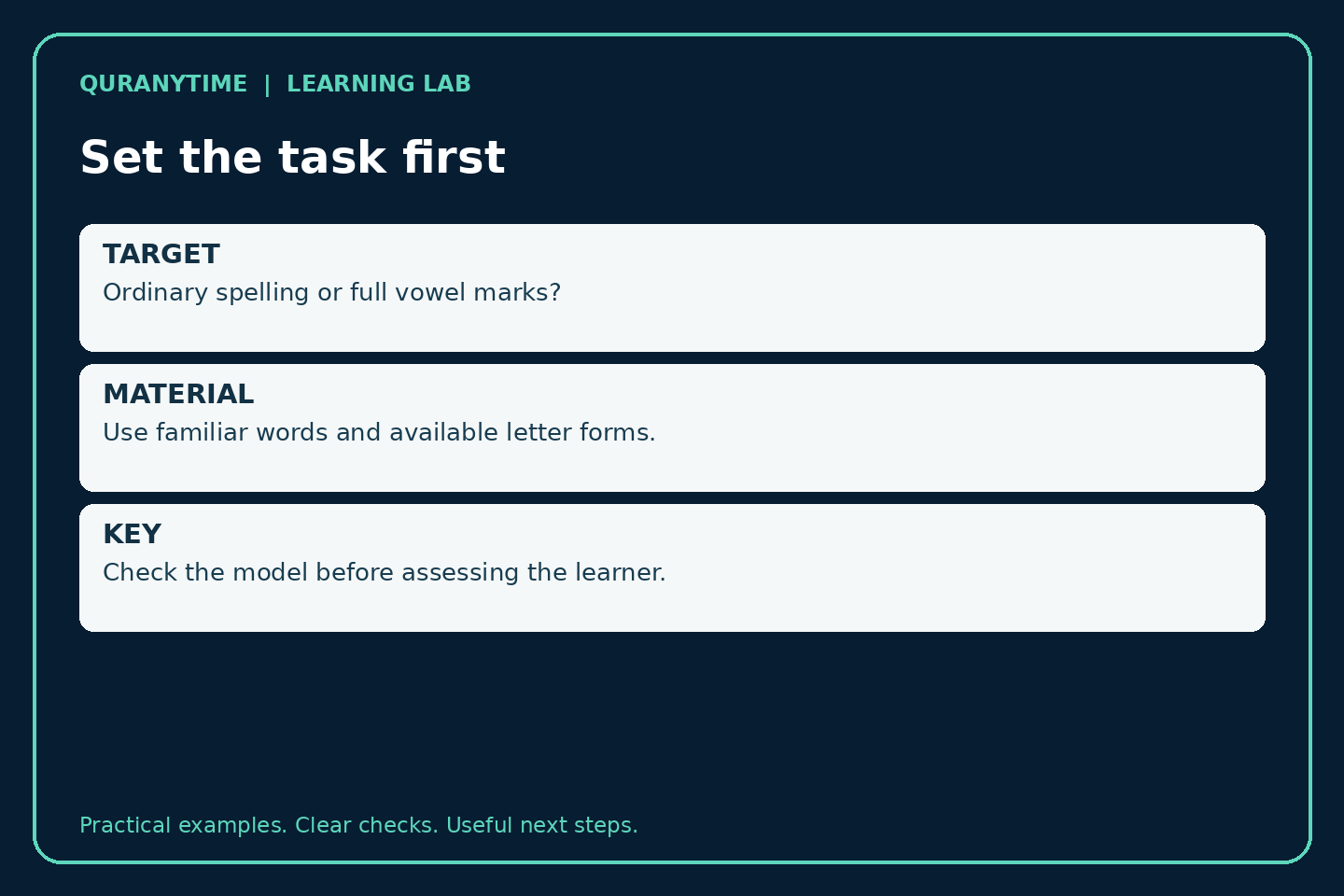
Before dictation, decide whether the learner is expected to write consonants only, ordinary unvowelled spelling, or full vowel marks. These are different tasks. A child who writes a correctly spelled unvowelled word has not failed merely because an adult silently expected all harakat. State the target before reading the first item.
For a beginner, separate spelling from penmanship. Accept readable handwriting even if the proportions are imperfect, then address letter formation in a different short activity. If you correct the sound choice, letter shape, spacing, vowel marks, and speed simultaneously, the learner may not know what to change next.
For this workshop, begin with our Arabic letter forms in words, which supports joining and position changes. Dictation should use words whose component letters the learner can already form.
Stage one: hear a contrast before writing it
Use two familiar words with a meaningful sound contrast. For short and long vowels, compare مَلِك — king — and مَالِك — owner. The second contains an alif after meem; the first does not. Listen with a teacher who can pronounce the examples clearly. Transliteration alone is insufficient for judging vowel length.
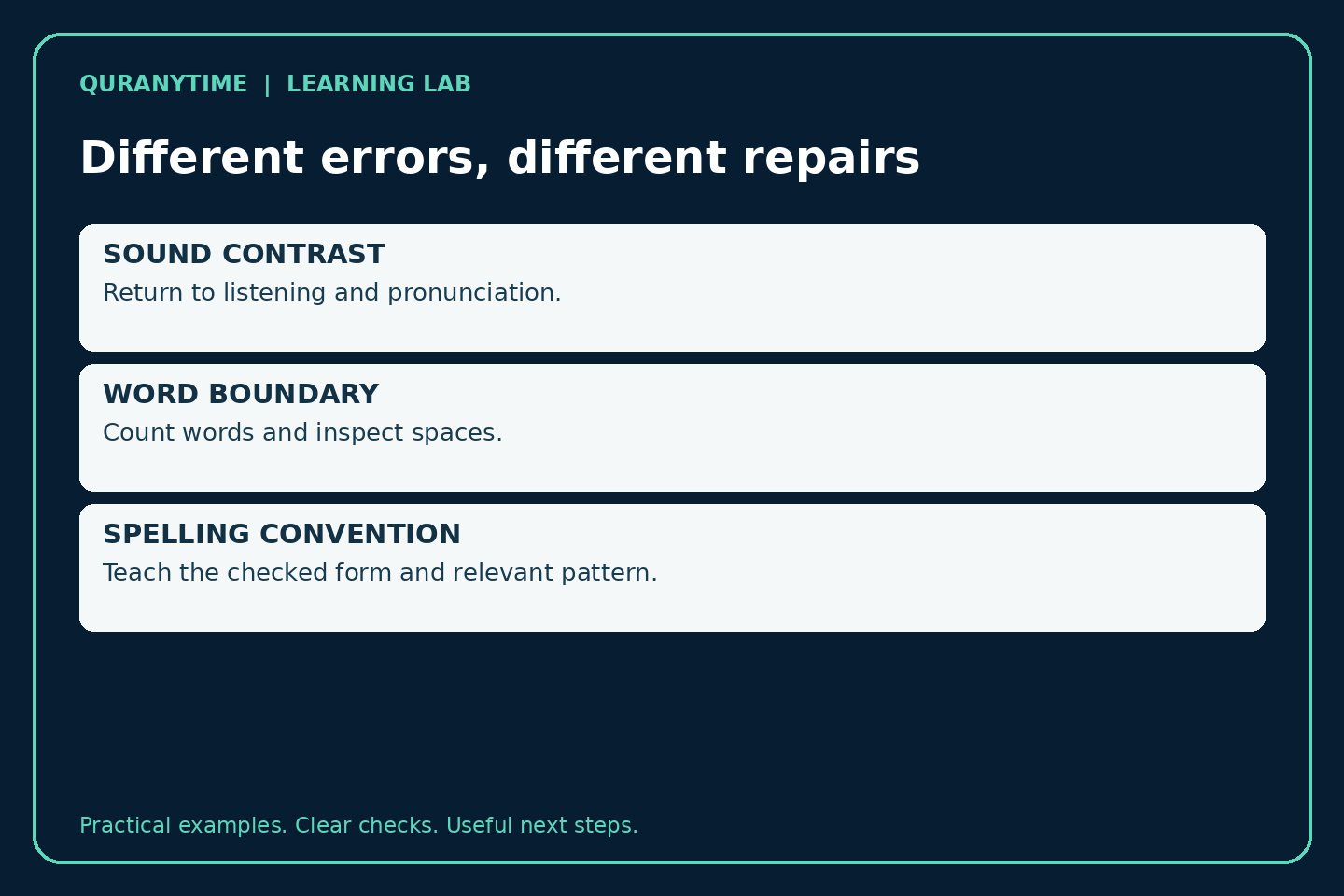
First ask the learner to point to the word they hear. Next, ask them to say which sound differed. Only then cover the models and ask for writing. If the pointing stage is unreliable, more handwriting will not repair the listening distinction. Return to listening and production before making the spelling task longer.
Our short and long Arabic vowels lesson explains the distinction, and our harakat guide supports the short-vowel symbols. Do not teach that every long sound can be solved by “adding an alif.” Arabic uses different long-vowel letters and has spelling conventions beyond one beginner pattern.
A tightly controlled first set
Use كَتَبَ — he wrote; كِتَاب — book; بَاب — door; بَيْت — house. Read each with its intended pronunciation, and agree whether to write the vowel marks. If the goal is ordinary word spelling, the answers are كتب، كتاب، باب، بيت. If the goal is a fully marked exercise, the teacher must specify the exact form being assessed.
Read the word once naturally, once slowly without distorting its sounds, and once naturally again. Avoid splitting every word into exaggerated letter names. That changes dictation into an oral spelling test. Letter naming can be a useful repair activity afterward, but it should not replace listening to the word.
Stage two: keep the word boundary visible
A learner may hear a short sentence as one stream. Start with three familiar words: هذا كتاب جديد — This is a new book. Ask the learner to repeat the meaning, then tap once for each word before writing. The target is three written words, with joining inside each word and spaces between them.
Do not use tapping as a rigid rule for syllables; in this exercise the taps represent words. Explain that distinction. A word can have several syllables but still occupy one word space. After writing, count the words again and compare the boundaries against the model.
Our Arabic nominal-sentence lesson helps a learner understand this example. Understanding meaning reduces the temptation to treat the sentence as an arbitrary noise string. However, do not assume meaning alone guarantees accurate spelling; check the actual letters.
Stage three: distinguish a sound problem from a spelling convention
Some mistakes occur because the learner did not hear a sound. Others occur because Arabic spelling cannot be predicted from the final sound alone. Taa marbuta is an important example: a learner may hear a paused word and choose ه where standard spelling needs ة. The correction needs an explanation, not simply “listen harder.”
Use a small familiar set such as مدرسة — school — and غرفة — room. Discuss the word’s written form, then practise it in a meaningful phrase. Our taa marbuta guide offers more context. Do not infer a universal rule from two examples; collect reliable words and ask about their morphology as your level develops.
Hamza spelling introduces another set of conventions. If the exercise is about vowel length, avoid filling the list with unfamiliar hamza decisions. Teach one challenge at a time. Our hamza spelling lesson can support a later targeted session rather than turning every dictation into an examination of the entire writing system.
Use an error map instead of one red score
Label each mistake with a simple category: missing sound letter, wrong letter, extra letter, word boundary, joining, or spelling convention. If vowel marks were required, add a separate category for them. A single score such as six out of ten tells you less than a pattern showing that all four errors involved omitted long vowels.
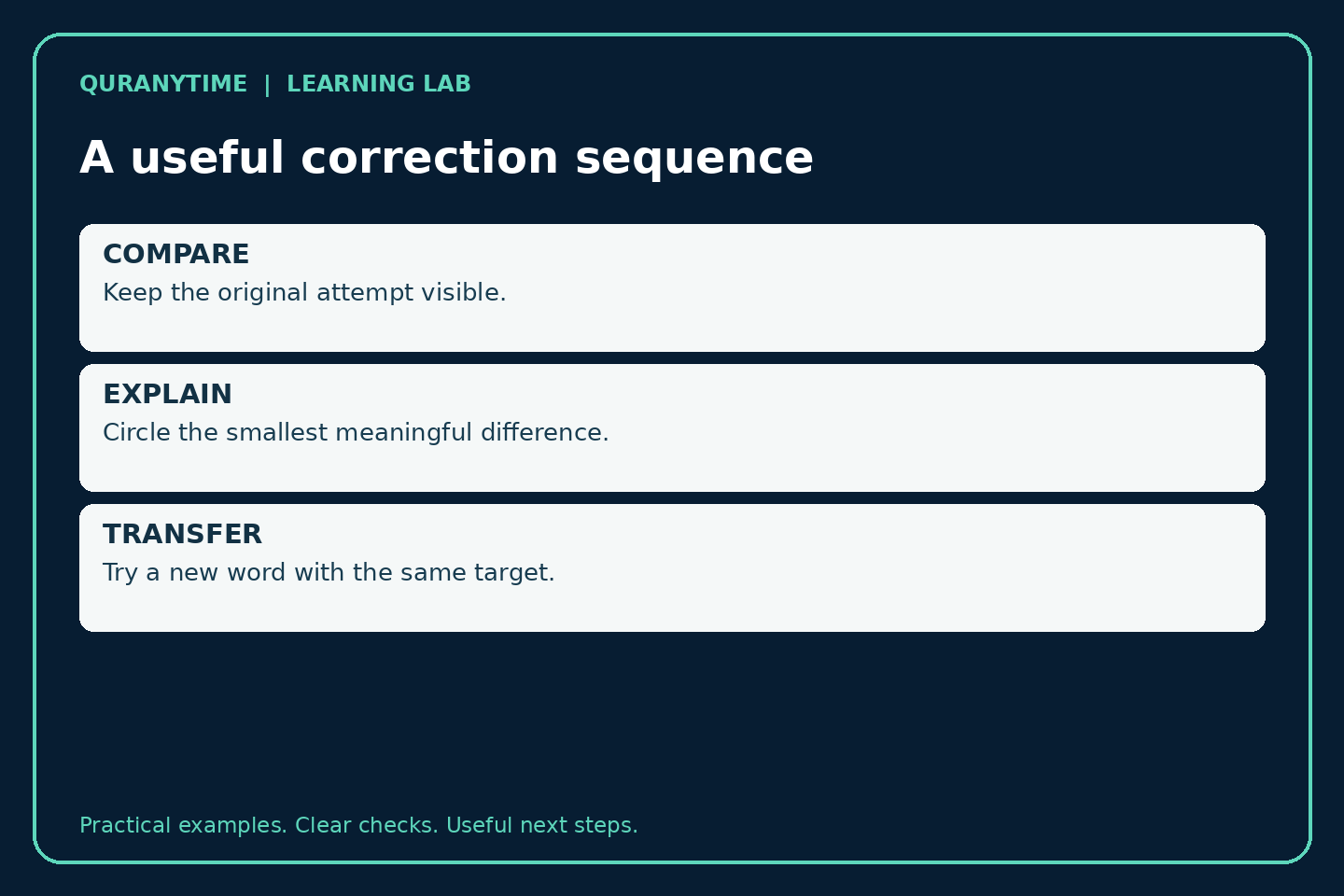
Write the intended word beside the learner’s attempt, then ask the learner to identify the smallest meaningful difference. For كتاب written as كتب in this task, the missing alif is a useful focus. Do not ask the learner to copy the whole word twenty times without first identifying what was missed.
Next, practise one fresh word with the same challenge and one old word as a check. This shows whether the correction transfers. Repeating the original answer immediately can reflect short-term visual memory rather than improved listening or spelling. Both can contribute to learning, but they should not be confused.
A short dictation lesson from beginning to end
Begin with two minutes of oral review using four known words. Check meanings and pronunciation. Spend three minutes on a contrast, such as a short versus long vowel, with the words visible. Then cover the words and dictate a small mixed set. Keep the total short enough that the learner can still discuss the corrections attentively.
After writing, show the answer key and compare one item at a time. Ask “What did you hear?” before “Why did you write that?” The first question can reveal an unclear model or an unfamiliar word. If the teacher’s reading was ambiguous, repeat it clearly and do not treat the resulting correction as evidence of a learner failure.
Finish with one transfer sentence using familiar material. The purpose is to check whether the learner can manage the target inside a meaningful line. A child who succeeds with isolated words but loses spaces in a sentence needs boundary work, not a longer isolated-word list.
An answerable practice set
Ask a teacher or proficient speaker to read these while the learner keeps this page hidden:
- باب — door.
- كتاب — book.
- هذا بيت. — This is a house.
- هذا كتاب جديد. — This is a new book.
- في البيت كتاب. — There is a book in the house.
For ordinary spelling, the models above are the answers; punctuation may be taught as a separate target. If you require vowel marks or case endings, have the teacher provide and explain a checked key before the exercise. Do not add uncertain endings afterward and score the learner against them.
Make home practice supportive
A parent does not need to turn every mistake into a lesson immediately. Mark one target, acknowledge what was accurately written, and schedule a brief follow-up. If the child is tired or upset, stop the exercise and return later. A useful session ends with one understandable correction, not a page full of unexplained marks.
Avoid dictating an unfamiliar word and then treating its misspelling as proof that the child did not listen. Preteach the meaning and pronunciation when the target is spelling a known pattern. An occasional unfamiliar word can be a deliberate challenge at a suitable level, but it should be labeled as such.
For adults, a voice recording can make practice convenient if the speaker agrees. Keep the answer key separate from the audio. On the first pass, write without pausing every syllable; on the second, check uncertain sections; then compare with the key. Our Arabic listening practice guide can help structure that listening component.
Keep the answer key honest
An answer key should match the announced task. If you dictated ordinary spelling, do not later deduct points for omitted case endings that were never requested. If you dictated a fully marked sentence, check the complete model with a teacher before using it. An uncertain key teaches confusion with the authority of a correction.
Let the learner compare one item while the original attempt remains visible. Ask them to circle the smallest difference and explain it. Then cover both versions and try a fresh example of the same target. This sequence separates noticing, understanding, and independent application. Copying the correct version once can be useful, but it does not demonstrate all three.
Keep teacher reading speed reasonably consistent across comparable attempts. If the second session uses much slower speech and extra repetitions, record that support. The learner may still be making progress, but the conditions changed. Honest records help you choose the next exercise and avoid declaring a problem solved merely because the task became easier.
Know when to change the task
If a learner cannot form the letters, return briefly to visible models and joining. If the letters are available but short and long vowels are consistently confused, train the auditory contrast. If pronunciation is understood but conventional spelling is uncertain, teach the relevant word pattern. If performance drops only in long sentences, reduce memory load before adding new spelling rules.
Keyboard dictation is another possible task, but it adds key-location demands. Use our Arabic keyboard guide and practise typing known words before combining it with fast listening. Comparing handwritten and typed responses can reveal whether the bottleneck is spelling or input speed.
Keep a weekly record with three entries: the target, one representative error, and a fresh successful example. Review that record before choosing the next list. This keeps dictation purposeful and prevents the repetitive cycle of random words, a disappointing score, and no clear next step.
For a guided diagnosis, Book a Free Trial Class and bring a short sample of writing from dictation. Explain how the words were read and whether vowel marks were expected. With that context, a teacher can choose a focused next activity instead of guessing what the mistakes mean.