
If you have ever looked at a joined Arabic word and wondered where one part ends and another begins, you are not alone. Learning how to split joined Arabic words in the Quran means reading a word’s structure—not putting new spaces into the Quranic text. One written token can contain a connector, a verb or noun, and one or more attached pronouns. Learn to label those pieces, then verify them instead of guessing from the first or last letter.
This guide uses a repeatable method: preserve the printed form, identify possible prefixes and suffixes, locate the stem, and check the parts against the whole phrase. The goal is grammatical reading, not a new spelling or an independent interpretation of the verse.
If you searched for “split joined Arabic words in Quran,” you are looking for a way to see how a token is built while keeping the written form intact.
What does it mean to split a joined Arabic word?
“Split” can mean two different things. In ordinary writing, Arabic words are separated by spaces. In morphology, one written token may be analyzed as smaller grammatical segments, even when those parts remain joined. You can mark boundaries mentally or in study notes; do not copy those marks into the Quran text as extra spaces.
Keep three layers separate. The written token is what appears between spaces. A morphological segment is a grammatical part identified by analysis. The stem is the central part to which prefixes or suffixes may attach. Some tokens have no attached segments; others have several. Arabic letters also change shape by position, so a connection in writing is not by itself a boundary clue. Review how Arabic letters change shape inside words if those forms are still unfamiliar.
Searchers may phrase the same problem as “Arabic word segmentation in the Quran,” “Quranic Arabic prefixes and suffixes,” or “how many parts are in an Arabic word?” These are one learning task, not separate rules. One token may be a stem alone or have several attached segments; the count refers to morphological parts, not letters, spaces, or syllables.
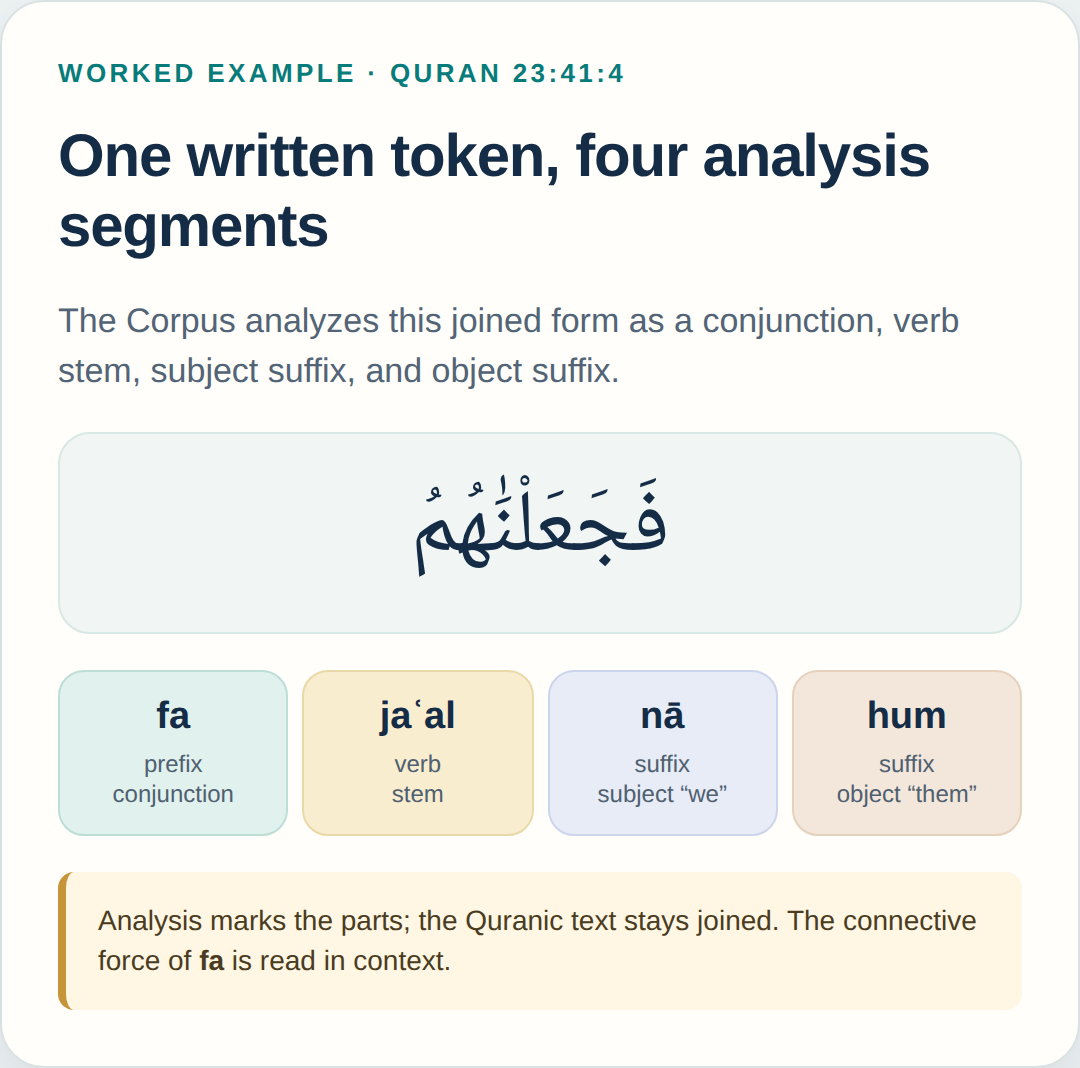
The Quranic Arabic Corpus’s Morphological Features documentation explains that segments before the stem are prefixes and those after it are suffixes. It gives the four-part example فَجَعَلْنَٰهُمُ (fajaʿalnāhum) at Quran 23:41:4, glossed as “and We made them”: prefixed fa, the verb stem jaʿal, a suffixed subject pronoun nā (“we”), and a suffixed object pronoun hum (“them”). A single token can therefore carry several grammatical roles.
A worked example: one token, four segments
Start with the written form: فَجَعَلْنَٰهُمُ. Keep its reference, 23:41:4, and do not insert spaces or translate each visible letter. The Corpus analysis lists the parts in reading order:
- fa — a prefixed conjunction. Its connective force is read in context; do not assume it always has one English equivalent.
- jaʿal — the verb stem that carries the main lexical action in this analysis.
- nā — a suffix functioning as the verb’s first-person plural subject pronoun, “we.”
- hum — a second suffix functioning as the third-person masculine plural object pronoun, “them.”
The study notation fa + jaʿal + nā + hum explains the structure; it does not replace the joined Quranic word. Both endings attach to a verb, so they are not the same as pronouns attached to a noun. The host—the kind of word a suffix attaches to—matters.
What can attach before or after a stem?
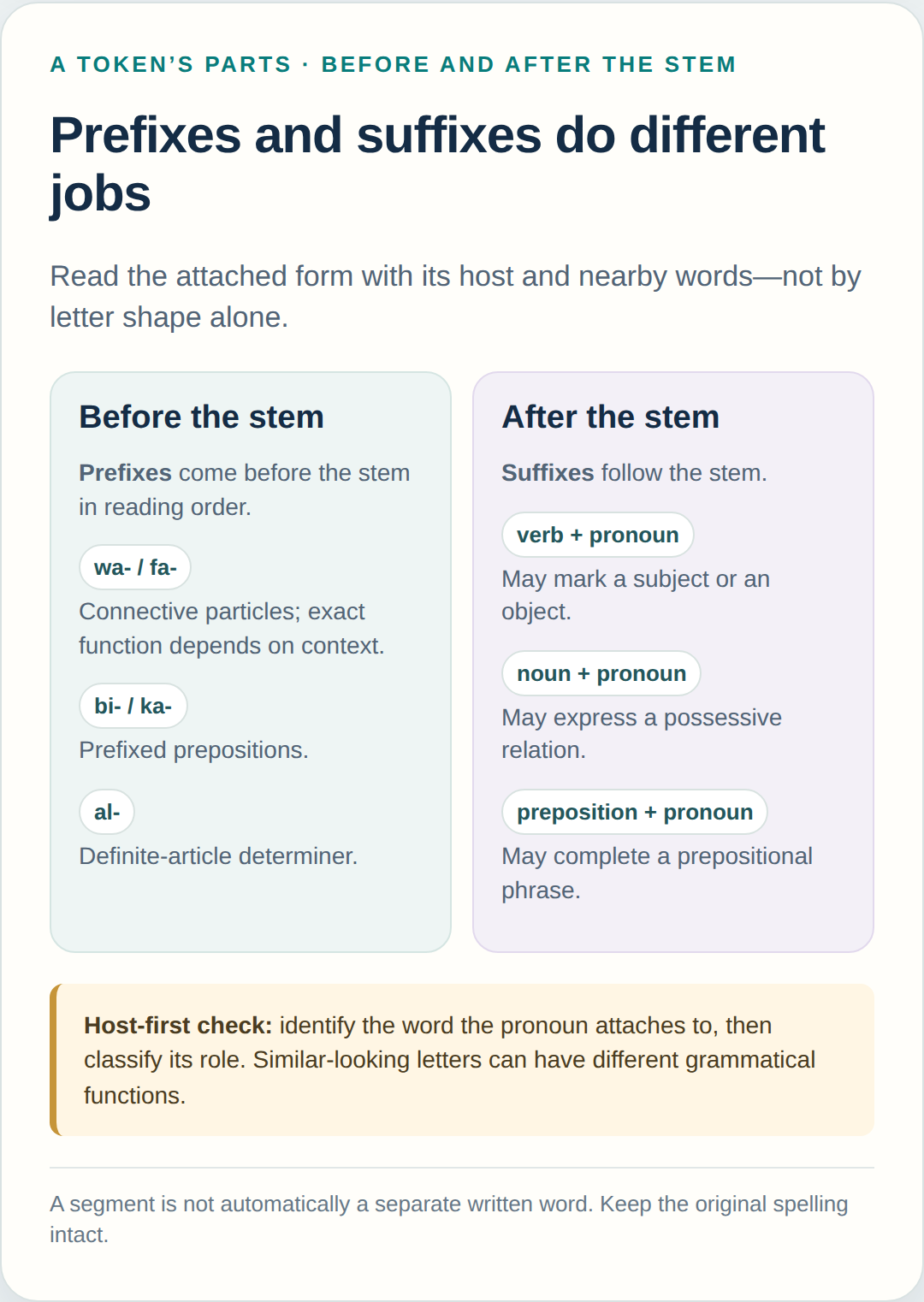
Prefixes appear before the stem in reading order. Common types include conjunctions such as wa or fa, prepositions such as bi- or ka-, and the definite-article prefix al-. The same visible letter can have more than one function: wa, for example, may be tagged as a conjunction, resumption, or oath-preposition. Treat a first-letter guess as provisional and check the phrase. Learn more about Quranic Arabic conjunctions and attached prepositions in Quranic reading.
Suffixes follow the stem. Attached pronouns can mark a subject or object on a verb, a possessive relation on a noun, or a complement after a preposition. Do not label every ending “possessive.” Identify the host, then ask what role the ending plays. Quranytime’s guide to attached pronouns and suffixes explains this host-first check; the Quranic pronoun chart reviews person, number, and gender forms.
Not every first or final letter is a segment, and not every segment can be identified by counting letters. Short vowels and other marks may guide pronunciation or grammar without creating another word. Also, do not confuse a morphological stem with a root or lemma: they describe different layers of analysis. Check the labels rather than inferring a full analysis from a rough transliteration.
A six-step method for analyzing a token
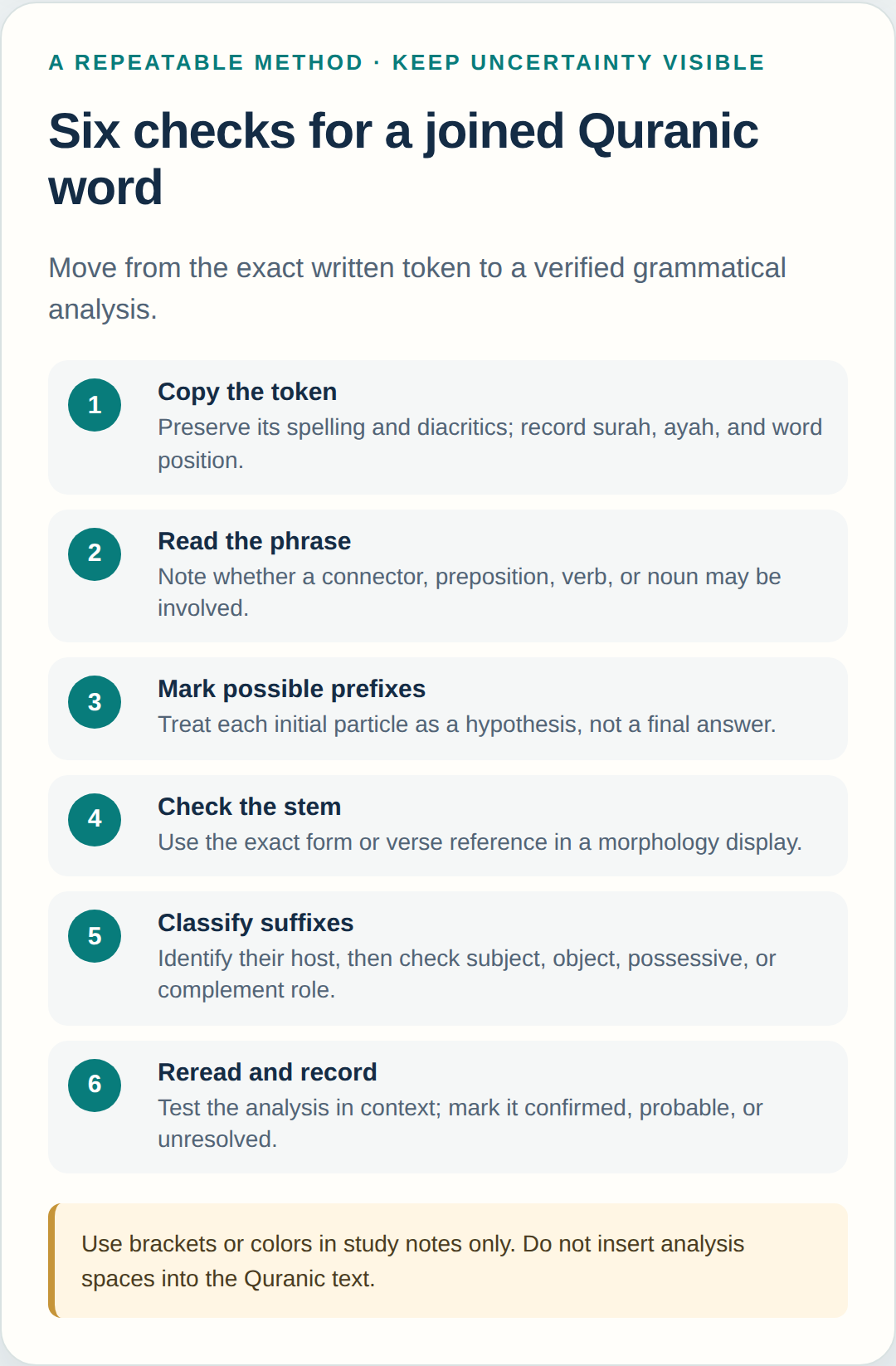
- Copy the token accurately. Keep the spelling and diacritics of your chosen mushaf or edition. Record the surah, ayah, and token position.
- Read the phrase around it. Note whether you may be looking at a connector, prepositional phrase, verb with pronouns, or noun with a suffix.
- Mark candidate prefixes. Look for a connector, preposition, or article, but treat each as a hypothesis. Two pieces may both occur before the stem.
- Find the stem in a morphology display. Search by exact form or verse reference. Check the segment order, part-of-speech tags, and features; do not guess a root from transliteration alone.
- Classify suffixes by host and job. Ask whether the host is a verb, noun, or preposition. Distinguish subject, object, possession, or complement only when the analysis supports it.
- Read the whole phrase again. Confirm that the parts fit the grammar of the verse. Mark what is confirmed and what is uncertain, and ask a teacher or consult a trusted reference if interpretation depends on it.
This conservative sequence moves from visible form to a checked grammatical hypothesis. It does not promise that a beginner can decode every word from spelling alone.
Common mistakes to avoid
- Adding spaces to the Quranic text. Boundaries belong in analysis or study notes; preserve the printed token.
- Calling the first letter a conjunction automatically. A similar prefix may be a conjunction, preposition, determiner, or another particle. Check its role.
- Calling every ending possessive. A verb suffix can be subject or object; after a preposition it may be a complement. Identify the host first.
- Using a translation as proof of morphology. English may combine segments or express them in another order. Treat a translation as a broad aid, not proof of a boundary.
- Treating each segment as a separate written word. A corpus can list several units within one token; that does not mean adding spaces to the mushaf.
- Ignoring the rest of the verse. A token’s function may depend on nearby words. After identifying its pieces, use a careful Quranic Arabic sentence-parsing routine.
How to use a corpus without over-trusting it
A corpus is a reference tool, not a substitute for understanding every layer of a verse. Search by chapter and verse when transliteration may be ambiguous. Compare the Arabic form, segment list, part-of-speech labels, and features. If the display differs from the copy you are reading, check the edition and orthography rather than silently changing the text. Quranytime’s guide to using a Quranic Arabic corpus explains where to look and what its fields can—and cannot—tell you.
Keep grammar distinct from tafsir. A tag may identify a prefix or pronoun role, but it does not settle every question about emphasis, rhetorical effect, or interpretation. After segmentation, review how Arabic case endings contribute clues in Quranic reading, then return to the complete phrase.
Practice: keep a small analysis log
Choose a short token from a passage you are already studying. Write its surah:ayah:word reference, exact printed form, and proposed segmentation. For each part, record whether it is a prefix, stem, or suffix; its part of speech; its grammatical role if supported; and the source you checked. Mark your confidence as confirmed, probable, or unresolved, then note what evidence might change your mind. This turns “I think that letter means…” into a checkable observation.
For a first exercise, compare your reading of فَجَعَلْنَٰهُمُ with the four-part analysis above. Why are nā and hum both suffixes but different in role? Why should the Quranic text remain joined? If you can answer without relying on a guessed English translation, you have practiced the key skill: separating grammatical analysis from visible spelling.
Optional video: a technical look at corpus data
The optional screen-recorded video below demonstrates how Quranic Arabic Corpus morphology data is organized. It is a technical database walkthrough, not a beginner grammar lesson, so skip it if you only need the six-step method. The useful idea is to inspect a segment and its tag rather than infer structure from a letter alone.
Segmentation is one step in learning, not the whole destination. Preserve the Quranic spelling, check grammar in context, and mark uncertainty honestly. If you would like guided feedback on reading Arabic and Quranic grammar, you can book a free Quran and Arabic trial class.