
Arabic Proficiency Levels: A Practical Self-Assessment Guide
If you are trying to place your Arabic, one label rarely tells the whole story. You may read familiar text comfortably but struggle to follow speech, or understand a teacher while finding it hard to answer without preparation. This guide explains Arabic proficiency levels in a practical way, shows how to profile your skills separately, and helps you choose the next useful step without mistaking a self-check for an official exam.
What do Arabic proficiency levels tell you?
Many learners use the Common European Framework of Reference for Languages (CEFR) as a shared map. It has six reference levels, from A1 to C2, grouped broadly as Basic, Independent, and Proficient User. The Council of Europe describes the framework through “can-do” statements and presents its self-assessment grid as an orientation tool for profiling skills—not a certificate or a single score. The official CEFR level and self-assessment overview also makes clear that its general descriptors apply across languages, while more specific reference descriptions can be developed for individual languages.
That distinction matters for Arabic. A level label can help you set a goal, compare course materials, or explain your current ability, but it does not automatically show what variety you know, what tasks you can manage, or how well your skills match one another.
A practical reading of A1 to C2 for Arabic learners
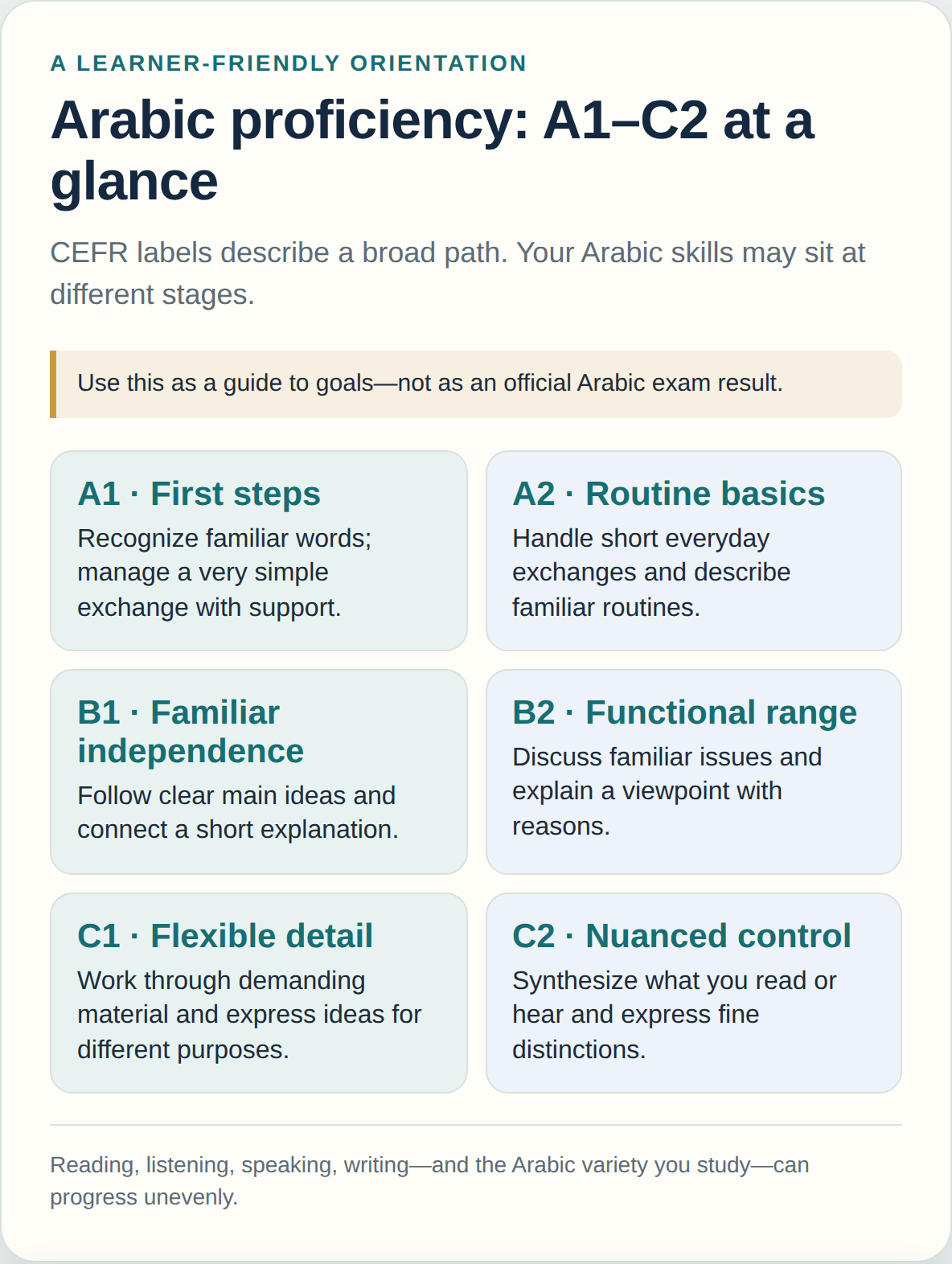
The short descriptions below are a learner-friendly orientation, not official Arabic exam definitions:
- A1 — first steps: You recognize familiar words and can share basic personal details or handle a very simple exchange when the other person speaks slowly and helps.
- A2 — routine basics: You can manage short everyday conversations, understand simple messages, and describe familiar people, places, or routines with common language.
- B1 — independent in familiar situations: You can follow the main point of clear speech on familiar subjects, handle many routine situations, and connect ideas in a short explanation.
- B2 — functional range: You can take part in sustained discussion, understand the main ideas of more complex material, and explain a viewpoint with supporting reasons.
- C1 — flexible and detailed: You can work through demanding material, express ideas clearly for different purposes, and notice implied meaning or shifts in tone more often.
- C2 — highly controlled use: You can understand nearly everything within your language experience, combine information from sources, and communicate fine distinctions with precision.
Progress is not a staircase where every skill moves up at the same speed. A learner may have B1 reading but A2 listening, especially if most study has involved written material. That uneven profile is normal; it is a reason to choose focused practice, not to dismiss the skill you already have.
Arabic is more than one learning target
Before comparing yourself with a level, name the Arabic you are assessing. Quranic or Classical Arabic, Modern Standard Arabic (MSA), and spoken varieties such as Egyptian or Levantine Arabic overlap, but they are not interchangeable goals. A learner may recite Quran accurately without being able to chat spontaneously, or speak a dialect comfortably while finding formal Arabic texts demanding. This overview of Quranic Arabic and Modern Standard Arabic explains why the variety and purpose should be stated clearly.
Also separate language skills from related knowledge. Knowing grammar rules or memorizing vocabulary supports performance, but it does not by itself prove that you can understand a fast conversation, read an unfamiliar passage, or write a clear message. For example, the Arabic grammar learning guide can strengthen your foundation, while a vocabulary notebook helps you revisit words in context; neither replaces practice using them.
If your main goal is Quran reading, use a Quran-specific measure as well. This guide to assessing your Quran reading level looks at reading accuracy and fluency, which are valuable but different from a broad spoken-Arabic rating.
Build a skill profile instead of guessing one level
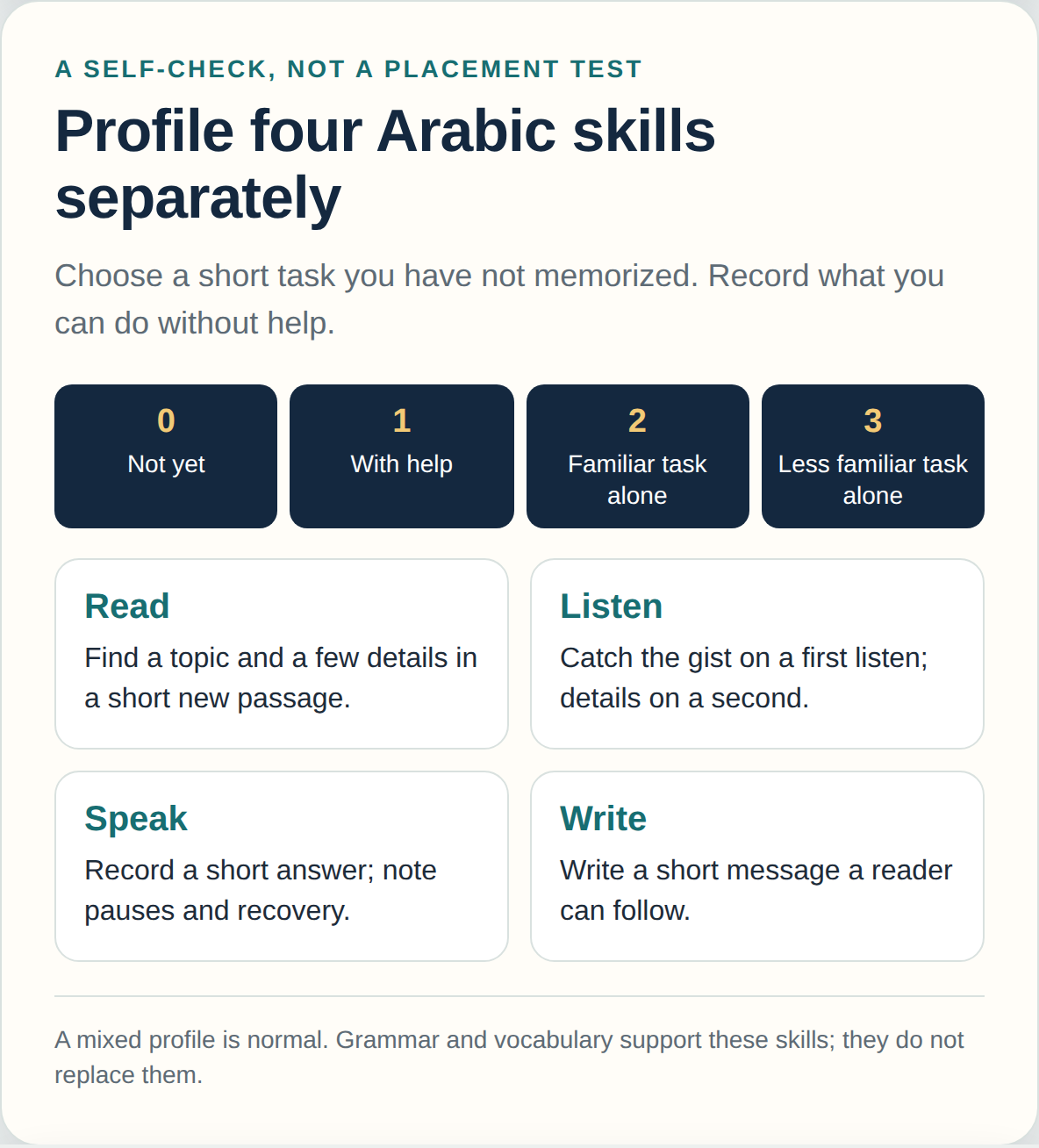
Use a simple reflection scale for each skill: 0 means “not yet”; 1 means “only with substantial help”; 2 means “I can do it independently on familiar material”; and 3 means “I can do it comfortably on less familiar material.” This is a planning tool—not a validated test. Choose a short task for each skill and record what you actually did, rather than rating yourself from memory.
- Reading: Pick a short, level-appropriate Arabic passage you have not studied. Can you identify the topic, find a few details, and keep going without translating every word? If letters or vowel marks slow you down, revisit the Arabic reading guide before judging comprehension.
- Listening: Listen once to a short clip without a transcript. Can you catch the topic and key points? Listen again and note what changed. A repeatable Arabic listening routine helps you track progress beyond “it felt easier.”
- Speaking: Record a one-minute answer to a familiar prompt, such as describing your daily routine. Could you complete the message, connect a few ideas, and recover when a word was missing? Try a guided Arabic conversation practice to build turn-taking and spontaneous responses.
- Writing: Write a short note or paragraph without translating every line from English. Check whether a reader can follow your meaning, whether ideas connect, and where you needed to look up words. A practical Arabic email-writing workshop gives one useful format for testing clear written communication.
Keep vocabulary and grammar notes beside this profile. If you are revising Quranic Arabic words, a structured vocabulary notebook can help you record meanings and examples without treating every unfamiliar word as a failure.
Use the result to choose your next step
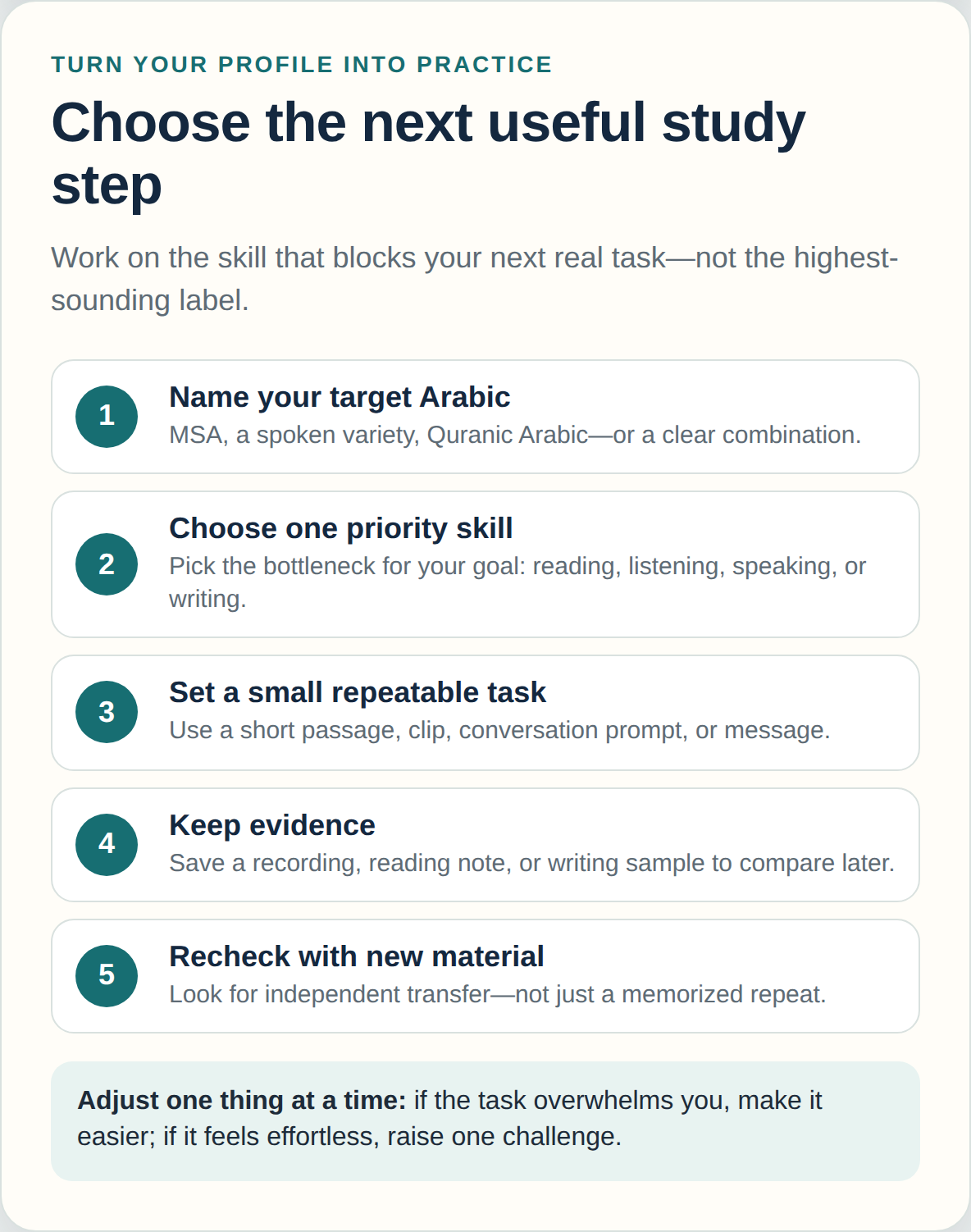
Suppose your reading score is 3, listening is 2, speaking is 1, and writing is 2. Do not average the numbers into a pretend “overall level.” Keep reading material challenging enough to maintain progress, but make speaking the priority: short guided exchanges, repeated useful prompts, and a second attempt with fewer notes. If listening is weakest, add short clips with a first-listen gist question and a second-listen detail check. If writing is weakest, write brief messages and review recurring errors rather than producing one long essay.
- Choose the variety: Decide whether the next goal is MSA, a spoken dialect, Quranic Arabic, or a combination. Write it beside your profile.
- Pick one priority: Choose the skill that blocks your next real task, not the one that feels most impressive to study.
- Set a small routine: Practice for 10–20 minutes on several days of the week. Use a task you can repeat, but change the text or prompt when you check progress.
- Save evidence: Keep a short recording, passage note, or writing sample. Compare it after a few weeks and look for clearer meaning, fewer pauses, or more independent work—not just speed.
- Recheck honestly: Try new material at a similar difficulty. If you can only repeat something memorized, that shows useful practice but not yet independent transfer.
When you are ready to choose materials, a simple rule helps: if you cannot understand the main idea even with a second look, make the text or audio easier; if it is effortless and predictable, raise one challenge at a time. Keep one record for each skill so that growth in reading does not hide a need for speaking or listening practice.
How to use CEFR without turning it into a label
CEFR can give teachers and learners shared language for goals, but no self-check in this article assigns an official A1–C2 grade. Results depend on the target variety, the task, how familiar the topic is, and whether you can act independently. If a school, employer, or university needs proof, ask which exam or assessment it accepts and whether that assessment covers the variety and skills you need.
The video below gives a general introduction to CEFR levels. Use it as background on the framework, not as an Arabic placement test; your own profile should come from Arabic tasks.
When a teacher’s feedback can help
Self-assessment is most useful when it leads to a concrete practice choice. If you are unsure whether a difficulty comes from reading, vocabulary, grammar, or listening, a teacher can observe a short task and suggest a starting point. Quranytime’s free Quran and Arabic trial class is one way to discuss your goals and see which kind of support fits. Bring your skill profile and one example you found difficult, so the conversation starts with evidence rather than a single label.
In short, think of Arabic proficiency levels as a map, not a verdict. Name the Arabic variety you want, check reading, listening, speaking, and writing separately, and choose the next practice from the skill that needs it most. A clear, specific goal is more useful than chasing a higher letter on its own.