

Arabic Addresses: Read, Write and Confirm a Delivery Location
A delivery driver asks for your address in Arabic. You recognize the street name, but the next questions come quickly: building number, floor, apartment, district. Knowing how to ask for directions does not automatically prepare you to answer those questions. An address is a set of labelled details, and a small mix-up can send a person to the right street but the wrong door.
This practical lesson teaches you to separate those details, transfer them into a form, and read them back clearly. The language examples use Modern Standard Arabic, with short pronunciation aids for key terms. Everyday spoken wording varies by country. All sample locations and address details below are invented for learning; they are not verified delivery destinations.
First distinguish an address from a route
An address identifies a destination. A route explains how to reach it from somewhere else. “Building 24, apartment 4” identifies two parts of a location. “Turn right after the pharmacy” gives an instruction whose usefulness depends on where the listener starts. You may need both, but put them in separate parts of a message.
If your main difficulty is following turns and landmarks, use our directions in Arabic lesson. Here the task is different: identify which information belongs in each field, then confirm it without changing a number or name. Think of the labels as questions that the address must answer.
The labels that tell you what to write
Start with عُنْوَان (ʿunwān), “address.” In context, عُنْوَانُ التَّوْصِيلِ means “delivery address.” The same Arabic word can mean a title in another context, so read the surrounding label rather than assuming that every occurrence asks where you live.
| Arabic field | Meaning | What belongs here? |
|---|---|---|
| المدينة | City | The city name |
| الحي | District / neighbourhood | The relevant local area |
| اسم الشارع | Street name | The name, not the apartment number |
| رقم المبنى | Building number | The building identifier |
| الطابق | Floor | The level within the building |
| رقم الشقة | Apartment number | The particular apartment |
| الرمز البريدي | Postal code | The verified code for the location |
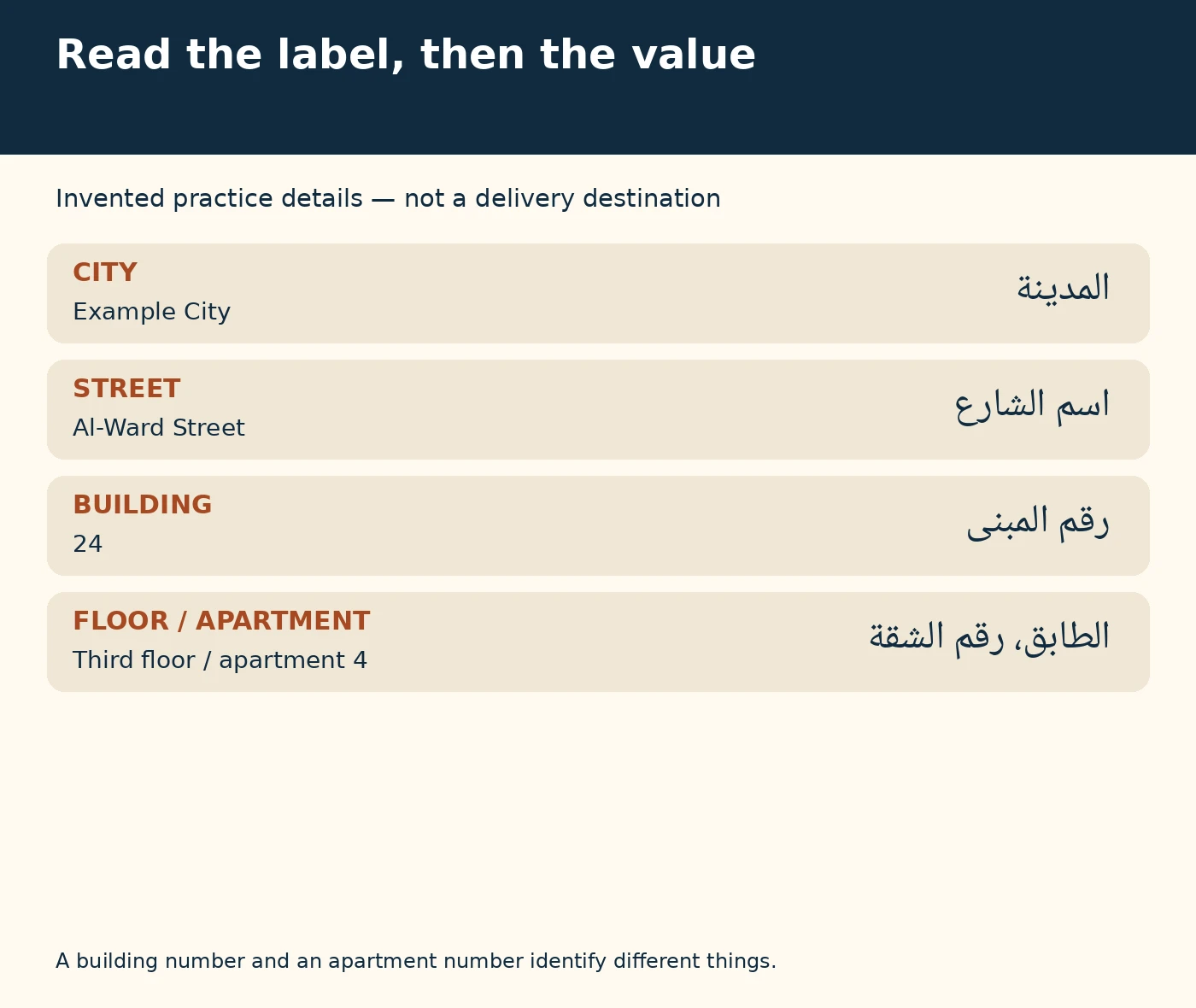
Useful pronunciation anchors are al-madīna for المدينة, al-ḥayy for الحي, ash-shāriʿ for الشارع, al-mabnā for المبنى, aṭ-ṭābiq for الطابق, and ash-shaqqa for الشقة. Learn a label with its purpose. Recalling “building number” while looking at رقم المبنى is more useful than recognizing رقم alone.
One practice address, six separate answers
Read this invented information card: المدينة: مدينة المثال؛ الحي: حي النور؛ الشارع: شارع الورد؛ رقم المبنى: ٢٤؛ الطابق: الثالث؛ رقم الشقة: ٤. It describes Example City, Al-Nur district, Al-Ward Street, building 24, the third floor, apartment 4. The names are teaching placeholders. Do not use them for an actual order.
Now imagine a form asking only for رقم الشقة. The correct answer is ٤. Writing ٢٤ because it is the first number on the card would be a field error, even if you copied the digits perfectly. Similarly, الثالث answers a floor question; it does not replace the street name. This is why a reading task should test the relationship between a label and a value.
For a first practice round, copy the labels down one side of a page and place each value beside its matching label. In the second round, rearrange the labels. If your answers change when the order changes, you were probably following the position of the information rather than understanding the fields.
Keep numbers intact when Arabic and English mix
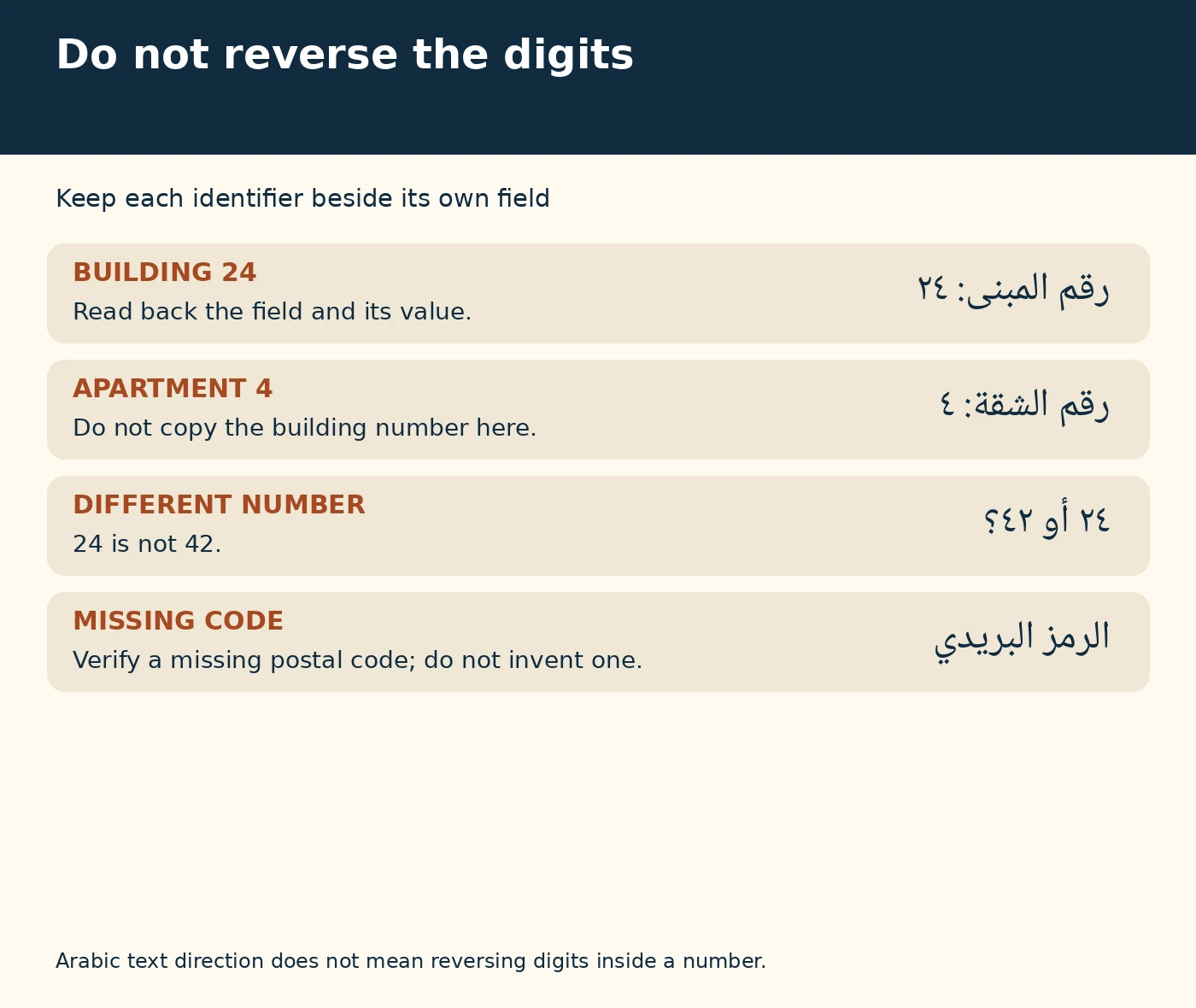
The digits ٢٤ represent 24; ٤٢ represents 42. Arabic text runs from right to left, but that does not mean you should reverse the digits within a number. The W3C explanation of bidirectional text describes how number sequences run left to right inside right-to-left text. Mixed punctuation can still make a line difficult to inspect.
For learning, give each numeric field its own line. Compare رقم المبنى: ٢٤ with رقم الشقة: ٤. Before submitting a real form, check the displayed value after moving out of the field. A copied line containing slashes, brackets, English abbreviations and several numbers deserves a slower check than an isolated digit.
Use our Arabic numbers guide if recognizing the digit shapes is still difficult. When confirming an identifier aloud, you can ask to check it digit by digit. For the building number 24, the sequence is اثنان، أربعة — two, four. This is a read-back of an identifier, rather than a complete lesson on the grammatical forms of cardinal numbers.
A zero at the beginning of a code may matter. Do not delete it simply because it would not change an ordinary mathematical value. Likewise, do not turn a building identifier such as ٢٤ أ into just ٢٤: the letter may distinguish an entrance or unit. Preserve the identifier supplied by the official address record.
Floor numbers need a separate check
الطابق الثالث means “the third floor”; الطابق الثاني means “the second floor.” These are positions, so they use ordinal language. You can review the pattern in our Arabic ordinal numbers lesson. An apartment number is an identifier, while a floor label describes a level; the two should not be merged into one answer.
Do not infer a floor from the first digit of an apartment number. Apartment ٤ may be on the ground floor, third floor, or another level depending on the building. Floor-counting conventions also differ. If a real arrangement is unclear, ask whether the supplied label includes the ground floor, or repeat the building’s own floor description. A language model is not a substitute for checking the actual building.
A short confirmation conversation
The following exchange demonstrates clear MSA. It is deliberately slower and more explicit than many local conversations. Practise with a partner before trying to follow faster spoken forms.
الموظف: ما رقم المبنى؟
العميل: رقم المبنى أربعة وعشرون.
الموظف: وما رقم الشقة؟
العميل: رقم الشقة أربعة، في الطابق الثالث.
الموظف: هل رقم المبنى أربعة وعشرون؟
العميل: رقم المبنى أربعة وعشرون، ورقم الشقة أربعة.
The employee asks for the building number; the customer supplies 24. The employee then asks for the apartment; the customer gives 4 and the third floor. The last exchange repeats the two labels to prevent confusion. In a real conversation you can keep the confirmation simpler by repeating the relevant label and its digits, rather than inventing a long sentence while the other person waits.
A useful repair question is هل يمكنك إعادة الرقم؟ — “Can you repeat the number?” Another is هل هذا رقم المبنى أم رقم الشقة؟ — “Is this the building number or the apartment number?” Both reveal what is uncertain. Saying “I do not understand” may be honest, but a specific question gives your partner a better way to help.
For another identifier practice task, compare our lesson on understanding spoken Arabic phone numbers. The transferable skill is to read information back and check it. You do not need to memorise somebody’s address or telephone number to practise that skill.
A landmark helps; it does not replace the address
بجانب المكتبة means “next to the library.” أمام المدرسة means “in front of the school.” Such descriptions can help someone recognise an entrance, but an area may contain several schools or libraries. Give the building and street details first, then add the relevant landmark as a separate note.
Write ملاحظات التوصيل — delivery notes — above an optional instruction. For example, المدخل بجانب المكتبة means “The entrance is next to the library.” If there are two entrances, say which one the recipient should use. Avoid sending a long route from your own starting point when the driver may approach from elsewhere.
When you ask someone to confirm a destination, request the missing detail rather than adding a guess. A missing district is not solved by choosing the district name that looks most familiar. An unclear postal code should be checked against the appropriate address record.
Why there is no single address format for all Arabic-speaking countries
Arabic is used across countries with different postal systems. The Universal Postal Union’s addressing guidance directs senders to follow the destination postal operator’s standards and verify address elements. Learn the Arabic field names, then follow the actual form and country requirements.
For example, Saudi Post SPL’s National Address explanation identifies six main components, including a building number, street, district, city, postal code and secondary number. A secondary number is not simply another name for an apartment number. Do not transfer that country-specific set of fields to every address written in Arabic.
Three activities with answers
1. Sort a scrambled card
Use the invented card above. Match these prompts: A) رقم الشقة; B) المدينة; C) الطابق; D) رقم المبنى. Your answer bank is الثالث، ٢٤، ٤، مدينة المثال. Write a separate line for each prompt before checking.
Answers: A: ٤; B: مدينة المثال; C: الثالث; D: ٢٤. If A and D were swapped, practise the complete labels رقم الشقة and رقم المبنى together. Recopying the numerals alone will not repair a label-reading problem.
2. Catch the two changes
Your partner reads back “building 42, apartment 4, second floor.” Compare it with the practice card. Which details need correction, and which one was already right? Give the correction with its label so your partner knows what to change.
Answer: The building should be 24, not 42; the floor should be third, not second. Apartment 4 was correct. A full restart is unnecessary when two specific corrections solve the problem. Repeat the corrected details once more and let the listener read them back.
3. Transfer without inventing
A form asks for street, building, apartment and postal code. The practice card contains the first three but no postal code. Fill the known fields and mark the missing one “needs verification” in your exercise notebook. Do not manufacture a realistic-looking code to make the form appear complete. For a real delivery, obtain the verified code before submitting if the service requires it.
Listen for the label before you chase the number
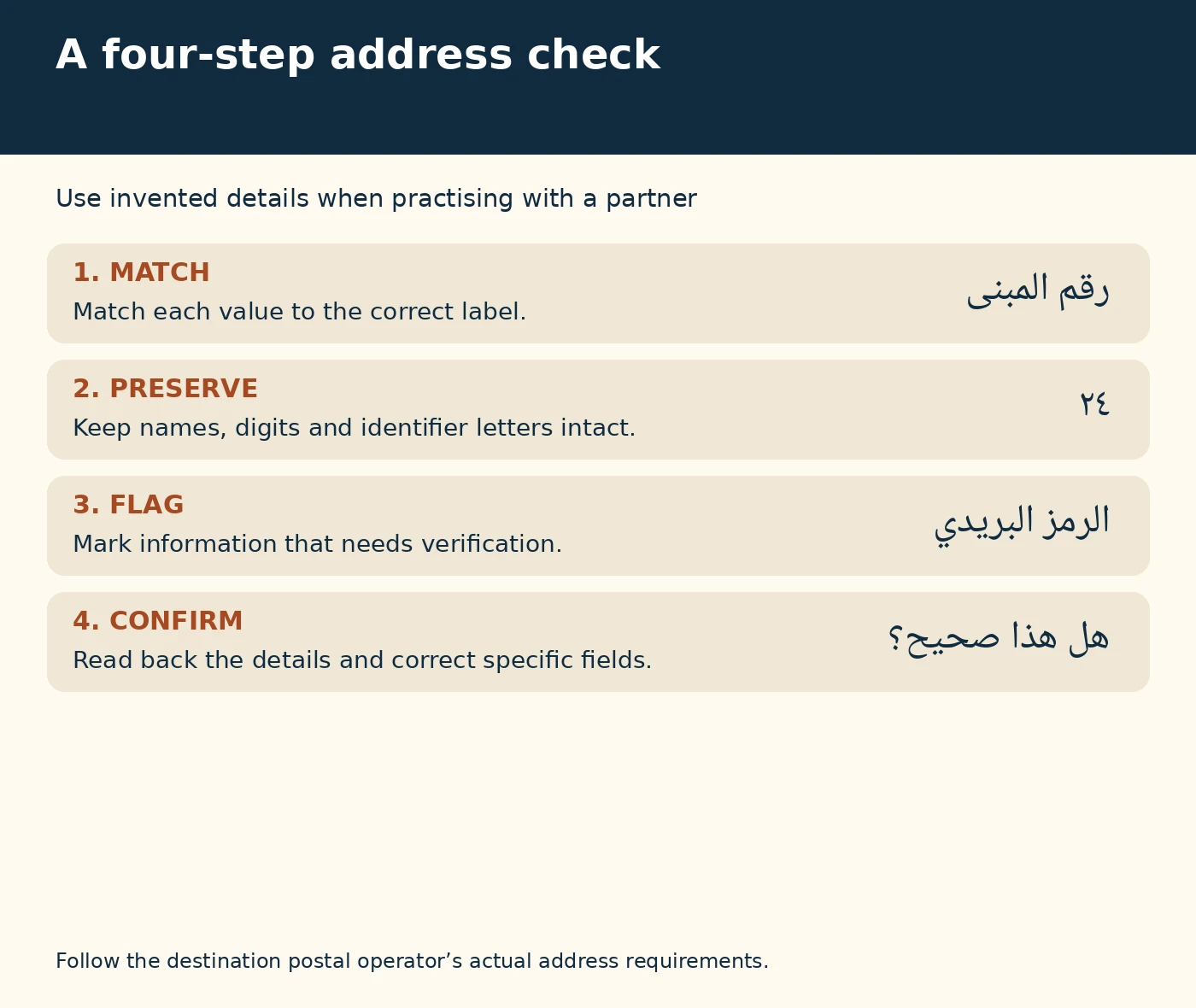
In a spoken exchange, a learner sometimes hears a number clearly and writes it in the wrong place because the preceding label was missed. Use two listening passes to separate those skills. On the first pass, identify whether the speaker is discussing the building, floor or apartment. On the second, write the associated value. Keep the same invented address for the first few turns, then ask your partner to change only one field.
Try this controlled test: your partner says رقم المبنى and pauses. Point to the correct box before hearing the number. Then the partner adds أربعة وعشرون. Write ٢٤ in that box and read the complete label-value pair back. Next, repeat with رقم الشقة and أربعة. Finally remove the pause. If accuracy drops, return to the separated version before increasing the pace. Our Arabic listening practice routine offers ways to work with short, repeatable audio segments.
Recordings for this exercise should use made-up details. You can practise the full language task without recording or sharing your actual home address. Let the listener control replay, and judge success by correct field placement and confirmation rather than speed.
Practise the complete task in ten minutes
Spend two minutes recognising six labels, three minutes transferring an invented address into a different field order, and two minutes reading the identifiers aloud. Use the final three minutes for a partner read-back with one deliberate error. Correct the error by naming the field. On your next practice day, change the numbers and rearrange the fields again.
If typing slows you down, follow our Arabic keyboard setup guide and practise one field at a time. For a longer message that accompanies an address, the Arabic email workshop explains how to keep a request clear. The address itself should remain easy to scan.
You are ready for a harder card when you can match the fields, preserve the digits, identify missing information and correct a read-back without relying on the original order. To practise this practical Arabic task with feedback, Book a Free Trial Class. Bring an invented example, explain the field you find difficult, and ask your teacher to vary the prompt so you learn the task rather than one memorised address.