
You recognize Arabic numbers on a page, but someone says a telephone number and the middle disappears. This is a listening problem with a very specific shape: several similar items arrive quickly, you must keep their order, and you may not know where the groups begin. Counting from one to ten is useful preparation, but it does not by itself teach this task.
This lesson trains digit-by-digit telephone-number listening in Modern Standard Arabic. Real speakers may use regional pronunciations, grouped numbers, or a mixture of languages. Begin with a clearly agreed digit-by-digit format, then ask your teacher to introduce the variety you actually need. All number strings below are invented practice sequences, not contact details to call.
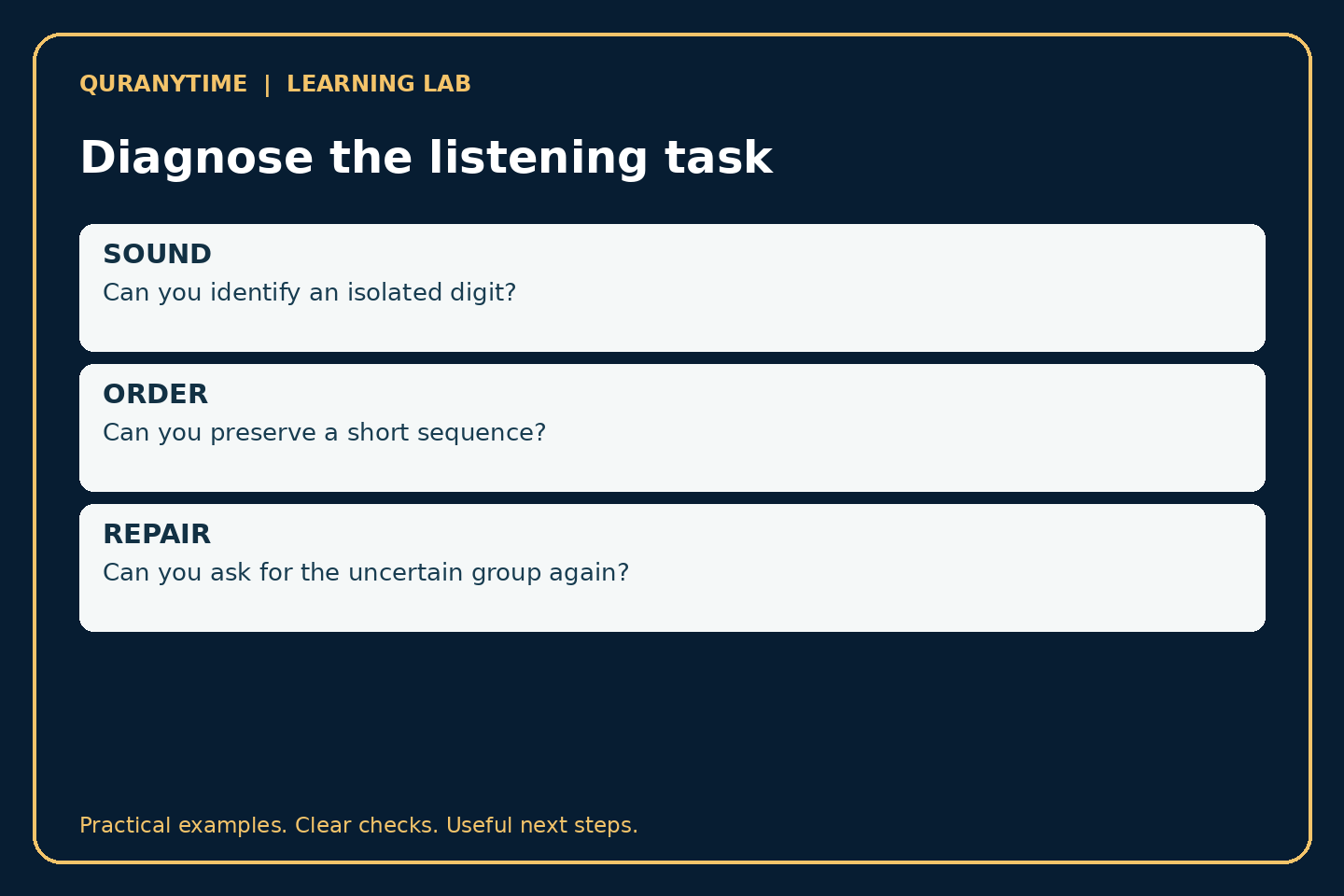
Separate three different abilities
Recognizing a digit, remembering a sequence, and confirming a sequence are different skills. If you hear ثلاثة and cannot identify three, you need sound-to-number work. If you identify every word but swap the last two digits, you need short sequence practice. If you notice uncertainty but say nothing, you need a clarification routine.
Test those skills separately. Ask a partner to say five individual digits in random order, leaving time to respond. Next, ask for a three-digit sequence without pauses between your responses. Finally, ask for a longer sequence and practise stopping the speaker politely. Record which stage fails; otherwise you may spend an hour counting when your main difficulty is keeping order.
Our Arabic numbers guide supplies the broader number system. Here we deliberately restrict the first task to digits. Telephone numbers are identifiers, so an initial zero matters. A phone number is not a quantity you can round, shorten, or paraphrase.
Establish your digit key
| Digit | Arabic form | Learning reminder |
|---|---|---|
| 0 / ٠ | صفر | Keep an opening zero |
| 1 / ١ | واحد | One spoken item |
| 2 / ٢ | اثنان | Regional speech may differ |
| 3 / ٣ | ثلاثة | Listen through the whole word |
| 4 / ٤ | أربعة | Notice the initial sound |
| 5 / ٥ | خمسة | Do not guess from length |
| 6 / ٦ | ستة | Contrast with other short forms |
| 7 / ٧ | سبعة | Keep it distinct from six |
| 8 / ٨ | ثمانية | A longer word is still one digit |
| 9 / ٩ | تسعة | Check the consonant pattern |
These are standard written forms for isolated-number practice. Do not assume every caller will pronounce each exactly as it appears in a beginner textbook. Ask a teacher for a short recording in your target variety, with permission, and label it clearly. Mixing several varieties before you recognize the basic set makes it harder to tell whether you heard a new pronunciation or made a listening error.
You can write either Western digits such as 507 or Arabic-Indic digits such as ٥٠٧ if the recipient accepts that format. Avoid changing numeral systems halfway through a note. For an international contact, country codes and local leading-zero conventions need separate verification; do not transform a real number from memory simply because you recognize its digits.
Build a two-column listening sheet
Draw boxes for three positions. Above the boxes write “first, second, third.” Your partner reads خمسة — صفر — سبعة. Write 5, 0, 7 in the boxes, then point to each box while reading back. The target is 507, not 570. The zero occupies a position even though it represents no quantity in ordinary counting.
Now cover your written answer and listen again. If the second attempt differs, do not select the answer that merely looks more plausible. Ask for a third reading or the uncertain section. Real telephone numbers often contain repeated digits and unfamiliar patterns. Plausibility is a poor substitute for confirmation.
Start with four sequences, not forty. After checking, classify each error as recognition, omission, insertion, or reversal. An omission means a digit vanished; an insertion means you wrote one that was not said. A reversal means the right digits appeared in the wrong order. Different errors call for different practice adjustments.
Use grouping to reduce the load
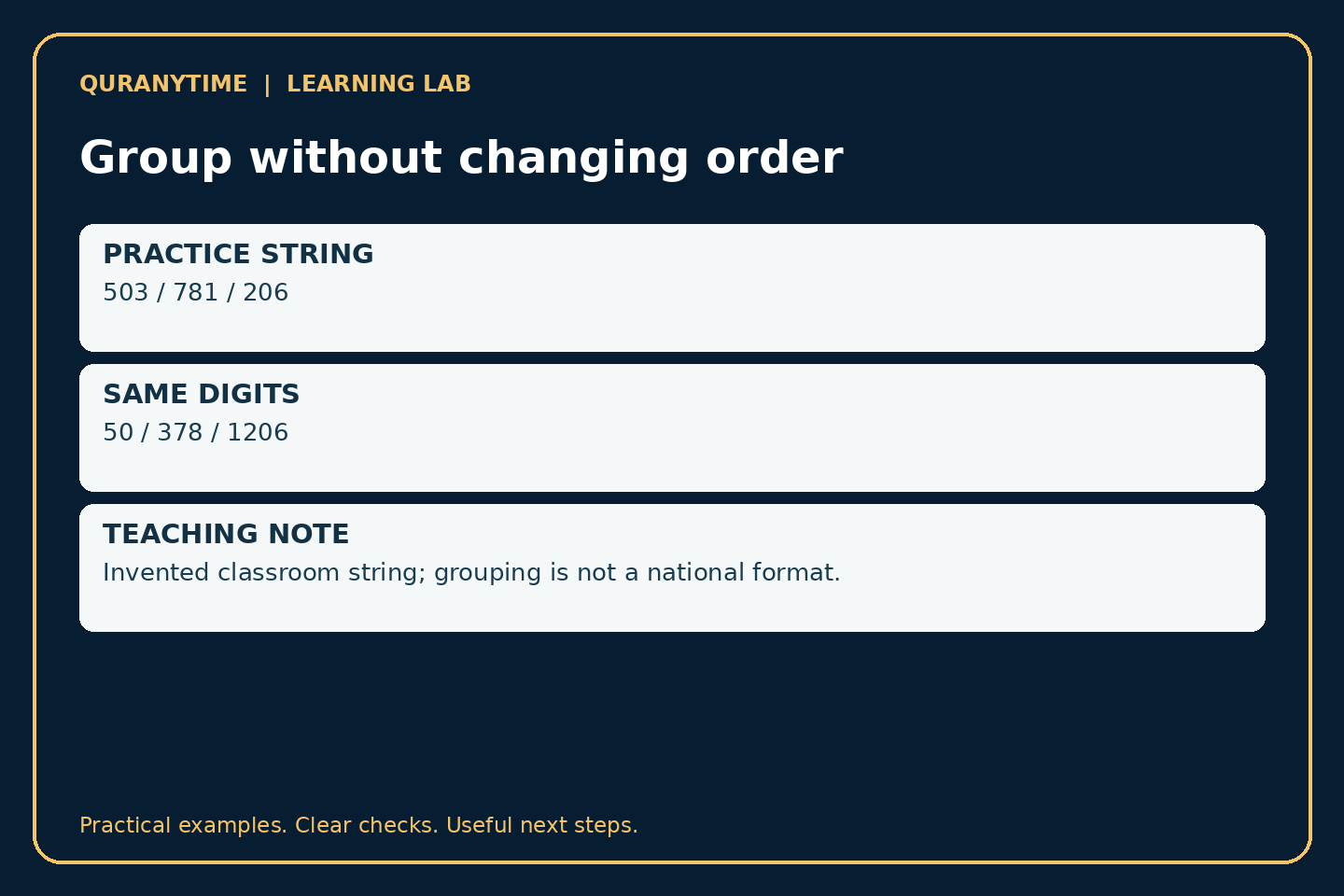
Try a nine-digit practice string: 503 / 781 / 206. The speaker says each digit, pauses after three, then continues. You write one group at a time. Do not treat these invented groups as a national numbering format; they are simply a classroom arrangement.
Once three-digit groups are comfortable, change the grouping while keeping the sequence identical. Compare 50 / 378 / 1206 with 503 / 781 / 206. You are training flexibility, not memorizing where every phone number must pause. If accuracy collapses when the pause moves, return to short groups and check that you are following the digits rather than the rhythm alone.
A useful progression is two digits, three digits, two groups of three, and then a longer string. Increase only one demand at a time. Do not simultaneously increase length, speed, background noise, and unfamiliar pronunciation. Our beginner Arabic listening routine can help you organize a short session around one controllable difficulty.
Learn the repair phrases before the fast exercise
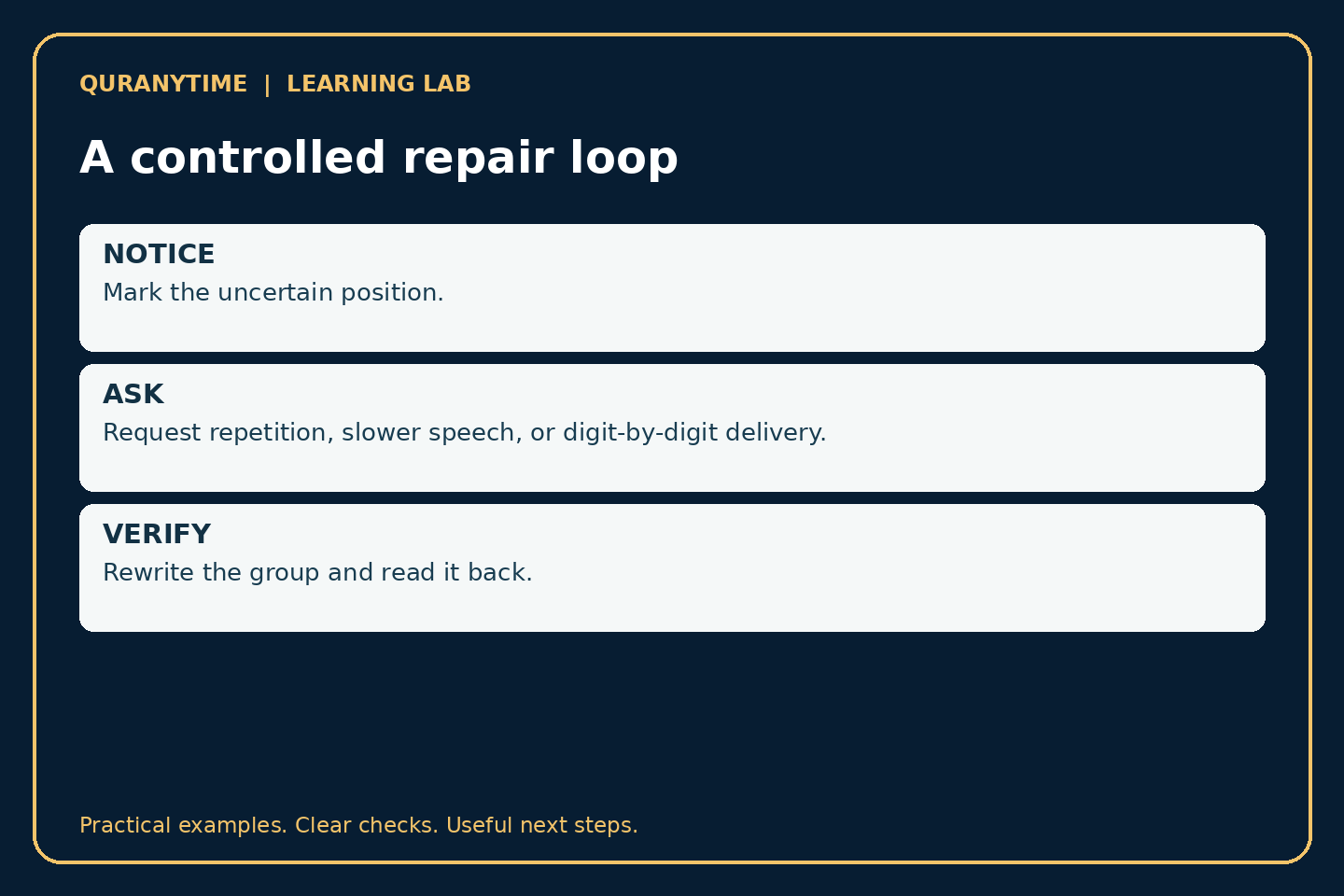
A listener needs permission to interrupt. Practise these phrases when nothing is going wrong:
- هل يمكنك التكرار؟ — Can you repeat?
- ببطء، من فضلك. — Slowly, please.
- رقمًا رقمًا، من فضلك. — Digit by digit, please.
- ما الرقم الأخير؟ — What is the last digit?
Forms of address may change with the person or group you are speaking to. Learn an appropriate version with your teacher instead of treating one printed form as universal. Our Arabic question words lesson explains the building blocks of a targeted question. A targeted repair usually works better than restarting the entire exchange.
Role-play a caller who deliberately pauses after the wrong group. The listener should ask for the uncertain part without apologizing repeatedly or pretending to understand. Being able to say “the last digit” is more useful here than knowing another twenty number words. You are practising successful communication, including what happens when communication briefly fails.
Confirm by reading back
After writing a sequence, say it back digit by digit and invite correction. A partner should compare against the original, not against your written page. Otherwise both of you may simply read the same mistake. For practice, alternate roles so each learner experiences what clear dictation sounds like from the speaker’s side.
Do not say “yes” before the speaker finishes correcting you. Cross out the wrong item neatly, rewrite the group, and read the whole group once more. Rechecking only the corrected digit can leave a neighboring reversal unnoticed. In a real contact exchange, confirm the final complete number through an appropriate channel before relying on it.
The same technique transfers to appointment dates and clock times, but the language changes. Our Arabic dates guide and telling-time guide cover those meanings. Do not mix date practice into the first phone-number exercise; first make the digit task reliable.
A controlled exercise set
Ask a partner to read the Arabic words, while you keep the answer key hidden. The slashes indicate optional teaching pauses.
- صفر — أربعة — تسعة
- ستة — سبعة — ستة
- ثلاثة — صفر — ثمانية / واحد — خمسة — اثنان
- تسعة — تسعة — أربعة / صفر — اثنان — سبعة
- ثمانية — واحد — ثلاثة / ستة — صفر — خمسة
Answers: 049; 676; 308152; 994027; 813605. If you use Arabic-Indic numerals, the same answers are ٠٤٩؛ ٦٧٦؛ ٣٠٨١٥٢؛ ٩٩٤٠٢٧؛ ٨١٣٦٠٥. These strings are classroom material only.
Check position by position. A response of 940 for the first item contains the right digits but loses the original order. A response of 49 omits the opening zero. Give neither answer full credit. The success criterion is exact sequence preservation, not a generally similar sound or approximately correct number.
Change the task without repeating the same test
On the second day, reverse roles and invent fresh sequences of the same length. On the third day, use one repeated pair, such as 66 or 00, in every other sequence. On the fourth day, add a deliberate correction: “five… no, six.” The listener should update the correct position and read back the revised group.
This variation addresses a practical problem: memorizing yesterday’s answer sheet can make a listening exercise look easier than it is. Keep one small untaught sequence for a final check. Do not use real students’ telephone numbers as classroom dictation material; invented strings are sufficient and avoid exposing contact details.
Diagnose the most common breakdowns
If the first digit disappears, agree that the speaker will wait until the listener is ready. If the last group disappears, shorten the total string before slowing every word to an unnatural crawl. If six and seven are confused, practise those two forms in varied order, then put them back among the other digits. If zeros vanish, add visible position boxes temporarily.
If you can repeat the digits aloud but cannot write them quickly, practise transcription as a separate motor task. Our Arabic keyboard guide may help if your final task involves typing a message. Handwriting, typing, and listening are related but not interchangeable; a slow keyboard should not be mistaken for poor understanding.
If mixed-script numbers appear backwards in a message, inspect the completed display rather than repeatedly rearranging digits in the draft. Put the number on its own line where useful, copy carefully, and verify the actual order. Never change a real contact number solely because a bidirectional display looks unfamiliar.
Design a fair recheck
For a later check, use fresh invented strings with the same length and grouping as the earlier set. Keep the speaker, pace, and number of permitted repetitions comparable. If you change all those conditions, the result may reflect a different task rather than a change in skill.
Include one opening zero and one repeated digit pair, but do not make every sequence a trick. Tell the learner which clarification phrases are allowed. In real communication, requesting repetition is part of competent listening, so a practice task can assess both exact transcription and effective repair.
Review the errors immediately while the audio or speaker’s original is still available. Ask the learner which position felt uncertain before showing the answer. This can reveal whether they noticed uncertainty accurately or felt confident in a mistaken sequence. The next practice target might then be recognizing a sound contrast, preserving order, or using the repair phrase sooner.
A fifteen-minute practice appointment
Use three minutes for isolated digits, four for short sequences, four for a role-play with repair phrases, and four for checking errors and planning the next session. This is a proposed practice structure, not a scientific promise about how quickly everyone will learn. Stop sooner if fatigue causes careless copying; accurate short work is the goal.
Finish with a real-world simulation: a learner asks an office for a contact number, writes it, requests one repeated group, and reads it back. Include a greeting and closing from our Arabic greetings guide, but score the exercise on accurate digits and successful clarification. The conversation can remain simple.
If this is a skill you need for travel, work, or arranging lessons, Book a Free Trial Class and ask to practise a short contact-information exchange. Bring an invented number string and explain whether you struggle with recognition, order, or speaking up. That diagnosis gives the lesson a clearer starting point than “I need more listening.”