
When you travel, study, or simply need to find a place, a few clear Arabic questions can turn confusion into a short, useful exchange. This guide to directions in Arabic teaches you how to ask “Where is…?” and “How do I get to…?”, understand right, left, straight ahead, and common landmarks, then follow or give a simple route. The examples use Modern Standard Arabic (MSA), with learner-friendly pronunciation and a map-style dialogue. Arabic spoken forms vary by country, so treat these as a shared starting point rather than assuming every local speaker uses exactly the same wording.
Start with two essential questions
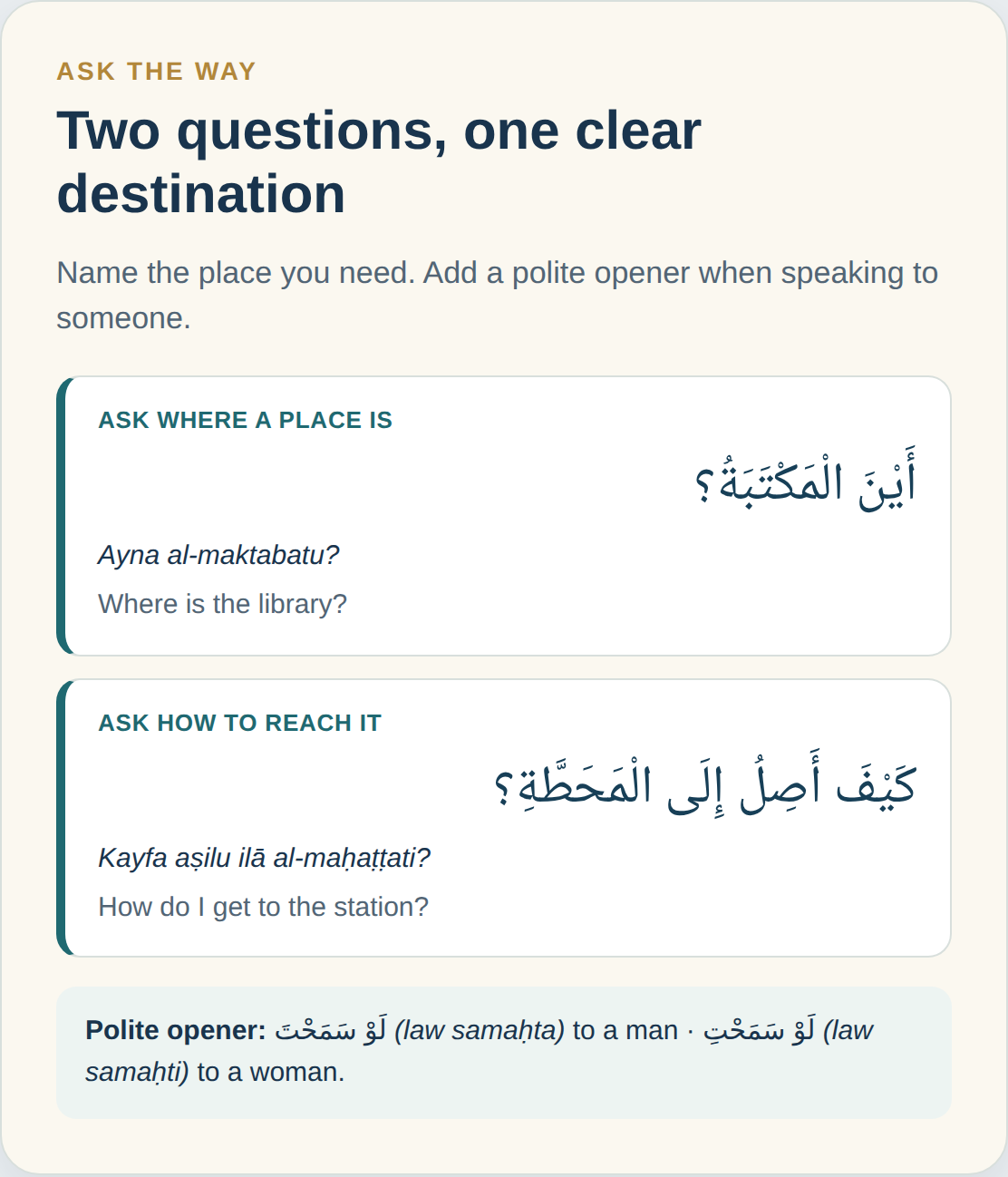
The quickest way to ask where a place is uses أَيْنَ (ayna, “where?”) followed by the place: أَيْنَ الْمَكْتَبَةُ؟ (ayna al-maktabatu?, “Where is the library?”). For a route, say كَيْفَ أَصِلُ إِلَى الْمَكْتَبَةِ؟ (kayfa aṣilu ilā al-maktabati?, “How do I get to the library?”). The verb aṣilu means “I arrive/reach,” and إِلَى (ilā) means “to.” If you need a refresher on question forms, Quranytime’s guide to Arabic question words explains the question starters you will meet in practical conversations.
To sound courteous, add لَوْ سَمَحْتَ (law samaḥta, speaking to a man) or لَوْ سَمَحْتِ (law samaḥti, speaking to a woman), meaning “please” or “if you would allow.” You can also use مِنْ فَضْلِكَ (min faḍlika, to a man) or مِنْ فَضْلِكِ (min faḍliki, to a woman). For more ways to open a first exchange politely, see Arabic greetings and introductions. You do not need a long sentence: one polite opener, a clear place name, and a patient pause are often enough.
If you want to build from a broader foundation of short beginner expressions before practising a route, Quranytime’s useful Arabic phrases guide offers another set of practical sentence models.
Direction words you will hear on a map
Learn these as short chunks rather than translating each word in isolation. When a direction describes where to move, Arabic often uses an adverbial form such as يَمِينًا (yamīnan, to the right) or يَسَارًا (yasāran, to the left). For example, the route phrase اِنْعَطِفْ يَمِينًا means “turn right.”
| Meaning | Arabic | Pronunciation |
|---|---|---|
| right / to the right | يَمِين / إِلَى الْيَمِين | yamīn / ilā al-yamīn |
| left / to the left | يَسَار / إِلَى الْيَسَار | yasār / ilā al-yasār |
| straight ahead | إِلَى الْأَمَام / مُبَاشَرَةً | ilā al-amām / mubāsharatan |
| near / far | قَرِيب مِن / بَعِيد عَنْ | qarīb min / baʿīd ʿan |
| next to / in front of | بِجَانِب / أَمَام | bijānib / amām |
| behind / opposite | خَلْف / مُقَابِل | khalf / muqābil |
| street / intersection | شَارِع / تَقَاطُع | shāriʿ / taqāṭuʿ |
| traffic light | إِشَارَةُ الْمُرُور | ishārat al-murūr |
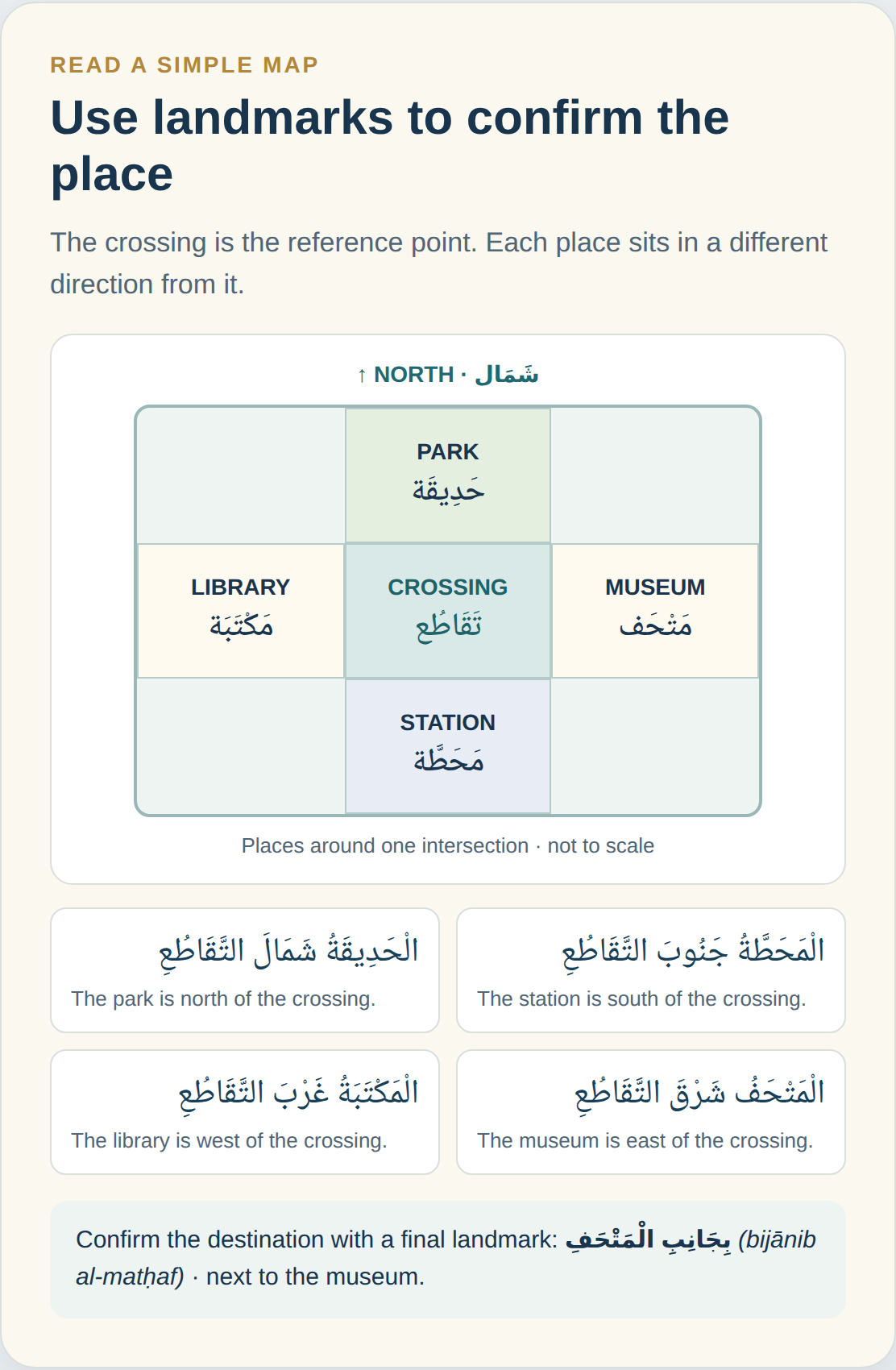
You may also need the compass points: الشَّمَال (ash-shamāl, north), الْجَنُوب (al-janūb, south), الشَّرْق (ash-sharq, east), and الْغَرْب (al-gharb, west). A university open-textbook lesson from LibreTexts shows these words in simple map statements, such as naming one country’s location relative to another; it is a useful reference for Arabic cardinal directions and map examples.
Give instructions in a useful order
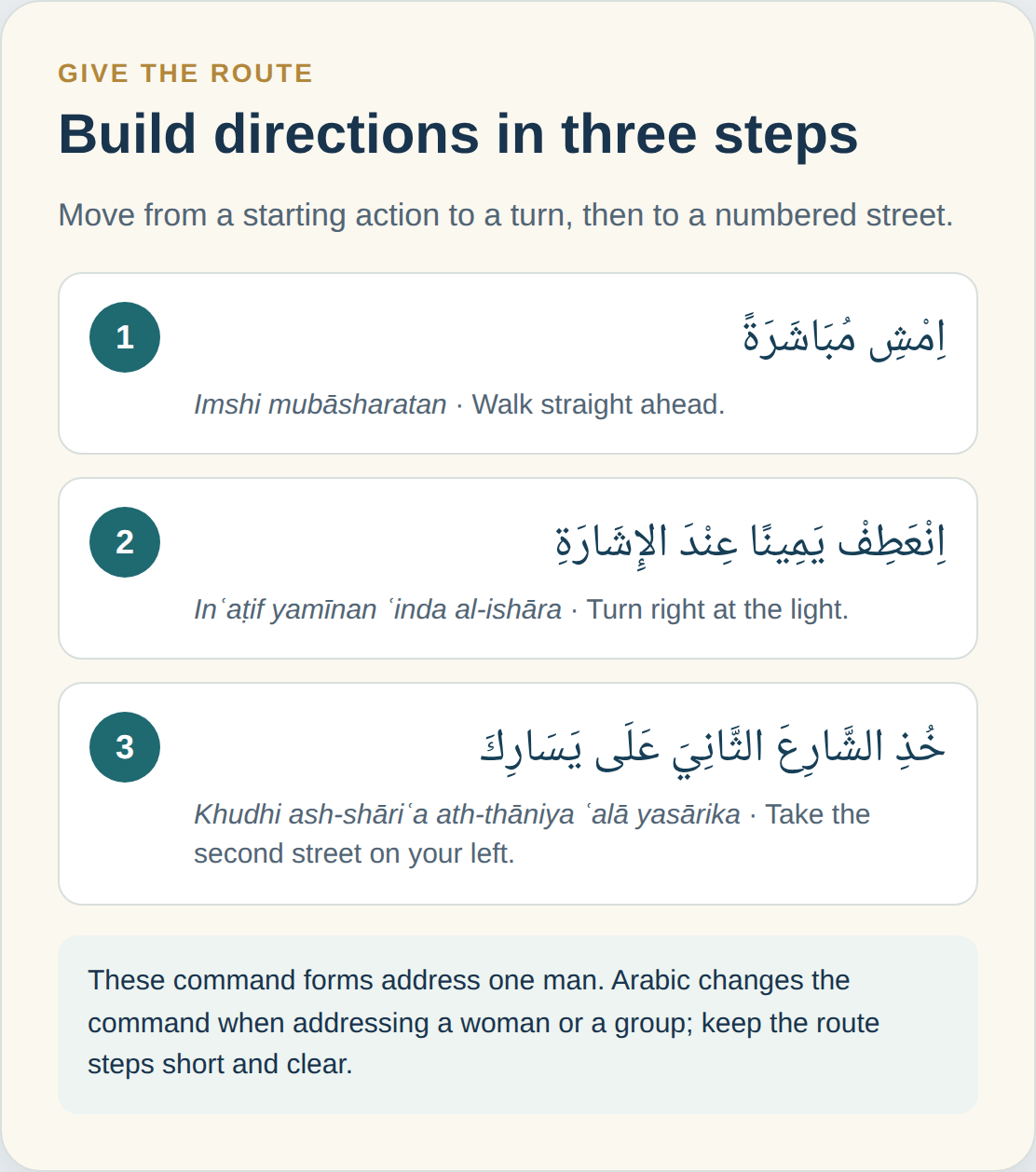
A route is easier to follow when you give one step at a time: name a starting point, say which way to move, identify the next landmark, and finish with the destination’s position. These common MSA commands help:
- اِمْشِ مُبَاشَرَةً (imshi mubāsharatan): walk straight ahead.
- اِنْعَطِفْ يَمِينًا / يَسَارًا (inʿaṭif yamīnan / yasāran): turn right / left.
- خُذِ الشَّارِعَ الثَّانِيَ (khudhi ash-shāriʿa ath-thāniya): take the second street.
- اِعْبُرِ الشَّارِعَ (iʿburi ash-shāriʿa): cross the street.
- تَابِعْ حَتَّى تَصِلَ إِلَى… (tābiʿ ḥattā taṣila ilā…): continue until you reach…
These command examples address one man in the singular; the form changes when you speak to a woman or to several people. For example, “walk” can be اِمْشِ to a man, اِمْشِي to a woman, and اِمْشُوا to a group. The corresponding “turn” forms are اِنْعَطِفْ, اِنْعَطِفِي, and اِنْعَطِفُوا. If you want to review how Arabic commands are formed and recognized, Quranytime’s lesson on Arabic imperative verbs is a helpful companion. In a real exchange, you can also avoid a command by giving a neutral description: الشَّارِعُ عَلَى يَمِينِكَ means “the street is on your right.”
Use sequence words to prevent a route from becoming a jumble. ثُمَّ (thumma) means “then”; بَعْدَ ذَلِكَ (baʿda dhālika) means “after that”; and حَتَّى (ḥattā) means “until.” A clear route might be: “Walk straight until the traffic light, then turn left. After that, take the second street.” For the difference between counting and naming a position in a sequence, see the guide to Arabic ordinal numbers.
Describe where the destination is
After giving turns, use a landmark to confirm the final location. عَلَى يَمِينِكَ (ʿalā yamīnika) means “on your right,” while عَلَى يَسَارِكَ (ʿalā yasārika) means “on your left.” The suffix -ka addresses a man; when addressing a woman, use -ki: عَلَى يَمِينِكِ. The phrases بِجَانِبِ الْمَتْحَفِ (“next to the museum”), أَمَامَ الْحَدِيقَةِ (“in front of the park”), and مُقَابِلَ الْمَحَطَّةِ (“opposite the station”) help a listener connect the route to something visible.
Notice the preposition or location word together with the noun after it. For instance, min (“from”) in قَرِيب مِنَ الْمَكْتَبَةِ gives “near the library,” while ʿan (“from/away from”) in بَعِيد عَنِ الْمَكْتَبَةِ gives “far from the library.” Quranytime’s guide to Arabic prepositions can help you recognize these relationships in both practical phrases and Quranic reading. Some place phrases also act like adverbs, telling you where an action happens; the guide to time, place, and manner adverbs offers a useful grammar connection.
A short ask-and-answer route dialogue
Traveller: لَوْ سَمَحْتَ، كَيْفَ أَصِلُ إِلَى الْمَكْتَبَةِ الْعَامَّةِ؟
Law samaḥta, kayfa aṣilu ilā al-maktabati al-ʿāmma?
Please, how do I get to the public library?
Local: اِمْشِ مُبَاشَرَةً حَتَّى إِشَارَةِ الْمُرُورِ، ثُمَّ اِنْعَطِفْ يَسَارًا.
Imshi mubāsharatan ḥattā ishārat al-murūr, thumma inʿaṭif yasāran.
Walk straight ahead until the traffic light, then turn left.
Local: خُذِ الشَّارِعَ الثَّانِيَ عَلَى يَمِينِكَ. سَتَجِدُ الْمَكْتَبَةَ بِجَانِبِ الْمَتْحَفِ.
Khudhi ash-shāriʿa ath-thāniya ʿalā yamīnika. Satajidu al-maktabata bijānib al-matḥaf.
Take the second street on your right. You will find the library next to the museum.
Traveller: هَلْ هِيَ قَرِيبَةٌ مِنْ هُنَا؟ (hal hiya qarībatun min hunā?, “Is it near here?”)
Local: نَعَمْ، عَلَى بُعْدِ خَمْسِ دَقَائِقَ مَشْيًا. (naʿam, ʿalā buʿdi khamsi daqāʾiqa mashyan, “Yes, about five minutes on foot.”)
Try reading the exchange twice: first follow the meaning, then cover the English and listen for the sequence markers. If you are practising independently, Quranytime’s Arabic listening routine for beginners has ideas for repeating short audio without trying to understand every word at once.
How to practise directions without getting lost
Draw a simple map with a crossing at the centre. Put the park north of it, the station south, the library west, and the museum east. Then say one sentence for each relationship: الْحَدِيقَةُ شَمَالَ التَّقَاطُعِ (“The park is north of the crossing”) and الْمَكْتَبَةُ غَرْبَ التَّقَاطُعِ (“The library is west of the crossing”). These match the map card above. Then ask where the station is and answer with a direction and a landmark.
Next, practise route instructions in three short chunks: start with an action such as “go straight,” add a turn at a landmark, and finish with the destination’s position. Avoid giving several turns in one breath. You can confirm the route by asking هَلْ هَذَا صَحِيحٌ؟ (hal hādhā ṣaḥīḥ?, “Is this correct?”) or هَلْ فَهِمْتُكَ جَيِّدًا؟ (hal fahimtuka jayyidan?, “Did I understand you correctly?”).
When learning from audio, replay one short phrase at a time. Listen for the contrast between yamīn (right) and yasār (left), then repeat ʿalā yamīnika (“on your right”). Arabic sounds such as ʿ in ʿalā and the emphatic ṭ in taqāṭuʿ may take practice; clear directions matter more than a perfect accent.
Common mistakes to avoid
- Mixing right and left: say yamīn and yasār slowly, then point to the direction while practising.
- Giving turns without landmarks: “turn left” is more useful when you add “at the traffic light” or “after the bridge.”
- Reversing the order: use thumma (“then”) and name the steps in the order the traveller will meet them.
- Forgetting the destination: finish with a location phrase such as “next to the museum” or “on your right.”
- Treating MSA as every local dialect: these examples are a shared formal starting point; local words and pronunciation can vary.
The purpose is successful communication, not a long memorized speech. Ask one clear question, listen for one landmark, and confirm the next step. If you want a teacher to check your pronunciation and foundational Arabic, you can book a free Quran and Arabic trial class with Quranytime.
Watch: Arabic directions on a map
This short visual lesson reviews the four cardinal directions and their in-between points through Arabic labels, a compass, and a map of the Arab world. It is useful for practising north, south, east, and west; the route phrases in the dialogue above add the everyday turns and landmarks.
A route detective worksheet: find the missing instruction
Recognising the words for right and left is only the beginning. A listener also needs a starting point, an orientation, and a landmark. This activity separates those skills so you can identify why a route went wrong. Use a paper map at a table; the exercise does not require walking near traffic or following unfamiliar real-world directions.
Build a map that has one clear answer
Draw a square with a single crossing at its centre. Mark north at the top. Place a station below the crossing, a park above it, a library to the left, and a museum to the right. Draw a line connecting each place to the centre. Both partners need the same layout. Start at the station facing the crossing, so the traveller is facing north. Establish that starting direction before either person speaks.
Partner A gives a route to the museum without naming it. The route should lead straight from the station to the crossing, then turn right. Partner B traces the route with a pencil and names the destination. Next, start from the park facing the crossing. To reach the same museum now, the traveller turns left at the centre. The destination remains east of the crossing, but the turn changes because the traveller faces another direction.
Explain the mistake rather than guessing
This contrast reveals why compass directions and relative turns cannot be substituted mechanically. “East” stays fixed on this map. “Right” depends on the direction someone faces. If partners reach different buildings, first check the starting orientation, then the turn, and finally the landmark. Do not repeat the whole route faster: identify the first point at which the two pencil paths differ.
- From the station, face north and turn left at the crossing. Which building do you reach?
- From the park, face south and turn right at the crossing. Which building do you reach?
- From the library, face east and continue straight through the crossing. Where do you finish?
- A route says only “turn right.” Which two missing details would you ask for?
Answers: 1) The library. 2) The library again. 3) The museum. 4) Ask where to start and where the turn occurs; also confirm which way you are facing if it is unclear. Use the Arabic direction words and commands from the earlier tables when explaining your answers.
Make the second round harder in one way
After the first map is reliable, add one landmark between the crossing and a building. Let the speaker choose whether to describe the landmark or name a compass direction. The listener must repeat the essential step before tracing it. Keep street names and distances out of this round so you can concentrate on sequence and orientation. Afterwards, add distances separately if they match your learning goal.
For independent study, record one route, put the map aside, and trace it later from the audio. Check whether your instructions contain enough information for a listener who cannot see what you were pointing at. That is a stronger test than reading a memorised dialogue while looking at its English translation.