

Arabic active and passive participles help you recognize whether a Quranic word describes the doer of an action or someone or something affected by it. The terms are ism al-fāʿil (اسم الفاعل) and ism al-mafʿūl (اسم المفعول). Their patterns offer useful clues, but sentence structure and context still guide the translation.
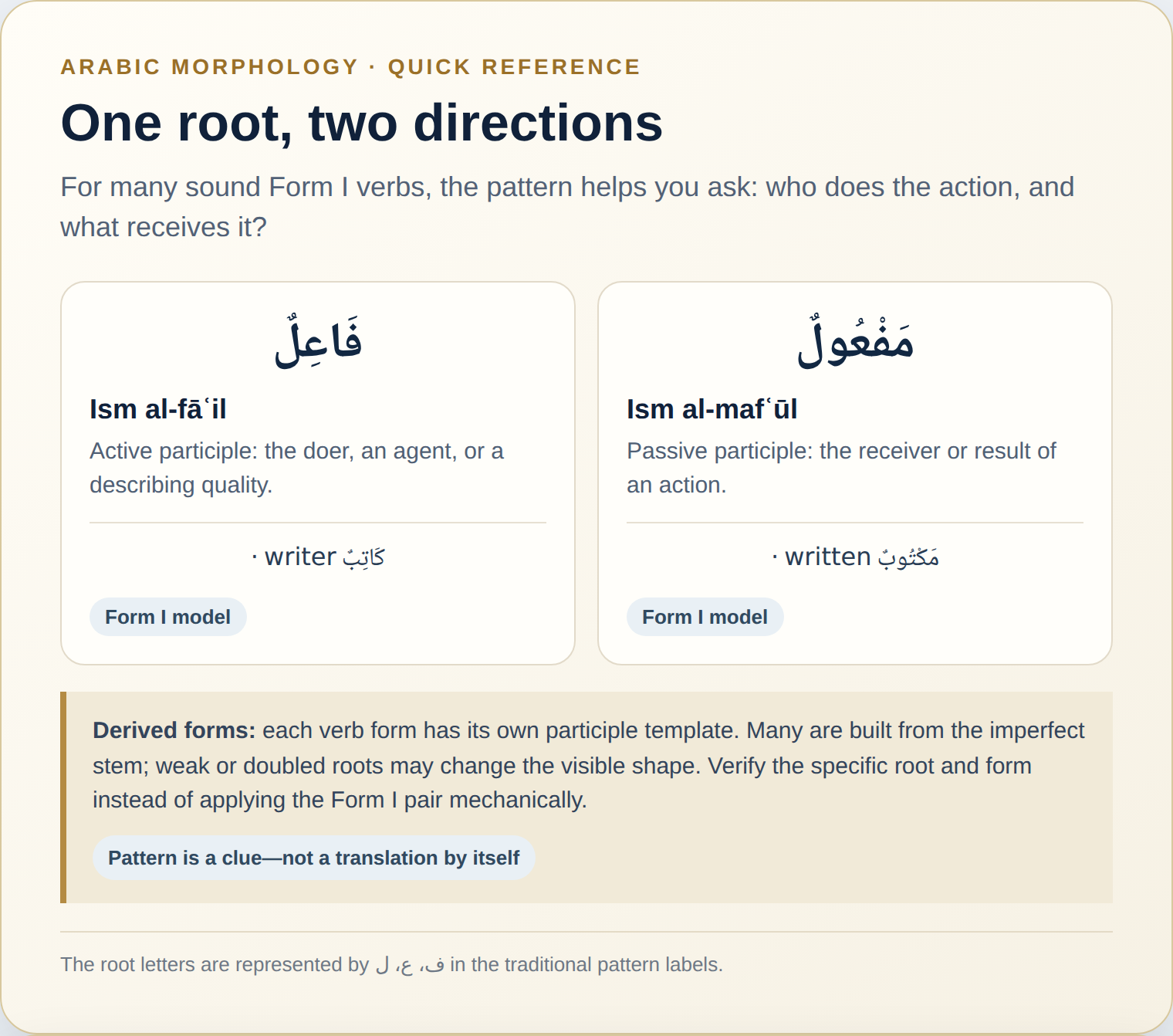
Quick distinction: an active participle points toward the doer or a quality; a passive participle points toward the receiver or result. For a familiar Form I model, compare كَاتِبٌ (kātib, writer) with مَكْتُوبٌ (maktūb, written). In Quranic reading, identify the pattern, ask what relationship the word expresses, and then check the phrase around it.
What is a participle in Arabic?
A participle is a noun-like form made from a verb. It carries an idea related to that verb but is not itself a finite verb telling you who acts and when. Arabic forms such words through patterns of consonants and vowels. English offers a rough comparison in pairs such as “write / writer” and “write / written,” although no one-to-one translation rule works for every Arabic word.
Ism al-fāʿil commonly presents an agent, performer, or bearer of a quality. Depending on context, it may be translated as a person who does something, an adjective, or a conventional noun. Avoid forcing every active participle into an English “-er” word.
Ism al-mafʿūl commonly presents the receiver or result of an action: something done, known, sent, or written. It often resembles an English past participle, but it does not automatically make the whole Arabic sentence grammatically passive. A participle can describe a person or thing in several kinds of sentence.
The core Form I patterns
For a sound three-consonant Form I verb, the familiar active template is فَاعِل (fāʿil), while the common passive template is مَفْعُول (mafʿūl). The letters fāʾ, ʿayn, and lām are placeholders for the root consonants. In كَاتِب and مَكْتُوب, the root is k-t-b: one form depicts a writer; the other depicts something written.
These are patterns, not guarantees that every verb forms both words predictably. Some verbs are intransitive, derived nouns can be uncommon or lexicalized, and weak or doubled roots can alter the visible form. Check the root and verb form instead of guessing from a long vowel. Quranytime’s introduction to Quranic roots and patterns explains how a root differs from the pattern built around it.
For derived forms, participles are generally built from the matching imperfect stem. A useful first clue is the prefix مُـ; the active form commonly has a kasrah before its final root consonant, while the passive form commonly has a fatḥah there. For example, Form II has the broad contrast مُفَعِّل and مُفَعَّل. Each verb form has its own template and weak-root adjustments, so treat this as a recognition aid rather than a complete chart. See the guide to Arabic verb forms I–X for the wider pattern system.
Participle meaning is not sentence role
Ism al-fāʿil names a derived agent-like form; fāʿil is also the grammar label for the subject of a particular verb. Related words, different questions: the first describes a word’s morphology and usual meaning, while the second describes its role in a sentence. An active participle itself may be a subject, predicate, object, or follow a preposition.
Likewise, ism al-mafʿūl is not the same as mafʿūl bihi, the direct object of a verb. A passive participle has a patient or result meaning, but its sentence position still needs parsing. For the separate finite passive-verb construction, review the practical guide to passive voice in the Quran. The Arabic verb-conjugation guide covers person-based tense forms that should not be confused with participles.
Four Quran examples: identify the relationship
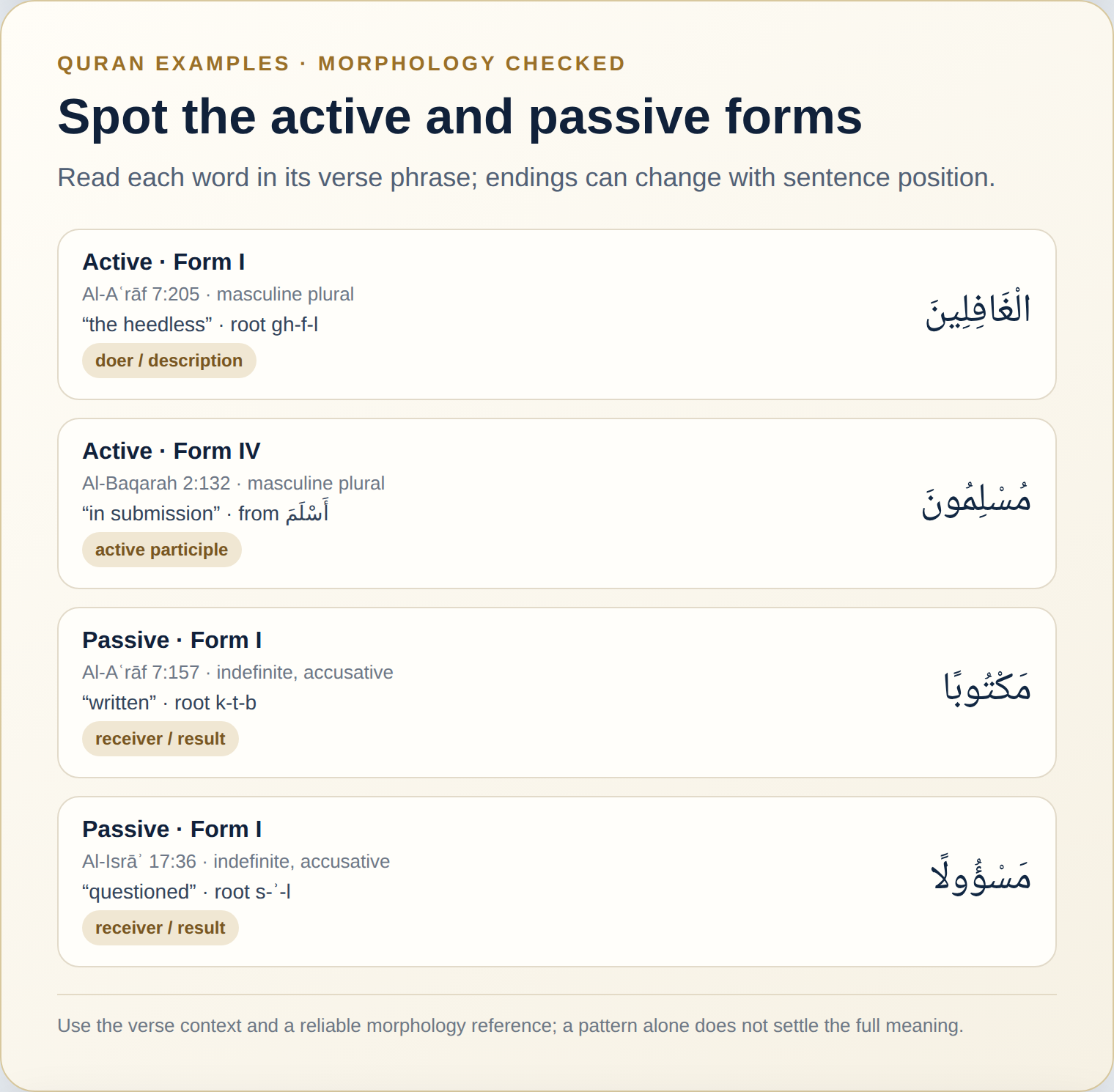
Read each form inside its phrase rather than memorizing a translation by itself. The examples below have been checked against their verse contexts and morphological analyses. Notice that case endings can change while the word remains an active or passive participle.
1. الْغَافِلِينَ — active participle
In Al-Aʿrāf 7:205, مِنَ الْغَافِلِينَ means “among the heedless.” Its base form is غَافِل (ghāfil), from root gh-f-l, on the Form I active-participle pattern. The verse uses a masculine plural form after min. It describes people characterized by heedlessness; it is not a finite verb meaning “they became heedless.”
2. مُسْلِمُونَ — active participle from Form IV
Al-Baqarah 2:132 ends وَأَنْتُمْ مُسْلِمُونَ, describing a state of submission. مُسْلِم (muslim) is an active participle from the Form IV verb أَسْلَمَ; here it is masculine plural and nominative. It shows why learners need more than the Form I فَاعِل model. The natural English translation is a description (“in submission” or “submitting”), not necessarily “submitters.”
3. مَكْتُوبًا — passive participle
Al-Aʿrāf 7:157 uses يَجِدُونَهُ مَكْتُوبًا, “they find him written” among the earlier scripture. مَكْتُوب (maktūb) follows the Form I passive pattern. The ending in مَكْتُوبًا reflects its role in the phrase; it remains a passive participle, not a past-tense passive verb. The Quranic Arabic Corpus entry for مَكْتُوبًا in 7:157 labels it an indefinite masculine passive participle in the accusative.
4. مَسْؤُولًا — another passive participle
In Al-Isrāʾ 17:36, كَانَ عَنْهُ مَسْؤُولًا refers to hearing, sight, and the heart as matters about which a person will be questioned. مَسْؤُول (masʾūl) is a passive participle from root s-ʾ-l. Its pattern suggests the “questioned” relationship, while the surrounding words tell you what the verse identifies as accountable.
A quick recognition checklist
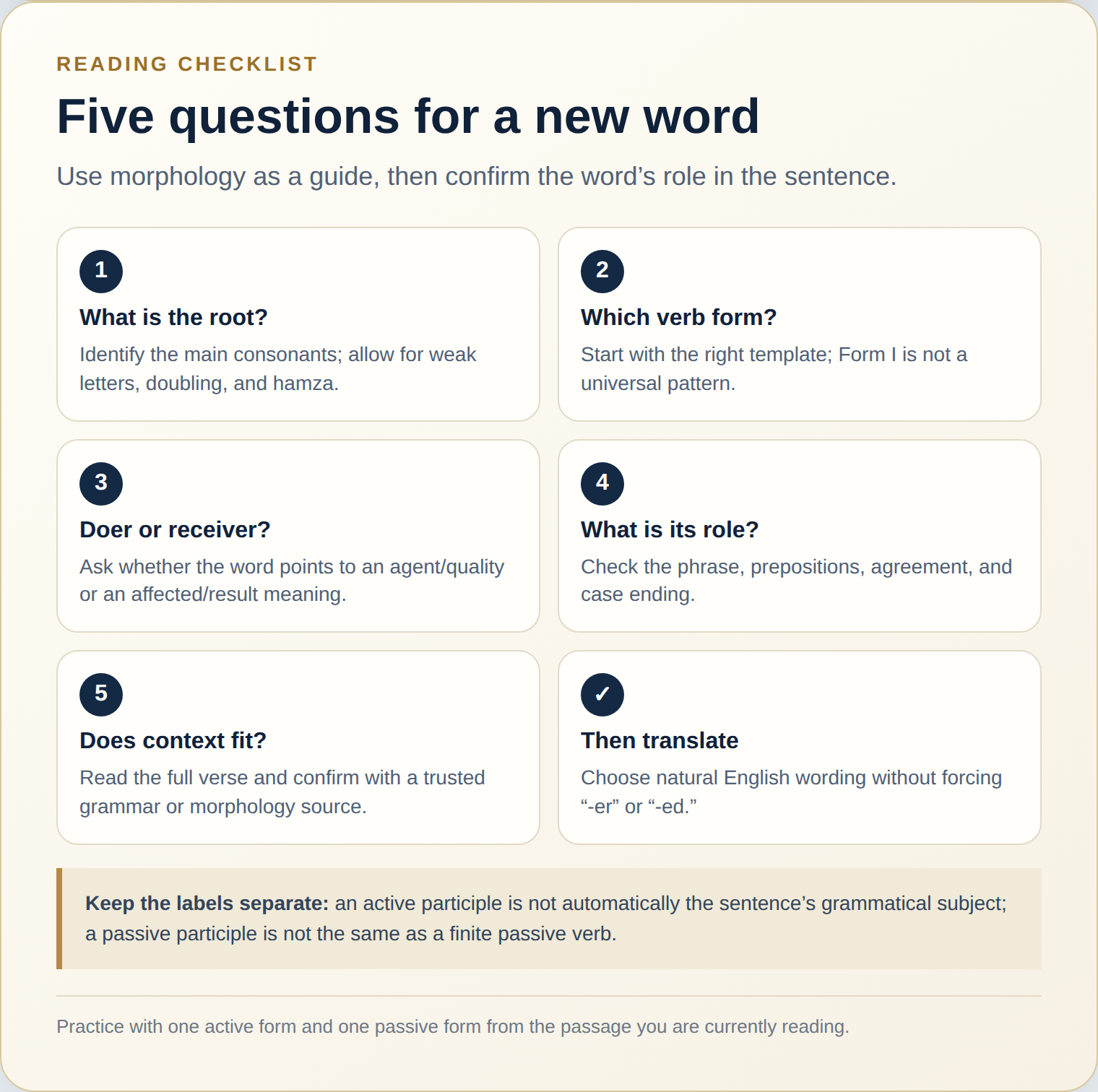
When you meet a possible participle, ask these questions in order. This makes the pattern useful without turning it into a shortcut around grammar:
- Can you locate the root? Identify the main consonants, allowing for weak letters, doubled roots, and hamza.
- Which verb form is involved? Form I often gives the clearest fāʿil / mafʿūl contrast; derived forms have their own templates.
- Doer or affected one? Ask which relationship fits the word in this verse, not just whether it begins with م.
- What is its sentence role? Check nearby verbs, prepositions, pronouns, and endings; the case-endings guide explains why final vowels change with grammatical position.
- Does context agree? Compare pattern, syntax, and a reliable translation or explanation. A pattern narrows possibilities; it does not replace context or tafsir.
Agreement and endings: clues, not the definition
Because participles behave like nouns or adjectives, they can show gender, number, definiteness, and case. A model such as كَاتِبٌ may appear in feminine, dual, or plural forms, and its final vowel may change with its sentence role. The base pattern remains recognizable even when the ending changes. Quranytime’s adjective-agreement guide reviews how descriptive words match nouns in gender, number, and case.
Do not classify a word only because it begins with م or resembles فَاعِل. Arabic has many noun patterns, and similar-looking strings can belong to different roots or categories. Fully vowelled text and verse context are especially important when short vowels distinguish forms that look alike in bare script.
Common mistakes to avoid
- Mixing meaning and sentence role: a participle may describe a doer or receiver while occupying several grammatical positions.
- Equating participles with passive verbs: مَكْتُوب (“written”) is noun-like; a finite passive verb has tense and agreement. Quranytime’s masdar guide also distinguishes a participle from a verbal noun, which names the action.
- Translating every active form with “-er”: a participle may work as an adjective or established noun, and context determines natural English wording.
- Guessing from unvowelled script: short vowels may distinguish patterns that look alike. Check a fully vocalized text and a morphology reference.
- Inferring tafsir from one pattern: identifying active or passive meaning is useful, but it does not settle a verse’s broader interpretation.
Try a three-word practice check
Classify الْغَافِلِينَ in 7:205, مَكْتُوبًا in 7:157, and مَسْؤُولًا in 17:36 before checking the answers. The first is active: it describes people characterized by heedlessness. The other two are passive: “written” and “questioned.” Then reread each phrase and note how its ending relates to its sentence position.
Build the skill with a short routine
Choose one word from the verse you are studying. Read its fully vowelled form, name its root and likely verb form, then label its relationship as active or passive. Explain in one sentence how the nearby words support your choice. Finally, compare your analysis with a reliable dictionary, morphology reference, or teacher. Mark uncertain roots as questions instead of forcing a neat rule.
Repeat with one active and one passive example on another day. A small note with the Arabic word, verse, root, pattern, and reason for your classification is more useful than a list of translations learned in isolation. If a weak or irregular root makes the template unclear, return to the word’s dictionary entry and study its specific form before generalizing.
For guided feedback, you can book a free Quran and Arabic trial class. Bring one verse, your root guess, and your reason for choosing active or passive; a focused question makes the teacher’s correction easier to apply.
The takeaway
Use فَاعِل and مَفْعُول as a starting contrast: active participles point toward the doer or a describing quality, while passive participles point toward the receiver or result. Then check root, verb form, vowels, endings, and context. The Quran examples الْغَافِلِينَ, مُسْلِمُونَ, مَكْتُوبًا, and مَسْؤُولًا show why morphology supports careful reading without replacing it.