

Two nouns can point to the same person or thing without forming a possessive phrase. If you read every neighboring pair as “the first noun of the second,” you will misunderstand sentences such as “The teacher, Maryam, arrived.” Arabic badal (بَدَل), usually introduced in English as apposition, gives you another way to connect nouns: a later expression clarifies, specifies, or replaces an earlier one within the sentence.
This workshop concentrates on a practical reading problem: deciding what the second noun contributes. You will compare short sentences, change their grammatical positions, and edit a paragraph. The examples marked as classroom practice are composed for learning; they are not Quran quotations. You need basic familiarity with Arabic noun case, but you do not need to memorize every traditional category before you begin.
Start with one person and two descriptions
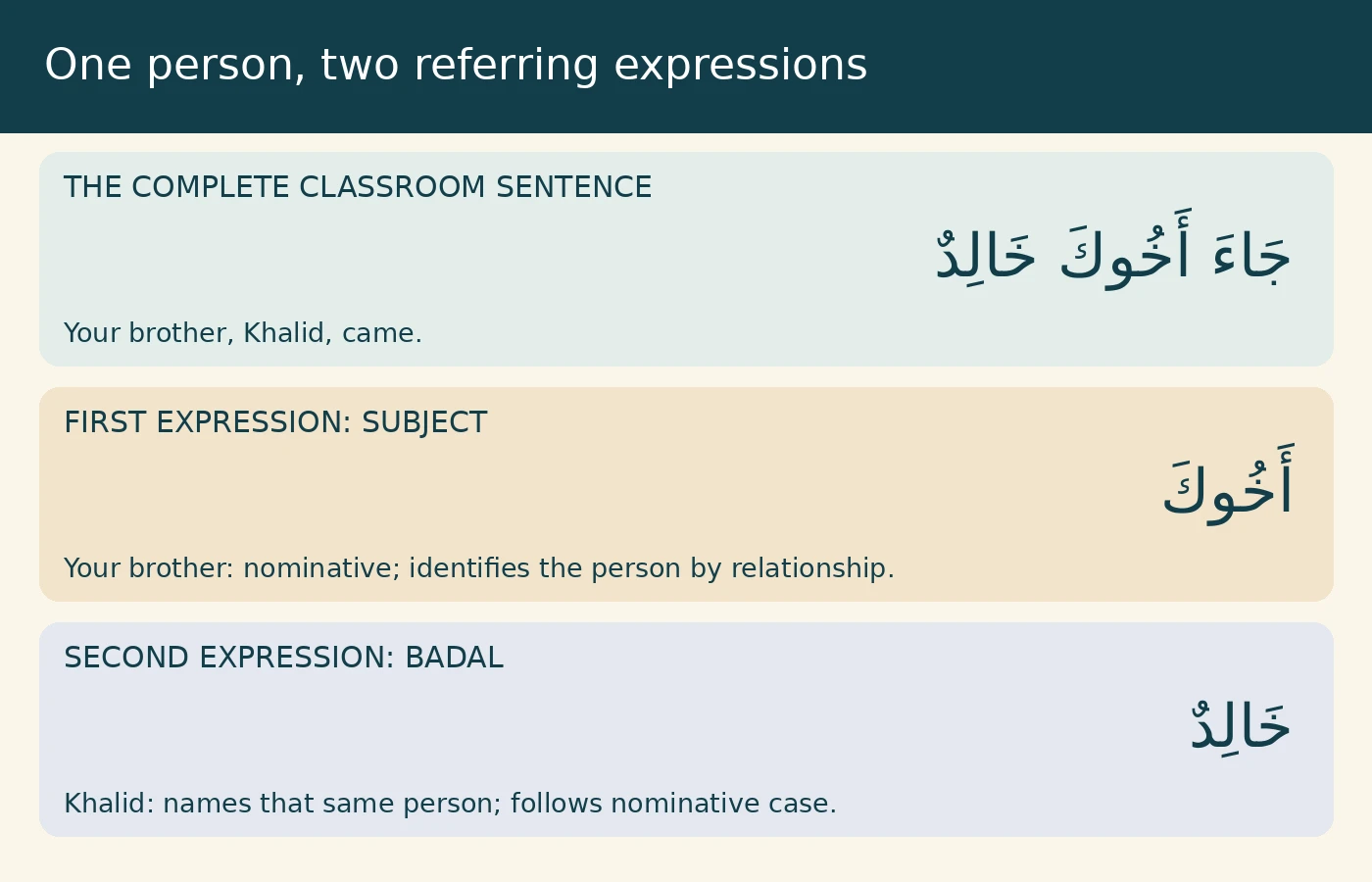
Read this classroom sentence in connected formal Arabic: جَاءَ أَخُوكَ خَالِدٌ — “Your brother, Khalid, came.” The sentence names one arriving person. أَخُوكَ identifies him through his relationship to you; خَالِدٌ gives his name. Khalid is not something that your brother owns, and the two expressions do not introduce two different people.
The first expression is called the mubdal minhu, the expression from which the substitution is made. The following badal is the clarifying expression. In this straightforward whole-for-whole example, the second expression refers to the same individual as the first. Both occupy the same grammatical position in the larger sentence. Here that position is the subject of جَاءَ, so both are nominative.
A useful first experiment is to read جَاءَ خَالِدٌ — “Khalid came.” The shortened sentence preserves the main event and participant. This substitution test is helpful for clear introductory examples, although it is not a universal mechanical test for every advanced type of badal. Use it alongside meaning and case, rather than treating deletion as proof by itself.
Compare three relationships before naming the construction
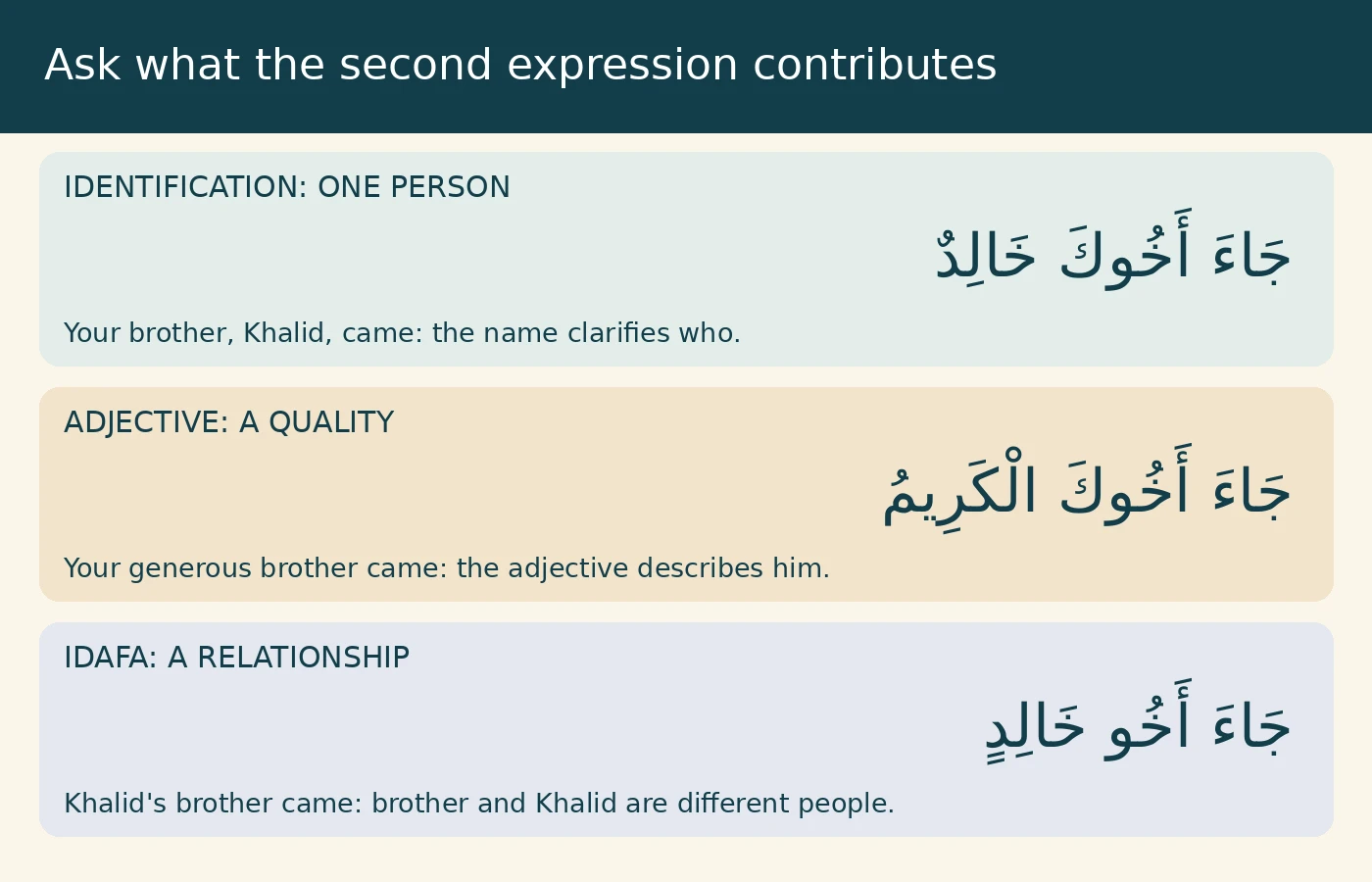
Put these composed examples beside one another: جَاءَ أَخُو خَالِدٍ, جَاءَ أَخُوكَ خَالِدٌ, and جَاءَ أَخُوكَ الْكَرِيمُ. They share familiar words, yet their noun relationships differ.
Possession or association: “Khalid’s brother”
جَاءَ أَخُو خَالِدٍ means “Khalid’s brother came.” This is an idafa: خَالِدٍ is genitive as the second member of the construct phrase. The arriving brother and Khalid are different individuals. The first noun gets its case from the sentence; the second gets genitive case from the construction. Review how idafa connects two nouns if this is the relationship you automatically expect.
Identification: “Your brother, Khalid”
جَاءَ أَخُوكَ خَالِدٌ refers to your brother and then names that same person. The name follows the first expression’s case. It is not genitive merely because another noun stands before it. For this workshop, this is the clearest introductory badal pattern.
Description: “Your generous brother”
جَاءَ أَخُوكَ الْكَرِيمُ describes your brother as generous. الْكَرِيمُ contributes a quality rather than introducing his name. Adjectives also agree in case, so matching endings alone cannot distinguish an adjective from badal. The adjective agreement lesson explains the additional agreement clues. Meaning remains essential: is the second expression naming the referent, or describing a quality?
Move the whole relationship through three cases
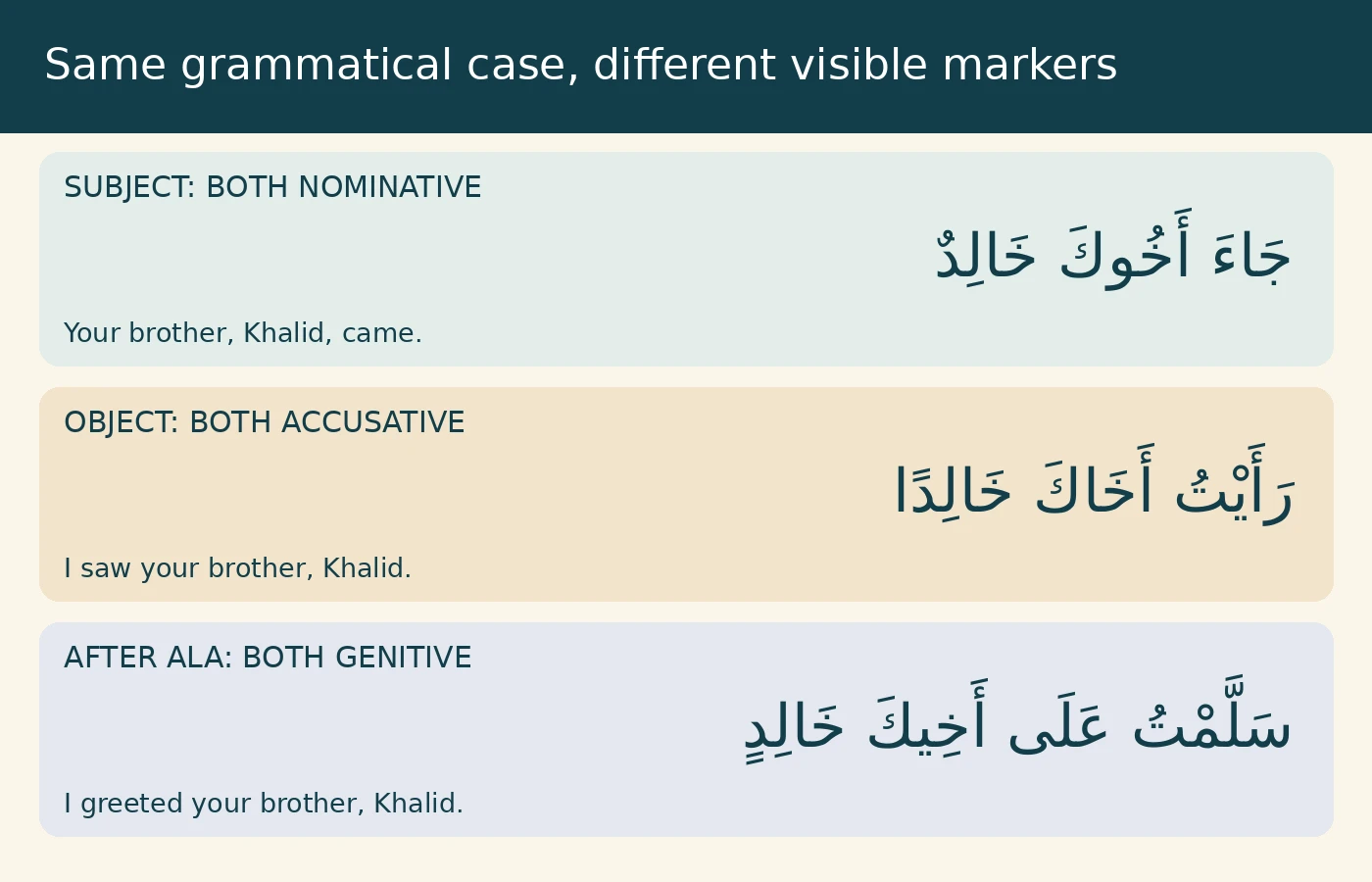
Keep the same person and change only his role in the sentence. In جَاءَ أَخُوكَ خَالِدٌ, “Your brother, Khalid, came,” the pair is nominative. In رَأَيْتُ أَخَاكَ خَالِدًا, “I saw your brother, Khalid,” the pair is accusative. In سَلَّمْتُ عَلَى أَخِيكَ خَالِدٍ, “I greeted your brother, Khalid,” the pair is genitive after عَلَى.
Notice that “same case” does not require identical visible letters. أَخُوكَ, أَخَاكَ, and أَخِيكَ belong to the special five-noun pattern under these conditions; the name خَالِدٌ uses ordinary case vowels and tanwin. Explain the shared grammatical case before comparing its different markers. This prevents a common mistake: expecting every nominative expression to end in a visible dammah.
If you lose track of who performs the action, temporarily bracket the clarifying expression. Read the main sentence, identify subject or object, then return the name to the same position. The guide to Arabic verbal sentences can help you establish that framework. Bracketing is a reading aid, not permission to ignore part of a Quran verse.
A Quranic example across a verse boundary
One documented example appears in Quran 96:15–16. The phrase بِالنَّاصِيَةِ occurs in 96:15, followed by نَاصِيَةٍ كَاذِبَةٍ خَاطِئَةٍ in 96:16. The Quranic Arabic Corpus discussion of apposition analyzes نَاصِيَةٍ as badal to the preceding expression. Both nouns are genitive; the initial preposition governs the first, and the apposition follows its case.
This example is particularly useful because the dependent nouns are separated by a verse boundary. A verse boundary does not automatically end every grammatical relationship. The following descriptive words qualify نَاصِيَةٍ. Read the complete verses with a reliable translation and tafsir to understand their context; this short extract isolates the noun relationship rather than supplying a complete interpretation.
Also notice the article difference: النَّاصِيَةِ has the definite article, whereas نَاصِيَةٍ is indefinite. Do not import every adjective-agreement requirement into badal. Our task is to explain the dependency and case, not to make the second noun visually identical to the first. In your notes, distinguish the reference label “96:16:1” from the sentence role “badal.” One locates a word; the other describes its grammatical relationship.
Whole, part, and associated meaning
Traditional grammar distinguishes more than the whole-for-whole identification used above. Two further patterns help explain why an introductory substitution test needs care. In a part-of-whole example, أَكَلْتُ الرَّغِيفَ نِصْفَهُ means “I ate the loaf—half of it.” نِصْفَهُ specifies the part actually intended, and its attached pronoun points back to the loaf. This is a composed classroom illustration of badal baʿḍ min kull.
In an associated-meaning example, أَعْجَبَنِي الْكِتَابُ أُسْلُوبُهُ means “The book impressed me—its style.” The style is associated with the book rather than being the entire book or a physical slice of it. This illustrates badal ishtimāl. أُسْلُوبُهُ is nominative here because it follows the nominative الْكِتَابُ. The pronoun ـهُ supplies the connection back.
These examples should change how you annotate. Instead of writing only “second noun repeats first,” write the actual relationship: same referent, part of referent, or associated aspect. The pronoun is meaningful evidence. Use the attached possessive-pronoun guide if you need help separating نِصْف from ـهُ or أُسْلُوب from ـهُ.
A case-matching puzzle with an answer key
Choose the suitable form of خَالِد from خَالِدٌ, خَالِدًا, and خَالِدٍ. First explain the earlier noun’s role. Then supply the name. All three items are composed practice sentences.
- سَافَرَ أَخُوكَ ____ — Your brother, Khalid, traveled.
- انْتَظَرْتُ أَخَاكَ ____ — I waited for your brother, Khalid.
- تَحَدَّثْتُ مَعَ أَخِيكَ ____ — I spoke with your brother, Khalid.
Answers: 1. خَالِدٌ, nominative, following the subject. 2. خَالِدًا, accusative, following the direct object. 3. خَالِدٍ, genitive, following أَخِيكَ in the phrase after مَعَ. The reason must come before the ending. If you answered correctly only because you remembered the order of the three forms, shuffle the sentences and try again.
Now diagnose this explanation: “Khalid must be genitive because names after nouns always form idafa.” The rule is false. Compare whether two expressions identify the same person or establish an association between different referents. In the identification examples, the name follows case; it is not automatically the second term of a possessive construction.
Edit a tiny story rather than memorize a label
Here is a composed classroom story: “Your brother, Khalid, arrived. I greeted your brother, Khalid. Then I saw Khalid’s book.” Write it in Arabic using جَاءَ, سَلَّمْتُ عَلَى, and رَأَيْتُ. Your goal is to keep the person-identifying relationship separate from the final possessive phrase.
A possible answer is جَاءَ أَخُوكَ خَالِدٌ. سَلَّمْتُ عَلَى أَخِيكَ خَالِدٍ. ثُمَّ رَأَيْتُ كِتَابَ خَالِدٍ. The first name is nominative; the second is genitive by case-following; the third is genitive as the second member of an idafa. The last two names look alike but have different grammatical explanations. That is the point of the exercise.
To extend the story, replace Khalid with a regular indefinite noun in an identification example rather than choosing a new proper name at random. Some proper names have special declension, and adding that difficulty too early can obscure the relationship you are practising. Consult the broken-plural lesson when your examples introduce a different noun pattern; changing the noun type can change the visible case marker without changing the dependency.
Use a relationship notebook for three short sessions
On your first practice day, make a page with three headings: “same person,” “quality,” and “association.” Put the brother-and-Khalid example under the first heading, the generous-brother example under the second, and Khalid’s-book example under the third. Underline only the words that create the relationship. Keep the page small enough that you can explain every mark without looking at a translation.
On the second day, cover the examples and reconstruct one sentence for each heading. Then change the first sentence from “arrived” to “I saw.” Predict what happens to both referring expressions. The important transfer is not remembering Khalid’s name; it is maintaining the dependency when the grammatical environment changes. If one ending changes and the other does not, pause and explain why you thought they belonged together.
On the third day, use a nominal sentence: هَذَا أَخُوكَ خَالِدٌ — “This is your brother, Khalid.” Your teacher may discuss more than one detailed analysis of the naming sequence, but the introductory observation remains useful: the two expressions identify the same person. Compare the sentence framework with the lesson on mubtada and khabar. You have changed the framework while preserving the reference relationship.
Finish each session by explaining one wrong answer. For example, “I wrote Khalid in the genitive after أَخُوكَ because I mistook identification for possession.” That diagnosis tells you what to practise next. Simply copying the corrected ending five times would not reveal whether the underlying mistake has changed.
What to do when the text has no vowel marks
Do not invent missing case vowels to make your first interpretation seem certain. Read the paragraph, identify whether one or two people are involved, and inspect verbs, prepositions, and pronoun suffixes. Write a provisional analysis and test whether it explains the next sentence. A name may clarify a previous noun, but adjacency by itself proves nothing. In a fully vocalized practice text, use the ending as another check; in ordinary unvocalized prose, meaning and construction must do more of the work.
When two grammar explanations disagree
You may encounter an expression analyzed as badal in one teaching resource and ʿaṭf bayān, explanatory apposition, in another. These categories overlap in some straightforward naming constructions. Do not settle the matter by searching for whichever label looks easiest. Record the full phrase, the proposed analyses, and the reason each source gives. A disagreement about a narrow label does not necessarily mean the sources disagree about the referent or case.
For an independent learner, the useful checkpoint is whether you can state what the second expression clarifies, which earlier expression it depends on, and what case the larger sentence requires. Bring an uncertain example to a qualified Arabic teacher with those observations already written. Ask for the reasoning, including any accepted alternatives. That produces a more helpful lesson than asking for a label without showing the sentence.
For guided practice on a passage you are studying, Book a Free Trial Class. Bring one example that you can explain and one that confuses you. Being able to distinguish identification, description, and possession in a new sentence is a better sign of progress than recognizing the word badal on a memorized chart.