
If you have wondered what يَا means in a Quran verse, the short answer is that it calls or directly addresses someone or a group. Grammarians call it a vocative particle, or ḥarf nidāʾ (حرف نداء); the addressee is the munādā (منادى). But the words after يَا do not all take one identical ending. The whole address pattern determines how to analyze them.
Quick guide: recognize the call particle first. A standalone name such as يَا زَيْدُ follows a different pattern from an open call such as يَا طَالِبًا. When an ordinary definite description is addressed, formal Arabic commonly uses يَا أَيُّهَا or يَا أَيَّتُهَا, as in Quranic يَا أَيُّهَا النَّاسُ. This distinction is useful for reading grammar, but do not add or pronounce case vowels in Quran recitation contrary to the recitation and stopping rules you are learning.
What the Arabic vocative particle يا does
The particle يَا (usually transliterated yā) signals a call or direct address. It can introduce a person, a group, or a description. English often translates it as “O,” but the translation is only a clue: the expression may introduce an appeal, instruction, warning, reassurance, or turn in discourse. In Quran reading, notice whom the address is directed to before moving on to the command or message that follows.
Keep two grammatical labels separate. Ḥarf nidāʾ is the calling particle; munādā is the called addressee. In the simple classroom example يَا زَيْدُ، اسْمَعْ (“Zayd, listen”), يَا opens the call, زَيْدُ is the addressee, and اسْمَعْ is the instruction. Compare this with other Quranic particles: Quranic Arabic conjunctions such as wa and fa link or sequence material, while يَا calls an addressee.
The spelling is short, but its role is not the same as a pronoun suffix. Read يَا as a separate particle before the addressee, not as the possessive “my” attached to a word. Context and word boundaries matter, especially in a fully joined Quranic script or when a learner is reading a transliteration.
Quran examples: يا أيها and يا أيتها
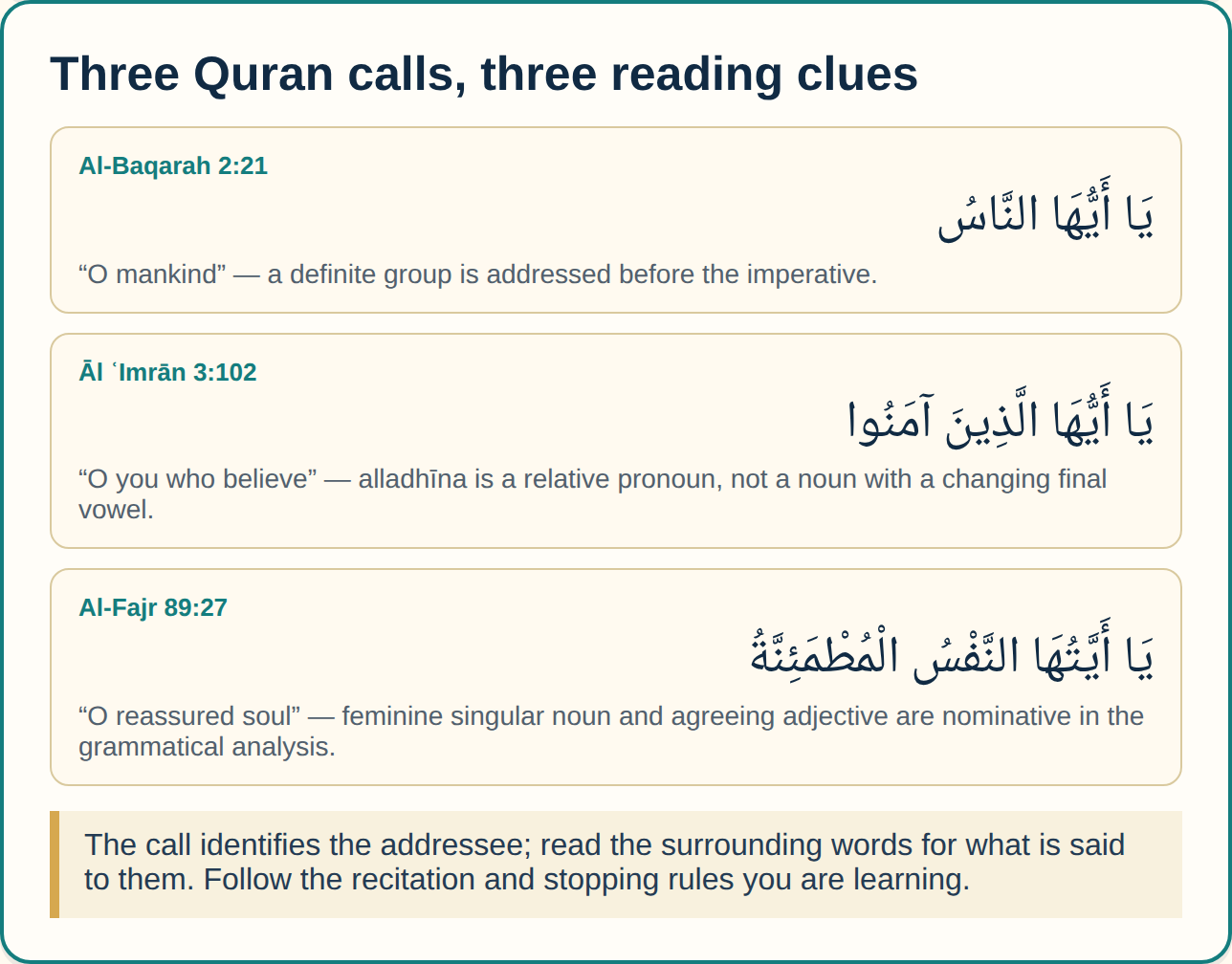
A familiar Quranic pattern is يَا أَيُّهَا النَّاسُ اعْبُدُوا رَبَّكُمُ in 2:21: “O mankind, worship your Lord.” The call is directed to النَّاسُ (“the people/mankind”), and the imperative follows it. Here أَيُّهَا is part of the formal address construction; do not translate every piece as if it were an independent English word.
In 3:102, يَا أَيُّهَا الَّذِينَ آمَنُوا addresses “O you who believe.” The word الَّذِينَ is a relative pronoun (“those who”), not a noun with an ordinary visible final ḍamma. Its grammatical role is understood from the construction. If this phrase is new, Quranytime’s guide to Quranic relative pronouns such as الَّذِينَ can help you separate the call from the description of the group.
A feminine example appears at the start of 89:27: يَا أَيَّتُهَا النَّفْسُ الْمُطْمَئِنَّةُ, “O reassured soul.” The noun النَّفْسُ and its adjective الْمُطْمَئِنَّةُ are feminine singular and nominative in the Corpus’s grammatical analysis. That makes the phrase a useful reminder that the descriptive word remains connected to the noun; review Arabic adjective agreement in gender, number, and case for the matching clues.
The Quranic Arabic Corpus annotates يَا as a vocative particle and gives case notes for these constructions. Its vocative-particle documentation and Quran 89:27 example are a useful next reference if you want to inspect the grammatical labels word by word. The Corpus is a linguistic aid; for recitation, follow your teacher and the established reading tradition.
Why the ending after يا can change
Beginners sometimes memorize either “put a ḍamma after يَا” or “the vocative is accusative.” Neither statement covers every pattern. The addressee’s type matters. Traditional grammar distinguishes several common forms, and a full treatment of their dual, plural, irregular, and classical uses is more than a beginner needs for a first reading.
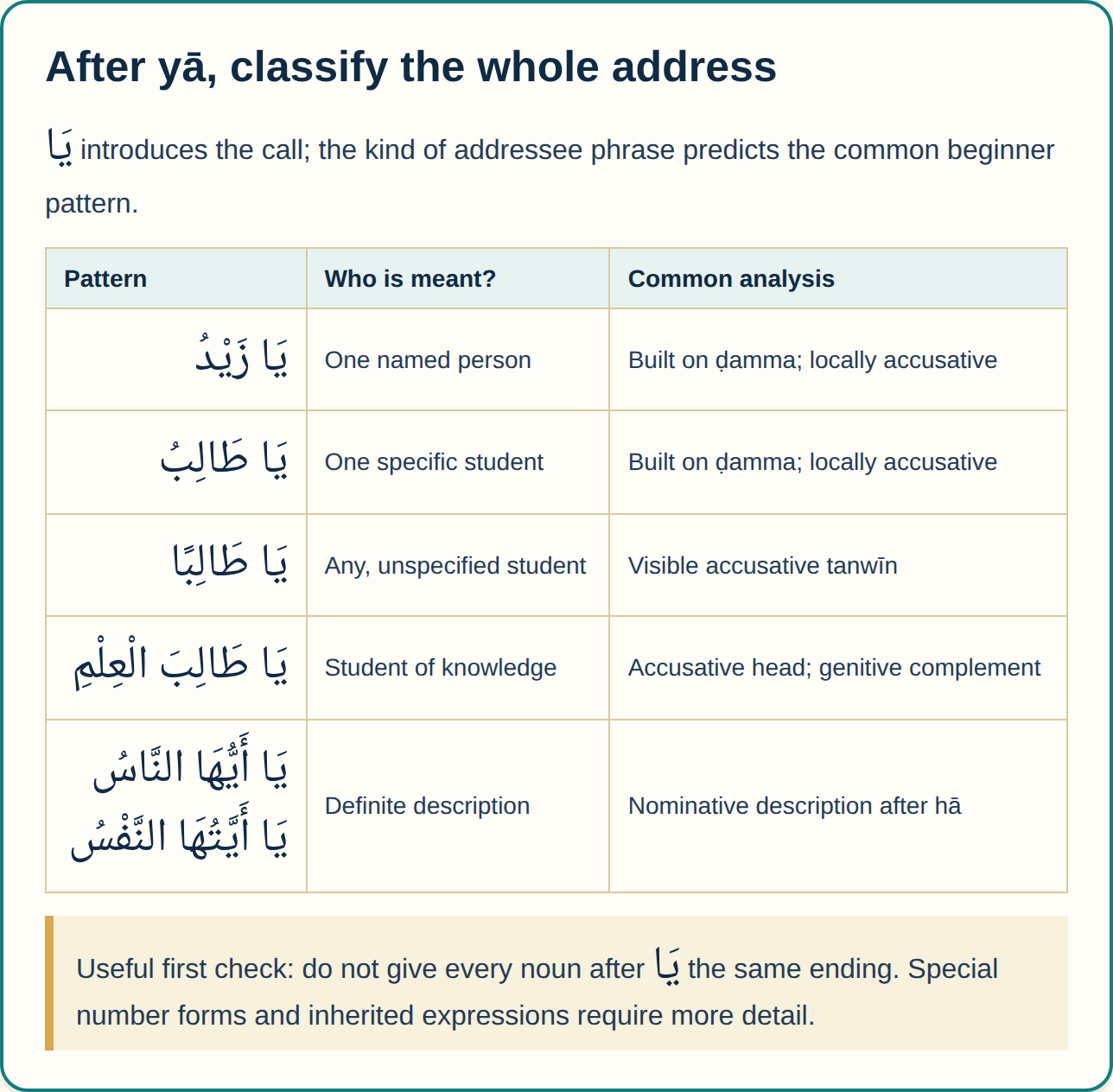
- A standalone singular name: يَا زَيْدُ (“Zayd!”). A singular proper name is commonly described as built on ḍamma in the syntactic position of an accusative vocative: mabnī ʿalā al-ḍamm fī maḥall naṣb (مبني على الضم في محل نصب). So the ending resembles a nominative marker, but it is not simply an ordinary subject of a sentence.
- A specific person named by a common noun: يَا طَالِبُ can call one particular student you have in mind. In the singular, this intended indefinite follows the same built-on-ḍamma pattern.
- An unspecified call: يَا طَالِبًا can address any student rather than one identified person. A regular singular indefinite is visibly accusative, commonly with fatḥa and tanwīn.
- An iḍāfa (construct phrase): يَا طَالِبَ الْعِلْمِ (“O student of knowledge”) has an accusative first noun, طَالِبَ, followed by the genitive complement الْعِلْمِ.
- A phrase-complement address: يَا رَاغِبًا فِي الْخَيْرِ (“O one who seeks good”) has an overt accusative ending on رَاغِبًا, while the following prepositional phrase completes its meaning. This resembles a construct in needing more words, but it is not an iḍāfa.
These are core teaching patterns, not a license to infer every ending from a translation. Duals, sound plurals, irregular names, and inherited expressions can show different visible signs or special usage. For a separate introduction to how Arabic endings express grammatical roles, see Arabic case endings in Quranic reading.
How يا أيها and يا أيتها work
In ordinary formal Modern Standard Arabic, a definite description with الـ is commonly addressed with يَا أَيُّهَا before a masculine form or يَا أَيَّتُهَا before a feminine one: يَا أَيُّهَا الْمُعَلِّمُ (“O teacher”) and يَا أَيَّتُهَا الْمُعَلِّمَةُ (“O female teacher”). The form أَيُّهَا is also used with many masculine or mixed groups; the following description supplies the number and meaning.
A useful beginner parse is to treat أَيّ or أَيَّة as the vocative element and the definite noun or description after هَا as a nominative follower. Traditional grammatical accounts describe the exact relationship of that follower in different terms, so beginners should focus on the practical clue: in يَا أَيُّهَا النَّاسُ, النَّاسُ is not made visibly accusative just because the expression begins with يَا.
This is a useful formal pattern, not an absolute claim about every historical or lexicalized expression. For example, the familiar direct address يَا اللَّهُ has special conventional usage. Avoid turning such an exception into a rule that any definite noun can always follow يَا directly in ordinary formal prose. Also distinguish the vocative from an interrogative: if you are unsure whether a phrase asks a question or calls someone, compare its structure with Arabic question words and interrogative particles.
Read the address, then the message
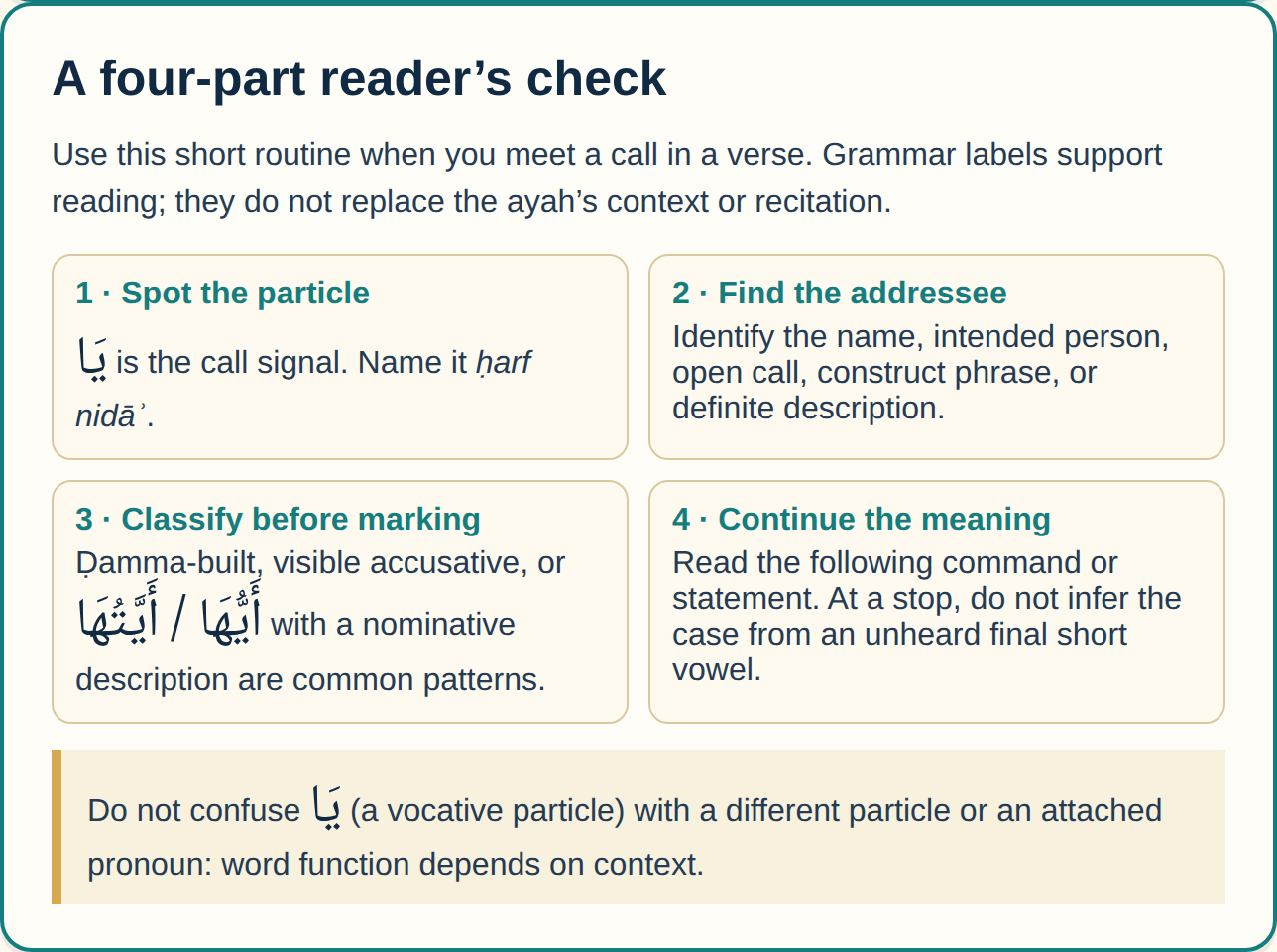
When you encounter a vocative in an ayah, make two passes. First find the addressed person or group. Then read the words that tell them what is said, asked, or commanded. In 2:21, the vocative helps identify the audience before the imperative اعْبُدُوا. In 3:102, it frames the phrase “those who believe” before the instruction that follows. The call is a grammatical doorway into the message, not a replacement for the surrounding context or a standalone translation of the whole verse.
For a first reading, mark these clues in your Mushaf or lesson notes: the particle يَا; the form of the addressee; any visible ending; and the next verb or sentence. Then check whether a description follows the address phrase. This is where knowing how demonstrative pronouns point to a noun can help you avoid confusing a demonstrative phrase with a vocative construction. When you return to recitation, Quranytime’s Quran reading and Tajweed lessons provide a place to practise the actual connected and stopping forms with an instructor.
Common mistakes to avoid
Do not give every vocative the same ending. First classify the addressee: standalone singular name, a specific intended common noun, an unspecified call, an iḍāfa, or a noun completed by a phrase. Do not call a name after يَا an ordinary subject. Its ḍamma-like form has a special vocative analysis. Do not label every word after يَا accusative. In يَا أَيُّهَا النَّاسُ, the definite description is nominative. Do not treat every following phrase as an iḍāfa. A prepositional phrase can complete a call without being a genitive construct.
Finally, do not confuse grammatical analysis with what you hear at a pause. When a reader stops, a final short vowel or tanwīn may not be pronounced, even though the grammatical role remains. The end-of-ayah reading should follow the rules of the recitation being learned; it is not an invitation to add a sound just to make the case visible. Review case-ending examples separately, and ask a qualified teacher when you need help connecting syntax to recitation.
Quick practice
Classify each call before choosing an ending: (1) يَا زَيْدُ; (2) يَا طَالِبُ said to one student you can see; (3) يَا طَالِبًا calling for any student; (4) يَا طَالِبَ الْعِلْمِ; and (5) يَا أَيُّهَا النَّاسُ. Answers: (1) standalone proper name, built on ḍamma in the accusative position; (2) a specific intended indefinite, same basic singular pattern; (3) an unspecified indefinite with visible accusative tanwīn; (4) iḍāfa with an accusative head and genitive complement; (5) formal definite-address construction with a nominative description after هَا. In connected speech, listen for what is actually recited; in a pause, the last short vowel may not be heard.
Learning the Arabic vocative particle يَا becomes easier once you identify the addressee and classify the whole phrase before looking at its ending. If you would like a teacher to check your Quran and Arabic reading, book your free trial class.