

“The director came” leaves open whether a writer is speaking loosely about the director’s office or an actual visit. “The director himself came” closes that gap. “The students passed” may describe a group broadly; “the students, all of them, passed” explicitly includes the whole group. Arabic has noun-based expressions that make these distinctions precise.
This lesson explores tawkeed maʿnawi, semantic reinforcement, through نَفْس, عَيْن and كُلّ. Its practical purpose is to help you read what is being reinforced: a person’s actual identity, or a group’s completeness. It is separate from the emphasis-particle lesson, which covers forms such as inna, lam and qad. Here the reinforcing expression is a noun or noun-based form that follows another expression.
Read two short reports and ask what changed
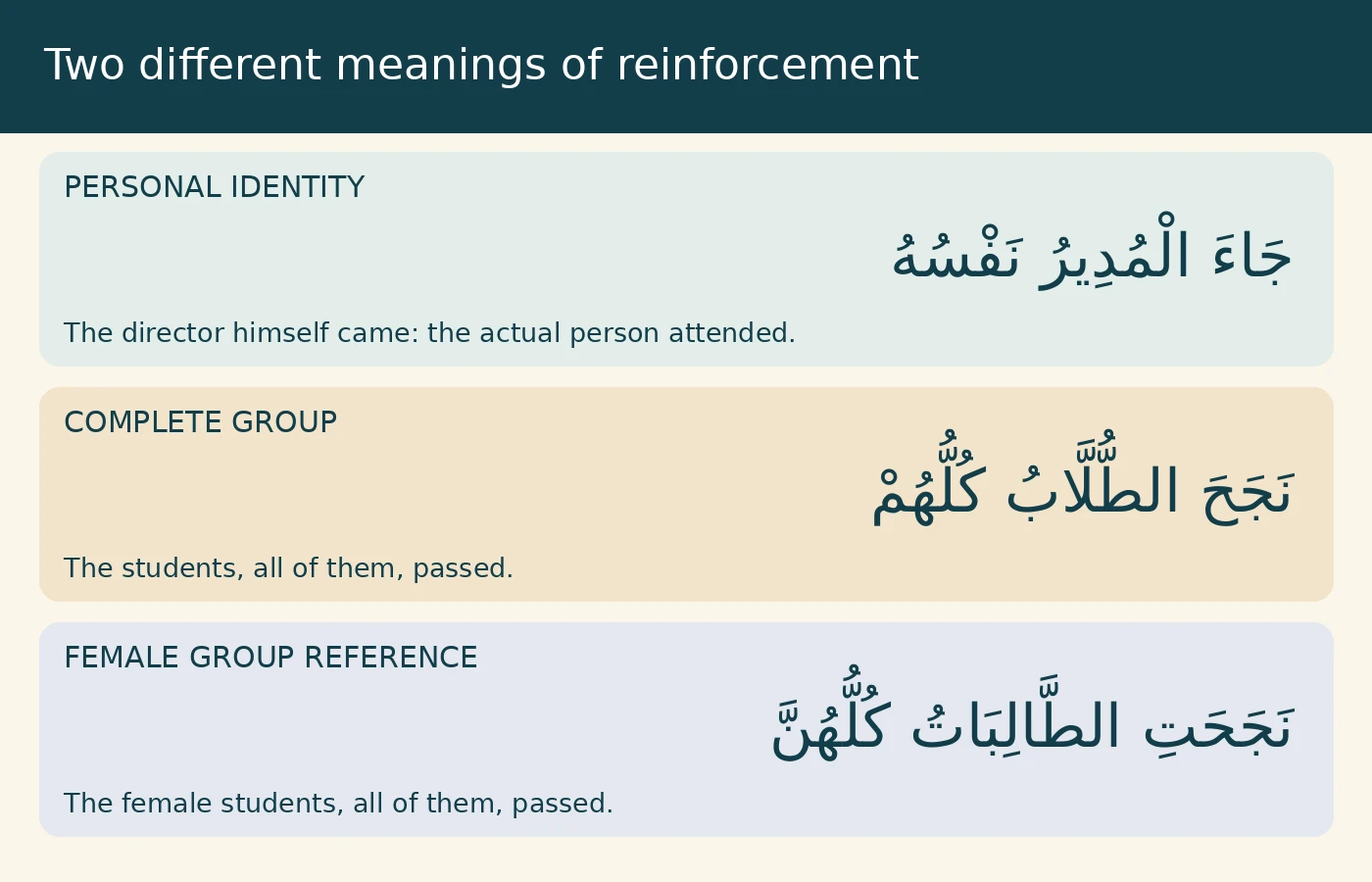
Report A, composed for practice: جَاءَ الْمُدِيرُ — “The director came.” Report B: جَاءَ الْمُدِيرُ نَفْسُهُ — “The director himself came.” Both describe the same basic event. The added نَفْسُهُ reinforces that the director in person is the intended participant. It is not another visitor arriving alongside him.
Now compare نَجَحَ الطُّلَّابُ, “The students passed,” with نَجَحَ الطُّلَّابُ كُلُّهُمْ, “The students, all of them, passed.” The second version explicitly reinforces completeness within the group being discussed. It does not automatically mean every student anywhere, in every year. The surrounding discourse identifies which students the statement concerns.
Do not translate these additions merely by making your English voice louder. They contribute a particular clarification. In your notebook, write either “the person in person” or “the entire relevant group,” then test whether that describes the Arabic expression’s job. Accurate scope is more useful than a vague label such as “extra emphasis.”
The reinforced noun lends its case to the reinforcement
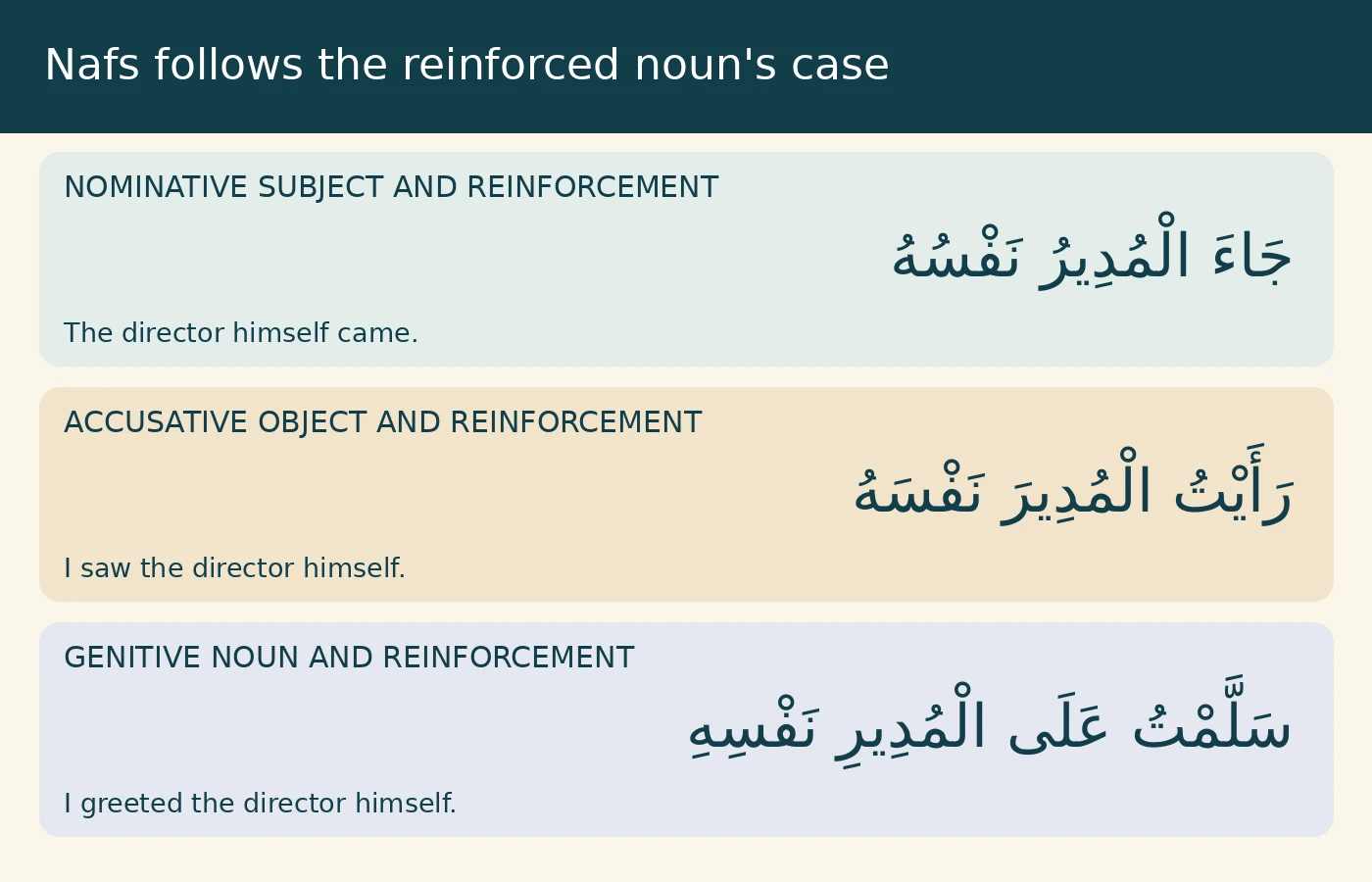
Use the director report in three grammatical environments. جَاءَ الْمُدِيرُ نَفْسُهُ has a nominative subject and nominative reinforcement. رَأَيْتُ الْمُدِيرَ نَفْسَهُ, “I saw the director himself,” has an accusative object and accusative reinforcement. سَلَّمْتُ عَلَى الْمُدِيرِ نَفْسِهِ, “I greeted the director himself,” has a genitive noun after عَلَى and genitive reinforcement.
The visible change is on نَفْس: نَفْسُ, نَفْسَ, نَفْسِ. The attached pronoun points back to the director. The suffix’s form also follows Arabic pronunciation rules: after the kasrah here, the familiar third-person suffix is read -hi. Avoid memorizing only the first example’s sound and repeating it after every verb and preposition.
The case-ending lesson explains why the sentence role changes case. In this particular construction, the reinforcement follows the noun it reinforces. It does not choose a new case independently just because it comes later in the sentence. Identify the earlier noun’s role, then explain the following relationship.
The pronoun must lead you back to the right referent
In جَاءَ خَالِدٌ نَفْسُهُ, the suffix ـهُ refers to Khalid. In جَاءَتْ سَارَةُ نَفْسُهَا, “Sarah herself came,” ـهَا refers to Sarah. In حَضَرَ الطُّلَّابُ أَنْفُسُهُمْ, “The students themselves attended,” the plural expression and ـهُمْ refer back to the students. These are composed practice examples.
Do not choose the suffix from the word نَفْس in isolation. Choose it from the referent being reinforced. A statement about the female students uses a suitable feminine plural reference, as in حَضَرَتِ الطَّالِبَاتُ أَنْفُسُهُنَّ. The attached-pronoun guide helps you read the suffix forms without confusing them with independent subjects.
It is useful to draw a small arrow from the suffix to the earlier noun in a practice copy. If you cannot identify that referent, you have not yet explained the reinforcement. In a longer paragraph, the nearest noun is not always the intended one; use agreement, the sentence structure and the actual meaning together.
Ayn does not always mean an eye
عَيْن has several lexical uses. In a suitable reinforcing expression, جَاءَ الْمُدِيرُ عَيْنُهُ can mean “The director himself came,” reinforcing the person’s actual identity. Translating عَيْنُهُ mechanically as “his eye” would give the wrong reading in that context.
This does not mean that عَيْن is always a reinforcement word. In a sentence discussing a person’s eye, it can retain that ordinary lexical meaning. A dictionary lists possibilities, while the construction selects among them. Ask whether the expression follows a referent and reinforces its identity, or whether it names a separate body part with a role of its own.
For a controlled exercise, use نَفْس first until the role and pronoun relationship are clear. Then compare عَيْن in the same simple pattern. You are learning a contextual reading, not replacing one dictionary definition permanently with another. If a real text permits multiple analyses, record the uncertainty and check a reliable explanation of that passage.
Kull before a noun is a different arrangement
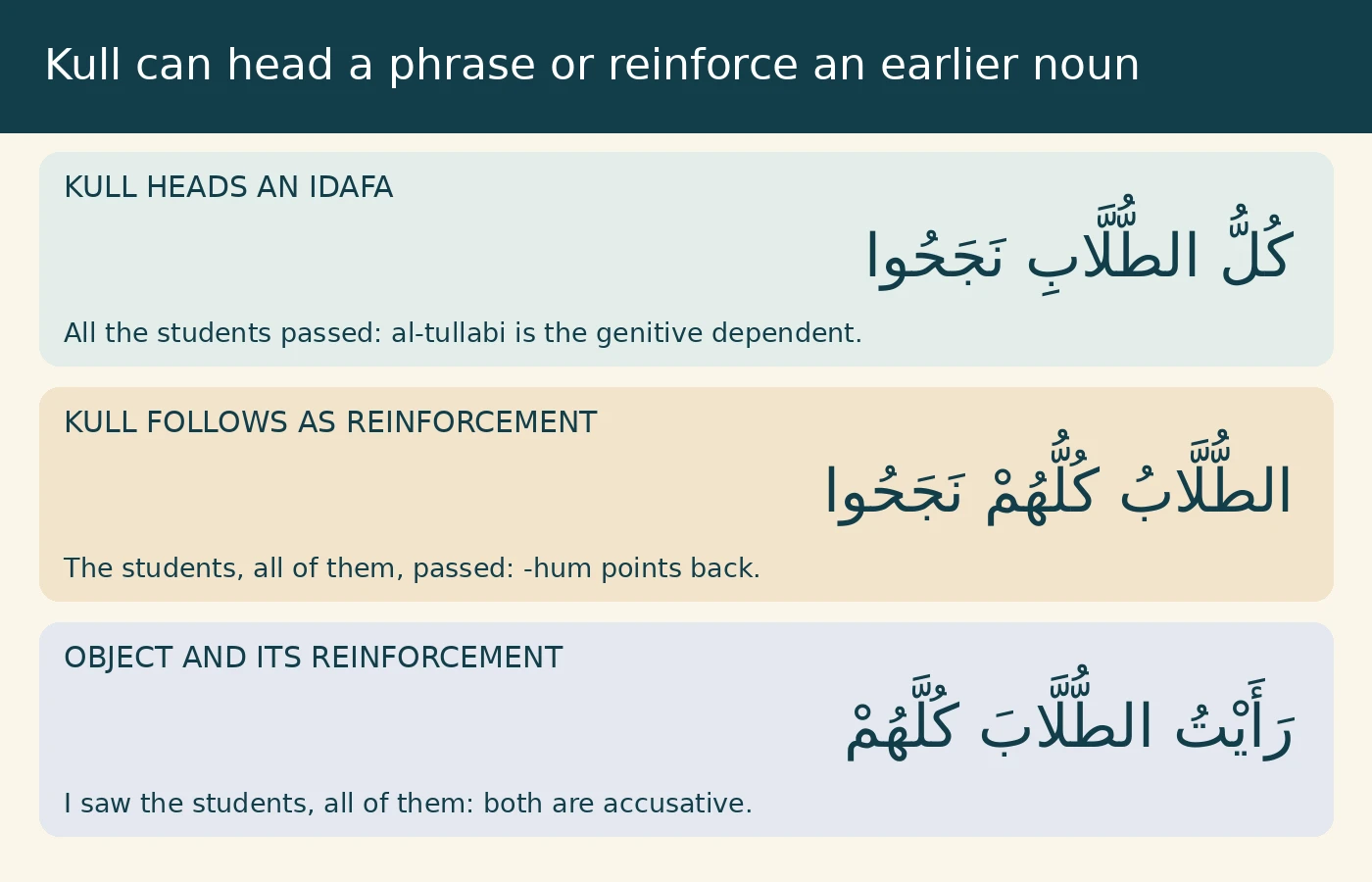
كُلُّ الطُّلَّابِ نَجَحُوا means “All the students passed.” Here كُلّ begins the noun phrase and is followed by a genitive dependent. Compare الطُّلَّابُ كُلُّهُمْ نَجَحُوا, “The students, all of them, passed.” In the second arrangement, the later كُلُّهُمْ reinforces the preceding group.
The overall messages can be close, but the word-by-word relationships are different. In كُلُّ الطُّلَّابِ, the students are the dependent of كُلّ. In الطُّلَّابُ كُلُّهُمْ, كُلّ follows the students as reinforcement and contains a pronoun referring back to them. The idafa lesson supplies the dependency needed to analyze the first construction.
Now make the group an object: رَأَيْتُ الطُّلَّابَ كُلَّهُمْ, “I saw the students, all of them.” كُلَّ follows the accusative noun. In رَأَيْتُ كُلَّ الطُّلَّابِ, the head كُلَّ is the object and the following الطُّلَّابِ is genitive. The two sentences provide a precise test: you cannot label every occurrence of “students” the same way just because the English translation contains “all.”
Do not mistake reinforcement for an adjective or an object
An adjective supplies a quality: الْمُدِيرُ الْجَدِيدُ, “the new director.” نَفْسُهُ instead reinforces the identity of the person already named. Both can follow a noun and reflect its case, so case agreement alone does not distinguish them. The adjective lesson covers the describing relationship. Ask what new information the following expression contributes.
Compare رَأَيْتُ الْمُدِيرَ نَفْسَهُ, “I saw the director himself,” with عَرَفَ الْمُدِيرُ نَفْسَهُ, “The director knew himself.” In the first, the phrase reinforces the object already named. In the second, نَفْسَهُ is itself what the director knew: a direct object referring back to the subject. The same written form has a different syntactic job.
Use a substitution question: does the sentence already contain the participant that the following expression reinforces? Or does نَفْس supply a necessary object relationship of its own? This question is an aid for clear practice examples, not a universal shortcut. A full parse and context may be needed in advanced texts.
Quran 15:30: completeness expressed twice
Quran 15:30 reads فَسَجَدَ الْمَلَائِكَةُ كُلُّهُمْ أَجْمَعُونَ. The wording reinforces the completeness of the angels’ prostration. The Corpus morphology identifies كُلُّهُمْ as a nominative noun plus a third-person masculine plural possessive pronoun. أَجْمَعُونَ is nominative too.
The Corpus grammatical analysis of 15:30 explains أَجْمَعُونَ as further reinforcement of كُلُّهُمْ. Notice that this reinforcing form does not carry the same attached-pronoun pattern as كُلُّهُمْ. Do not apply the suffix explanation for nafs and kull mechanically to every possible reinforcement word.
Read the following verses and trusted tafsir for the narrative context and how the next statement relates to it. Grammar helps identify the wording’s structure; an isolated reinforcement label cannot settle every interpretive question about a passage. Keep your language note specific to the forms you have actually analyzed.
Edit a report whose scope is unclear
A fictional school report says “The director attended. The female students completed the exercise.” The writer now clarifies that the director attended in person and that every female student in the group completed the task. Rewrite the report with appropriate reinforcement, without changing the participants or inventing extra achievements.
One composed answer is حَضَرَ الْمُدِيرُ نَفْسُهُ. أَكْمَلَتِ الطَّالِبَاتُ كُلُّهُنَّ التَّمْرِينَ. The first addition reinforces personal identity; the second reinforces the whole relevant group. In both, the reinforcement follows the nominative subject. The object التَّمْرِينَ belongs to the completion verb and is not what كُلُّهُنَّ reinforces.
To test understanding, change the first sentence to “I met the director himself”: قَابَلْتُ الْمُدِيرَ نَفْسَهُ. Explain why the ending changes. Then change only the second sentence’s intended meaning to “The students themselves completed the exercise,” emphasizing their personal participation rather than explicitly stressing everyone. Use أَنْفُسُهُنَّ in the composed female-student example and explain the difference you intend.
Identity is not the same as being alone
“The director himself came” does not necessarily mean that no one accompanied him. The reinforcement confirms that the actual director was present. A secretary or visitor could still have come with him. Do not make the English paraphrase stronger than the Arabic information you have identified. To express being alone, Arabic has other expressions and constructions that require their own analysis.
Likewise, “the students, all of them” refers to the complete relevant group, but the sentence still needs a context to identify that group. If a paragraph has been discussing the students in one class, the reinforcement need not extend the claim to every student in the school. Scope depends on the noun phrase and discourse together.
Practise with a small drawing of four fictional participants, not real student records. Label three as the group discussed in a short report and leave the fourth outside that group. Write an English statement equivalent to “The students, all of them, attended.” Explain which three it covers and why the fourth is irrelevant to that particular reference. The drawing makes a scope decision visible without turning grammar into an unsupported factual claim.
Follow the suffix through a change of speaker
In a teacher’s report, “the students themselves” uses a third-person reference back to the students. If those students speak as “we ourselves,” the pronoun relationship changes with the viewpoint. Do not copy a third-person suffix simply because the same people are involved in the story. Identify who is speaking and how the earlier expression refers to the group.
The Arabic pronoun chart can help you establish person, number and gender before choosing a suffix. In practice, first paraphrase the referent in English, then return to the Arabic construction. A correct case ending does not rescue a pronoun that points to the wrong people.
For a final explanation challenge, give a partner two readings: one that reinforces a participant’s identity and one that claims the participant acted alone. Ask which reading the actual Arabic example supports. Require a reason from the wording, not a guess about what probably happened. This trains restraint in translation as well as recognition of the grammatical pattern.
What counts as a complete explanation?
For each example, state the referent, the contribution of the reinforcement, its case, and the source of that case. If you identify only a suffix, your analysis is incomplete. If you identify only the meaning “all,” you may have missed whether كُلّ heads a phrase or follows as reinforcement. If you choose the case correctly but attach a pronoun to the wrong group, the sentence may convey a different reference.
Try the analysis in both a verbal report and a nominal sentence. The framework can change while the reinforcing relationship remains. For a neutral description of the core pattern and case-following, see Al Jazeera Learning Arabic’s tawkeed lesson.
For guided work on a passage or formal-Arabic paragraph, Book a Free Trial Class. Bring two sentences with the same reinforcement word but different roles. Explaining the difference will help you read for reference and scope, rather than treating every repeated idea as interchangeable emphasis.