

In Quranic Arabic, small particles can change how a whole statement sounds: asserted, confirmed, or presented as a possibility. Learners often ask whether قَدْ (qad) means “already,” whether لَقَدْ (laqad) is simply a stronger version, and what the short لَـ (la-) adds. The answer depends on the word that follows and the sentence around it—not on one English translation.
This guide compares four common forms—إِنَّ (inna), emphatic لَـ, قَدْ, and لَقَدْ—with Quran examples. The goal is practical recognition: spot the particle, notice the grammatical pattern, and then read the full clause before choosing a translation. These are grammar observations for learners, not a rule that every particle must receive the same English word.
At a glance: what to look for
Start by looking immediately to the right of the particle. Is it a noun phrase, a past-tense verb, or an imperfect verb? Next, check whether another particle is present. These clues help narrow the function, but context still matters.
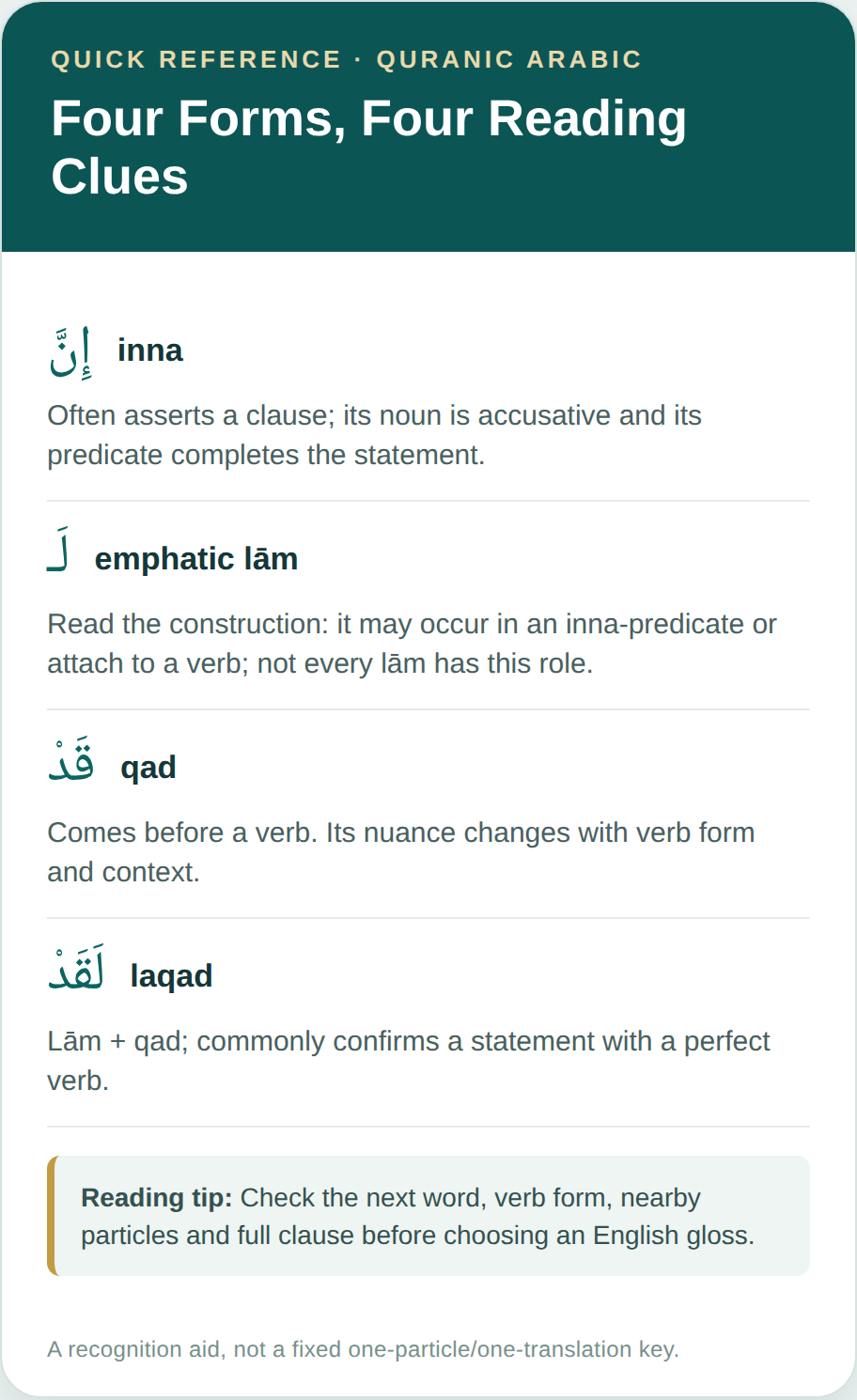
The card is a first-pass comparison, not a complete grammar of every lām or every use of qad. In particular, the same-looking lām appears in different grammatical constructions. Identify its neighbors before naming its function.
1. إِنَّ (inna): an asserting particle that changes the clause
إِنَّ commonly introduces an asserted statement and is often translated “indeed,” “truly,” or “surely.” It also has a grammatical job: its noun (the ism inna) is accusative, while its predicate (the khabar) is nominative, whether the predicate is a single word or a larger phrase. So do not treat inna as a meaning-only decoration; it affects how the clause is parsed.
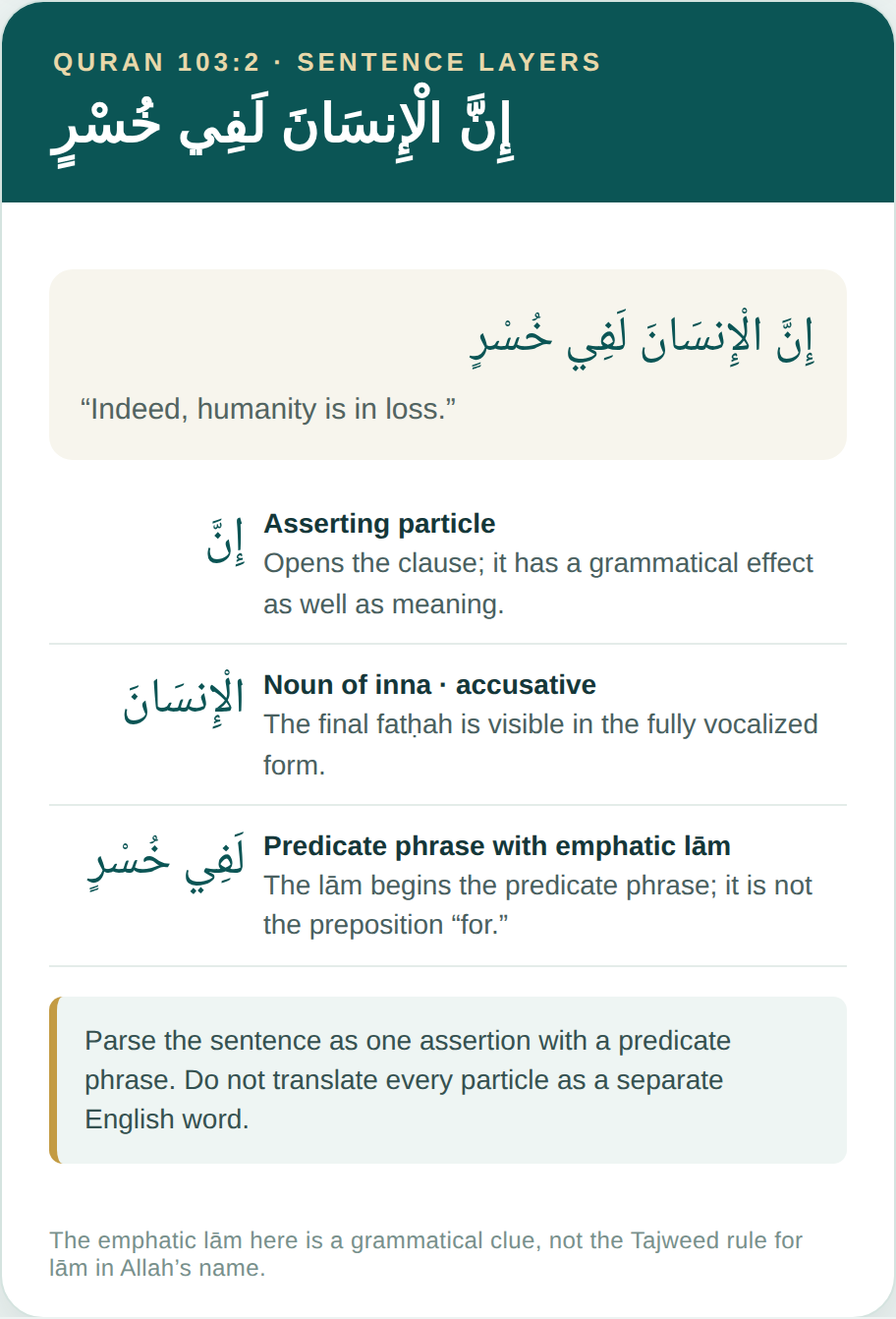
A familiar example is إِنَّ الْإِنسَانَ لَفِي خُسْرٍ in Quran 103:2: “Indeed, humanity is in loss.” Here al-insāna is the noun of inna. The predicate is the prepositional phrase fī khusr (“in loss”), and a lām appears at its front: لَفِي. In this construction, the emphatic lām accompanies inna in the predicate; it is not the preposition “for.” The layers reinforce the assertion, but English can express the sentence naturally without translating each particle separately.
If you want a fuller explanation of the case-changing pattern, see our guide to inna and its sisters in Quranic Arabic. For the clause structure around a noun and predicate, review nominal sentences in Quranic Arabic.
2. Emphatic لَـ (la-): read the construction, not just the letter
A lām with fatḥah can mark emphasis, but Arabic has several lām constructions. One useful Quran example is the lām inside the predicate of an inna clause above: إِنَّ … لَفِي. Another is the emphatic lām attached to a verb in Quran 26:49, where Pharaoh says لَأُقَطِّعَنَّ (la-uqaṭṭiʿanna), “I will surely cut off.” That verb also carries the emphatic nūn at its end.
The morphology entry for this word in the Quranic Arabic Corpus analysis of 26:49 separates the emphatic prefix lām, the imperfect verb, and the suffix nūn of emphasis. It is a useful example of why the whole word matters: two emphasis markers can occur around a verb. The lām in la-uqaṭṭiʿanna is not the same function as every other lām you meet.
For contrast, the lām in the divine name has a well-known heavy/light pronunciation rule in recitation. That is a Tajweed question, not the grammatical emphasis discussed here; see the separate guide to the lām in Allah’s name so the two topics stay distinct.
3. قَدْ (qad): the following verb is a key clue
قَدْ comes before a verb, and its interpretation shifts with the verb form and context. With a perfect (often called past-tense) verb, it commonly presents an action as realized or confirmed; translations may use “indeed,” “certainly,” or no separate equivalent. With an imperfect verb, it can express possibility, expectation, or a recurrent/occasional sense depending on the clause. Therefore, a dictionary gloss such as “already” is not a safe automatic substitution.
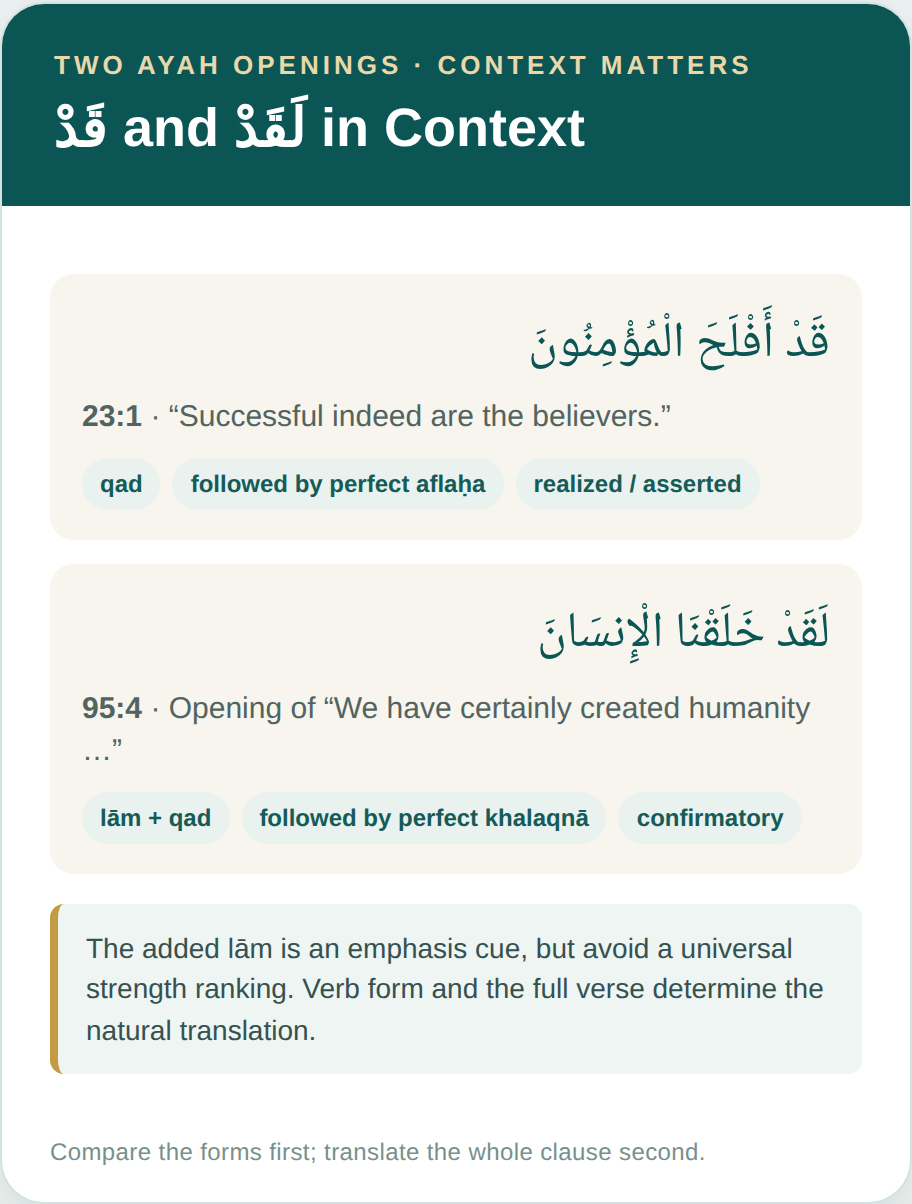
Quran 23:1 begins قَدْ أَفْلَحَ الْمُؤْمِنُونَ (qad aflaḥa al-muʾminūn), translated “Successful indeed are the believers.” The perfect verb aflaḥa follows qad; the verse asserts their success. Here “indeed” fits the translation, but that does not mean qad always maps to that one English adverb. You can also find qad before imperfect verbs; read those examples within their clause rather than carrying over the perfect-verb gloss.
This is also why “already” and “emphasis” should not be treated as rival fixed definitions. Translators may choose “already” when the context foregrounds prior completion, while another sentence may use qad to present a realized or possible action. Tense, particles nearby, and the passage’s meaning all contribute.
4. لَقَدْ (laqad): a combined form, not a magic translation
لَقَدْ combines a lām with qad. With a perfect verb, it commonly adds an emphatic, confirmatory tone. In Quran 95:4, لَقَدْ خَلَقْنَا الْإِنسَانَ فِي أَحْسَنِ تَقْوِيمٍ begins a statement often rendered, “We have certainly created humanity in the best form.” The opening particle cues confirmation; the rest of the verse supplies the statement being confirmed.
It is helpful to compare qad and laqad, but avoid a rigid “one is always weak, the other always strongest” ranking. The added lām is an emphasis cue, yet emphasis is interpreted in context and may already be reinforced elsewhere in the verse. Ask: What verb form follows? Is there an oath or another particle? What is the full clause asserting?
For another useful grammar contrast, our guides to Quranic Arabic verb forms and negation particles such as lā, lam, lan and mā explain why a particle’s neighboring verb and sentence pattern matter.
A short method for reading an emphasis particle
- Keep the full word. Do not detach a prefixed lām from what follows until you have checked whether it belongs to a compound such as laqad, an emphatic verbal form, a preposition, or another lām construction.
- Check the next word. Inna is followed by its noun; qad is followed by a verb. A lām may attach directly to a verb or occur at the start of a predicate phrase.
- Look for companions. In inna … la-fī, the lām appears in the predicate. In la-uqaṭṭiʿanna, it precedes a verb that also ends in nūn of emphasis. With laqad, notice both the lām and qad.
- Translate the clause, not each mark. Try a natural English rendering, then check whether “indeed,” “certainly,” “may,” or “already” best reflects this context. Sometimes English conveys the emphasis through word order or tone instead.
Particles also sit beside other pieces of grammar. Quranic Arabic conjunctions such as wa and fa show how clauses connect, while conditional sentences in Quranic reading help you distinguish an assertion from an “if” clause. These are useful cross-checks when the particle’s role is not obvious in isolation.
Quick practice: identify the cue before translating
Try the four examples without beginning from an English gloss:
- قَدْ أَفْلَحَ (23:1): identify qad, then note that the following verb is perfect.
- إِنَّ الْإِنسَانَ لَفِي خُسْرٍ (103:2): mark the noun of inna, then the lām on the predicate phrase.
- لَقَدْ خَلَقْنَا (95:4): recognize the combined opening and the perfect verb; express the confirmation naturally.
- لَأُقَطِّعَنَّ (26:49): locate the emphatic lām, verb, and emphatic nūn. Then compare the whole sentence with a trusted morphology note.
A good answer names the pattern and explains why it fits; it does not merely say “this particle means surely.” When a sentence remains unclear, compare the full verse and its surrounding lines, then ask a qualified Arabic or Quran teacher to check your parsing. You can book a free Quran and Arabic trial class for guided practice with reading and grammar.
Key takeaway
Inna asserts a clause and affects its case structure; emphatic lām has to be identified by its construction; qad changes its nuance with the following verb; and laqad combines lām and qad as a common confirmation pattern. Let the Arabic form, nearby words, and verse context guide your translation. The English equivalent is a conclusion—not the starting definition.
Watch: how qad changes with the verb
This short lesson from the Five College Center for World Languages focuses on qad and laqad, complementing the Quran examples above.