
Arabic learners often see both ح and ه written as “h” in English transliteration. That shorthand can hide a real sound difference. In Quran reading, ḥāʾ (ح) is articulated from the middle part of the throat, while hāʾ (ه) comes from the deepest part. The goal is not to make either sound louder or harsher; it is to give each letter its own natural place and airflow.
This guide focuses on the practical question many beginners ask: what is the difference between ح and ه, and how can I practise them without straining my throat? You will learn a simple contrast, hear each letter in Quran words, and follow a short listening-and-recording routine. If the Arabic sound names are new, start with our overview of the main makharij, or articulation points, in Tajweed.
Arabic ح vs ه: the difference at a glance
The letters have different makharij even though both may be represented with an English “h.” The ḥāʾ in ḥa is a deeper, constricted breath from the middle throat. The hāʾ in ha is a lighter breath from farther back, near the deepest throat. A standard Tajweed description places the two letters at different throat levels; see the Standard Arabic phonology consonant table. This distinction also matters in names: Harun begins with ه, while Muhammad contains ح. Our baby name generator with pronunciation notes highlights these sound features alongside meanings and sources.
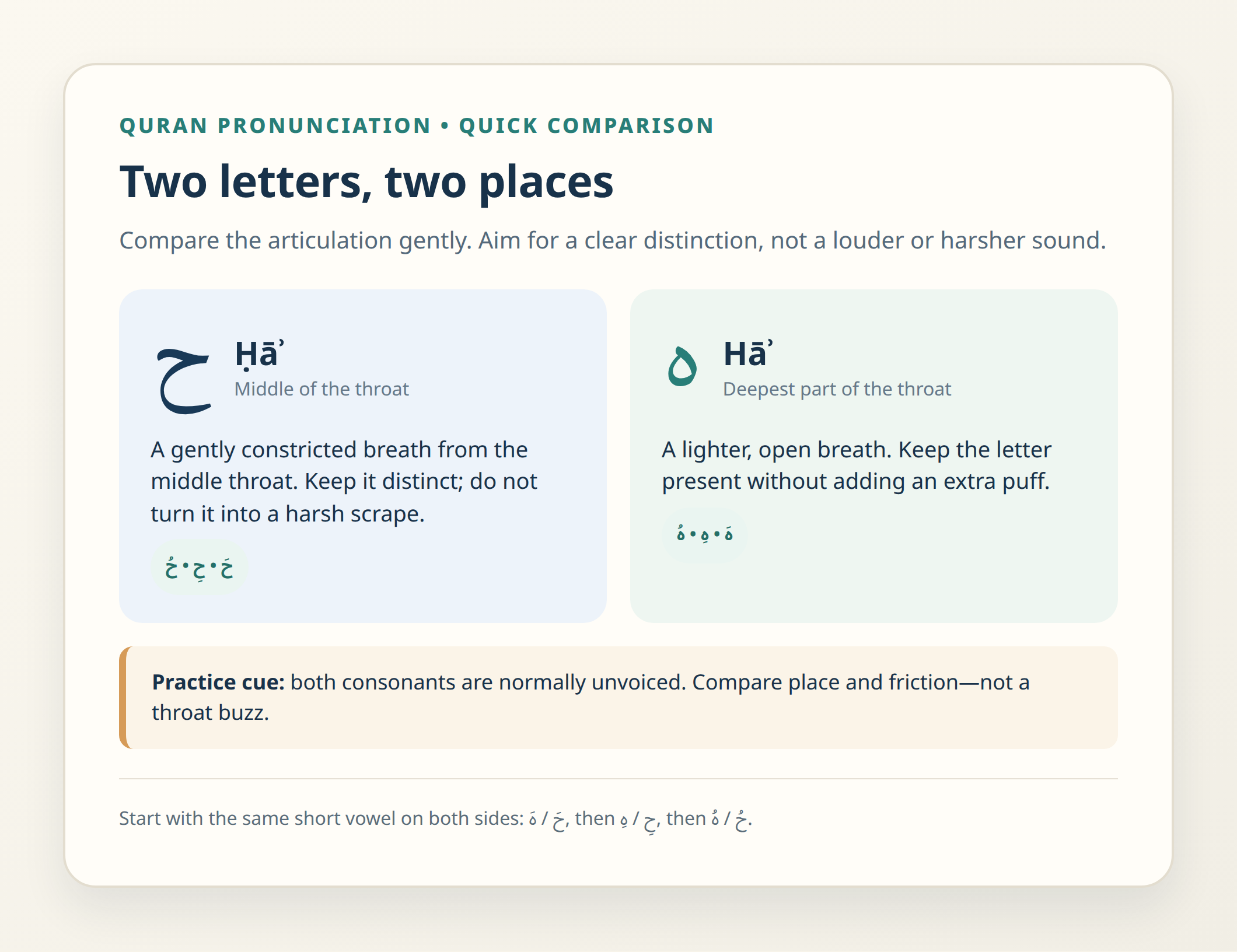
Think of this as a place-and-quality contrast, not a test of volume. Both consonants are normally unvoiced: nearby vowels can make the whole syllable feel voiced, so a “buzz test” at the throat is not a reliable way to tell them apart. Begin with the consonant alone if you can, then add the vowel lightly. Do not squeeze, scrape, or force air to manufacture a stronger ḥāʾ.
Where do ḥāʾ and hāʾ come from?
In the common Tajweed map of the throat, ه is assigned to the deepest part of the throat and ح to the middle part. These are not two spellings of one sound. Their written forms, letter names, and places of articulation are different. Our broader guide to Quran pronunciation challenges for English speakers explains why familiar Latin-letter approximations can be helpful as a first reminder, but cannot replace listening to Arabic.
A useful starting cue is to keep the hāʾ light, like a soft breath beginning a vowel, while allowing the ḥāʾ to have a gentle, deeper friction. Avoid turning ḥāʾ into خ (khāʾ): خ is a different letter, with a rougher sound formed farther forward than the middle-throat ḥāʾ. Also avoid adding a “k” or “g” onset. In a careful recitation, the aim is a clear letter—not a theatrical throat-clearing sound.
These are neighboring articulation questions, so the lesson on how to practise the Arabic letter ʿayn can help you become more aware of the throat without confusing ʿayn with ḥāʾ. Each letter still has its own sound; do not substitute one for another.
Hear the letters in Quran examples
Start by listening to the target consonant in a real word, not by relying only on Latin spelling. Read the Arabic slowly, notice the vowel mark, and listen to a qualified reciter or teacher. These examples keep the focus on the consonant while giving you familiar Quran contexts:
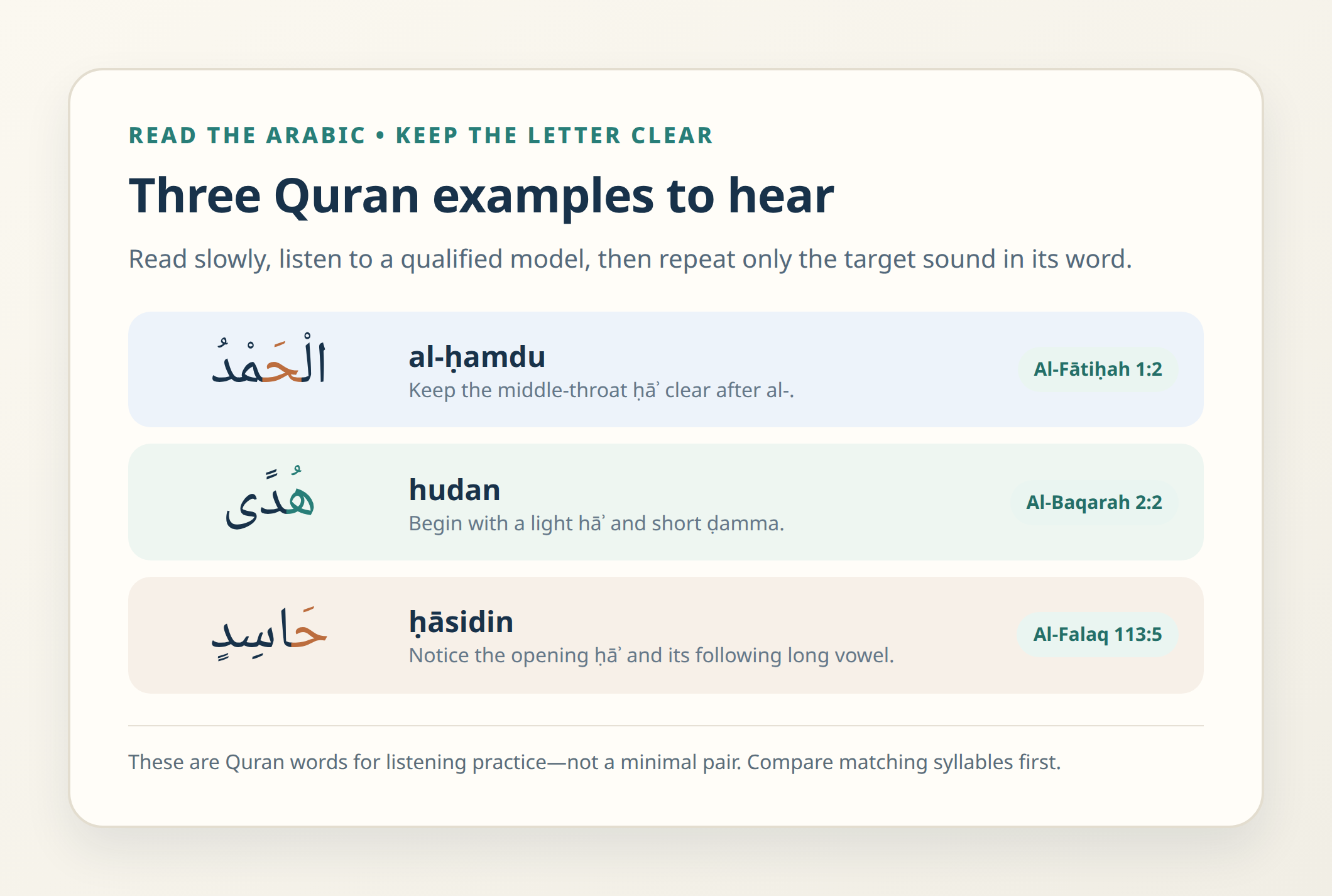
- ح in الْحَمْدُ — “al-ḥamdu,” in Al-Fātiḥah 1:2. Keep the initial ḥāʾ clear after the article; do not replace it with a light English-style h.
- ه in هُدًى — “hudan,” in Al-Baqarah 2:2. Let the hāʾ begin gently, then pronounce the short ḍamma sound. Do not add a second breathy consonant.
- ح in حَاسِدٍ — “ḥāsidin,” in Al-Falaq 113:5. Notice the opening ḥāʾ and then keep the long vowel distinct from the consonant itself.
These are examples of each letter in Quranic words, not a pair of words that differ by only one consonant. First compare the letters in matching syllables—حَ / هَ, حِ / هِ, and حُ / هُ—so the short vowel stays the same. Then read a whole word. If vowel marks are still unfamiliar, review Fatha, Kasra, Damma, Sukoon, and Tanween before you speed up.
A gentle five-minute practice routine
Practise one small contrast at a time. Use the same teacher or reciter for both letters when possible, because comparing two unrelated recordings can make differences in speed or microphone quality distract from the sound.
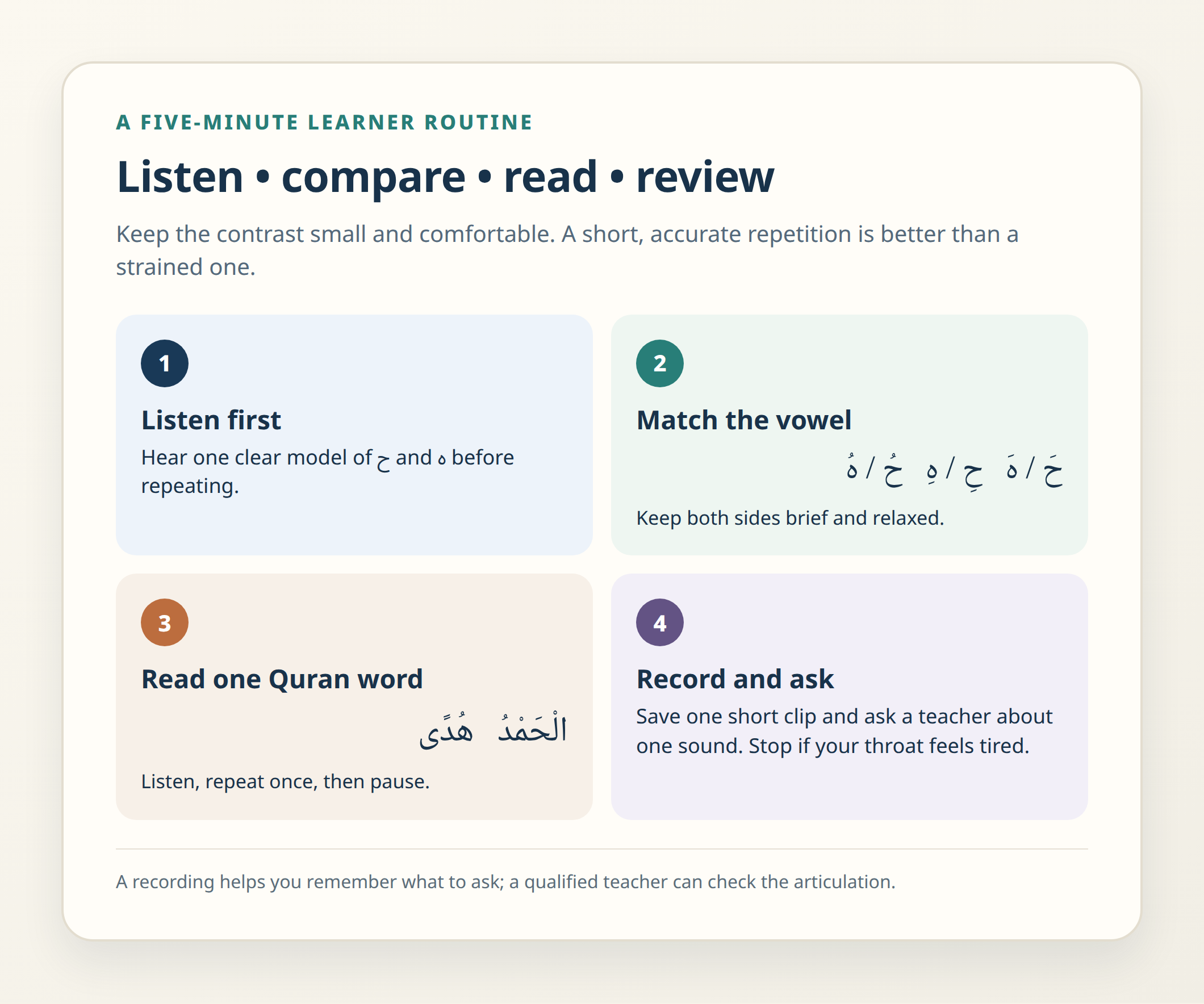
- Listen first. Hear a clear model of ح and ه. Before repeating, identify which letter you hear. The short lesson embedded below demonstrates ح and contrasts it with ه and خ.
- Alternate the same vowel. Say حَ then هَ; pause; repeat with حِ then هِ, and حُ then هُ. Keep each sound comfortable and brief. Do not push the ḥāʾ into a rasp or make the hāʾ disappear.
- Move into a Quran word. Read الْحَمْدُ, then هُدًى, slowly. Listen again, repeat once, and stop to notice whether the two target letters stayed distinct.
- Record and compare. Make a short phone recording and compare it with the same model. Keep a note of one sound to ask about rather than trying to fix every part of the recitation at once. Our guide to recording recitation for useful teacher feedback explains how to make a short clip that is easier to review.
If your throat feels tired, stop and return later at a softer volume. Pronunciation practice should not hurt. A teacher can hear distinctions that are difficult to judge from your own recording, and you can use these tips for asking your Quran teacher a clear, specific question. If the sound is not clear yet, focus on one example at a time rather than rushing through a full page; see our advice on building Quran reading fluency without rushing.
Watch a pronunciation demonstration
This lesson demonstrates the Arabic ḥāʾ and explains how it differs from hāʾ and khāʾ. Listen for the placement and keep your own practice gentle; a video can support practice, but it cannot tell you exactly what your own articulation sounds like.
After listening, practise one word and then ask for feedback. For structured support, you can book a free Quran and Arabic trial class and ask the teacher to listen specifically for the difference between ح and ه.
Three mistakes that blur the difference
- Letting Roman letters decide the sound. Some learning materials use a plain “h” for both letters. Look at the Arabic letter first; a dotted ḥ in transliteration is a useful reminder, but it cannot teach the articulation by itself.
- Making ḥāʾ loud instead of placing it well. More volume does not create a more accurate ح. Keep the effort light and the friction controlled. If the sound turns into a scrape, cough, or painful tightening, stop and return to a gentle model.
- Changing the consonant and vowel together. When comparing حَ and هَ, keep the short “a” alike; repeat the same method for kasra and damma. Otherwise, you may be reacting to a different vowel rather than hearing the consonant contrast.
When you listen back, ask one narrow question: “Can I hear a clear difference between these two letters while the vowel stays the same?” Do not judge your accent or try to copy a teacher’s vocal style. Use a clear, reliable model, and let a qualified Quran teacher check your articulation if you are uncertain. A phone recording is a memory aid, not a final pronunciation test.
Common questions about ح and ه
Is ح the same as the English letter h?
No. English “h” can be a temporary cue for ه, but ح has a distinct middle-throat articulation in Quran recitation. Latin transliteration varies: you may see “ḥ” for ح and “h” for ه. The dot under ḥ is a reminder that it is not the same consonant as plain h.
Should I make ح very strong or scratchy?
No. It should be clear and distinct, not forced. Over-tightening may make the sound uncomfortable or turn it into a different consonant. Keep the airflow controlled and ask a qualified teacher to check it if you are uncertain.
Can I learn the difference from transliteration alone?
Transliteration can remind you which letter is in a word, but spellings like “Haa,” “Ha,” and “ḥāʾ” are not always used consistently. Read the Arabic script, listen to a reliable model, and practise with feedback. For smoother progress, combine the sound work with a short routine and a teacher’s correction.
The short version is simple: ح comes from the middle throat and ه from the deepest throat. Practise them first in matching vowel syllables, then in real Quran words, listening and recording without forcing your voice. A small, accurate distinction repeated calmly is more useful than a loud or hurried attempt.