
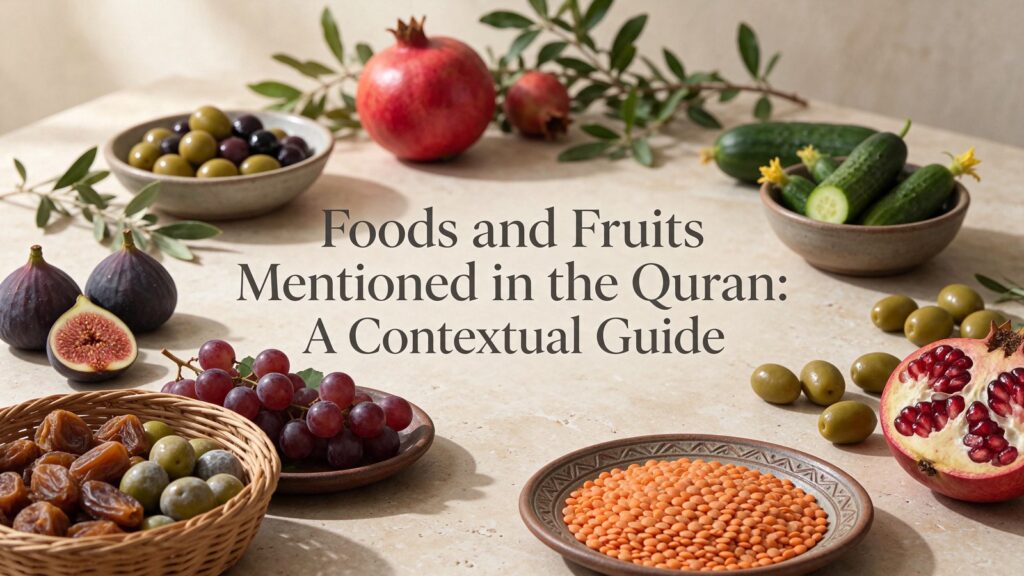
Foods mentioned in the Quran appear in a range of settings, but there is no single verse that presents a complete shopping list. These include provision in this world, a part in a story, a sign of creation, and imagery of the Hereafter. A careful inventory therefore needs to keep those settings distinct.
Among the clearest named items are dates, grapes, olives, figs, pomegranates, cucumbers, lentils, onions, herbs, milk and honey; Al-Baqarah 2:61 also contains fūm, a disputed term rendered “garlic” by some and “wheat” or “grain” by others. The Quran also mentions grains and crops generally, and describes foods and drinks of Paradise. Those references are not all the same kind of statement. This guide points to the passages, explains what each says, and avoids treating later explanations or popular lists as if they were Quranic wording.
Direct answer: The Quran names dates, grapes, olives, figs, pomegranates, cucumbers, lentils, onions, herbs/greens, milk and honey. In Al-Baqarah 2:61, fūm is translated as “garlic” in some versions, but other renderings include wheat or grain, so garlic should be treated as a possible translation rather than an undisputed item. The list depends on whether one counts only earthly food, broad categories, or descriptions of Paradise. Use the verse references below as the reliable starting point.
First, what counts as “mentioned”?
“Foods mentioned in the Quran” can mean several things: edible plants named explicitly; nourishment described without naming a particular plant; foods in a narrative; or the food and drink promised in Paradise. The Quran itself does not announce a definitive catalogue or total. A list that claims an exact number should therefore state its inclusion rules—especially whether it counts generic terms such as crops and fruit, drinks, or otherworldly descriptions.
Translation choices matter, too. In Al-Baqarah 2:61, the people ask Moses for produce from the earth. The Arabic word fūm is rendered “garlic” by some translations and “wheat” or “grain” in others. Quran.com’s Clear Quran translation says “garlic”; the verse’s central point is the people’s request for a variety of ordinary produce after the manna provision, not a botanical definition of the disputed word. If you are studying a particular Arabic term, compare translations and consult a trusted tafsir rather than silently presenting one English gloss as universally settled. The article on using a Quranic Arabic corpus can help readers examine words in context.
Fruits and plants named in earthly settings
Dates, grapes, olives and “every kind of fruit”
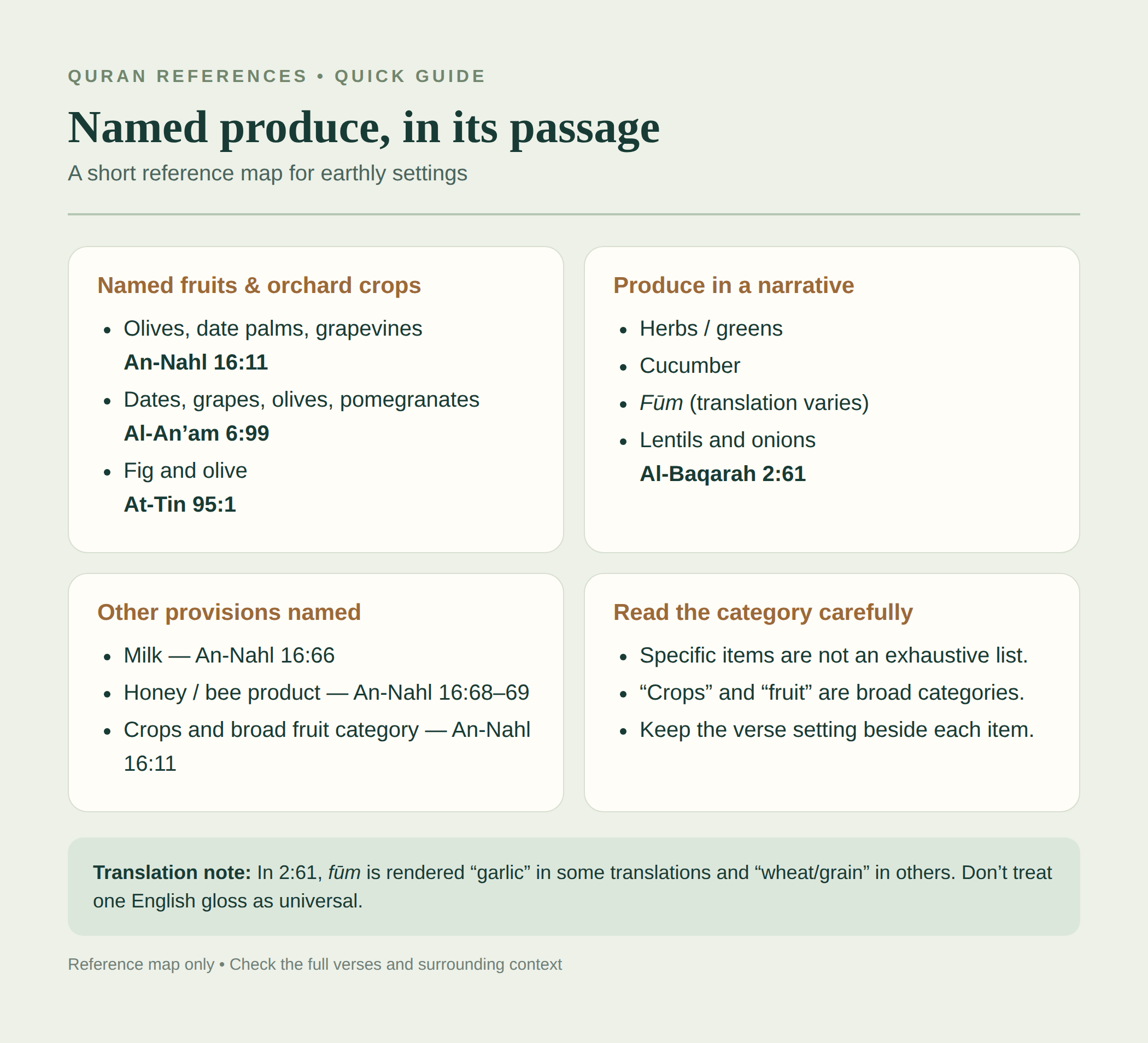
One of the most useful passages for a broad overview is An-Nahl 16:10–11. After mentioning rain and water, verse 11 says that God produces crops, olives, date palms, grapevines and every type of fruit. The list sits within a passage asking readers to reflect on provision and the natural world. It names familiar crops as examples, then widens the frame to fruit in general; it does not claim that the named items are the only fruits.
Al-An’am 6:99 likewise describes rain bringing forth vegetation and gardens, with clusters of dates, grapes, olives and pomegranates. It asks readers to consider the stages and variety of plant growth. Al-An’am 6:141 again refers to gardens, crops and produce, including olives and pomegranates, while giving guidance about harvest and use. Read together, these verses establish that dates, grapes, olives and pomegranates are explicitly named in passages about agricultural provision.
Dates and grapes also occur in other contexts. In Al-Mu’minun 23:19, gardens of date palms and grapevines are presented as provision from which people eat. In Ar-Rahman 55:68, the description of the gardens of Paradise includes fruits, date palms and pomegranates. The two settings should not be collapsed: a worldly orchard passage and a description of the Hereafter serve different purposes even when some plant names overlap.
Figs and olives
Surah At-Tin opens with an oath “by the fig and the olive” (95:1). This is a direct mention of both fruit names, but the verse’s rhetorical form is an oath; it is not a food list or dietary instruction. The same restraint applies to other brief references: identify what the text says, then avoid adding an interpretation as though it were part of the verse.
Cucumber, lentils, onions, herbs and the disputed word
Al-Baqarah 2:61 gives a distinctive group of requested produce: herbs or greens, cucumbers, fūm, lentils and onions. The scene belongs to the account of the Children of Israel and Moses. Immediately beforehand, the passage recalls manna and quails as provision (2:57); verse 61 recounts a request for familiar crops. It is a narrative passage, not a general dietary ranking or prohibition on the listed vegetables.
English versions differ on fūm: “garlic” appears in The Clear Quran, while other translations and lexicons discuss wheat or grain. That uncertainty is exactly why a careful list should flag the variation. It is safe to say the verse names herbs/greens, cucumber, lentils and onions in common translations, and contains a term whose rendering varies. It is not responsible to state simply that every English translation agrees that the Quran names garlic.
Grain, crops and produce as categories
Some passages use broad agricultural language rather than naming a specific edible species. An-Nahl 16:11 speaks of crops, and ‘Abasa 80:24–32 describes rain, soil, grain, grapes, forage, olives, date palms, gardens and fruits as provision for people and livestock. These categories are part of the answer to readers seeking food references, but they should not be inflated into a list of separately named species. The distinction between a named fruit and a general category makes an inventory more useful and more accurate.
Milk and honey: foods described as provision
An-Nahl 16:66 points to milk from cattle as a sign and describes it as pure and pleasant to drink. This passage does not list it alongside fruits; rather, it draws attention to a provision and invites reflection. The next verse, 16:67, mentions products made from date palms and grapevines. Quran.com’s translation calls them intoxicating drink and good provision. The verse’s wording is often discussed in relation to the Quran’s broader treatment of intoxicants, but this article is not a legal ruling; for questions of halal status or law, consult a qualified scholar and a reliable, directly relevant answer. We do not infer a practical ruling from a single isolated phrase.
In 16:68–69, the Quran describes bees and says that a drink of varying colors comes from them, containing healing for people. The explicit item is honey, understood from the passage’s description of what bees produce, and it is presented as a sign and benefit. The wording is not a promise that honey cures every illness or substitutes for medical care. This distinction between scripture’s statement and a sweeping health claim matters when readers encounter online lists that turn a verse into unsupported medical advice.
For the terms themselves, Quran.com provides the passage and translation; the surrounding verses are essential to understanding the subject. Readers building vocabulary can also use the site’s Quranic Arabic vocabulary notebook to record a word, its root or form, verse location and context rather than memorizing an English gloss in isolation.
Foods and drinks described in Paradise
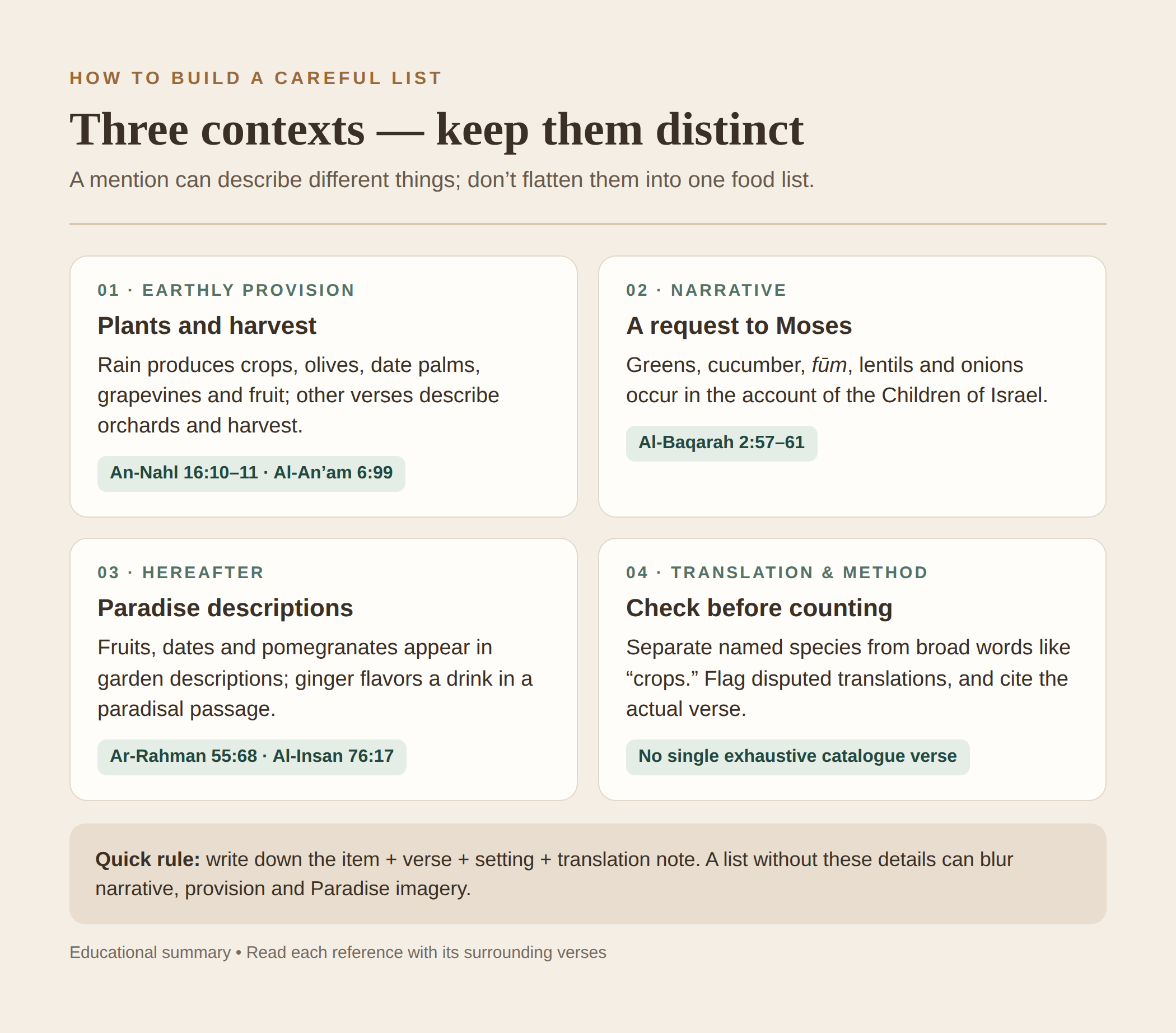
A complete answer to “foods in the Quran” should note that some references are descriptions of the Hereafter. These are not straightforward entries in an earthly produce list. For example, Al-Insan 76:17 mentions a drink flavored with ginger in its description of the righteous in Paradise. Ar-Rahman 55:68 mentions fruits, date palms and pomegranates in the gardens. Al-Waqi’ah 56:20–21 says that the people of Paradise will be served fruit they choose and the flesh of birds they desire; it does not say that some fruits are “known” and others unknown. That correction matters because the verse describes choice and provision, not a contrast between familiar and unfamiliar fruit. For a related Islamic Q&A whose scope is specifically food in Paradise (the first food offered on entry, based on hadith), see Islam Question & Answer’s “What Will Be the First Food in Paradise?”; that answer concerns the Sunnah report, not a catalogue of Quranic plant names.
These descriptions use familiar words while speaking of realities of the Hereafter; readers should not assume that every detail maps one-to-one onto a worldly recipe or botanical variety. “Ginger” in 76:17, for instance, occurs in a description of a paradisal drink. It is accurate to say the word is mentioned in that context; it would go beyond the verse to treat it as a dietary prescription or to claim that the drink is identical to a present-day ginger beverage.
Similarly, Al-Baqarah 2:25 speaks of fruits as provision in Paradise. The repeated image of gardens, flowing water and fruit emphasizes reward and provision. Keeping this category separate from ordinary agriculture helps answer the search question without confusing a promise of the Hereafter with a recipe book.
A practical checklist for reading Quran food references
- Record the exact verse. For instance, dates and grapes are explicitly in An-Nahl 16:11; cucumbers, lentils and onions appear in Al-Baqarah 2:61.
- Note the setting. Is the passage about worldly provision, a historical account, a sign of creation, or Paradise?
- Separate names from categories. “Olive” is specific; “crops” and “fruit” are broader categories.
- Flag translation variation. The word fūm in 2:61 is a clear example. Do not force agreement where translations differ.
- Do not add medical or legal claims. The Quran’s mention of honey and milk is not, by itself, a complete medical guide or legal ruling.
- Check a verse in context. Read the preceding and following verses, then consult a translation and tafsir if interpretation is needed. Quranytime’s guide to studying a verse without losing context offers a practical approach.
When sharing a list, cite the passage beside each item rather than repeating a list without references. A guide on verifying Quran quotations before sharing is useful for checking wording and references. Readers who want to trace a passage by surah can also use this Quran surah index.
Frequently asked questions
What fruits are mentioned in the Quran?
Explicitly named fruits include dates, grapes, olives, figs and pomegranates. An-Nahl 16:11 names olives, date palms, grapevines and “every type of fruit”; At-Tin 95:1 names fig and olive; Al-An’am 6:99 includes dates, grapes, olives and pomegranates. The exact list varies if one includes broad categories or descriptions of Paradise.
Does the Quran mention vegetables?
Yes. Al-Baqarah 2:61 mentions herbs or greens, cucumber, lentils and onions, and includes the debated word fūm, translated as garlic in some versions and wheat or grain in others. It appears in a narrative about the Children of Israel and Moses.
Is there one complete Quran list of foods?
No single passage presents a definitive, exhaustive catalogue. The Quran mentions foods in separate contexts and uses both specific names and general categories such as crops and fruit. Any total depends on the compiler’s method and should explain what is included.
Are all these foods described as “foods of Paradise”?
No. Dates, grapes, olives and other crops appear in earthly settings as provision and signs; some of the same or other foods and drinks appear in descriptions of Paradise. Ginger in Al-Insan 76:17 is part of a paradisal description, while Al-Baqarah 2:61 is a worldly narrative. Keep the context attached to each reference.
Does mentioning a food mean the Quran recommends eating it?
Not necessarily. A mention may occur in a story, an oath, a sign of creation or a description of the Hereafter. Do not turn a reference into a dietary recommendation, medical promise or halal ruling without an appropriate source and context.
Bottom line
The Quran names a range of foods and fruits, including dates, grapes, olives, figs, pomegranates, cucumber, lentils, onions, herbs or greens, milk and honey, while also referring to crops, grain and fruit more generally. The best way to answer “which foods are mentioned?” is with verse references and context—not an unexplained master count. Start with An-Nahl 16:11, Al-An’am 6:99, At-Tin 95:1 and Al-Baqarah 2:61, then read the surrounding passages and note where translation or context affects the classification.
Sources
- Quran, An-Nahl 16:10–18
- Quran, Al-An’am 6:99
- Quran, Al-An’am 6:141
- Quran, At-Tin 95:1
- Quran, Al-Baqarah 2:57–61
- Quran, ‘Abasa 80:24–32
- Quran, Al-Insan 76:17–18
- Quran, Ar-Rahman 55:68
- Quran, Al-Mu’minun 23:19
- Quran, Al-Waqi’ah 56:20–21
- Islam Question & Answer, “What Will Be the First Food in Paradise?” (hadith-based discussion of the first food offered in Paradise)