

إِيَّاكَ نَعْبُدُ begins with the person addressed, yet that first expression is not the subject “we.” The verb نَعْبُدُ already carries the first-person plural subject. إِيَّاكَ is the object placed before the verb. Recognizing that structure prevents a familiar Quran phrase from being forced into English subject-first order.
This lesson investigates fronted objects in Arabic: how an object can appear before its verb, how independent object pronouns work in that position, and why a fronted object differs from a topic followed by a resumptive pronoun. The focus is a reading decision, not a replacement for the broader Arabic verbal-sentence lesson. Composed examples are clearly distinguished from the Quran example.
A first word can still be an object
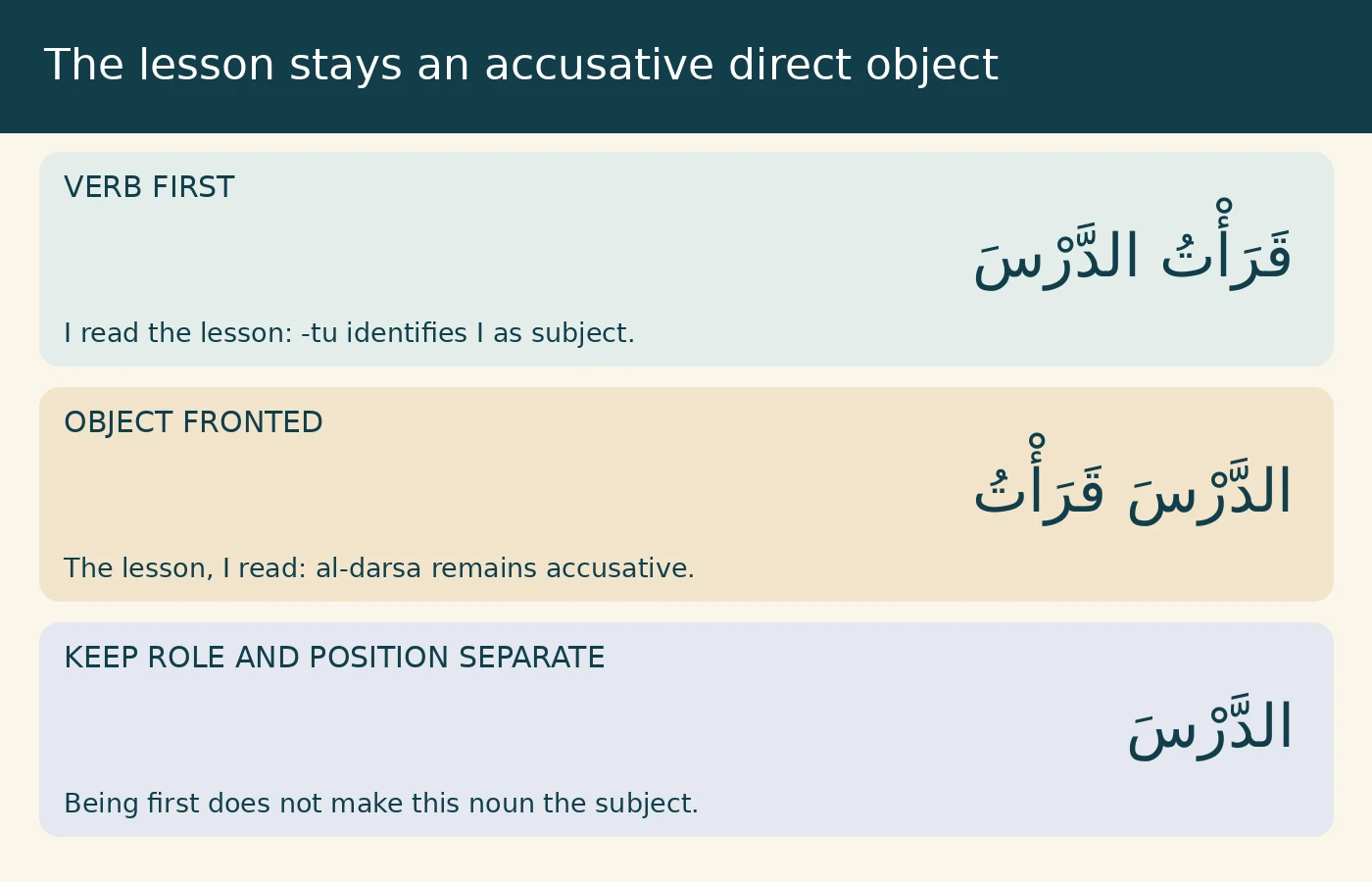
Start with the composed قَرَأْتُ الدَّرْسَ — “I read the lesson.” The verb ending ـتُ identifies the subject as “I.” الدَّرْسَ is the direct object: what was read. Now compare الدَّرْسَ قَرَأْتُ — “The lesson, I read,” or, with appropriate contextual focus, “It was the lesson that I read.”
The lesson noun remains accusative in the fronted version. Moving it to the beginning does not automatically make it a nominative subject. Its relationship to the reading verb remains that of a direct object. The order changes how the information is presented, while the case and verb morphology preserve the core roles.
That is why “the first noun is the subject” is not a dependable parsing rule. Identify the verb, the subject information it already contains, and the noun’s relationship to it. The case-ending lesson supplies an important clue, but in unvocalized prose you will also need context and construction.
Why an attached object pronoun cannot simply be moved
In the composed أَسْأَلُكَ, “I ask you,” the object pronoun ـكَ is attached to the verb. You cannot detach the letter kāf and use it by itself as a free-standing object before the verb. Arabic has independent accusative pronoun forms for suitable contexts, including إِيَّاكَ for a second-person masculine singular addressee.
Compare إِيَّاكَ أَسْأَلُ — “It is you I ask,” in an appropriate contrastive context. The speaker remains “I,” carried by أَسْأَلُ. The initial إِيَّاكَ identifies the person asked. It does not turn the addressee into the grammatical subject merely because it appears first.
Use the Arabic pronoun guide for the wider inventory of independent and attached forms. Here the main skill is distinguishing a subject pronoun such as أَنْتَ from an independent object expression such as إِيَّاكَ. They can refer to the same person while doing different grammatical jobs.
Subject and object can refer to different people without separate nouns
Read إِيَّاكَ أَقْصِدُ — “You are the one I mean,” in this composed practice example. The first-person subject is indicated by the verb’s form. The fronted object refers to the person addressed. You do not need to invent a missing overt noun for the subject, nor identify the initial object as the doer.
Now compare إِيَّاهُ أَقْصِدُ, “He is the one I mean,” with إِيَّاهَا أَقْصِدُ, “She is the one I mean.” The intended subject remains the speaker. The object reference changes. The exercise is useful because the English translations may begin with “he” or “she,” which can tempt you to assign an English subject role directly to the Arabic object.
Keep the Arabic parse and natural English paraphrase separate. An idiomatic English cleft such as “You are the one I mean” can clarify focus, but its word-by-word structure is not a diagram of the Arabic. Explain the Arabic roles from its own verb and pronoun forms.
A fronted object differs from a topic with a resumptive pronoun
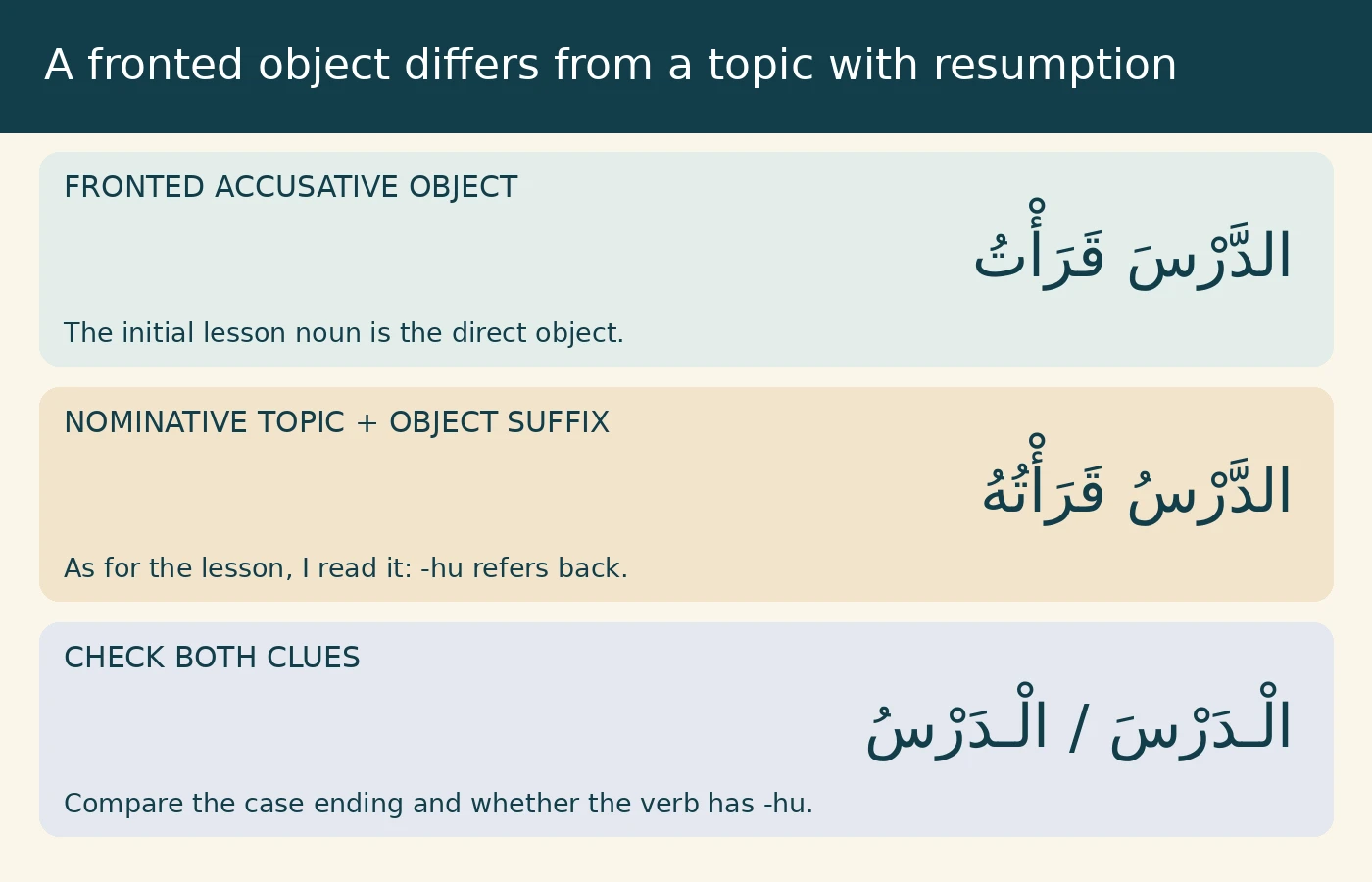
Compare الدَّرْسَ قَرَأْتُ with الدَّرْسُ قَرَأْتُهُ. The first has a fronted accusative object. In the second, الدَّرْسُ is a nominative topic, and the predicate contains قَرَأْتُهُ, “I read it,” with ـهُ referring back to the lesson. A natural English paraphrase is “As for the lesson, I read it.”
The two examples differ in both the initial case and the presence of the attached object pronoun. Do not combine the nominative topic ending from one with an analysis that ignores the resumptive suffix. The nominal-sentence lesson explains how a verbal clause can function as a predicate.
In an unvocalized text, الدرس قرأته visibly includes the resumptive object suffix even though the initial short vowel is absent. That clue can guide the analysis. But do not treat one clue as a universal rule for every advanced construction. Arabic has additional patterns, including analyses involving omitted verbs, that require more than this introductory contrast.
The Quran example: two objects placed first
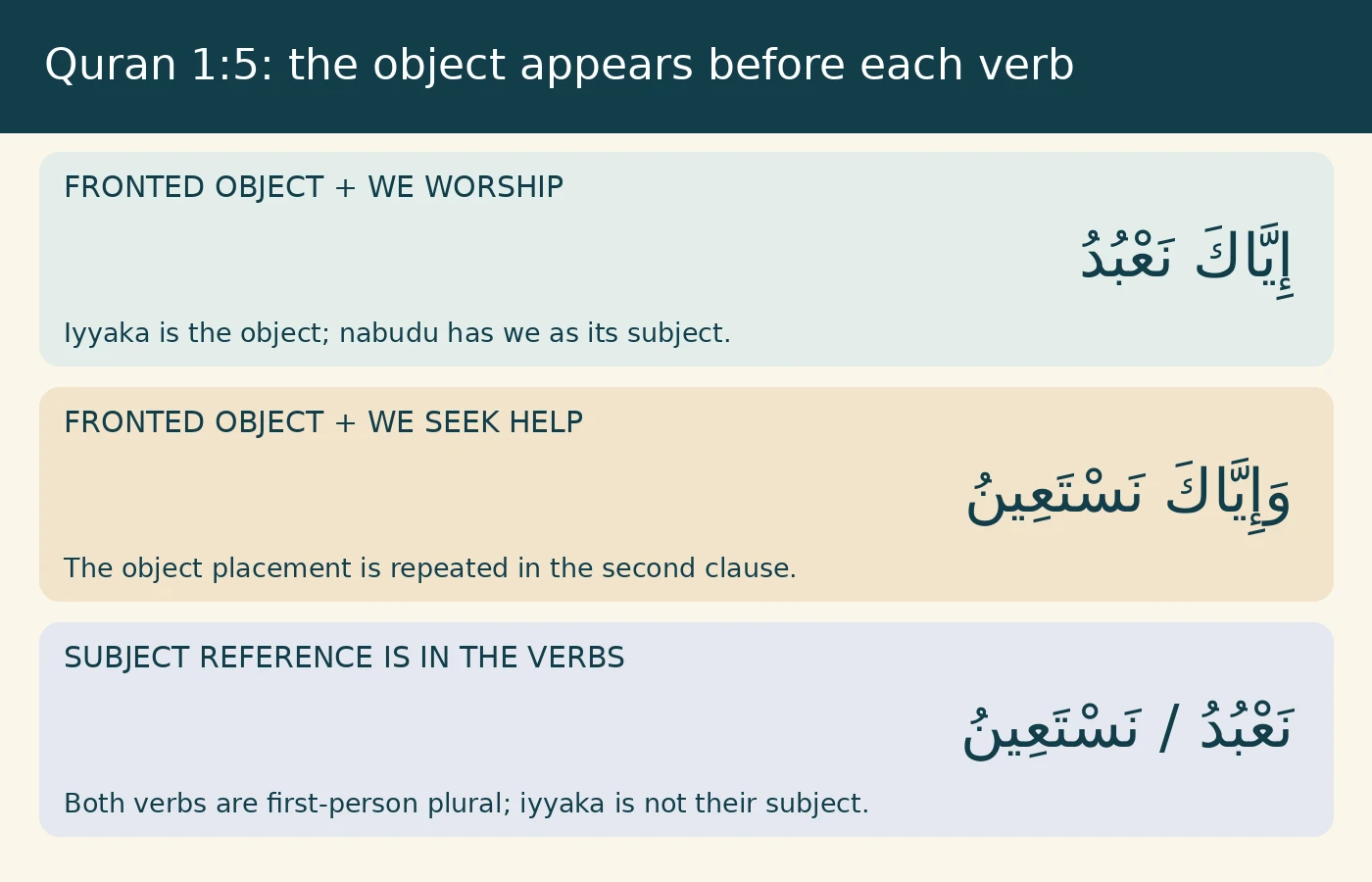
Quran 1:5 reads إِيَّاكَ نَعْبُدُ وَإِيَّاكَ نَسْتَعِينُ. The Quranic Arabic Corpus analysis of Al-Fatihah identifies إِيَّاكَ as a second-person masculine singular independent pronoun and both verbs as first-person plural imperfect forms. Each object expression comes before its verb.
For a learner’s role map, identify the person addressed in إِيَّاكَ, then the “we” subject in نَعْبُدُ. Repeat the analysis for وَإِيَّاكَ نَسْتَعِينُ. The coordinating wāw connects the expressions, while the object placement is repeated. The repetition is part of the actual wording; do not silently remove the second object when explaining the verse’s structure.
Ibn Kathir’s tafsir of 1:5, hosted by King Saud University discusses the fronting and repetition in relation to attention and restriction. In this verse, that supports the familiar rendering of worship and seeking help directed to Allah alone. This explanation belongs to the verse and its interpretive context; it is not a license to assign the same degree of exclusivity to every Arabic object placed early in any sentence.
Fronting can highlight information without a universal “only” rule
Arabic word order responds to grammar, context and information structure. A fronted object may highlight or contrast what is being discussed. The intended force depends on the whole utterance. A beginner should avoid turning a useful observation about a Quran verse into a mechanical translation rule for all prose.
In a composed classroom exchange, someone asks which passage you read. الدَّرْسَ قَرَأْتُ can bring “the lesson” into focus. In another context the same word order may serve a different discourse purpose. You need the surrounding question or contrast to judge the most natural English wording.
Therefore separate three questions in your notes: What is the grammatical role? Why might the writer place it here? How should I translate the focus in this context? The first may be clear from morphology and syntax even when the precise rhetorical effect still needs discussion.
Do not confuse object fronting with a question word
Arabic interrogatives can also occur early in a sentence and may fill an object role. That does not mean every early object is a question or every question word is a subject. Determine the function in the actual clause rather than treating the beginning of the sentence as one fixed grammatical slot.
The question-word lesson explains the interrogative forms and their roles. Compare an information-seeking question with a statement that highlights its known object. In one you are asking for the missing referent; in the other you are presenting the referent and organizing attention around it.
Similarly, a prepositional phrase placed early is still a prepositional phrase. فِي الْبَيْتِ قَرَأْتُ, “At home I read,” gives a location, not a direct object. The preposition lesson helps prevent the broad mistake “anything before the verb is its object.”
Edit three deliberately misleading analyses
First: “إِيَّاكَ is the subject of نَعْبُدُ because it comes first.” Incorrect; the verb carries a first-person plural subject, while إِيَّاكَ is the fronted object. Second: “الدَّرْسَ becomes nominative when moved before قَرَأْتُ.” Incorrect; a direct object remains accusative in the controlled fronting example. Third: “الدَّرْسُ قَرَأْتُهُ has no object.” Incorrect; ـهُ is the object pronoun inside the verbal predicate and refers back to the topic.
For each correction, identify the actual clue: the verb’s person marking, the noun’s case, or the attached suffix. An answer that merely says “Arabic word order is flexible” is too vague. Flexibility operates within grammatical relationships; it does not mean that every rearrangement has the same analysis or meaning.
Compare “you ask” with “you are the one I ask”
Put أَنْتَ تَسْأَلُ beside إِيَّاكَ أَسْأَلُ. The first composed sentence means “You ask”: أَنْتَ is the person performing the asking, and the verb is second person. The second means “You are the one I ask”: the object is the addressee, while the first-person verb identifies the speaker as the asker. Both begin with an expression referring to “you,” yet they organize the participants differently.
Draw two fictional people on a practice page, one labeled speaker and the other addressee. For the first sentence, draw the asking action from the addressee. For the second, draw it from the speaker toward the addressee. The arrows should follow the Arabic roles, not the order in which the people are mentioned in your English paraphrase.
Then cover the initial pronoun and inspect the verb alone. تَسْأَلُ and أَسْأَلُ provide different person information in these controlled examples. Restore the pronoun and check that the reference matches the intended construction. This prevents you from assigning every role from the first visible word while ignoring information encoded in the verb.
What to do when the written vowels are absent
An ordinary Arabic message may omit the final case marks that distinguish a fronted object from a topic. In that situation, preserve the clues that remain visible: an attached object suffix, a verb’s person prefix or ending, an overt subject, and the surrounding discourse. An initial noun’s location alone is insufficient evidence. Write a provisional analysis and test it against the complete clause.
For teaching practice, begin with fully vocalized examples whose intended constructions are clear. Only then remove the final marks and ask which clues still support the reading. This makes the exercise a controlled test of transfer. Starting with an ambiguous fragment and inventing vowels can train confidence in a guess rather than confidence in a grammatical relationship.
When listening, do not rely on a reciter’s or reader’s pause to tell you whether a noun is a topic or object. Pausing can conceal an audible ending. Compare the written construction and a reliable analysis, then ask your teacher to explain any alternative reading that remains plausible. That approach respects both the language’s flexibility and the limits of what one short fragment can establish.
A two-version rewriting task
Start from the composed قَرَأْتُ الْكِتَابَ, “I read the book.” Produce a fronted-object version, then a topic-plus-resumption version. One set of answers is الْكِتَابَ قَرَأْتُ and الْكِتَابُ قَرَأْتُهُ. Explain the initial case and the final suffix in each rather than treating the two as interchangeable spellings.
Next replace the object reference with a person addressed in a suitable “I mean you” exercise. Compare أَقْصِدُكَ with إِيَّاكَ أَقْصِدُ. The object moves from an attached pronoun to an independent form in the fronted construction. The speaker remains the subject in both.
The verb-conjugation guide helps you recognize that unchanged subject information. To practise on a passage you are reading, Book a Free Trial Class. Bring one initial expression you mistook for a subject and show which verb or suffix changed your analysis. That gives you a concrete reading skill to test in a new sentence.