
When two Arabic words run together in Quran recitation, an initial hamza may either disappear from the sound or remain clear. The key distinction is between Hamzat al-Wasl (هَمْزَةُ الْوَصْلِ), the “connecting hamza,” and Hamzat al-Qatʿ (هَمْزَةُ الْقَطْعِ), the “cutting” or fully pronounced hamza. A simple starting rule helps: Wasl is pronounced when you begin on its word and dropped when you connect from the word before; Qatʿ is pronounced both ways.
This guide compares initial hamza in Quran examples; for medial and final spelling, see Quranytime’s guide to writing hamza in Arabic.
The quick difference
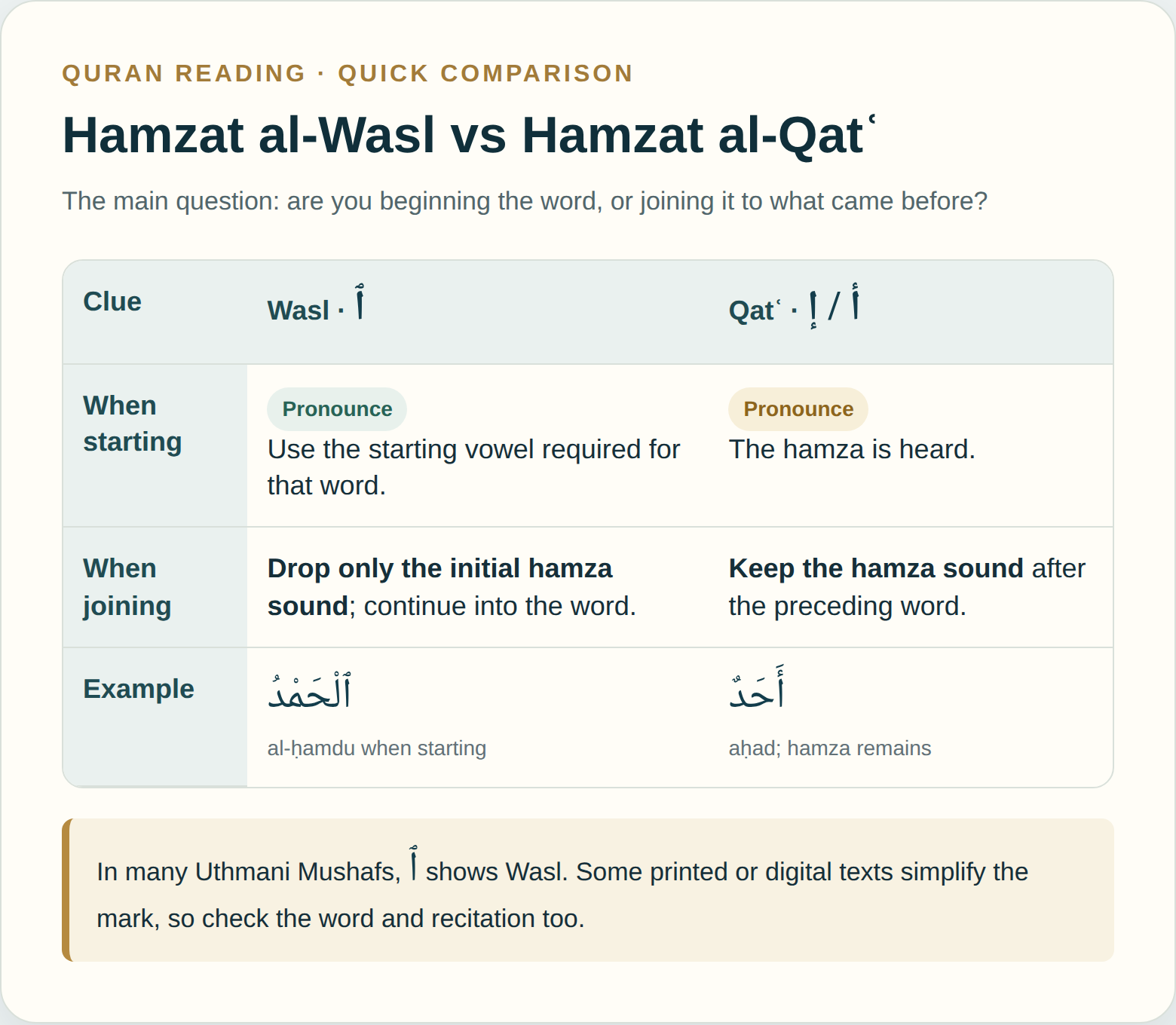
| Feature | Hamzat al-Wasl | Hamzat al-Qatʿ |
|---|---|---|
| When starting | Pronounce it, using the starting vowel required by the word. | Pronounce it. |
| When joining to a preceding word | The initial hamza sound is omitted; continue into the next sound. | Keep the hamza sound. |
| Common initial spelling | Often shown as a marked or bare alif; many Uthmani texts use ٱ. | Usually written on alif as أ or إ. |
| Typical example | ٱلْحَمْدُ — al-ḥamdu when starting. | أَحَدٌ — aḥad; the hamza remains. |
The alif can carry an initial hamza, but dropping Wasl in connection does not make the whole word silent: the following sounds are still read.
How to recognize the marks
In many Uthmani Mushaf editions, Wasl is identified by the small waṣla sign above the alif: ٱ. In other printed or digital Arabic texts, the mark may be simplified or omitted, leaving a bare alif. That is one reason not to identify the rule from a tiny shape alone. Follow the fully marked Mushaf you are reading, and use the word’s place and pronunciation as additional clues. Quranytime’s overview of Uthmani and Indo-Pak Quran scripts explains why printed conventions can look different.
At the beginning of a word, Qatʿ normally has the hamza written above or below its alif: أَ or إِ. The short vowel affects its written position in ordinary Arabic spelling: fatha or damma commonly appears above the alif, while kasra appears below. In fully marked Quranic text the vowel sign also guides the reading. Quranytime’s primer on fatha, kasra, damma and other Arabic vowel marks can help you read those signs.
Some digital text omits small Quranic marks. Follow the Mushaf’s spelling rather than adding or removing a sign from memory.
Think of Wasl and Qatʿ as sound categories, not just two alif designs. Hamza is a consonant; alif can carry it in writing or represent a long vowel elsewhere. A clear waṣla sign is helpful, but in a simplified text the word’s form and your position in the phrase still matter.
What happens when you start or connect?
When starting on a Wasl word, pronounce its hamza with the required initial vowel. When joining from the preceding word, omit that sound and continue into the word. The starting vowel depends on the word’s form and reading; it is not always the same.
Qatʿ remains pronounced whether you begin or join. The preceding word changes the rhythm, not the hamza sound.
The Quranic Arabic Corpus’s phonetic-transcription note on Hamzat al-Wasl demonstrates the connected reading: it writes the Wasl element as “al-” at the start of a verse but “l-” after a preceding word. This notation is a learning aid, not a substitute for listening to a qualified reciter.
Pausing can change which case you are in: if you stop and then restart at a Wasl word, you begin that word and pronounce the hamza with its required vowel. When you continue through the phrase without a stop, the Wasl sound drops. Follow the stopping signs and recitation rules of the Mushaf rather than treating every word boundary as a pause.
Hear the contrast in Quran examples
1. Starting with Wasl: Al-Fatihah 1:2
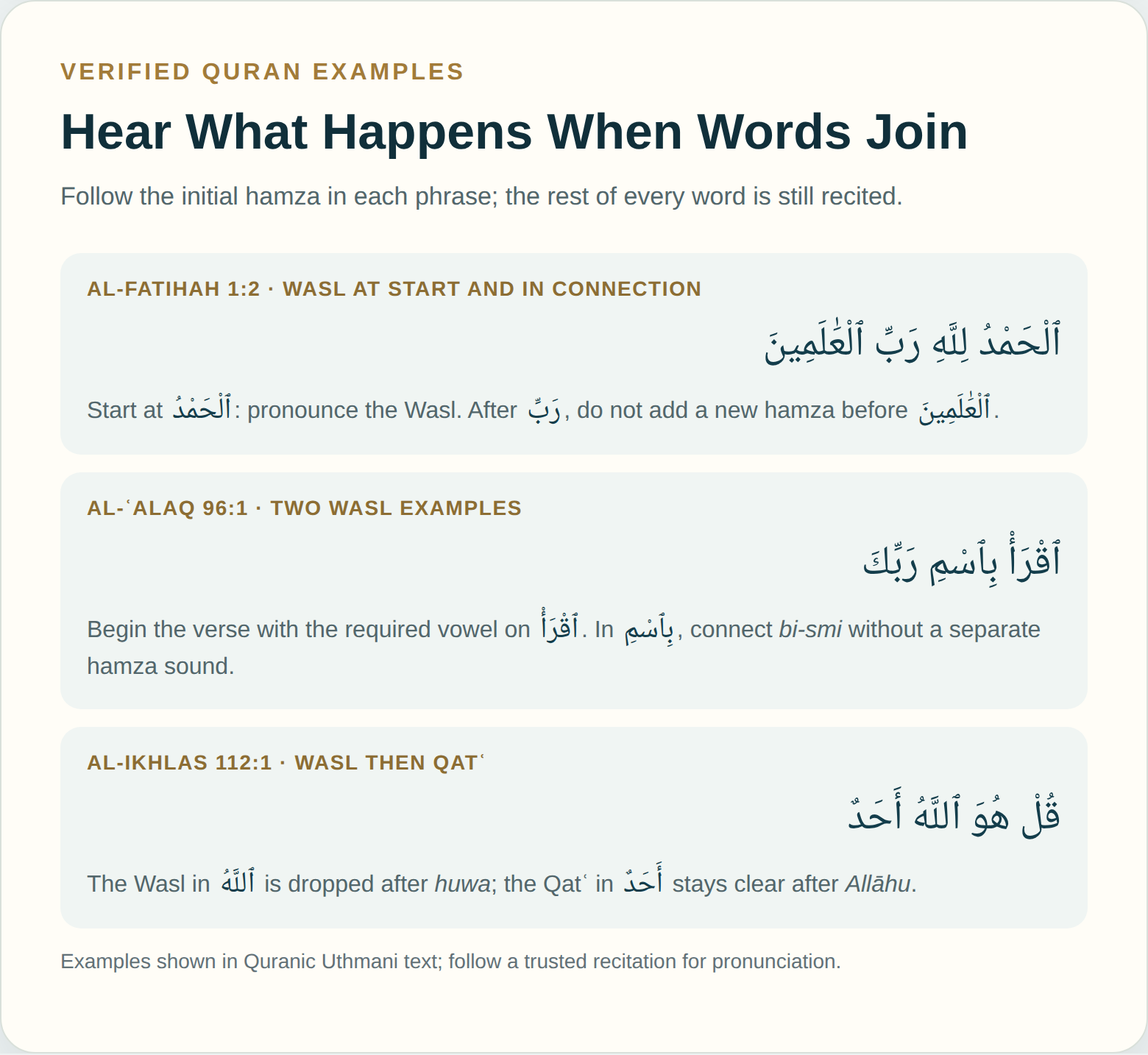
The verse begins ٱلْحَمْدُ لِلَّهِ رَبِّ ٱلْعَٰلَمِينَ. At the verse start, pronounce ٱلْحَمْدُ (al-ḥamdu). Later, Wasl at the start of ٱلْعَٰلَمِينَ follows رَبِّ; in connected recitation the phrase flows as rabbi l-ʿālamīn, with no fresh hamza.
2. Wasl inside a phrase: Al-ʿAlaq 96:1
The verse reads ٱقْرَأْ بِٱسْمِ رَبِّكَ (“Read in the Name of your Lord”). When beginning here, pronounce ٱقْرَأْ with its required vowel. In بِٱسْمِ, Wasl follows the preposition بِ and is omitted in bi-smi rabbika.
3. Qatʿ stays: Al-Ikhlas 112:1 and Al-Fatihah 1:5
In قُلْ هُوَ ٱللَّهُ أَحَدٌ (Al-Ikhlas 112:1), Wasl in ٱللَّهُ is omitted after هُوَ, but Qatʿ in أَحَدٌ is pronounced. The same rule appears in وَإِيَّاكَ (Al-Fatihah 1:5): Qatʿ remains after the conjunction وَ.
Where Hamzat al-Wasl commonly appears
Three useful groups help you recognize common Wasl words:
- The definite article ال. Words such as ٱلْحَمْدُ begin with Wasl. If you start at the word, pronounce the initial vowel; if you join from the previous word, the hamza drops.
- A small set of nouns. Common examples include ٱسْم (“name”), ٱبْن (“son”), and ٱمْرَأَة (“woman”).
- Some verb forms. Several imperatives and derived past-tense forms begin with Wasl, but not every command does: أَقِيمُوا begins with Qatʿ. For more examples, see Quranytime’s guide to when Hamzat al-Wasl is pronounced in Quran reading.
The familiar phrase بِسْمِ ٱللَّهِ lets you hear Wasl in a noun after بِ. Some derived verb forms also start with it, such as اِسْتَغْفَرَ (he sought forgiveness). These patterns help you predict common cases, but check unfamiliar Quran forms against a marked text and a trusted recitation.
A three-step reading check
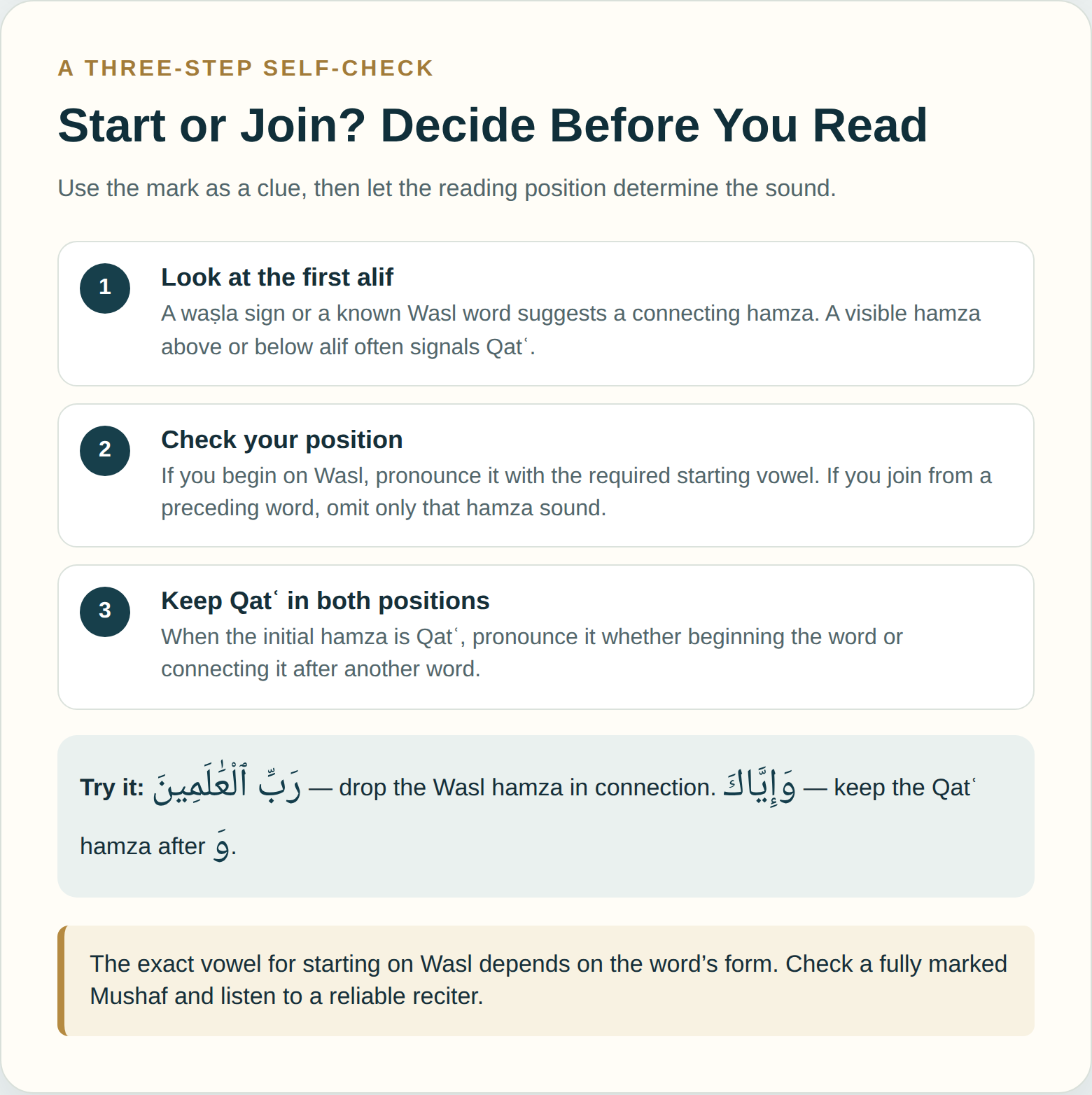
- Look at the initial alif. If the Mushaf shows a waṣla sign or a plain alif in a known Wasl word, treat it as a clue, not a complete answer. A visible hamza on or under the alif often signals Qatʿ.
- Ask whether you are starting or joining. Beginning from a Wasl word? Pronounce it with the correct initial vowel. Continuing from the previous word? Omit the Wasl hamza. With Qatʿ, pronounce the hamza in either position.
- Read the whole phrase, then listen. Check the vowel marks and the context; then compare with a trusted recitation. If you are still learning to infer sounds from marks, see the guide to reading Arabic without vowel marks and the broader beginner’s map of Quran Tajweed rules.
For a practical recitation routine that includes beginning, joining and stopping choices, Quranytime’s guide to starting Quran recitation and connecting its opening phrases provides a useful next step.
Common mistakes to avoid
- Dropping the whole word. When Wasl is dropped, only its initial hamza sound is omitted; the rest of the word is read.
- Dropping Qatʿ in a connected phrase. A word boundary does not make Qatʿ disappear. Keep the hamza in examples such as وَإِيَّاكَ.
- Assuming all initial alifs are Wasl. Many words begin with Qatʿ, and some commands use Qatʿ. Check the mark, known form and recitation context together.
- Using one starting vowel for every Wasl word. The starting vowel depends on the word form; check it instead of applying a single default.
- Reading a plain alif as proof. Simplified fonts may omit small marks, so combine the written form with the word and a reliable recitation.
Watch a visual lesson
This slide-based lesson compares Hamzat al-Wasl and Hamzat al-Qatʿ. Its complete timeline was visually checked before embedding; no women appear on screen.
Frequently asked questions
Is Hamzat al-Wasl silent?
Not when you begin on its word: it is pronounced with the vowel required for that form. It is omitted only when you connect the word to what precedes it. “Connecting hamza” does not mean that its word is skipped.
Does Hamzat al-Qatʿ stay pronounced when I join words?
Yes. Qatʿ is pronounced whether you begin on the word or connect it after another word. Keep it in أَحَدٌ and إِيَّاكَ, even when a preceding word or conjunction is read directly before it.
If you would like a teacher to check how you start and connect these Quranic words, you can book a free Quran and Arabic trial class. Bring a short passage that contains both kinds of hamza and practise the transitions with feedback.
The takeaway
Ask what kind of hamza begins the word and whether you are starting or joining: Wasl is omitted in connection; Qatʿ remains audible. Check the Mushaf’s marks and practise with accurate recitation.