
When beginners ask how to write hamza in Arabic, they are usually asking why one consonant appears as ء، أ، إ، ؤ، ئ. These are not five different sounds. They are hamza, a consonant that may be written independently or placed on a carrier. This guide teaches standard Modern Standard Arabic spelling for ordinary Arabic reading and writing. It is not a replacement for checking a particular Mushaf, whose specialist conventions may vary.
Quick answer: first identify whether hamza is initial, medial, or final. For a medial hamza, compare the vowel on hamza and the preceding vowel using the beginner hierarchy kasra > ḍamma > fatḥa > sukūn. For a final hamza, inspect the vowel immediately before it. Then remember that the carrier is only a seat: ؤ does not automatically add a /w/ sound, and ئ does not automatically add a /y/ sound.
Hamza is not alif: understand the identity first
Hamza (ء) represents a glottal stop, written here as /ʾ/. Alif (ا) is a separate letter. Alif can represent a long ā and can also carry hamza, but the two letters must not be treated as interchangeable. Compare fully vowelled سَأَلَ (he asked) with سَالَ (he flowed): the first contains hamza on alif; the second has alif serving as a long-vowel letter. Learners building their alphabet foundation can use the Quranytime Arabic reading guide and the explanation of dagger alif and its long-vowel sound to keep consonants separate from vowel-length marks.
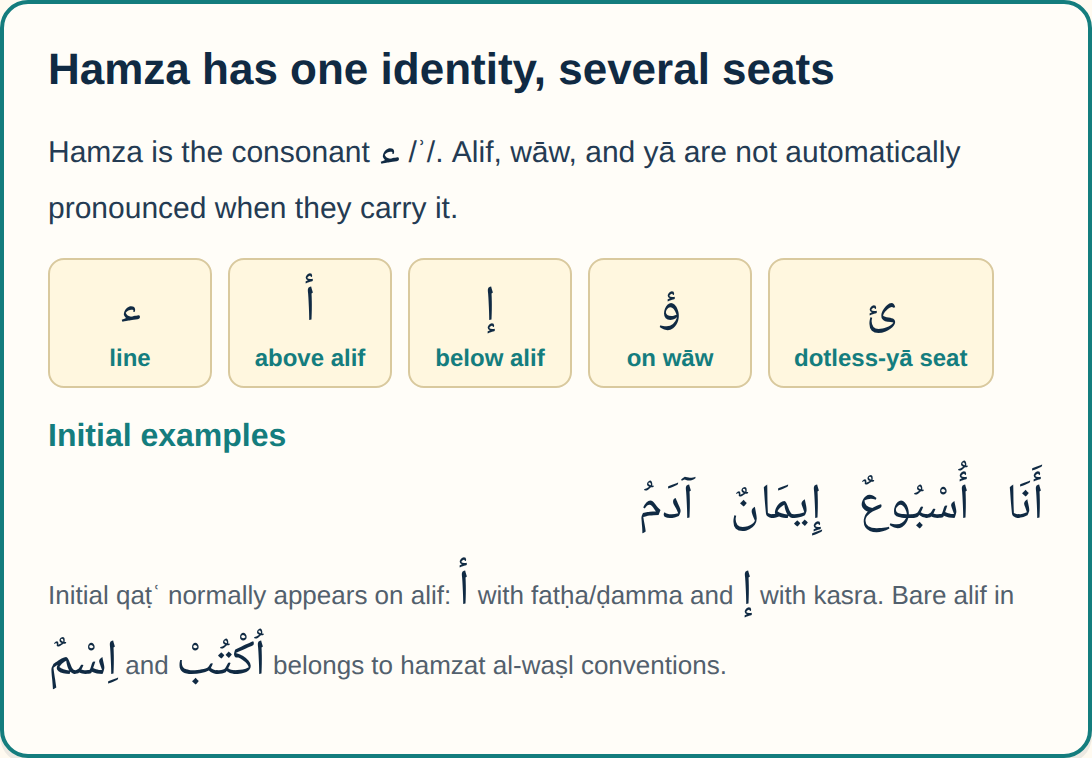
A “seat” or “carrier” is the supporting shape around hamza. On alif, you see أ or إ; on wāw, ؤ; on the dotless yā-shaped seat, ئ. Independent hamza is simply ء. The carrier follows spelling conventions; it is not a second consonant to pronounce.
The five hamza forms at a glance
Read this row as five written environments for one consonant: independent ء, above alif أ, below alif إ, on wāw ؤ, and on the dotless yā seat ئ. With full vowel marks, examples include أَخَذَ, إِيمَانٌ, مُؤْمِنٌ, and بِئْرٌ. The same sound may therefore be visible in different forms. Short-vowel terms such as fatḥa, kasra, ḍamma, and sukūn are reviewed in Quranytime’s guide to Arabic harakat for Quran reading.
Initial hamza: when to write أ, إ, آ, or bare ا
In ordinary MSA, a pronounced initial hamza of hamzat al-qaṭʿ sits on alif. Use أ when the initial hamza carries fatḥa or ḍamma: أَنا (I), أُسْبُوعٌ (a week), and آدَمُ (Adam, with alif madda for the conventional long opening). Use إ with kasra: إِيمَانٌ (faith) and إِنْجِيلٌ (Gospel).
Do not turn the initial rule into “every word beginning with a glottal stop gets a visible hamza.” Bare alif in words such as اُكْتُبْ (write!) and اِسْمٌ (a name) reflects hamzat al-waṣl conventions. It is pronounced when starting there, but can drop in connected speech. That is a brief reading distinction, not the main subject here; connected-reading questions deserve a teacher’s feedback. A useful habit is to learn the word’s conventional spelling instead of inventing a seat from an English transliteration.
Medial hamza: choose the strongest vowel
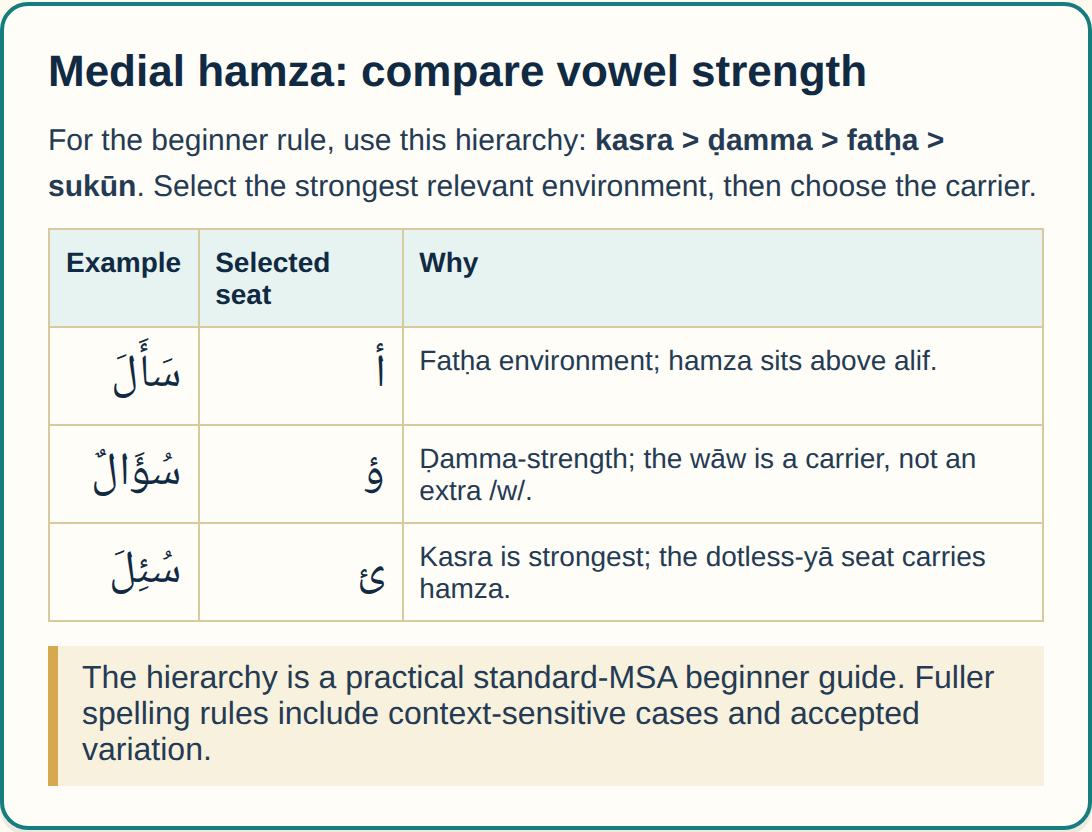
For a beginner-safe account of internal hamza, compare the hamza’s own short vowel with the short vowel immediately before it. The practical strength order is kasra > ḍamma > fatḥa > sukūn. Kasra-strength normally selects ئ; ḍamma-strength selects ؤ; fatḥa-strength selects أ. This is a learning hierarchy for standard spelling, not a promise that every historical, lexical, or edition-specific case has no variation.
Work through three contrasting forms: سَأَلَ (he asked) has hamza with fatḥa after a fatḥa, so أ is natural. سُؤَالٌ (a question) has a ḍamma environment, so hamza sits on wāw: ؤ. سُئِلَ (he was asked) has kasra on hamza, so it sits on the dotless yā-shaped seat: ئ. The carrier is not pronounced as wāw or yā.
Long vowels need careful wording. Do not claim that every hamza after a long alif or long wāw is independent. Standard examples with a fatha-bearing hamza after long alif or wāw include قِرَاءَةٌ (reading) and مُرُوءَةٌ (manliness). After long yā, a common seat environment is بِيئَةٌ (environment), with hamza on ئ. These examples show why you should inspect the full vowel context rather than memorize an overbroad “long vowel means line” rule. Fuller orthographic accounts also recognize context-sensitive cases and accepted variation.
In connected Arabic text, the surrounding letters may join normally to the carrier. Think of the writing mechanics in two steps: choose the hamza seat, then apply the normal joining behavior of the carrier and neighboring letters. An independent hamza on the line does not join onward. This is why a visual break is not automatically a missing letter.
Final hamza: look at the preceding vowel
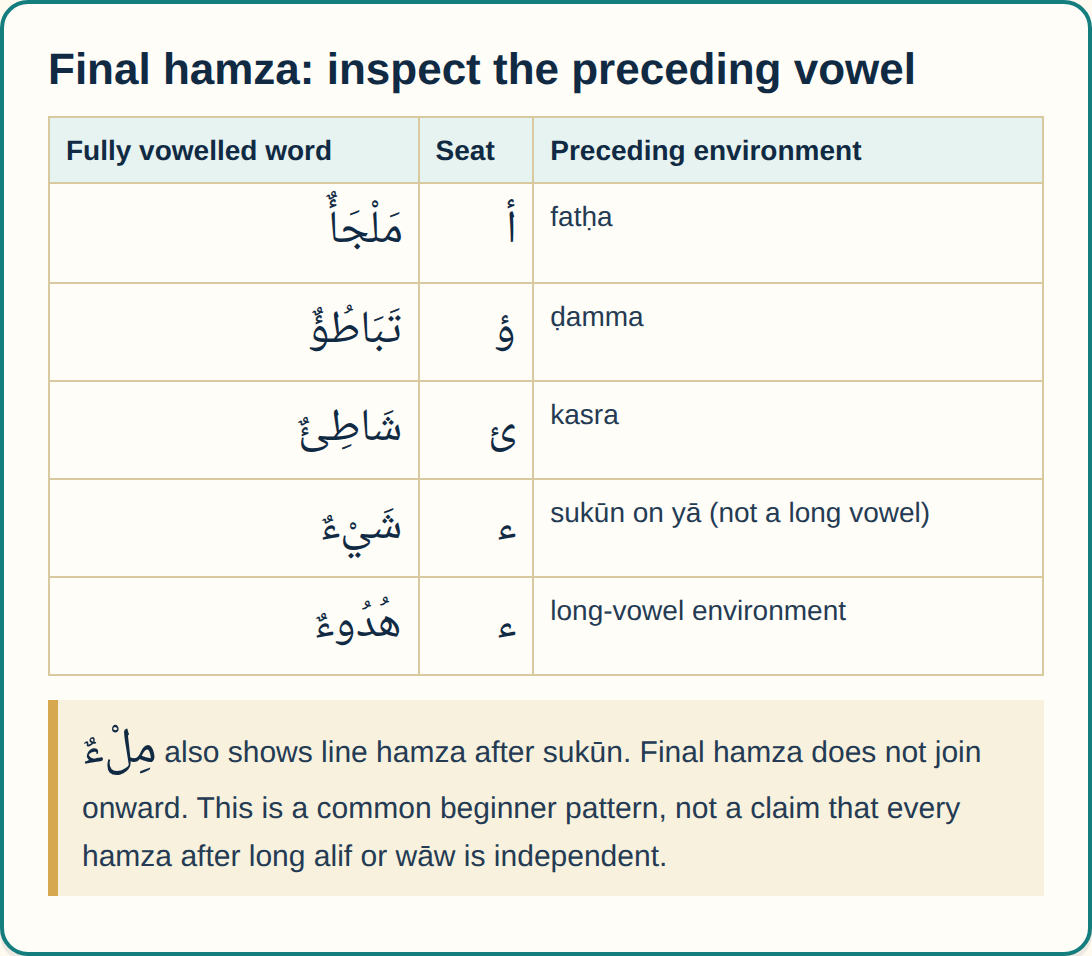
For final hamza, the main beginner question is the vowel immediately before hamza, not a following vowel. After fatḥa, use alif: مَلْجَأٌ (refuge) and بَدَأَ (he began). After ḍamma, use wāw: تَبَاطُؤٌ (slowness). After kasra, use the dotless yā-shaped seat: شَاطِئٌ (shore).
After a long vowel or sukūn, final hamza is commonly written independently on the line: شَيْءٌ (thing), هُدُوءٌ (calm), and مِلْءٌ (fullness). Notice the scope: this is a common final pattern, not a claim that all hamza after every long alif or wāw must be independent. Final hamza does not connect to a following letter, so the preceding letter may look visually disconnected from ء. Do not mistake that joining behavior for a pronunciation rule.
Tanwīn can make a familiar word look more complicated. In forms such as جُزْءًا and شَاطِئًا, the accusative tanwīn and appended alif add a spelling detail beyond the basic seat chart. Quranic orthographies, waṣla signs, and edition-specific marks should be checked against the learner’s Mushaf and teacher rather than flattened into one universal chart. For more practice with reading words whose short vowels may disappear in ordinary text, see how to read Arabic without vowels.
How to write hamza in Arabic: a one-minute check
- Locate hamza. Is it at the beginning, in the middle, or at the end of the word?
- If initial, classify the convention. A pronounced hamzat al-qaṭʿ is normally أ or إ; alif madda and hamzat al-waṣl are separate conventional cases.
- If medial, compare strength. Start with kasra, then ḍamma, fatḥa, and sukūn. Select ئ، ؤ، أ as the practical seat choices, while allowing for context-sensitive spelling.
- If final, inspect the preceding vowel. Fatḥa commonly gives أ, ḍamma gives ؤ, kasra gives ئ, and long-vowel or sukūn environments commonly give independent ء.
- Verify the whole word. Use a reliable dictionary, Arabic lesson, or the spelling in the relevant Quran edition. To type and compare the characters accurately, use this Arabic keyboard guide.
Common mistakes to avoid
Do not drop hamza because the carrier looks like another letter. Do not write إ in every medial position, and do not pronounce ؤ as /w/ or ئ as /y/. Do not treat bare alif as always meaning hamza, copy an apostrophe from transliteration as though it were Arabic spelling, or confuse the dagger alif mark with hamza. Most importantly, do not use a single absolute joining rule: carriers join according to the ordinary behavior of the letters, while independent hamza remains independent.
When handwriting, leave enough space to make the seat visible, especially in a word with several small marks. Write the base letters first, then add the short vowels and inspect the hamza position as a separate spelling decision. When reading unvowelled text, do not assume that an absent fatha or kasra means the hamza has disappeared; ordinary Arabic often omits short-vowel marks while retaining the consonant and its carrier. If a word still feels uncertain, compare a fully vowelled dictionary entry or a trusted lesson rather than guessing from the English meaning. This habit is especially helpful for pairs that look similar on a screen but differ in hamza placement, because the mark can carry the only obvious clue to the underlying consonant.
For broader guided reading and Tajweed study, Quranytime’s Quran reading and Tajweed classes can put spelling questions in lesson context. For a fuller MSA spelling treatment and discussion of exceptions, see the Lebanese Arabic Institute guide to writing and pronouncing hamza.
Mini practice quiz
Cover the examples above and supply the missing hamza form in these ordinary-word prompts: مَسْـ_َلَةٌ (question), سُـ_َالٌ (a question), بِيـ_َةٌ (environment), شَاطِـ_ٌ (shore), شَيْـ_ٌ (thing), _َحْمَدُ (Ahmad), and _ِيمَانٌ (faith). Then ask whether اِسْمٌ needs a visible hamza mark. The answers illustrate the decision tree: medial fatḥa gives أ in مَسْأَلَةٌ; medial ḍamma gives ؤ in سُؤَالٌ; long-yā context commonly gives ئ in بِيئَةٌ; final kasra gives ئ in شَاطِئٌ; final sukūn on yā gives line hamza in شَيْءٌ; and initial qaṭʿ gives أ or إ. اِسْمٌ is the hamzat al-waṣl reminder, not a simple fifth initial seat.
Spelling becomes manageable when you separate the consonant from its carrier, identify the position, and read the vowels that control the seat. If you want an instructor to check your Arabic or Quran reading and help you practise these forms, book your free trial class.