

Quranic Arabic grammar · context-first reading guide
A short particle can change both a sentence’s grammar and its tone. The Arabic word لَعَلَّ (laʿalla) is a good example: learners may meet it translated as “perhaps,” “may,” “hopefully,” or “so that.” Those English choices are related, but they are not interchangeable in every verse. This guide shows how to recognize laʿalla, read the pronoun or noun that follows it, and use the surrounding Quranic sentence to choose a careful meaning rather than memorizing one English gloss.
Quick answer: لَعَلَّ belongs to the group known as inna and its sisters. It introduces a noun or pronoun as its subject, which is accusative in grammatical position, while its predicate is nominative in grammatical position. In Quranic phrases such as لَعَلَّكُمْ تَتَّقُونَ, a natural English rendering is “so that you may be mindful” or “that you may become mindful.” Read the whole clause to decide whether “perhaps,” “may,” or “so that” best expresses the context.
What does laʿalla mean?
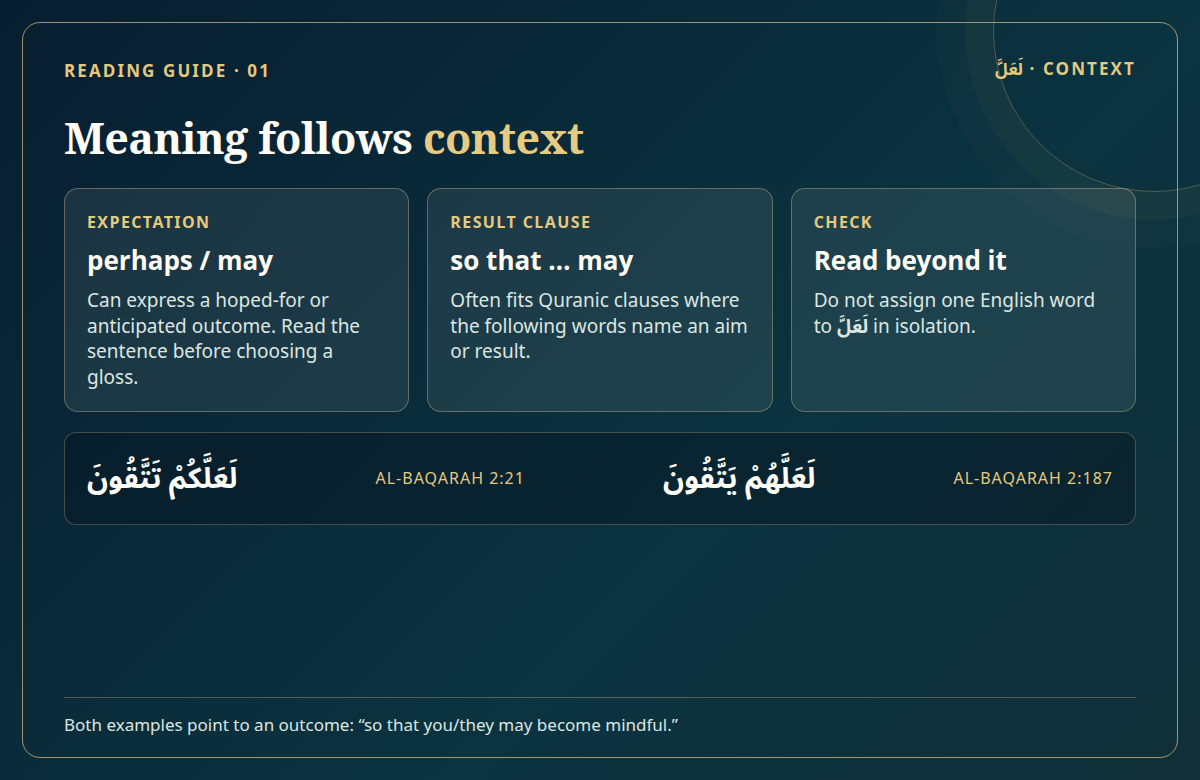
Laʿalla (لَعَلَّ) is a particle traditionally associated with expectation or hope. In a sentence about a desired result, English may express that sense with “perhaps,” “may,” or “I hope.” In many Quranic clauses, however, the most natural translation is “so that” or “that … may,” because the following words name an outcome or aim. A word-for-word translation can hide this difference, so treat English glosses as clues—not as a fixed one-word replacement.
The Quranic Arabic Corpus lists لَعَلَّ among the accusative particles known as inna and its sisters, glosses it as “so that,” and notes that exact meaning depends on context. Its grammar guide also describes the case pattern for the particle’s subject and predicate. That is a useful starting point: identify the construction first, then read the clause around it before choosing an English phrase.
A compact Quranic example occurs in Al-Baqarah 2:21: لَعَلَّكُمْ تَتَّقُونَ (laʿallakum tattaqūn). The phrase follows a command to worship the Lord who created people. English translations commonly convey the result with wording such as “so that you may become mindful.” The following verb tells you what outcome is in view; translating only the particle would leave the reader waiting for the point of the sentence.
In Al-Baqarah 2:187, the phrase is لَعَلَّهُمْ يَتَّقُونَ (laʿallahum yattaqūn), “so that they may become mindful.” Here the attached pronoun changes from -kum (“you, plural”) to -hum (“they”). In both examples, the clause after laʿalla presents the intended or anticipated result. The syntax is the same even though the pronoun and surrounding verse differ.
How laʿalla changes the sentence
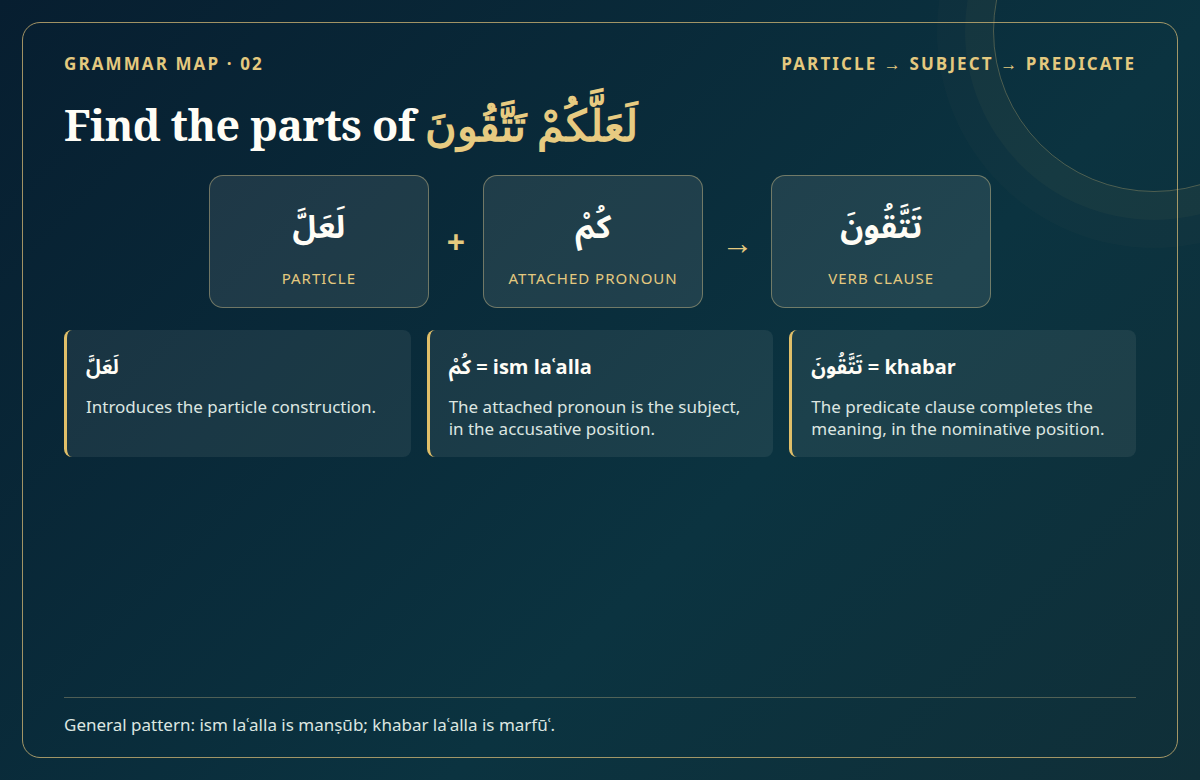
Before an inna-family particle enters a basic nominal sentence, its topic and predicate are normally both nominative. When لَعَلَّ enters, the topic becomes ism laʿalla (the particle’s subject) and is accusative in grammatical position; the predicate is khabar laʿalla and is nominative in grammatical position. The pattern parallels inna, but the particles do not have the same meaning. For a review of the underlying topic-and-predicate pattern, see our guide to Arabic nominal sentences in Quranic Arabic; for the case labels and common endings, see Arabic case endings.
A simple teaching example is لَعَلَّ الْجَوَّ جَمِيلٌ (laʿalla al-jawwa jamīlun), “Perhaps the weather is pleasant.” Here الْجَوَّ (the weather) is the ism laʿalla, marked accusative with fatḥah; جَمِيلٌ (pleasant) is the predicate, marked nominative with ḍammah and tanwīn. It is a classroom sentence for seeing the pattern; the Quranic examples above show laʿalla in its own context.
One source of confusion is that the pronoun may attach directly to the particle. In لَعَلَّكُمْ the ending -kum is not a separate word: it is an attached pronoun serving as the ism laʿalla, in the accusative position. The word after it can then function as the predicate. For a refresher on independent and attached forms, use our Arabic pronoun chart for Quranic reading. If suffixes on nouns and prepositions are new, our guide to Arabic attached pronouns and possessive suffixes shows how the same general idea of attachment works in other grammatical settings.
Read laʿalla in Quranic context
Use the words before and after the particle. In Al-Baqarah 2:21, the surrounding sentence gives an instruction, and تَتَّقُونَ names the result associated with it. In 2:187, يَتَّقُونَ likewise gives the result in the third-person plural. This helps explain why “so that they may” can sound more natural than “perhaps they” in English. It does not mean every occurrence should be forced into the same translation; the verse’s structure and meaning still matter.
A practical reading sequence is: (1) mark the particle and any attached pronoun; (2) identify the ism laʿalla; (3) find the predicate, which may be a word, phrase, or full verbal clause; (4) read the sentence before and after the phrase; and (5) choose an English wording that preserves the relationship. If “so that” makes the clause flow as an aim or result, use it. If the context foregrounds expectation, “may” or “perhaps” may fit better. Do not decide from the particle in isolation.
Context-first reading also helps distinguish the different jobs of mā and Arabic negation; neither is a synonym for laʿalla.
Do not confuse laʿalla with inna or layta
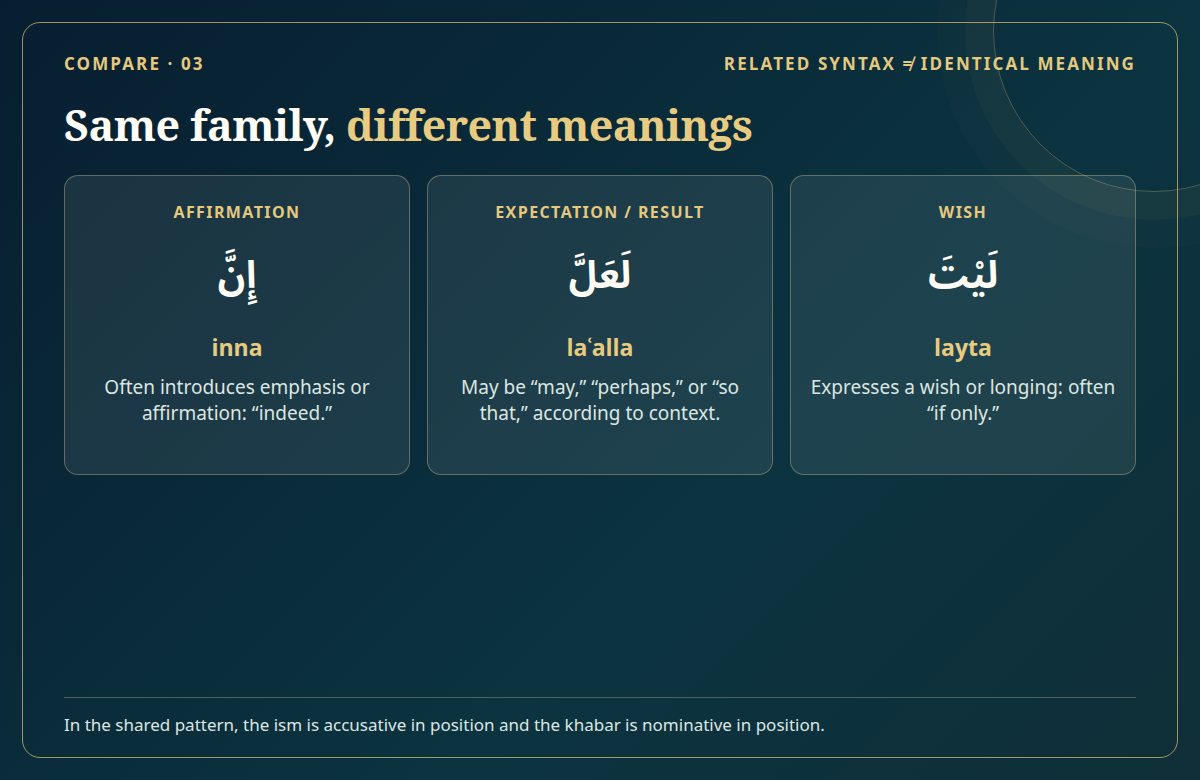
All three can enter a nominal construction and affect its case pattern, but their usual meanings differ. Inna commonly introduces affirmation (“indeed”); لَعَلَّ points toward expectation or a possible/intended outcome, often rendered “may” or “so that” in Quranic context; and layta expresses a wish or longing. The shared grammar family is a reason to compare their meanings, not a reason to translate them alike. For a different case pattern, compare kāna and its sisters in Quranic Arabic: its noun is nominative and its predicate is accusative.
Two mistakes are especially common. First, learners memorize a single translation such as “hopefully” and use it even when the following clause clearly states a result. Second, they treat the attached pronoun as an object because it is joined to the particle. Instead, ask whether the form is part of the ism laʿalla, then locate the predicate. This small analysis keeps the grammar and the translation connected.
Practice: find the subject, predicate, and sense
Try the following short analysis before looking at the notes. In لَعَلَّكُمْ تَتَّقُونَ, underline the attached pronoun, circle the predicate, then decide whether “so that you may become mindful” reads naturally in context. Next, compare لَعَلَّهُمْ يَتَّقُونَ. What changed? The pronoun now refers to “them,” while the verbal clause still states the anticipated result. The construction remains recognizable even though the person changes.
For the first phrase, -kum is the attached pronoun and serves as ism laʿalla in the accusative position. Tattaqūn is the predicate clause. In the second phrase, -hum has the same grammatical role, and yattaqūn completes the sentence. The Quranic Arabic Corpus describes لَعَلَّهُمْ in Al-Baqarah 2:187 as an accusative particle with an attached third-person masculine plural pronoun; its guide also explains the general subject-and-predicate case pattern. You can revisit that Quranic Arabic Corpus explanation of the particle inna and its sisters while checking the analysis.
A quick checklist
- Recognize لَعَلَّ as an inna-family accusative particle, not a verb.
- Include any attached pronoun when identifying the subject: لَعَلَّكُمْ and لَعَلَّهُمْ each contain the particle plus a pronoun.
- Expect the subject to be accusative in grammatical position and the predicate to be nominative in grammatical position.
- Read the full sentence before choosing between “may,” “perhaps,” and “so that.”
- Keep inna, laʿalla, and layta distinct even though their syntax is related.
If you want feedback on your Quranic Arabic reading, you can book a free Quran and Arabic trial class and ask your teacher to practise identifying the particle, its attached pronoun, and the predicate in context.
Watch: laʿalla in Arabic grammar
This text-and-slide lesson reviews laʿalla as one of the sisters of inna, including its context-sensitive glosses, case pattern, and attached pronouns. It complements the Quranic examples and reading checklist above.
When you meet لَعَلَّ again, let syntax answer who or what follows the particle, then let context answer how the phrase sounds in English. That two-step approach is more reliable than memorizing one gloss—and it helps you read Quranic Arabic with greater care.