

A sentence about walking “with the river” does not normally mean that the river put on shoes and walked beside you. It can mean that your route followed the river. Arabic has a formal construction for accompaniment in which wāw carries a “with” relationship and the following noun is accusative: الْمَفْعُولُ مَعَهُ, the comitative object.
This lesson is a reader’s investigation of accompaniment, coordination and circumstance. You will compare a route description with a report about two people, decide what the grammar does and does not assert, and rewrite a small fictional travel note. The examples are composed for study unless a Quran reference is explicitly given.
A route description that is not a list of two walkers
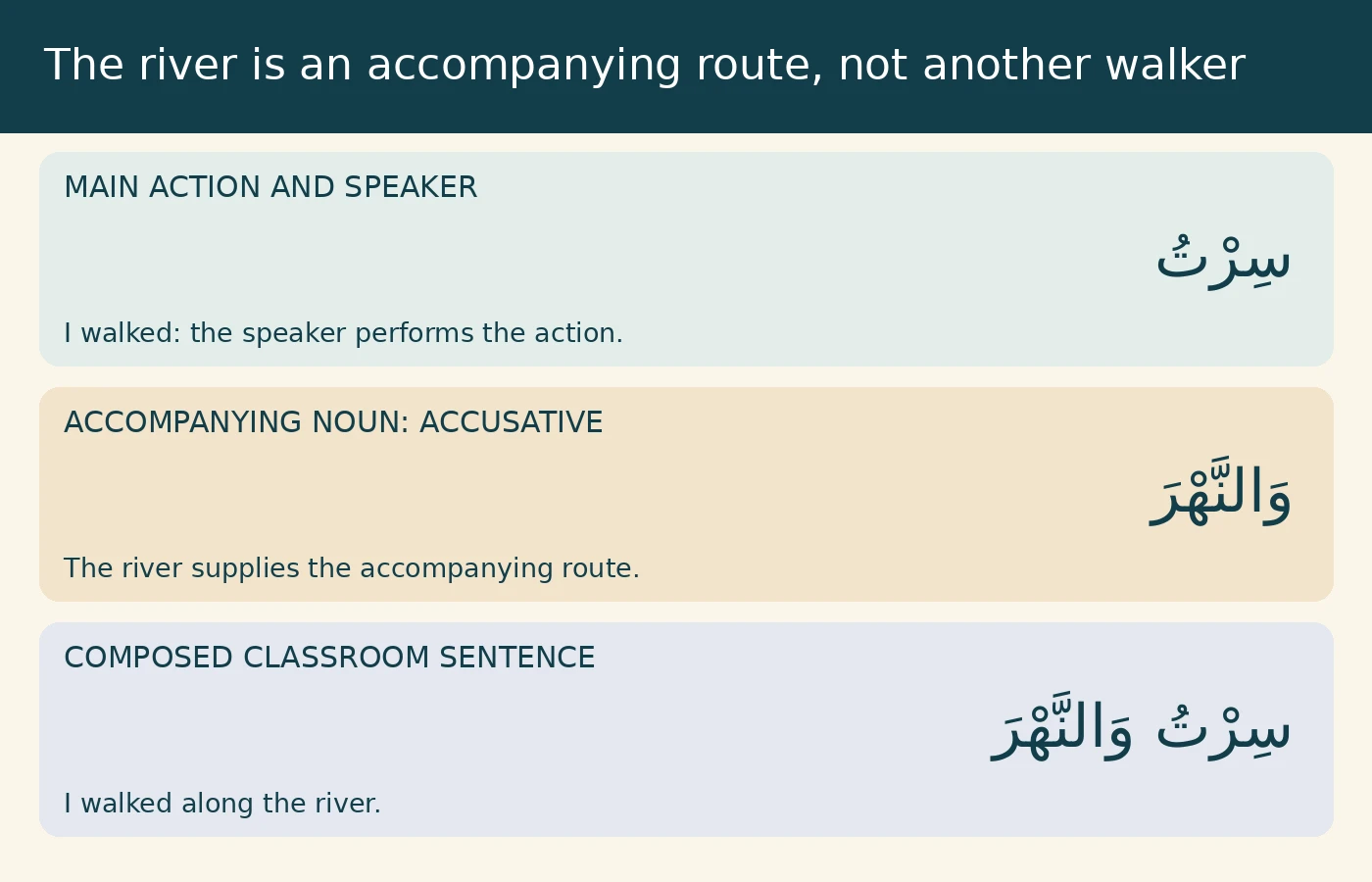
Read سِرْتُ وَالنَّهْرَ — “I walked along the river,” or more literally, “I walked with the river.” The speaker is the walker. النَّهْرَ supplies the accompanying route or feature. In this intended reading, the river is not coordinated with the speaker as another agent performing the same walking action.
The wāw is called واو المعية, the wāw of accompaniment, and the following noun is the comitative object. Its accusative case belongs to that construction. The ordinary final fathah on النَّهْرَ is a visible marker here, but do not identify the role from a fathah alone: direct objects and several other noun roles can have the same marker.
The case-ending guide explains the broader distinction between a grammatical case and the ending that expresses it. For this lesson, your first question is semantic and structural: does the following noun name another participant coordinated in the action, or does it supply something with which the action occurs?
Now put two people in the report
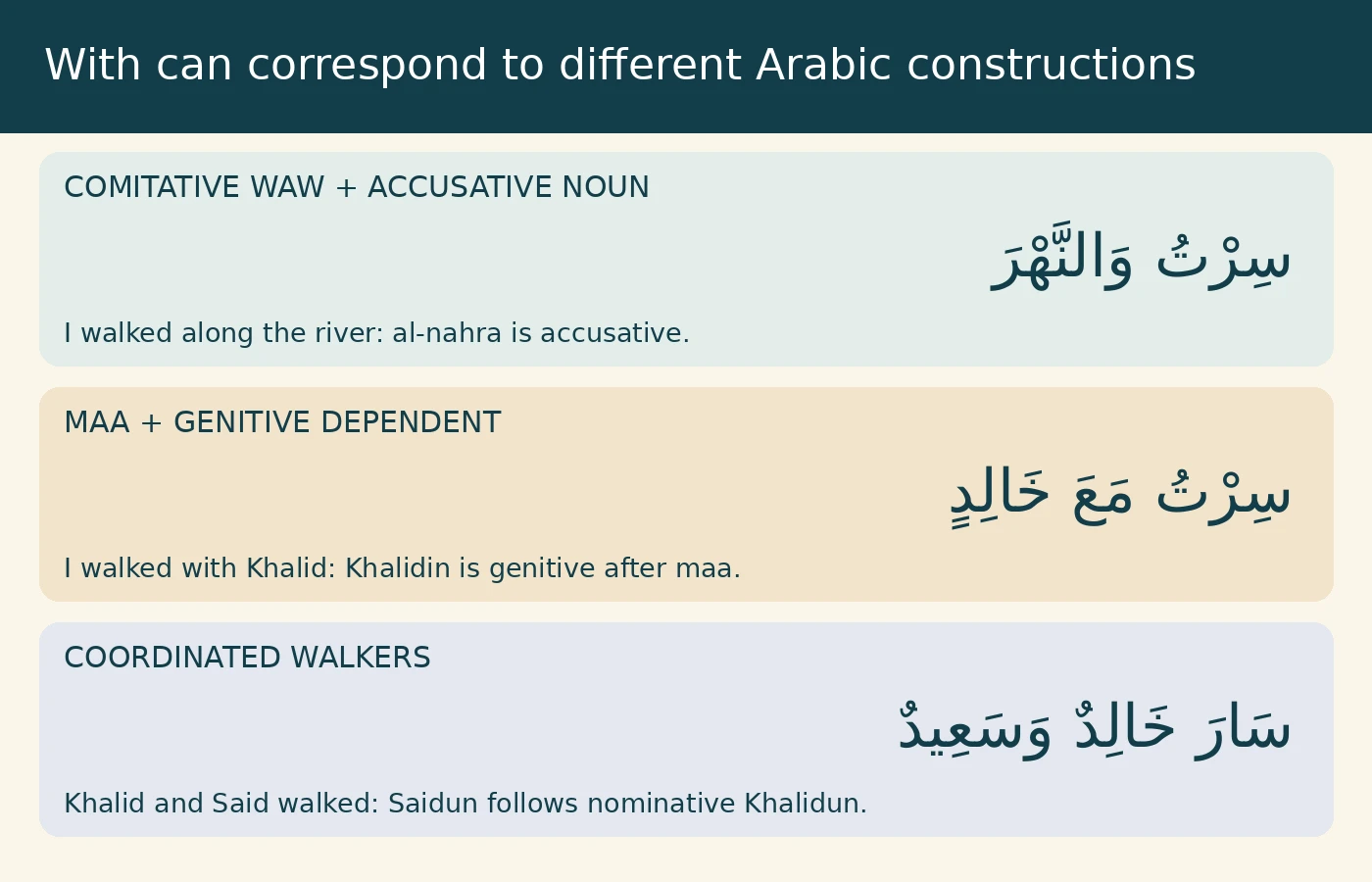
سَارَ خَالِدٌ وَسَعِيدٌ means “Khalid and Said walked.” In this composed coordination example, both named people participate in the walking. سَعِيدٌ follows the nominative case of the noun with which it is coordinated. That is a different relationship from the river example.
Do not create a rule that every noun after wāw is accusative. Wāw can coordinate a nominative subject, an accusative object, a genitive dependent, or larger expressions. A coordinating noun follows the grammatical case appropriate to its relationship, rather than taking one universal “after wāw” case.
The conjunction guide explains ordinary wa, fa and other connectors. Read it alongside this lesson rather than replacing its coordination explanation with “wāw means with.” A single written letter has several grammatical uses, and the sentence determines which one is relevant.
Some examples permit more than one analysis
When both accompaniment and shared participation are plausible, a sentence may allow alternative constructions. A report about a leader arriving with a group can present the group as accompaniment or coordinate the participants. The noun ending and intended relationship then matter together.
Al Jazeera Learning Arabic’s comitative-object lesson explicitly contrasts these possibilities. Do not “correct” a valid coordination into a comitative merely because an English translator used “with.” Likewise, do not erase an intended accompaniment reading by forcing every following noun into a list of equal agents.
For an ambiguous unvocalized sentence, record the alternatives before deciding. Ask what each reading claims and whether the wider text supports it. A careful note such as “possible coordination or accompaniment; need context” is more accurate than a confident label based only on the nearest wāw.
With maʿa, the internal construction changes
Compare سِرْتُ وَالنَّهْرَ with a suitable phrase using مَعَ, such as سِرْتُ مَعَ خَالِدٍ, “I walked with Khalid.” The second example expresses accompaniment through مَعَ and its following genitive dependent. It is not a comitative object after wāw.
Do not treat مَعَ as though it were simply a different spelling of the same particle. In traditional analysis it is a noun used adverbially, commonly in an idafa relationship with what follows. The idafa guide helps explain why خَالِدٍ is genitive in this phrase. The semantic idea “with” can be expressed through different grammatical structures.
When rewriting, build a complete new construction rather than changing one word and keeping the old ending automatically. This is a useful general editing habit: a similar message can survive a change of wording while the internal grammar changes substantially.
Accompaniment is different from a circumstantial clause
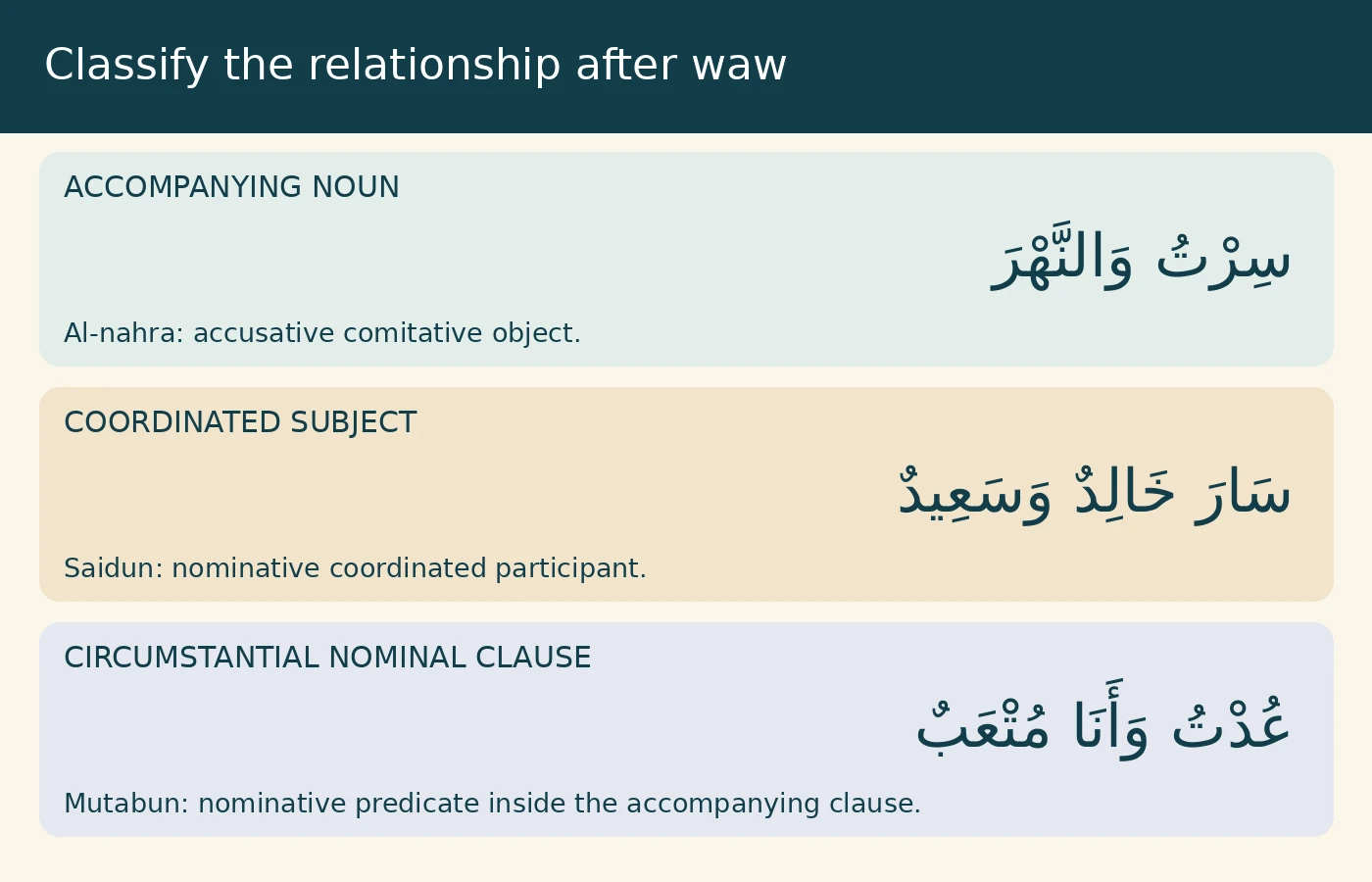
In the composed عُدْتُ وَأَنَا مُتْعَبٌ, “I returned while I was tired,” the wāw introduces a clause describing the speaker’s state. There is a subject/predicate structure after it. The sentence is not presenting مُتْعَبٌ as a comitative object noun.
Contrast that with the noun after wāw in سِرْتُ وَالنَّهْرَ. One construction supplies an accompanying noun; the other supplies a whole circumstantial statement. The adverbial-expression lesson gives the wider state/manner framework, while the nominal-sentence guide explains the internal statement أَنَا مُتْعَبٌ.
This distinction prevents a misleading analysis: “The word after wāw is nominative, so the sentence must be wrong.” In the circumstantial clause, مُتْعَبٌ is nominative as a predicate. Its clause-level relationship does not turn every word inside it into an accusative noun.
A comitative noun is not the thing acted upon
قَرَأْتُ الْكِتَابَ, “I read the book,” contains a direct object: the book is what was read. سِرْتُ وَالنَّهْرَ contains an accompaniment expression: the river is not what the speaker walked in the same object-taking sense. Both target nouns are accusative, but their relationship to the verb is different.
The verbal-sentence guide helps establish the main action and its participants first. After that, examine what the wāw expression adds. Do not use “it follows a verb” as proof of a direct object. Many kinds of additional expression can follow a completed verbal clause.
One useful test for these clear examples is to paraphrase the contribution without a grammar label. The book gives “what I read.” The river gives “the feature along which I walked.” The paraphrases make it harder to merge two different roles merely because their endings match.
Do not apply a verb-mood rule to the noun
Advanced Arabic lessons also discuss a comitative wāw followed by an imperfect verb in certain constructions. That is a different word-class problem from the accusative comitative noun studied here. Seeing the label “wāw of accompaniment” does not tell you to apply a noun ending to a verb or a verb-mood ending to a noun.
Before discussing the governor, identify what follows: a noun, a finite verb, or a whole nominal clause. The verb-mood guide covers relevant imperfect-verb patterns. You do not need to solve those patterns to explain why النَّهْرَ is accusative in the route example, but you do need to avoid confusing the categories.
A documented Quranic use, with its source’s analysis
The Quranic Arabic Corpus documentation on the comitative object gives a phrase from Quran 5:36 as an example, including وَمِثْلَهُ مَعَهُ. It analyzes the noun after wāw through the comitative relation. The phrase forms part of a larger conditional statement and must be read with that full context.
This is a useful reminder that a comitative analysis is not restricted to a literal walking companion. Accompaniment can connect amounts or other entities within a larger statement. Follow the source’s identified dependency rather than trying to translate the isolated word “with” back into one universal Arabic formula.
For Quran study, distinguish a documented grammatical analysis from a full interpretation of the verse. Consult a reliable translation and tafsir for the passage’s meaning. Where a source presents one recognized syntactic analysis, do not pretend that your beginner exercise has independently ruled out every scholarly alternative.
Reconstruct a fictional travel note
A fictional notebook contains three separate observations: one person walked along a river; two named people walked together; and the speaker returned tired. Match each observation to one of the three composed examples already studied: سِرْتُ وَالنَّهْرَ; سَارَ خَالِدٌ وَسَعِيدٌ; عُدْتُ وَأَنَا مُتْعَبٌ.
Answers: the first uses an accompanying noun after comitative wāw, the second coordinates the two walkers, and the third gives a circumstantial clause. Explain why النَّهْرَ is accusative, سَعِيدٌ is nominative, and مُتْعَبٌ is nominative. Three following words have different roles even though the preceding written wāw looks familiar.
Next rewrite the two-person observation using مَعَ: سَارَ خَالِدٌ مَعَ سَعِيدٍ. The meaning still places Said with Khalid, but the following noun is now genitive in the maʿa construction. This is a controlled editing comparison, not a claim that every coordination has an identical companion-phrase substitute in every context.
A noun phrase can contain its own dependency
The accompanying expression need not consist of one isolated word. A following noun may have a dependent that explains it more fully. When you encounter that kind of phrase, identify the comitative head first, then analyze the words inside its phrase. Do not give the dependent an accusative ending merely because the whole expression follows a comitative wāw.
For comparison, the noun in a time expression such as طُلُوعَ الْفَجْرِ, “the rising of dawn,” has a genitive dependent الْفَجْرِ. If a suitable sentence uses the whole phrase for accompaniment, the head’s role in that sentence and the dependent’s role inside the phrase remain separate decisions. A more advanced text can place several grammatical relationships close together without making them identical.
Use two brackets when annotating: one around the full accompanying phrase, and a smaller one around its dependent. Write the case reason beside the relevant word. This prevents a vague explanation such as “everything after wāw is accusative.” It also prepares you to read the Corpus example without treating every nearby pronoun and noun as another comitative object.
Test the explanation on a changed scene
Imagine that the river example is replaced by a path running beside the walker. The physical feature changes, but the intended accompaniment relationship can remain. Now imagine replacing the feature with another person who is explicitly said to perform the same walking action. The intended grammatical presentation may change to coordination. Your decision should respond to the new relationship, rather than preserve a label because the sentence has the same number of words.
For an oral exercise, give your partner the scene before showing the Arabic. Ask for a plain-language explanation of who acts and what accompanies the action. Then reveal the sentence and compare its actual construction with that expectation. If the wording permits more than one reading, make that the discussion point instead of pretending that an ending settles every question by itself.
What an accurate translation should preserve
An English “and” may sound awkward when Arabic presents a river as an accompanying route. “Along the river” can preserve the intended relationship more clearly. Conversely, translating coordinated walkers with “along” would lose the shared participants. Translation should preserve the scene’s relationships rather than copy one dictionary equivalent for every wāw.
Make two columns in your exercise: “what the Arabic explicitly relates” and “what I have added in English.” If your English makes the river an agent, claims a sequence that the sentence does not state, or turns tiredness into a traveling companion, revise it. This is a meaning check, not merely a style preference.
For guided analysis, Book a Free Trial Class. Bring a short sentence where wāw could mean coordination, accompaniment or circumstance. State your proposed reading and the clue that supports it. A tutor can then help you test a precise hypothesis rather than translate a disconnected letter.