

When two consonants meet in Quran recitation, Tajweed sometimes asks the first sound to flow into the second instead of being heard as two fully separate letters. This is Idgham, or assimilation. In the common minor (or small, saghir) meeting discussed here, the first letter is sakin (without a vowel) and the following letter carries a vowel. The first consonant is merged into the next, generally making the second letter sound doubled, like a shaddah. Learning the types of Idgham in Tajweed helps you notice what is happening without turning a useful label into a substitute for listening and instruction.
The three relationship-based types at a glance
These three names describe how the two letters are related. They are often written with slightly different transliterations: Idgham Mutamathilayn or Mithlayn (also Mutamatsilayn), Idgham Mutajanisayn (or Mutajanisain), and Idgham Mutaqaribayn (or Mutaqaribain). You may also see the same topic summarized as identical-letter, same-nature, similar-letter, or close-letter Idgham. The vocabulary is helpful, but classifications and detailed applications can vary slightly among teaching references. The safe habit is to identify the actual pair, its position, and the reading tradition before deciding to merge it.
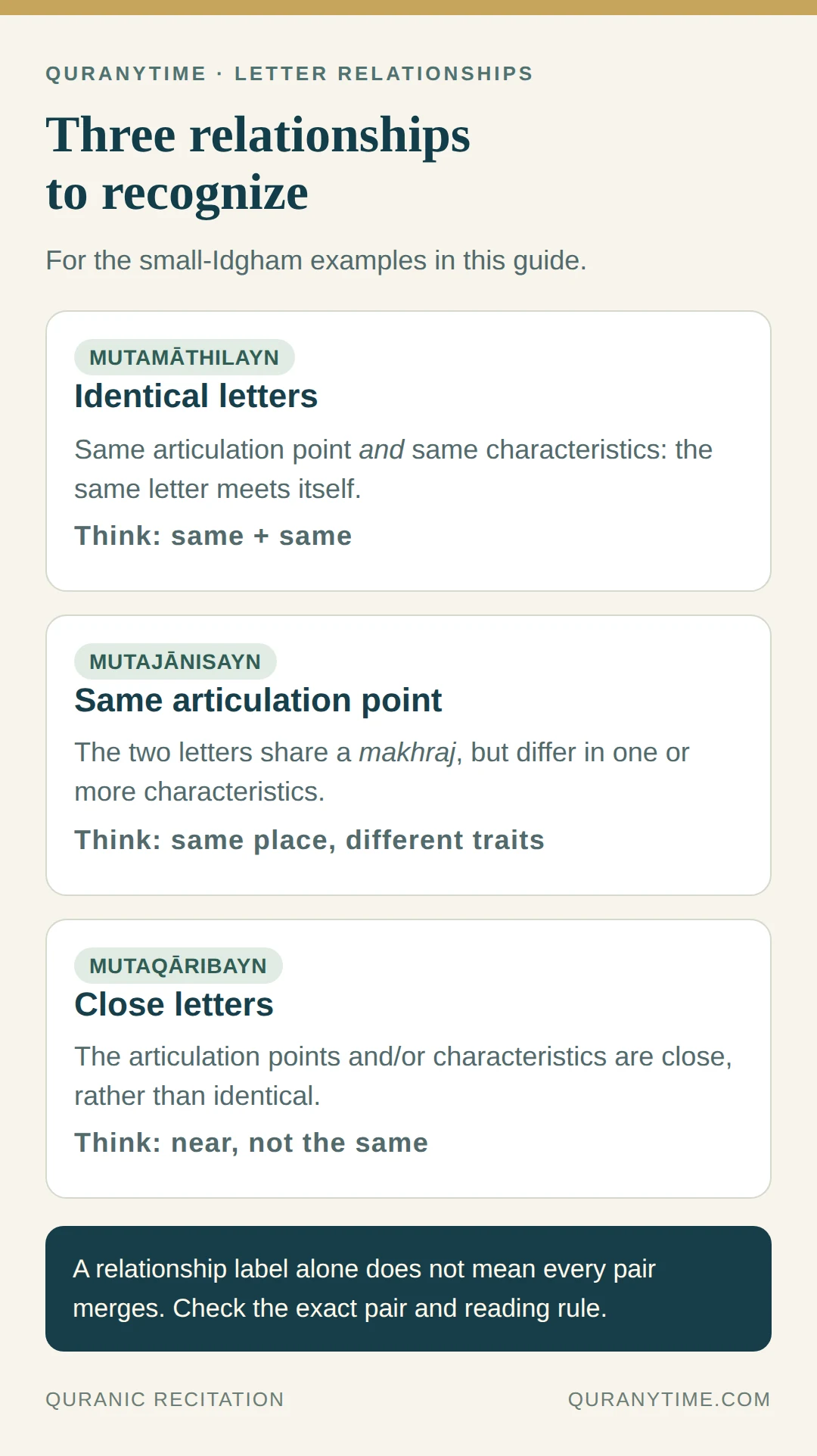
- Mutamathilayn: the two letters are identical: they share the same makhraj (articulation point) and the same relevant characteristics. In a qualifying meeting, the first is absorbed into the second.
- Mutajanisayn: the letters share an articulation point but differ in characteristics. Their shared origin makes assimilation possible in specified cases, even though they are not the same letter.
- Mutaqaribayn: the letters are close in articulation and/or characteristics. “Close” is a practical description, not permission to merge every pair that feels similar.
For a specialist explanation of how same, similar, close, and far letters are discussed, see About Tajweed’s lesson on letter relationships. Use it as a reference alongside a qualified teacher, not as a reason to guess an unfamiliar occurrence.
Mutamathilayn: when the letter meets itself
Mutamathilayn is the most intuitive category. The first and second letters are the same, and the first is sakin while the second is vowelled. Rather than releasing the first consonant and then starting the same consonant again, let the sound continue into the second position. The audible result is normally a strengthened second letter, represented by shaddah in teaching notation.
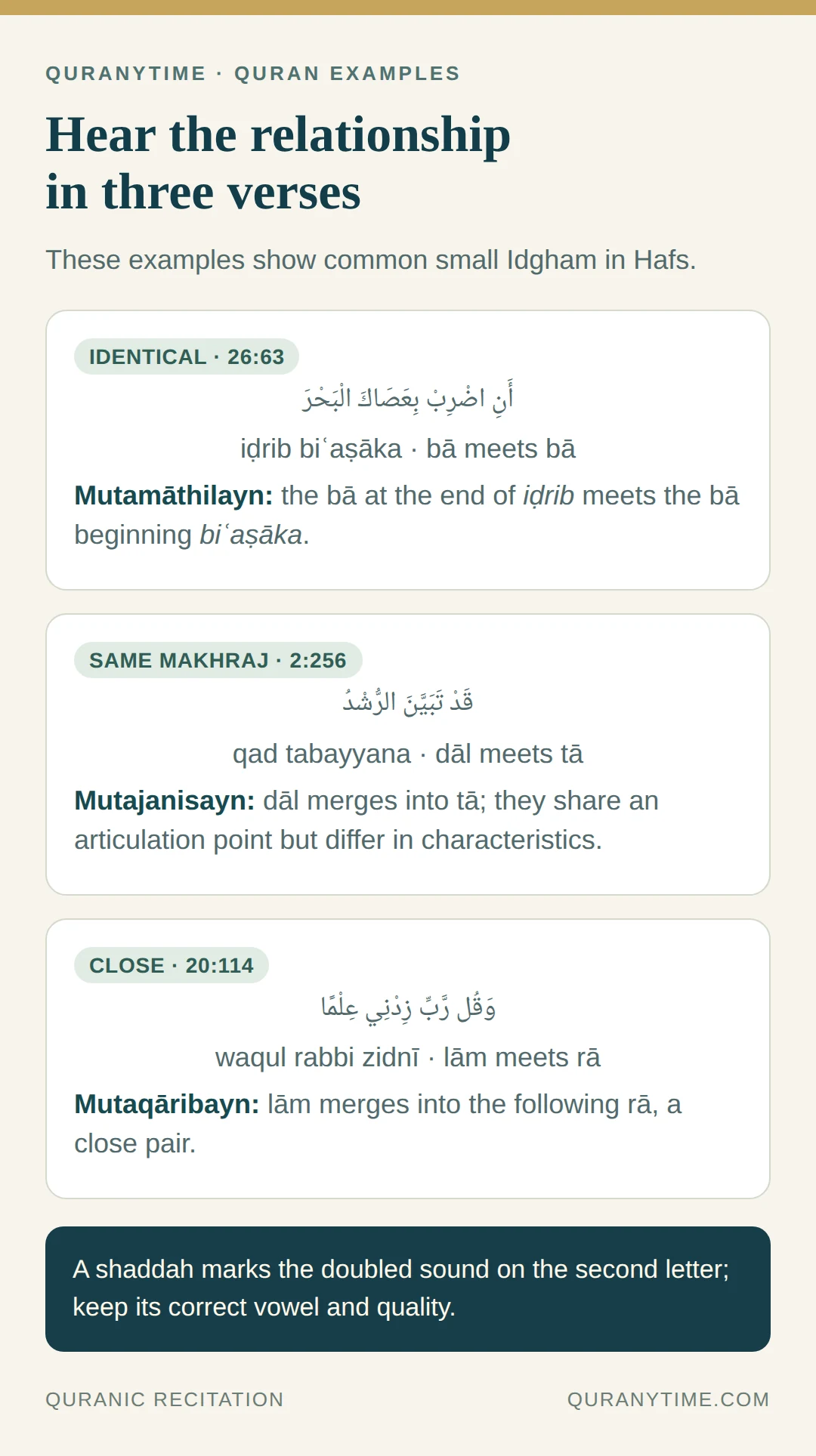
A verified Quran example is in 26:63: أَنِ اضْرِبْ بِعَصَاكَ الْبَحْرَ, iḍrib biʿaṣāka al-baḥra, “strike the sea with your staff.” The final bā of iḍrib meets the preposition bā of biʿaṣāka at the word boundary. Because it is the same letter meeting itself, this is the common Mutamathilayn example: the first bā merges into the following bā, which is heard with a shaddah. Do not insert an extra fully separate bā between the two words.
Mutajanisayn: same articulation point, different qualities
Mutajanisayn asks you to look beyond the letter’s written identity. The two consonants share a makhraj, yet their characteristics differ. In a qualifying minor Idgham, the first sound is not given a full independent release; it is assimilated toward the following sound. The following letter still keeps its own correct identity and qualities.
Consider 2:256: قَدْ تَبَيَّنَ الرُّشْدُ مِنَ الْغَيِّ, qad tabayyana al-rushdu mina al-ghayy, “the right course has become clear from error.” The dāl in qad is followed by tā in tabayyana. They share the articulation point while differing in attributes. In common Hafs treatment, the first dāl assimilates to the tā, often shown in Tajweed marking as قَد تَّبَيَّنَ. This does not mean the printed Uthmani spelling has been rewritten. It is a recitation instruction: hear the transition as qattabayyana, with the tā strengthened, rather than pronouncing a separate, fully released dāl.
Mutaqaribayn: when the letters are close
Mutaqaribayn concerns a close relationship in articulation and/or characteristics. Since “close” is broader than “identical,” this category especially requires a reliable rule source and a teacher’s correction. A pair may be close in a general phonetic sense without every occurrence qualifying for Idgham. Check the exact context and the reading you are learning.
In 20:114, وَقُل رَّبِّ زِدْنِي عِلْمًا, waqul rabbi zidnī ʿilman, “and say, ‘My Lord, increase me in knowledge,’” the lām of qul comes before rā of rabbi. This lām–rā meeting is the familiar Mutaqaribayn example. The lām merges into the following rā, so the rā is heard as doubled. Aim for a clear rā, not a separate lām followed by rā and not a vague deletion that loses the target sound.
A practical test before you merge
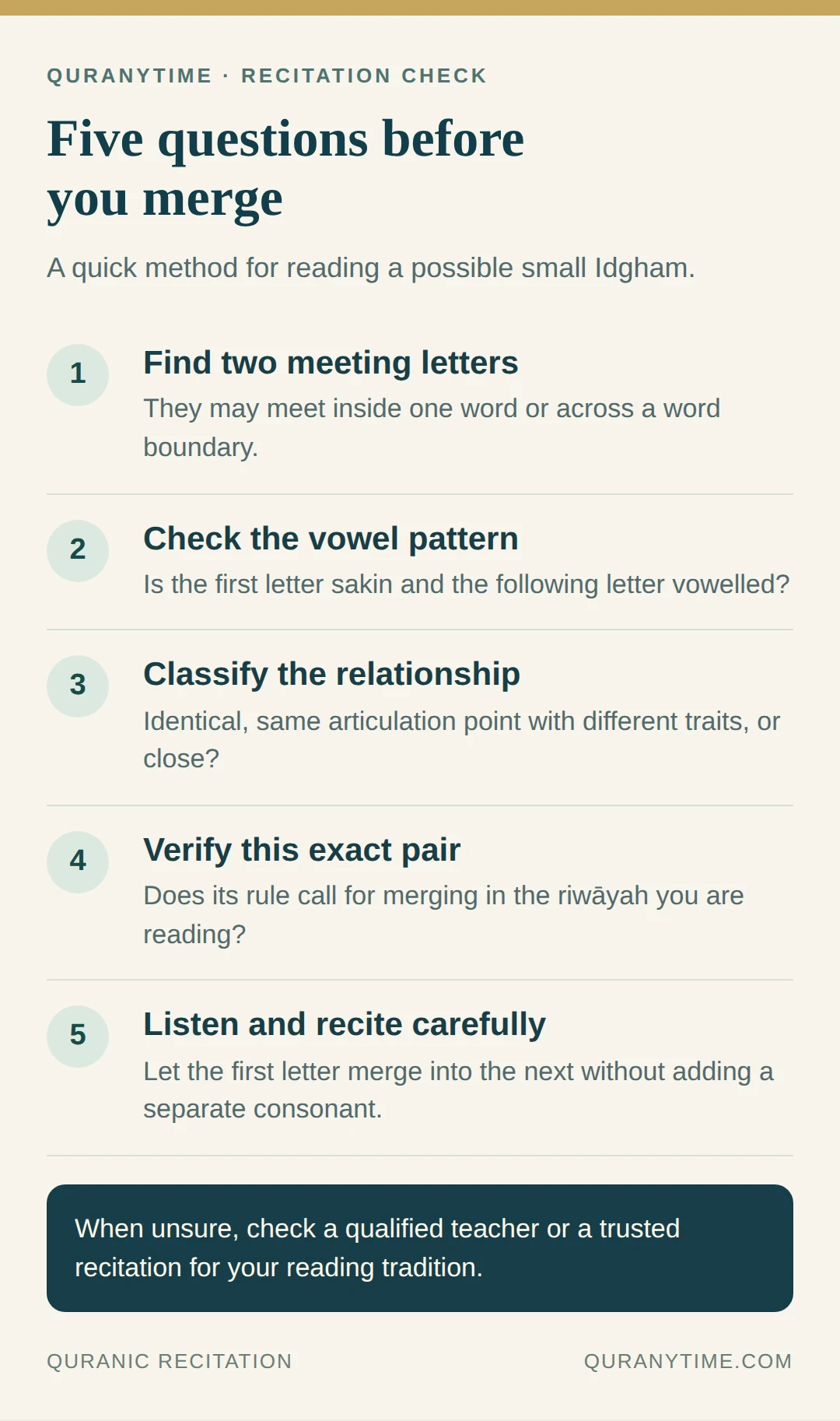
Use this five-question routine whenever you meet a possible example:
- Which two consonants meet, and are they in the same word or across a word boundary?
- Is the first letter sakin and the next letter vowelled? If not, you may be looking at a different rule.
- Are the letters identical, at the same articulation point with different qualities, or merely close?
- Does the specific pair and position qualify in the common Hafs reading and in your mushaf’s marking?
- Can you recite one connected, strengthened second consonant while preserving its correct qualities?
That checklist prevents a common beginner mistake: treating the relationship name as an automatic command. A relationship label alone does not mean that every possible pair merges. Exceptions, positions, and reading traditions matter. When the marking is unclear, pause and ask a teacher rather than applying a pattern by analogy.
How to practise without losing the sound
First read the two letters slowly as a pair, then repeat the phrase with the first letter absorbed. Feel the second consonant receive the emphasis of the shaddah, but do not add an unrelated vowel. For Mutamathilayn, compare two identical bā sounds; for Mutajanisayn, listen for the transition from dāl toward tā; for Mutaqaribayn, listen for the doubled rā after lām is merged. Record yourself and compare with a trusted recitation. A name does not substitute for guided listening.
Practice item: classify the relationship and describe the reading in each phrase: (A) اضْرِبْ بِعَصَاكَ, (B) قَدْ تَبَيَّنَ, and (C) وَقُل رَّبِّ.
Answers: (A) Mutamathilayn, bā into bā, with the second bā strengthened. (B) Mutajanisayn, dāl toward tā in the common Hafs treatment, heard as qattabayyana; do not alter the printed spelling. (C) Mutaqaribayn, lām into rā, with a clearly doubled rā. In all three, the first consonant is not pronounced as an extra, fully separate consonant.
Common errors and a quick diagnostic
Watch for four errors. Some readers release the first letter twice, producing a choppy “bā-bā,” “dāl-tā,” or “lām-rā.” Others erase too much and leave the second letter weak or indistinct. A third error is adding a vowel between the consonants. A fourth is carrying a rule into a pair or position where it does not apply. Keep the following qualities: Idgham is not a licence to erase ghunnah, change a consonant’s articulation, or shorten or lengthen a vowel that another rule requires.
Role-based diagnostic: if you are a learner, circle the first sakin letter and underline the following vowelled letter before reading. If you are a parent or study partner, listen for an unwanted first consonant and ask the reader to repeat only the pair. If you are a teacher, check makhraj first, then the timing and strength of the second consonant; do not correct only the label. This keeps diagnosis practical and kind.
Keep this rule in its proper scope
This article focuses on relationship-based Idgham between consonants: Mutamathilayn, Mutajanisayn, and Mutaqaribayn. It is not a full lesson on Idgham of Nūn Sākinah and Tanwīn, where the following letters and ghunnah rules create a different framework. It is also distinct from Idgham Shafawi (or Meem Sakinah Idgham), which concerns a sākinah mīm before another mīm. For a broader map, review this Tajweed rules chart, then study how shaddah works in Quran reading. Keeping these lessons separate helps you select the right test instead of merging every similar-looking sound.
Related practice and teacher support
When reviewing connected recitation, it can help to revisit Izhar and clear pronunciation, since not every meeting is an Idgham meeting. If a consonant seems to bounce, compare it with Qalqalah without adding an extra vowel. If your reading becomes rushed while trying to merge, use this guide to build Quran fluency without rushing. Also check Tajweed madd rules so a nearby vowel’s length is not changed while you focus on the consonant pair.
For the common Hafs reading, follow the markings in your trusted mushaf and confirm uncertain cases with a qualified instructor. If you want individual feedback on makhraj, timing, and whether the second letter is truly receiving the merge, you can book your free trial class. A teacher can hear details that a written explanation cannot, especially when a learner either over-merges or leaves the first consonant fully exposed.
Optional listening lesson
A short visual lesson can reinforce the three categories and their common errors. Listen actively: pause after each example, predict the relationship, and then imitate the merged sound. Keep the written examples and your teacher’s correction as the final guide for your own recitation.