
Weak verbs in Quranic Arabic can look unfamiliar even when you already know their roots. You may recognize قَالَ (qāla, “he said”) but hesitate at قُلْ (qul, “say”). These are not unrelated vocabulary items. Both belong to ق و ل. A weak root letter changes its visible form as the verb is conjugated.
This guide teaches recognition, not an entire conjugation system. You will learn where a weak letter sits, compare three useful Quranic examples, and use a short checking routine instead of guessing a missing radical. If roots are new to you, begin with our introduction to Quranic Arabic roots and patterns.
What makes an Arabic verb weak?
A weak verb, or fiʿl muʿtall (فِعْل مُعْتَلّ), has a weak radical, usually و or ي, in its root. The radical is an underlying root consonant; it is not necessarily a letter you can point to in every written form. Depending on the pattern and grammatical environment, it may appear as a long vowel, change its written shape, or disappear from the surface form.
“Weak” describes grammatical behavior, not weak meaning or poor pronunciation. These changes follow patterns. Calling the verbs irregular can be convenient, but it should not suggest that their forms are random. Start with one family and learn a few connected forms rather than memorizing every changed word separately.
It also helps to distinguish a root from a complete verb. Our past-and-present conjugation guide introduces the regular model. Weak verbs build on that foundation but do not always preserve its visible sequence of consonants and vowels.
Three positions to recognize
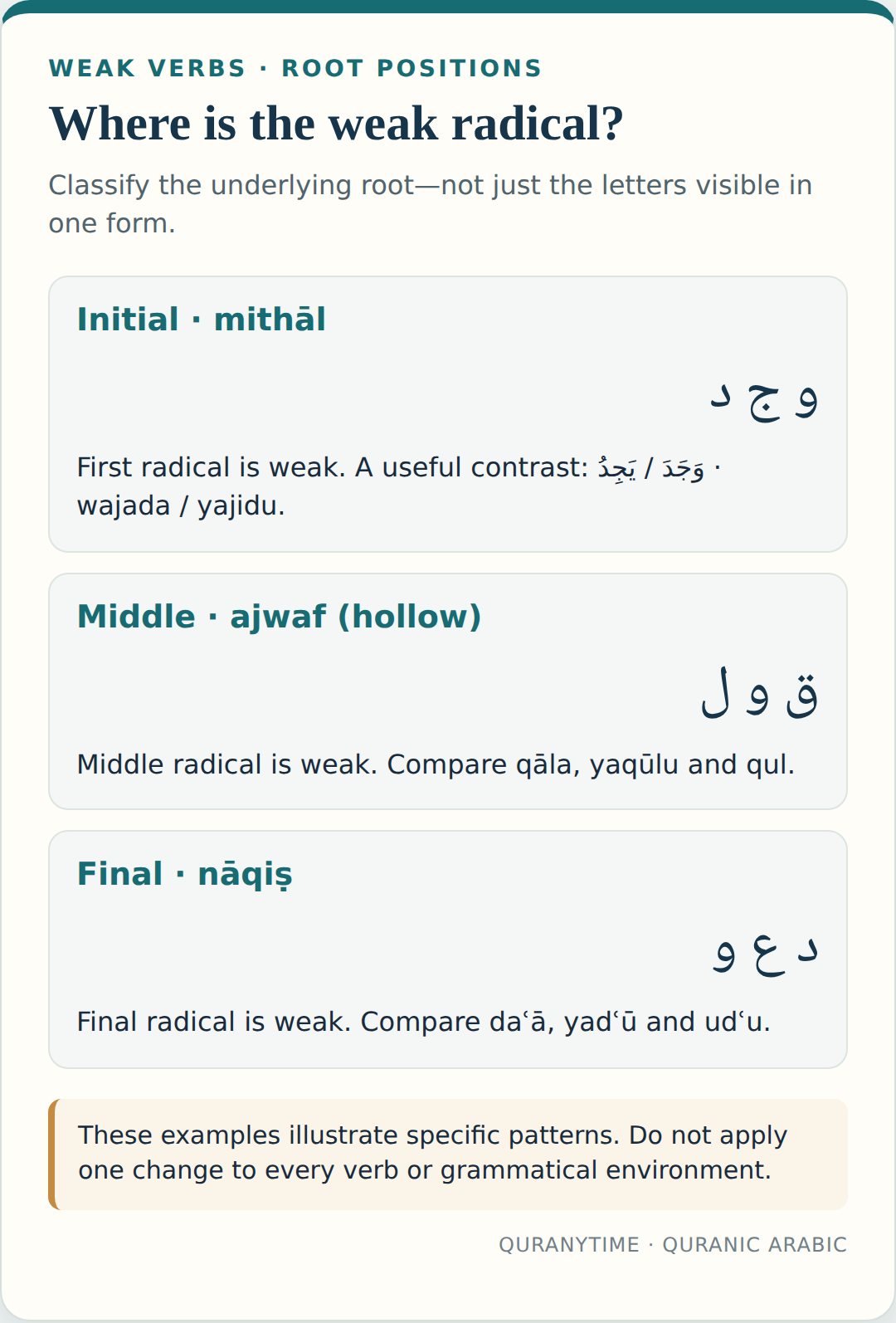
Initial weak verbs, traditionally called mithāl, have a weak first radical. With وَجَدَ (wajada, “he found”), the root is و ج د. The initial wāw is absent in يَجِدُ (yajidu, “he finds”). This particular contrast is useful; it is not a rule that every initial wāw disappears in every form.
Hollow verbs, or ajwaf, have a weak middle radical. In قَالَ, the root’s middle wāw surfaces through the long vowel rather than a written و. Other conjugations reveal different shapes. You therefore need more than a three-letter visual scan to recognize the family.
Final weak verbs, or nāqiṣ, have a weak last radical. دَعَا (daʿā, “he called”) belongs to د ع و. Compare يَدْعُو (yadʿū, “he calls”) and ادْعُ (udʿu, “call”). Some roots contain two weak radicals as well; leave those for a later, carefully checked stage.
A hollow family: qāla, yaqūlu and qul
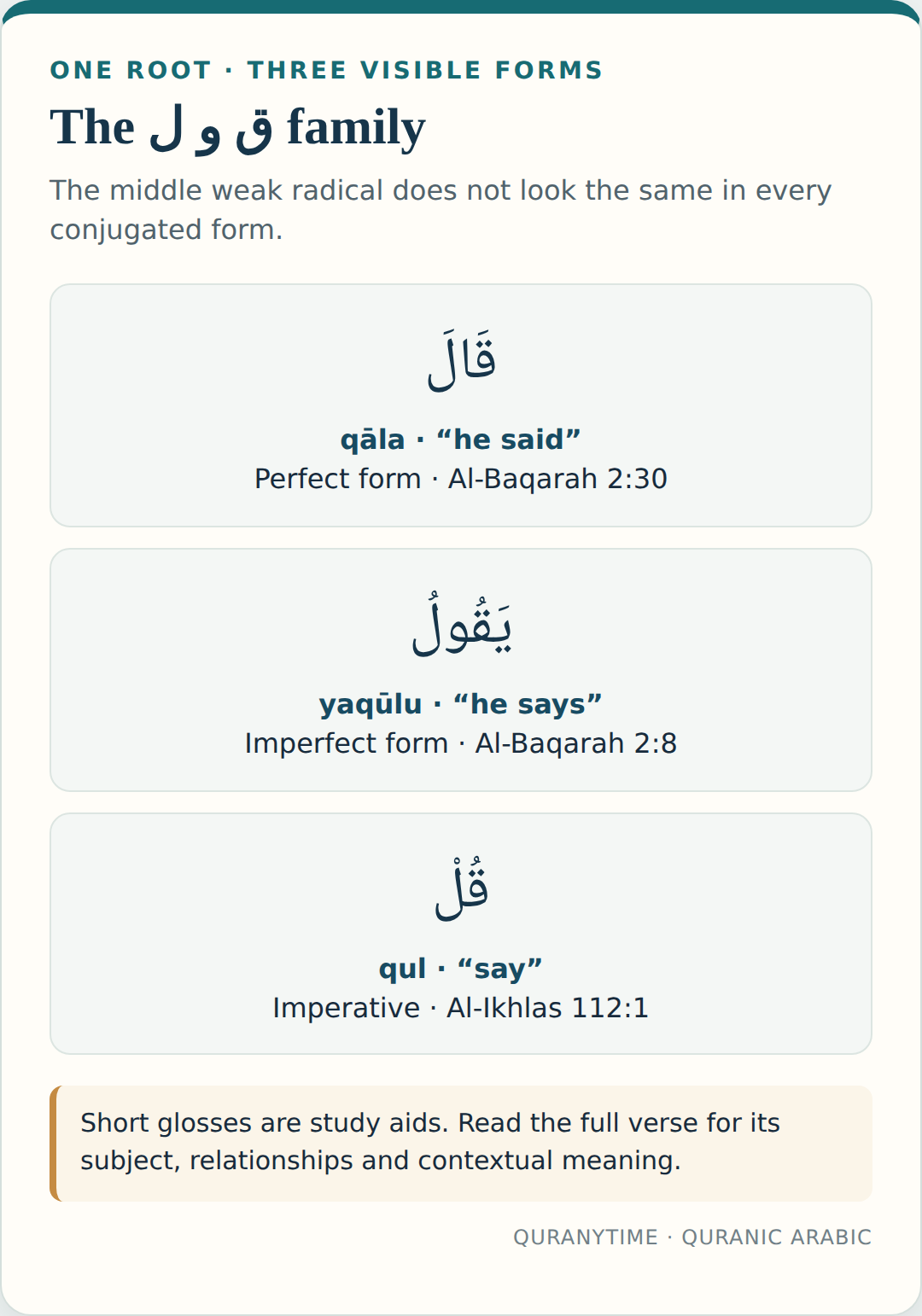
The family ق و ل gives a compact Quran-reading lesson. قَالَ appears in Al-Baqarah 2:30, يَقُولُ in Al-Baqarah 2:8, and قُلْ at the opening of Al-Ikhlas 112:1. Their short study glosses are “he said,” “he says,” and “say.” Read the full verses for their actual subjects, relationships and meaning.
Notice what changes: qāla has a long ā; yaqūlu has a long ū; qul has a short u and no written middle weak radical. Do not insert an extra vowel or pronounce a missing wāw simply because you know the root. Recite the transmitted written form, with appropriate recitation guidance.
قُلْ is an imperative addressed to a masculine singular addressee in the grammatical analysis. It is not a past-tense word shortened at random. Our guide to recognizing Quranic imperatives explains why identifying the command form matters before assigning a translation.
An initial-weak example: yajidka in 93:6
In Ad-Duha 93:6, يَجِدْكَ (yajidka) combines a verb with an attached object pronoun. Its root is و ج د, although the initial root wāw is not written. The final كَ refers to the addressee, “you”; it is not a fourth root letter.
The verb is imperfect and jussive in this verse, following أَلَمْ. Separate two observations: the absent initial wāw belongs to this weak-verb pattern, while the jussive analysis explains another part of the grammatical form. Do not attribute every change to one cause. For that second layer, see our Quran-reading guide to jussive and subjunctive moods.
A final-weak example: udʿu in 16:125
An-Nahl 16:125 begins with ادْعُ (udʿu), an imperative from د ع و. The root’s final wāw is absent from this written command. A brief gloss is “call” or, in this context, “invite.” That gloss is a learning aid, not a complete translation of the verse.
The example also prevents a common root-finding mistake: the initial alif in ادْعُ is not the root’s first radical. Recognizing the command pattern helps you recover د ع و without treating every written letter as part of the root. Compare the verified form with its family rather than mechanically adding or removing letters.
Weak-root behavior and derived verb patterns are related but separate questions. Identify the actual pattern before transferring a rule from one verb to another; our Forms I–X recognition guide gives that wider framework.
A five-step reading routine
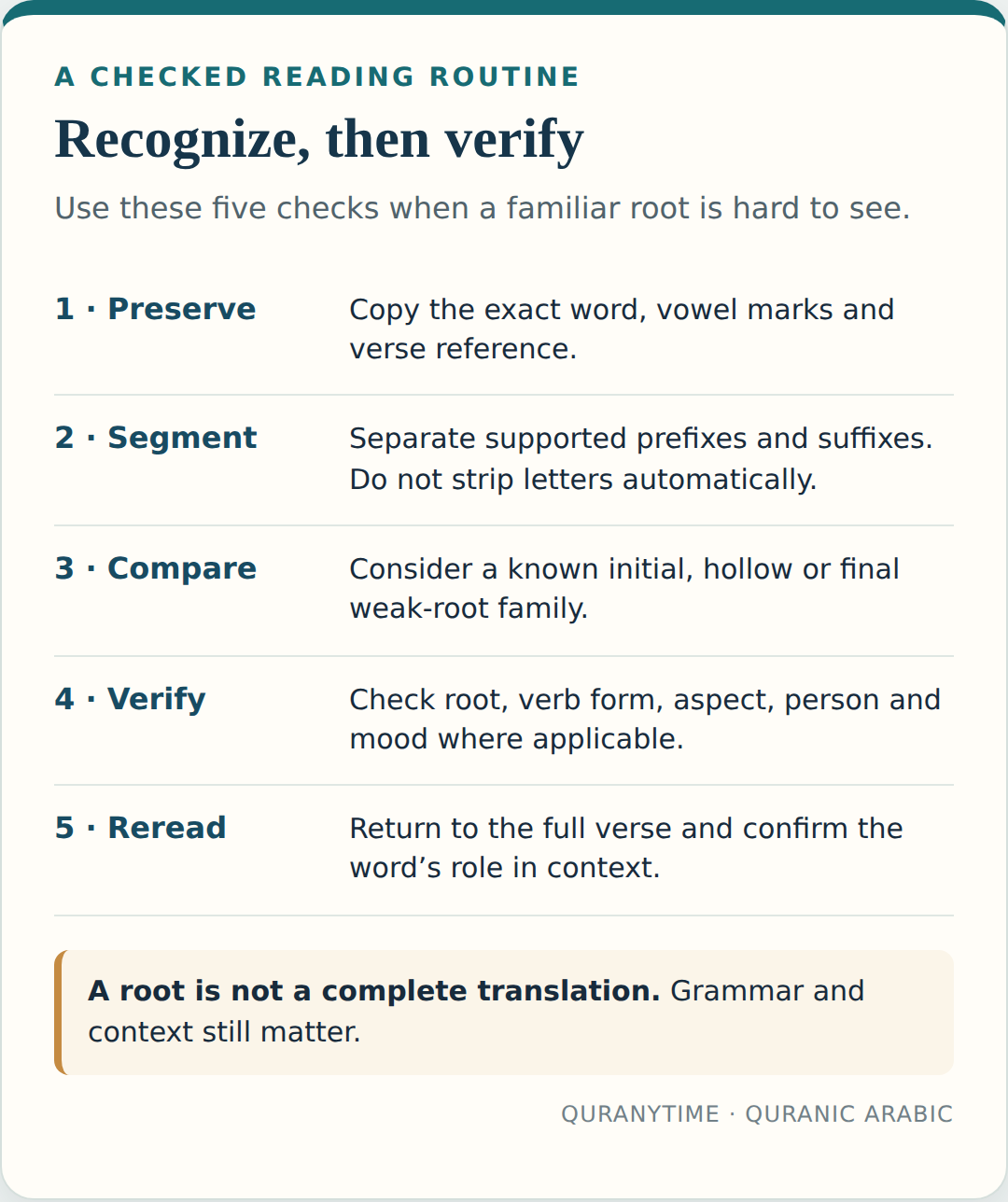
- Preserve the exact form. Copy its vowel marks and verse reference before changing anything. A remembered approximation may hide the clue you need.
- Separate attached material. Mark a conjunction, person prefix or object pronoun only when the analysis supports it. Never strip every initial wāw or yā automatically.
- Compare a known family. Ask whether the unfamiliar word could belong to a verified initial, hollow or final weak root. Treat this as a hypothesis, not an answer.
- Verify root and grammar together. Check root, verb form, aspect, mood where applicable, and person. Our Quran dictionary lookup method helps keep surface forms and roots distinct.
- Return to the verse. Reread the full phrase and confirm who acts, whether it is a statement or command, and how the word contributes in context.
The Quranic Arabic Corpus morphological-features reference distinguishes roots, attached segments, aspect, mood and verb forms. Those separate labels help you test an analysis instead of assuming that a root alone determines the word’s meaning.
Watch a hollow-verb demonstration
This FC LangMedia whiteboard lesson examines hollow verbs in the jussive. It is supplementary grammar practice, not Quran recitation instruction. Watch how the instructor compares complete forms; do not extend a shortening rule to every pronoun ending or derived pattern without checking.
Three recognition traps to avoid
Counting visible letters as radicals. A word may contain prefixes and suffixes while omitting a weak radical. Letter count alone therefore cannot identify its root. In يَجِدْكَ, the person prefix and object suffix belong to the grammatical form, while the root’s wāw is absent.
Confusing vowel length with a different root. The ā in qāla, ū in yaqūlu, and short u in qul do not make three unrelated families. Record the vowel accurately, but verify the root separately. Equally, do not assume every alif in another verb represents the same underlying radical.
Turning a useful example into a universal rule. A chart for one weak verb does not automatically explain another class, a different derived form, or every pronoun combination. Keep your first study note narrow: “This verified form behaves this way.” Expand the rule only when you have learned its conditions.
Try a short self-check
Without looking back, answer three questions: What root connects قَالَ and قُلْ? Which part of يَجِدْكَ means “you”? What is the root of ادْعُ, despite its initial alif and missing final wāw? Then check your answers: ق و ل; the attached كَ; and د ع و.
Next, explain one answer aloud in a complete sentence: “I identify this as an imperative, and I verified its root rather than treating every written letter as a radical.” If you can supply the root but not the grammatical form, your next practice should be form identification—not a larger vocabulary list. Revisit the same examples tomorrow before adding a new family.
Build recognition without overgeneralizing
Make one small study note for each family: root, exact Quranic form, verse reference, grammatical label and contextual gloss. Add a contrasting form only after checking it. Keep noun and participle patterns separate; our guide to active and passive participles explains those related but different word types.
Review the notes through retrieval: cover the root, identify it from the word, then explain the visible change. Fit a few examples into your Quranic Arabic vocabulary routine rather than collecting a huge chart you never revisit.
If you repeatedly confuse root letters, attachments and short vowels, bring three examples to a teacher. A free Quranytime trial class can help identify whether your next step is reading accuracy, regular conjugation or weak-root recognition. The goal is not to guess faster: it is to recognize a familiar family and verify the form accurately.