
Many beginners hear that the Quran should be recited with tartil and assume it means reading very slowly, adding a beautiful melody, or copying a famous reciter’s style. Those can be part of a pleasant recitation, but none of them defines tartil by itself. Tartil is a deliberate way of reciting: the words are clear, the sounds are given their due, and the pace leaves room for accuracy and attention.
That makes tartil practical for every learner. You do not need a dramatic voice or a perfect Arabic accent to begin. You need a manageable passage, an attentive ear, and a willingness to receive correction. This beginner’s guide explains the idea, separates it from speed and melody, and gives you exercises you can repeat without turning practice into guesswork.
What does tartil mean?
Tartil (ترتيل) is commonly translated as measured, orderly, or deliberate recitation. The Quran describes the instruction in Surah Al-Muzzammil 73:4: “and recite the Quran properly in a measured way.” Read Quran 73:4 on Quran.com. The verse gives a direction about the manner of recitation; it does not give a stopwatch target or require one particular vocal style.
In everyday terms, tartil means that you do not let speed blur letters, vowels, words, or meaningful pauses. You read what is on the page carefully, moving forward at a pace you can control. A beginner may need a slower pace while learning. A more experienced reader may recite more quickly while remaining clear and measured. The quality is in the control and clarity, not in a fixed number of seconds per verse.
Tartil, tajweed, speed, and melody
How tartil relates to tajweed
Tartil describes the overall manner: careful, composed, intelligible recitation. Tajweed is the study and application of pronunciation details that help a reader produce Quranic letters and sounds correctly. They overlap, but they are not interchangeable labels. A reader can slow down without fixing a recurring letter error, while another reader can know a rule but rush through it. Tartil brings knowledge and delivery together in a controlled performance.
This is why it is useful to learn rules in small groups rather than trying to monitor everything at once. A beginner tajweed rules chart can help you identify a focus for the week, but a chart cannot hear whether your tongue, lips, or throat are producing the sound accurately.
Slow is not automatically measured
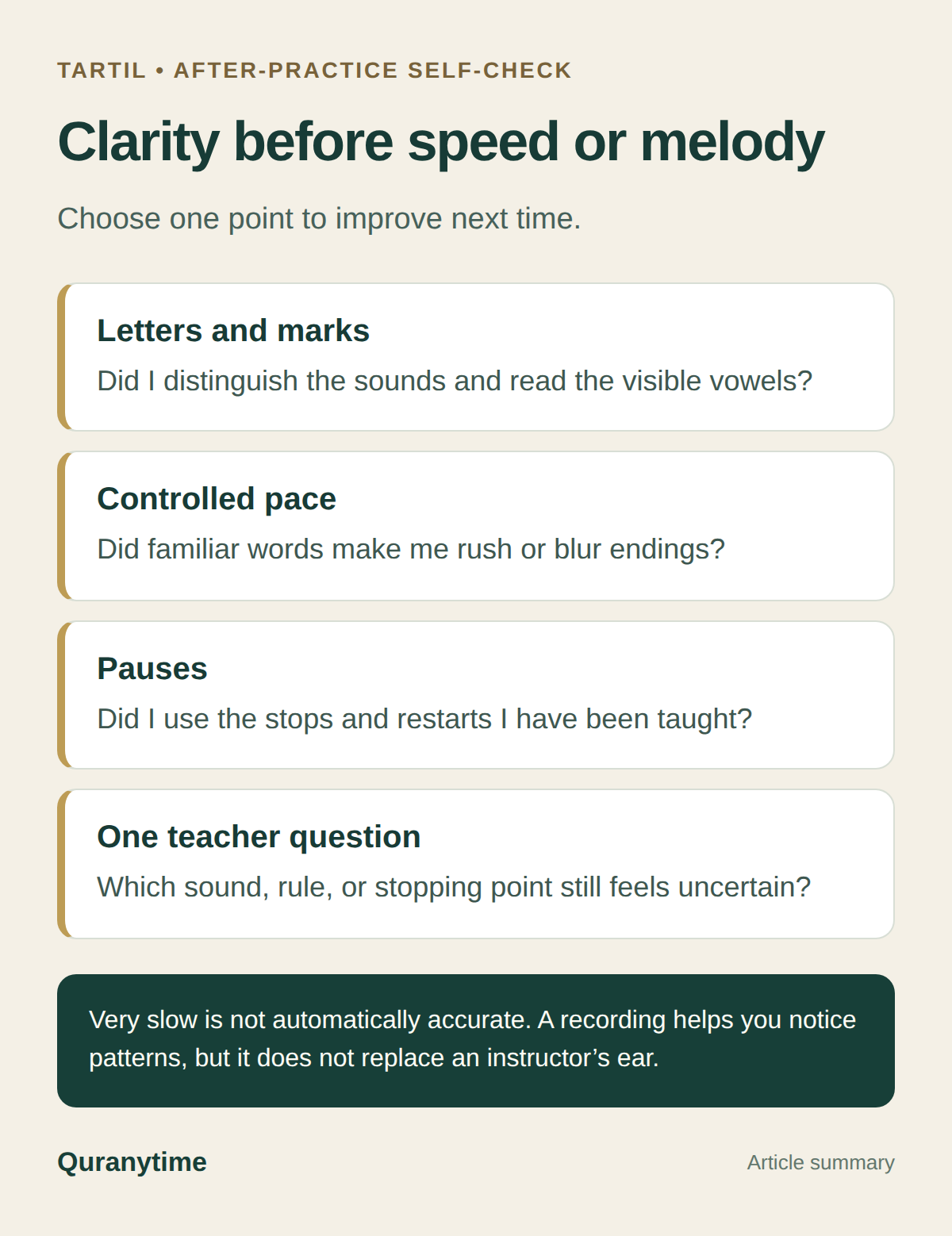
Slowing down can expose mistakes, but a very slow reading may still be disconnected, uneven, or unclear. For example, a learner might stretch ordinary vowels, insert pauses in the middle of a word, or stop so often that the sentence loses its flow. Tartil is not dragging each syllable. It is choosing a pace that protects pronunciation and lets each word remain distinct.
Melody is not the test of quality
A pleasing tune can make recitation engaging, but melody alone does not make it tartil. If a tune causes a reader to force a sound, change a vowel, rush a difficult letter, or pause merely to follow a musical pattern, the musical effect is working against the purpose. Keep the voice natural enough that clarity stays in charge. Your recitation can be simple and still be measured.
What can a beginner listen for?
Instead of asking, “Do I sound like a skilled reciter?” use a short checklist. First, are the letters distinguishable, especially sounds that are unfamiliar in your first language? Second, are short vowels and other visible marks being read rather than guessed? Third, are elongations and recurring rules being applied consistently according to what you have been taught? Fourth, do your pauses follow the written signs and the sense of the passage rather than appearing whenever you run out of momentum?
These questions are observations, not a complete personal ruling about your recitation. Some details require an instructor who knows what to listen for. If pronunciation is your main difficulty, review this guide to pronunciation challenges for English speakers and bring specific examples to a teacher.
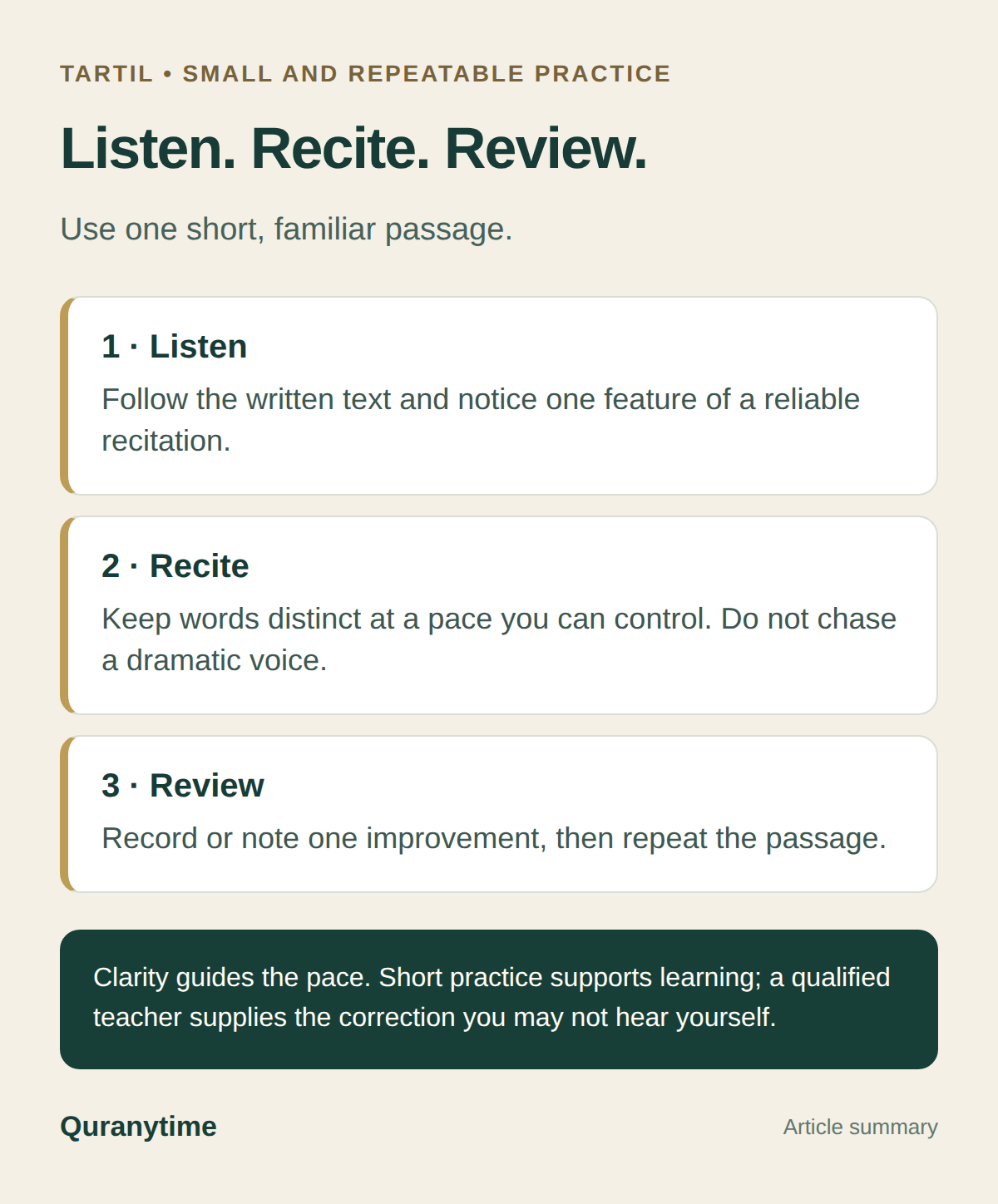
Four practical tartil exercises
1. The one-line clarity loop
Choose one line or a very short ayah that you already recognize. Read it once at your natural pace and notice where clarity drops. Then read it again more deliberately, giving yourself time to see each letter and mark. Repeat three times, but choose only one target: a difficult consonant, a vowel ending, or a place where you tend to merge words. Finish by reading once without stopping after every word. The aim is controlled continuity, not maximum slowness.
2. Listen, cover, and compare
Use a reliable audio model for the same short passage. Listen once while following the text, then cover the text and recite from memory if you know it. Uncover the page and identify one difference between your attempt and the model. Do not try to imitate the model’s entire voice. Listen for a concrete feature such as a letter, an elongation you are studying, or the shape of a pause. If you are still learning the alphabet, use a step-by-step Arabic alphabet guide before expecting audio imitation to fix letter formation.
3. The pause-and-restart drill
Select two or three stopping points shown in your Quran. Read up to the first point, stop calmly, and restart from an appropriate place rather than jumping into the middle of a word. Then continue to the next point. This exercise is not a license to invent new stopping rules; it is a way to practise the pauses already indicated in the copy or taught by your instructor. Ask a teacher when a sign is unfamiliar.
4. Record one minute, then log one fix
Record a short passage on your phone. Listen once without judging your voice and once with the page open. Write down one correction for the next session: perhaps a heavy letter became light, a word ending disappeared, or your pace accelerated at a familiar line. Keep the note specific and repeat the same passage later. A Quran recitation mistake log can make this review more useful than relying on memory.
A simple weekly routine
Start with five to ten focused minutes on most days rather than an ambitious session you cannot repeat. Spend the first minute looking at the passage. Use two or three minutes to listen or review a teacher’s correction. Recite the passage in short loops, then make one recording or note. On another day, revisit the same passage before adding new material. Consistency gives your ear time to notice patterns, while a small scope keeps you from collecting corrections faster than you can apply them.
It is fine to read a little faster once the passage is stable, provided the letters remain clear and you are not skipping marks or forcing pauses. It is also fine to return to a slower pace when a new rule or unfamiliar passage exposes a weakness. Tartil is adaptable: the pace serves accurate, attentive recitation rather than becoming a performance goal.
What tartil cannot replace
Self-practice is valuable, but it cannot reliably diagnose every pronunciation issue. A recording lets you hear yourself; it does not guarantee that you can identify a subtle distinction or know whether a pause changes the reading. Apps and videos can support repetition, yet they are not a substitute for a qualified teacher listening to you directly.
Seek feedback especially when you are unsure about a letter’s articulation, a repeated vowel error, or a stopping and restarting point. You can prepare a short recording and ask focused questions using this teacher-feedback recording guide. The goal is not to wait until you are “good enough” to ask for help; feedback is part of learning.
There is also no need to make unsupported promises about breathing, speed, or spiritual results. Tartil does not require a special breath-holding technique, and a longer breath is not proof of better recitation. Breathe naturally and pause where your reading and teacher’s guidance support it. Work within your comfort and ability, and ask a teacher when a passage feels physically difficult.
A beginner’s definition to remember
Tartil is measured Quran recitation in which clarity, accuracy, and attention guide the pace. It may sound beautiful, but beauty is not reduced to melody. It may be slow, but slowness is not enough. It grows through short, careful practice, listening, useful notes, and feedback from someone who can hear what you cannot yet hear.
Choose one short passage today. Read it once, slow down only enough to keep the words clear, and write down one improvement for tomorrow. That modest loop is closer to tartil than chasing a dramatic style you cannot yet control.