
Hamzat al-Wasl in Quran reading can feel like a small mark with a large question behind it: should you pronounce the initial hamza, or move straight into the next sound? The answer depends mainly on where you begin. When you start or restart at a word carrying hamzat al-wasl, you pronounce a starting vowel. When you connect into that word from the word before it, that extra hamza is not pronounced. This guide gives you a simple start–connect–restart method without asking you to memorise an advanced catalogue of word types.
What Hamzat al-Wasl Does
Hamzat al-wasl is an extra hamza used at the beginning of certain Arabic words to make it possible to begin recitation with a word that would otherwise begin with a difficult consonant cluster. It is established—heard—when the word is the place where you begin. It is dropped—unheard—when your voice is already connected from the preceding word.
In an Uthmani Quran script, you may see its sign on the initial alif, often as a small صاد-like mark above the alif: ٱ. Fonts and other Arabic orthographies can display the marker differently, and a printed alif does not automatically mean that it is hamzat al-wasl. Read the actual word and the recitation convention, rather than treating every alif as wasl.
The sign is a useful visual clue, but it does not mean you can always guess the starting vowel from the shape alone. In the definite article الـ, the beginning is read with fatha when you start it. Verbs and other word categories follow prescribed rules. If a less familiar word leaves you unsure, pause and check a teacher or qualified reciter instead of improvising an advanced grammatical answer.
The Three-Question Decision Guide
When your eye reaches an initial alif with the wasl marker, ask these questions in order:
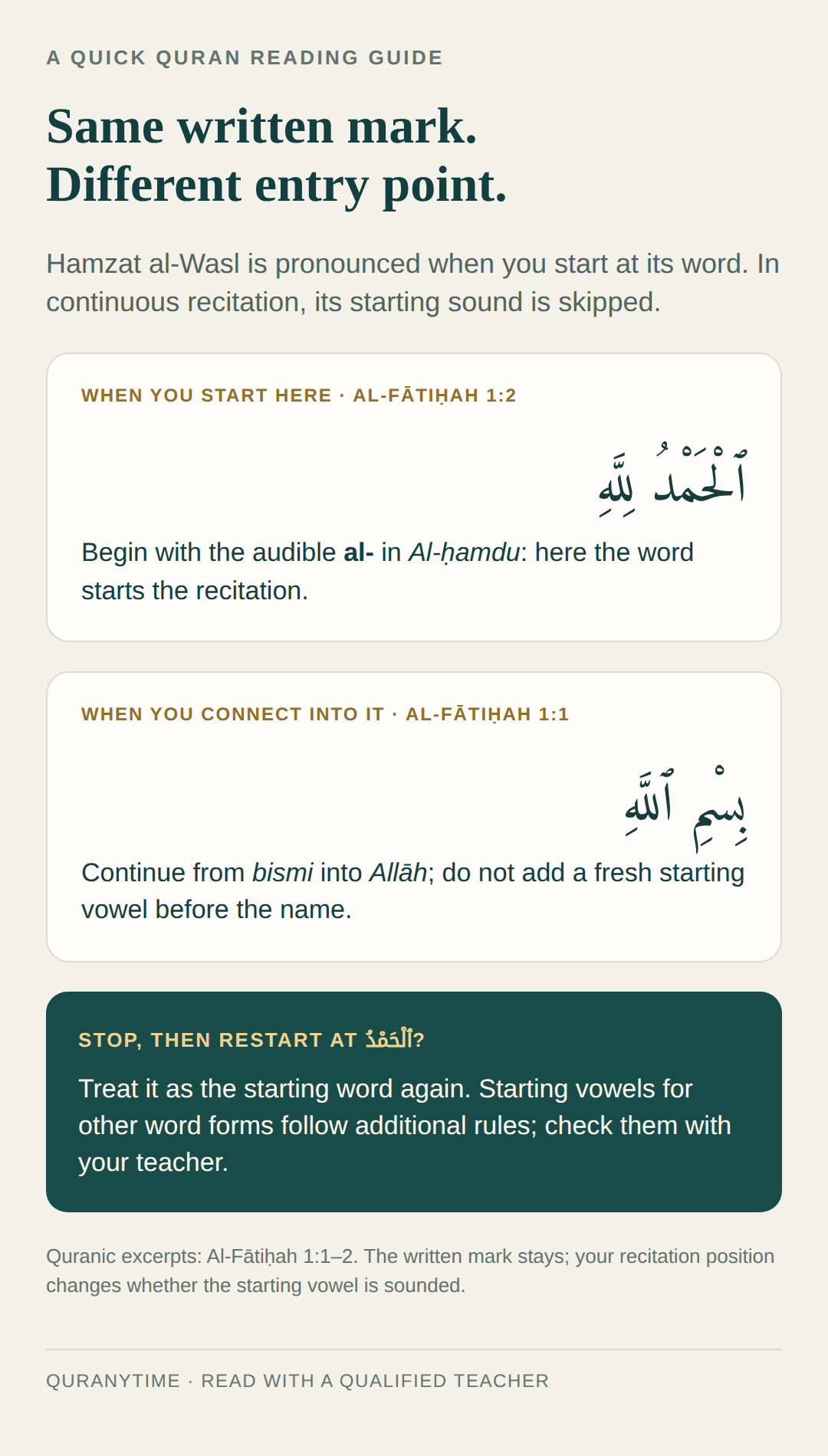
- Am I beginning recitation at this word? If yes, pronounce the word’s prescribed starting vowel. For a familiar example, begin ٱلْحَمْدُ لِلَّهِ with the audible “al-” of the article. You are treating this as the opening word of your recitation.
- Am I connecting from a word immediately before it? If yes, do not insert a new hamza sound or starting vowel before the next part. The preceding sound carries into the word. In بِسْمِ ٱللَّهِ, you do not stop and then add a fresh “al-” before Allah when you are reading the phrase as a connection.
- Did I stop and now want to continue? If you stop, the next word is no longer being reached by a continuous breath. When you restart at a word with hamzat al-wasl, treat it as a new beginning and pronounce its prescribed starting vowel. So if you stop before ٱلْحَمْدُ, you begin that word as you would at the start of recitation.
This is the practical difference: wasl changes with your route into the word. The writing stays visible, but your voice either begins at the word or arrives from the word before it.
Read the Same Mark in Context
Compare the two routes rather than staring at the alif in isolation. At the start of Al-Fātiḥah, ٱلْحَمْدُ لِلَّهِ is the opening phrase, so the article is heard at the beginning. In the connected phrase بِسْمِ ٱللَّهِ, the word before the marked alif is already supplying the connection; do not create a second, separate starting vowel before the next word.
These examples are a decision card, not a replacement for listening to a correct recitation. The exact sound joining two words is best learned with a teacher-approved reading, especially if your printed mushaf uses a different script style. For a concise definition and introductory examples, see About Tajweed’s definition of Hamzah al-Wasl.
Hamzat al-Wasl Versus Hamzat al-Qat’
Hamzat al-qat’ is the opposite kind of hamza for this decision. It remains pronounced whether you begin at the word or connect to it from the word before. Its sound is not simply “turned off” because the word is internal to a phrase. Hamzat al-wasl, by contrast, supplies a starting entry when needed and disappears in a normal connection.
A useful learner’s test is not “Do I see an alif?” but “Does this word’s hamza survive connection?” If it is qat’, keep the hamza sound at the beginning of the word in both positions. If it is wasl, pronounce the entry when beginning or restarting, and omit that extra entry when joining from the previous word. Do not assume the two signs are interchangeable, and do not label every unmarked alif without checking the word.
Because Arabic script styles vary, a digital font may make the visual difference less obvious. If the mark is hard to see, use a reliable mushaf, listen to a teacher’s model, and ask which letter or sign you are looking at. This is a reading question, not a reason to rush through the line.
A Safe Five-Minute Practice Drill
Choose one or two teacher-approved examples containing the marked initial alif. Keep the drill short and audible:
- Look: Point to the initial alif and identify whether your mushaf shows the wasl marker. Do not generalise from this one word to every alif.
- Start: Read the word from silence. Say the prescribed starting vowel clearly, then complete the word. For the beginner card, practise starting ٱلْحَمْدُ.
- Connect: Read a short preceding word or phrase into the example, following your teacher’s model. With بِسْمِ ٱللَّهِ, listen for the connected route rather than adding a new opening vowel before the marked word.
- Stop and restart: Make a natural stop, take a breath, and begin the target word again. It is now a new starting point, so apply the starting rule.
- Check: Record one attempt or read it to your teacher. Ask one precise question: “When I connect here, did I add a starting vowel?”
Repeat each route slowly once or twice. The goal is to notice the change in entry point, not to race through a page or promise instant fluency. A spoken lesson on Hamzatul Wasl in The Quran Reading Course offers Quran examples, a wasl-and-qat contrast, and guided practice; use it as listening support alongside qualified instruction.
Troubleshooting Common Hesitation
“I see the symbol, so I pronounce it every time.”
That is the most common overcorrection. The mark identifies a word that can need an entry sound, but a continuous connection is precisely where that extra hamza is omitted. Re-run the three questions: start, connect, or restart?
“I stopped, but I kept reading as if the phrase were connected.”
Stopping changes the next action. Once you decide to restart at the marked word, give it its prescribed opening. If your stopping point or restart point is uncertain, review this practical guide to Quran waqf signs and confirm the actual recitation choice with your teacher.
“The mark is unclear on my screen.”
Zooming in can help, but do not infer the rule from a blurry font. Learners still building letter recognition may benefit from a step-by-step Arabic alphabet review. If the question is about a specific word, capture the page, verse, and position and send that exact question to your teacher.
“I want a full list of every exception.”
That is a good later study goal, but it is not necessary for this immediate reading decision. Begin with the route into the word, then learn additional prescribed cases in a structured lesson. A Noorani Qaida and Tajweed next-step plan can help you place this topic in a gradual sequence rather than collecting isolated rules.
Make the Rule Easy to Recall
Write this one-line prompt beside your practice page: “Start or restart: sound the entry; connect: do not add it.” Then mark the word’s position with a small S, C, or R in your private notes—not in the Quran text. If your question persists, bring the marked verse to a lesson and ask for one start example and one connection example. A focused question for your Quran teacher is more useful than guessing from a transliteration.
Keep your reading measured while you practise; a no-rushing approach to Quran reading fluency can support careful listening without turning this small rule into a race. You can also log the word, route, and teacher correction in usable Quran lesson notes so the next review starts with the exact uncertainty.
Quick Recap
- Hamzat al-wasl is associated with an initial alif in Uthmani writing, but fonts and scripts can show it differently.
- At a new beginning or after a stop, pronounce the prescribed starting vowel.
- When connecting from the preceding word, omit the extra starting hamza.
- Hamzat al-qat’ remains pronounced at the word’s beginning in both starting and connected positions.
- Do not guess advanced categories from the sign alone; ask a qualified reciter about unfamiliar forms.
Once you can name your route—start, connect, or restart—you have a practical way to respond when a marked alif appears. Keep the examples teacher-approved, listen carefully, and treat uncertainty as a clear question to bring to your next lesson.