
Shaddah ( ّ ) is one of the most useful signs to understand when you are learning to read the Quran. It tells you that an Arabic consonant is doubled in pronunciation. That does not mean you stretch the vowel for two counts, and it does not mean every Shaddah receives the same length of hold. Instead, you make the consonant clearly and accurately, without leaving a gap between its two parts.
For many learners, the mark looks small but creates a large difference in meaning and sound. A word with an unmarked letter is not read in exactly the same way as a doubled letter. This guide explains how to decode Shaddah, practise it in Quranic words, and avoid confusing a doubled consonant with a long vowel. If you are still building your foundation, begin with this plain-language Tajweed guide for beginners, then try the exercises below.
What does Shaddah mean?
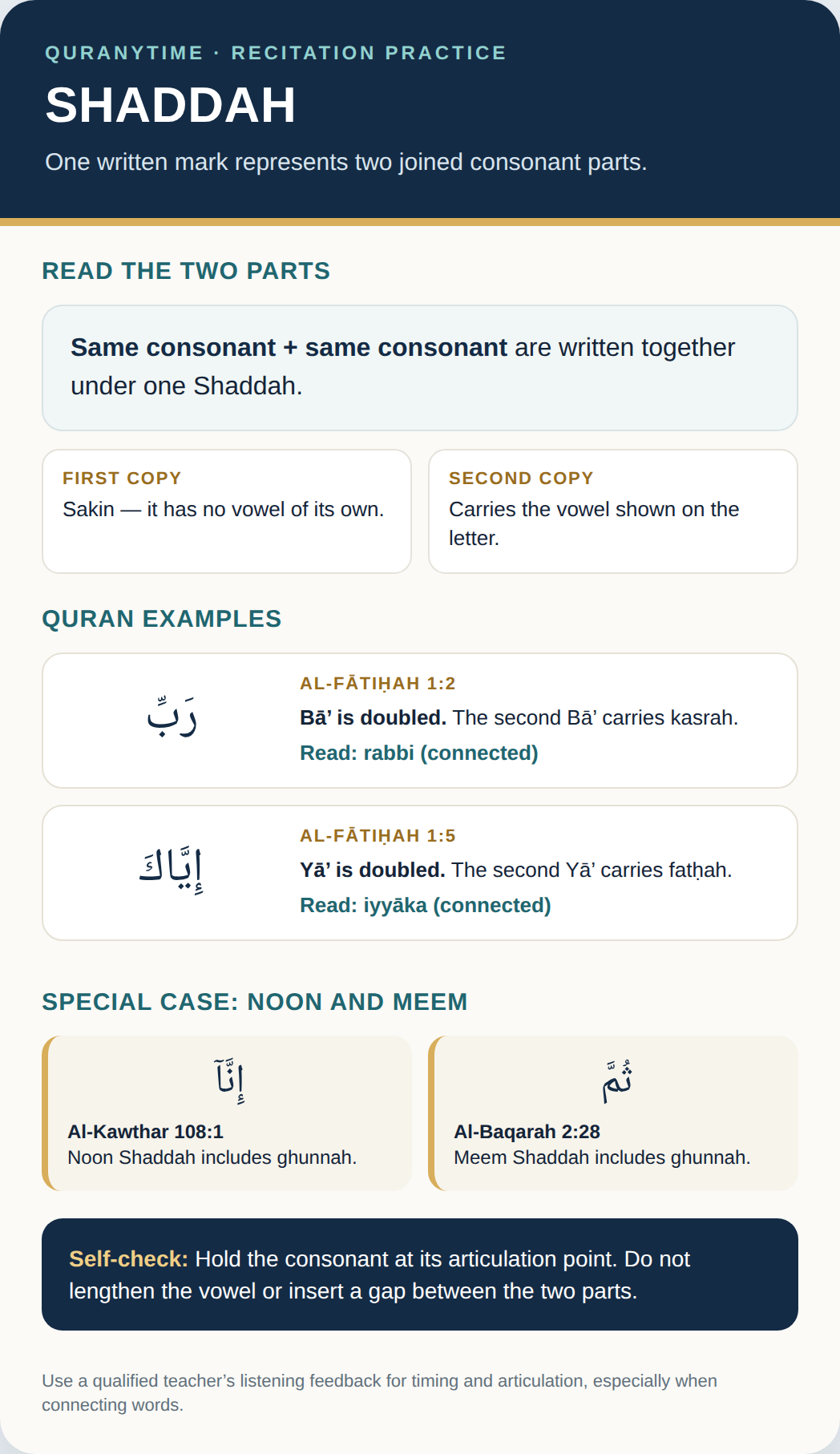
Shaddah is the small w-shaped mark written above a letter: ّ. In a simple written example, it represents two identical consonants combined into one written letter. The first copy is sakin, meaning it has no vowel of its own. The second copy carries the vowel mark that you can see with it. You therefore move through the consonant twice, but you do not pronounce two separate, disconnected letters.
Think of the structure as:
- first copy: the same consonant with sukoon;
- second copy: the same consonant with its vowel, such as fatha, kasrah, or dammah.
The two copies meet in one continuous consonant. The first part closes onto the second part, and the vowel is heard with the second part. This is why a Shaddah can feel like a brief “catch” or firmness in the sound. It is not a request to add a pause, and it is not a vowel-lengthening sign.
For a broader mark-by-mark reference, keep this Tajweed rules chart nearby, while using teacher feedback to train your ear and mouth.
How to read a Shaddah step by step
When you meet a Shaddah, use this four-step routine:
- Identify the letter. Name the consonant under the mark. Do not treat the Shaddah as a separate letter.
- Notice the vowel. Look at the fatha, kasrah, or dammah attached to the doubled letter. This vowel belongs to the second copy.
- Set the first copy without a vowel. Hold the consonant at its articulation point in its sakin state, then release into the vowel-bearing second copy; do not add a new vowel.
- Release into the vowel. Continue directly into the second copy and its vowel, with no gap between the two halves.
For example, when a letter has Shaddah with kasrah, the sound is not “letter, pause, letter with kasrah.” It is one connected, firm consonant followed by the kasrah sound. When the Shaddah has fatha, keep the same doubled consonant structure, then let the fatha accompany the second copy.
Shaddah is not a long vowel
One of the most common mistakes is to see a doubled-looking mark and hold the vowel. Shaddah doubles a consonant; it does not lengthen a vowel. Long vowels are indicated through their own letters and rules, while Shaddah tells you to give the consonant two connected parts.
Compare the questions you ask yourself:
- Shaddah: Which consonant must I make firmly and continuously?
- Vowel length: Is there a long-vowel letter or another rule requiring measured extension?
Do not assume that every Shaddah has a fixed two-count hold. The correct timing depends on the letter, the surrounding sounds, the recitation context, and the applicable Tajweed rules. The essential beginner correction is simple: hold or strengthen the consonant, not the vowel. If you are unsure whether a sound is doubled or elongated, compare it with a teacher’s model and ask for feedback on the exact word.
Quranic examples: رَبِّ and إِيَّاكَ
Start with short, familiar examples. In رَبِّ (Al-Fatihah 1:2), the letter ب has Shaddah and kasrah. Decode it as a doubled Ba: the first Ba is sakin, and the second Ba carries kasrah. Keep the two parts connected, then finish the word with the short “i” sound of the kasrah. The Shaddah is on Ba, not on the preceding ra and not on the vowel.
In إِيَّاكَ (Al-Fatihah 1:5), the letter ي has Shaddah and fatha. Decode it as a doubled Ya: the first Ya is sakin, and the second Ya carries fatha. The alif after the doubled Ya gives the long ā sound; that vowel length is separate from the Shaddah. This is a helpful reminder that a word can contain both vowel length and consonant doubling, so identify each feature independently.
Read both examples slowly, then at a comfortable pace. Ask yourself: Did I make the doubled letter audible? Did I keep the two halves joined? Did I accidentally stretch the vowel instead? Marking the exact letter with a pencil can help your eyes and mouth coordinate.
Noon and Meem with Shaddah: a special ghunnah to remember
When the Shaddah is on Noon or Meem, there is an additional feature: ghunnah, the nasal sound associated with these letters. In إِنَّآ (Al-Kawthar 108:1), Noon has Shaddah, so read the doubled Noon with its ghunnah. In ثُمَّ (Al-Baqarah 2:28), Meem has Shaddah, so read the doubled Meem with its ghunnah.
These examples still contain the basic Shaddah structure: first copy with sukoon, second copy with its vowel. The special point is that Noon and Meem with Shaddah carry ghunnah. Do not transfer that nasalization to every letter with Shaddah. A doubled Ba, Ya, or another consonant is still doubled, but it does not automatically become nasal.
Because ghunnah has its own timing and articulation guidance, learn its sound from a qualified teacher. A learner’s written checklist is useful, but it cannot replace listening, correction, and repeated accurate reading. You can also review broader Tajweed rules in the Quran as you connect this topic with other recitation principles.
When a Shaddah appears at the start of a printed word
Sometimes a Quran print appears to show a Shaddah at the beginning of a word. This can reflect linked-reading assimilation across word boundaries, often called idgham in the relevant context, rather than a normal standalone word beginning with two independently written copies. Whether you are continuing from the previous word or beginning after a stop can change what you should do.
Do not mechanically ignore the mark, and do not invent a doubled sound without checking the reading context. Follow a qualified teacher’s stopping and starting guidance for the specific passage, because the correct reading depends on whether you are continuing or beginning after a stop.
Common Shaddah mistakes and practical corrections
Adding a gap: Saying the first consonant, pausing, and then repeating it makes two separate beats. Practise a closed first consonant flowing immediately into the second.
Stretching the vowel: Learners sometimes hold the kasrah, fatha, or dammah because they feel the doubled sound should be longer. Return your attention to the consonant. The vowel does not receive an automatic two-count extension.
Skipping the first copy: Reading only the second consonant can make the word sound light or incomplete. Use the vowelless-first-copy idea: hold the consonant’s articulation, then release into the vowel-bearing second copy.
Adding ghunnah everywhere: Ghunnah belongs here to Noon and Meem with Shaddah, as in إِنَّآ and ثُمَّ. It is not a general effect for all doubled letters.
Practising only in isolation: A word may feel easy alone but change when joined to what comes before it. Read short passages, listen back, and ask someone knowledgeable to identify whether the issue is the letter, the vowel, the connection, or a separate rule. Readers who speak English may also benefit from these Quran pronunciation tips for English speakers.
A simple five-minute Shaddah practice plan
- Look: circle every Shaddah in one short ayah.
- Label: write the letter and its vowel beside each mark.
- Split mentally: say “first copy with sukoon, second copy with vowel.”
- Connect: read the word without a gap or an unnecessary vowel hold.
- Record and review: listen for consonant firmness, correct ghunnah on Noon or Meem, and smooth joining.
Repeat the same ayah several times rather than collecting many examples too quickly. For between-lesson study, use this guide to practise Tajweed at home. Recording a short passage can make a subtle gap or vowel stretch easier to notice; these instructions on recording Quran recitation for teacher feedback can help you prepare a useful clip. This steady approach supports fluency without rushing.
Quick Shaddah checklist
- Have I identified the doubled consonant?
- Have I treated the first copy as sakin and the second as vowel-bearing?
- Did I join the two halves without a gap?
- Did I strengthen the consonant instead of lengthening the vowel?
- If it is Noon or Meem with Shaddah, did I apply ghunnah?
- Could a word-initial mark be connected to idgham across a boundary?
Shaddah becomes much less intimidating once you stop treating it as a mysterious extra mark. See the doubled consonant, identify the vowel on its second copy, and practise a smooth connection. Then check your reading with a teacher, especially for ghunnah and linked-reading cases. If you are still learning letter shapes, revisit learning the Arabic alphabet so that recognising the consonant remains automatic while you work on accurate Quran recitation.
For a concise rule reference, see Quranica’s explanation of Shaddah in Tajweed. Use the reference alongside guided practice: clear, steady repetition is what turns the written mark into a reliable reading habit.