
If you have ever paused at the word Allah and wondered whether its lam should sound full or light, you are noticing an important Tajweed detail. The Lam in Allah’s Name has two recognised pronunciations: it is heavy (tafkhim) after a fatha or damma, and light (tarqiq) after a kasra. The decision is usually made by looking at the vowel sound immediately before the divine name when you are joining the words.
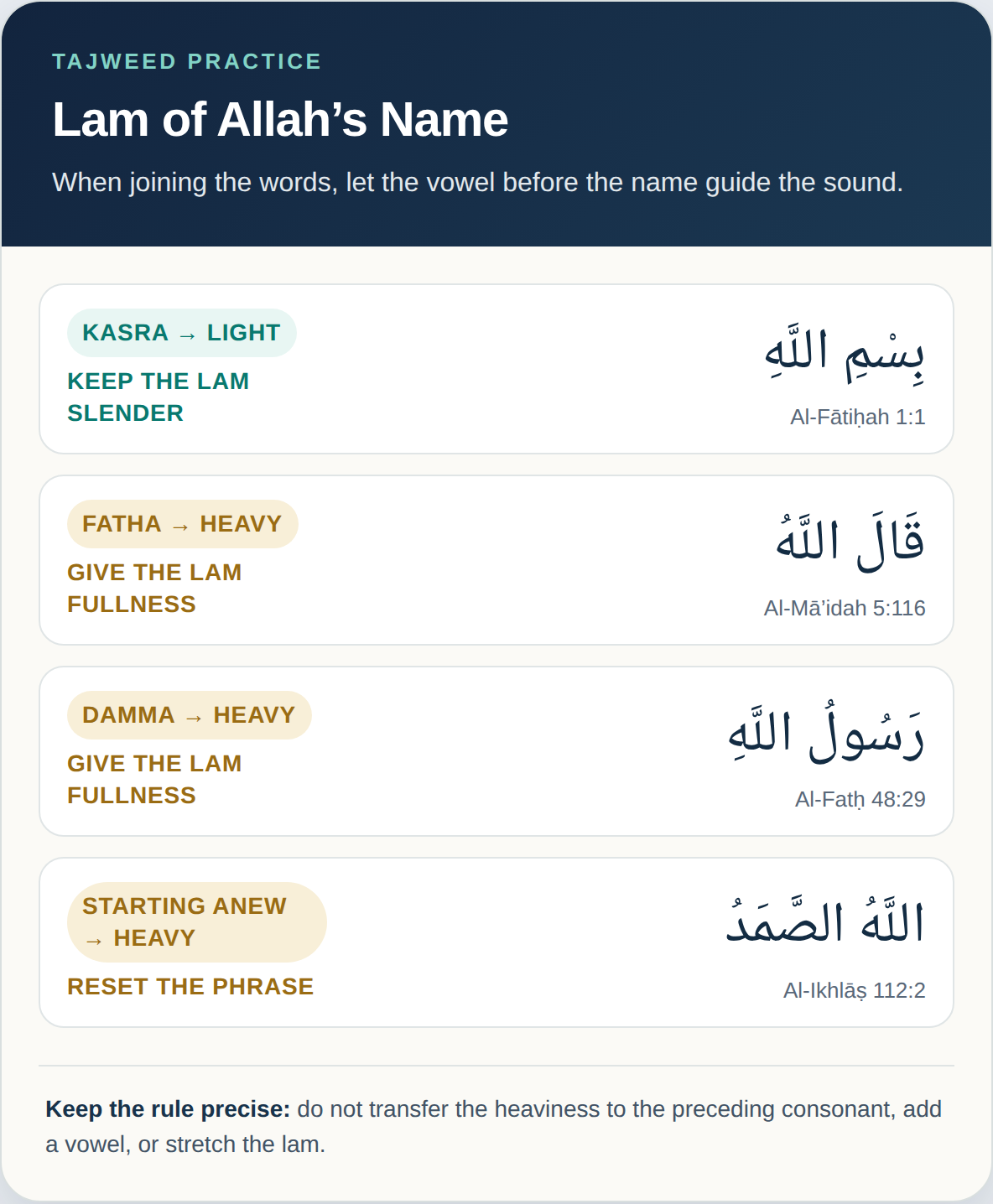
For example, بِسْمِ اللَّهِ begins the name after a kasra, so the lam is light. In قَالَ اللَّهُ, it follows a fatha and is heavy. In رَسُولُ اللَّهِ, it follows a damma and is also heavy. This guide explains how to hear and apply that difference without adding a vowel, stretching the sound, or making nearby letters heavy by mistake.
What is the special lam in Allah’s Name?
The word Allah contains a lam that has a special rule in Quran recitation. Unlike an ordinary Arabic lam, which is generally read light, this lam changes quality according to its recitation context. The tongue still makes the familiar lam articulation, but the sound may feel fuller and more resonant when it is heavy. When it is light, it stays slimmer and closer to the ordinary lam quality.
This is one small part of a larger system. If you are new to the subject, a beginner’s guide to Tajweed can help you understand why precise letter qualities matter. You do not need to treat this rule as mysterious or alarming. It is a practical listening-and-reading decision that becomes easier when you identify the vowel before the name and then keep the rest of the word natural.
The simple decision rule
In connected recitation, use this three-part check:
- After a fatha: read the lam of Allah’s name heavy.
- After a damma: read the lam heavy.
- After a kasra: read the lam light.
In other words, listen for the vowel immediately before the name, not merely for the shape or heaviness of the preceding consonant. A consonant can be an emphatic letter and still be followed by a vowel whose effect must be considered separately. Likewise, a light preceding consonant does not automatically make the lam light. The trigger is the vowel context in the recitation.
Tafkhim means giving the letter a fuller, deeper quality; tarqiq means keeping it light and slender. Neither one means shouting, pressing the throat, changing the word’s vowel, or holding the lam for extra time. A fuller quality is not a new syllable. A light quality is not an omitted sound.
For a broader visual overview, you can also keep a Tajweed rules chart nearby while revising. Use it as a reminder, but let a reliable recitation recording and your own careful repetition guide your ear.
Example one: light after a kasra
Consider the opening of Al-Fatihah, بِسْمِ اللَّهِ (1:1). The final vowel of بِسْمِ is a kasra: bis-mi. When you connect it to Allah’s name, the lam is light. The phrase should flow smoothly as one connected expression, with the kasra remaining clear and the lam avoiding a broad, heavy colouring.
Try saying the phrase slowly once, then at a comfortable reading pace. Do not turn the kasra into an extra pause, and do not make the lam disappear. The target is a clean connection: the preceding short vowel is heard, then the light lam begins the divine name. If your first attempt sounds too full, reduce the pressure and return to the ordinary, slender lam sensation while preserving the word exactly.
Example two: heavy after a fatha
In Al-Ma’idah, قَالَ اللَّهُ (5:116), the divine name follows the fatha at the end of قَالَ. The lam is therefore heavy. The phrase is not read as though the preceding qaf or the whole phrase must become more emphatic. Keep قَالَ accurate, complete its fatha naturally, and then give the lam of Allah’s name its fuller quality.
One useful exercise is to alternate the two parts without rushing: قَالَ, then اللَّهُ, then the connected phrase. Notice that the heavy quality belongs to the special lam. It should not spread backward into the preceding vowel or forward into every letter that follows.
Example three: heavy after a damma
Al-Fath gives another clear example in رَسُولُ اللَّهِ (48:29). The name follows the damma at the end of رَسُولُ, so the lam is heavy. The damma does not become longer, and the final vowel does not need to be exaggerated. Read the phrase with ordinary timing, then let the lam carry a fuller resonance.
Compare the three examples as a set. The key change is not the meaning, speed, or emotional force of the passage; it is the vowel immediately before the name. The two heavy examples have different preceding vowels, fatha and damma, while the kasra example is light.
Starting the name versus joining it
The vowel rule is most useful when you are connecting words. What happens if you begin with Allah’s name at the start of an ayah, phrase, or restart? When the divine name is started independently, read its lam in the heavy form. For instance, اللَّهُ الصَّمَدُ (Al-Ikhlas 112:2) begins with the name, so the lam is heavy.
This distinction matters because a restart does not always carry the sound that came before it. If you stop and then begin the name again, do not invent a preceding kasra merely because the previous word ended with one. Start the name clearly and use the heavy form. Conversely, when you are genuinely continuing from a kasra, keep the lam light.
In a longer passage, listen for whether your recitation is connected or has been reset by a stop. If you are unsure where a restart changes the context, mark the place in your mushaf and ask a qualified teacher to demonstrate it. The goal is confident, accurate reading, not anxiety over every tiny pause.
Do not transfer the heaviness
A frequent practice problem is correctly identifying a heavy lam but then making the preceding consonant heavy as well. These are separate matters. The special quality belongs to the lam in Allah’s name; it does not give permission to alter the articulation of the preceding letter. A lesson on the Tajweed rules of Raa can also help reinforce the wider principle that each letter has its own conditions and qualities.
Another mistake is treating tafkhim as a madd. The lam is not stretched because it is heavy. Keep the short vowels short and observe the normal timing of the word. Do not add an “a,” “u,” or other vowel before the lam, and do not insert a pause between the preceding word and Allah’s name when the reading calls for connection.
It is also possible to over-correct the light form. Light does not mean weak, breathy, or missing. The lam must still be articulated clearly. If you are reviewing several rules at once, a general Quran Tajweed rules reference may help you separate this lam rule from rules about other letters.
A short practice routine
Use this routine for a few minutes at a time:
- Listen: Choose a trusted reciter and hear each target phrase twice. Focus only on the vowel before Allah’s name and the quality of the lam.
- Label: Write “kasra-light,” “fatha-heavy,” or “damma-heavy” beside the phrase. For a phrase-start example, write “start-heavy.”
- Read slowly: Say the phrase without changing its vowels or timing. Make the contrast noticeable but modest.
- Connect and restart: Read a connected example, pause at a suitable place, and then begin the divine name independently. Notice how the context changes.
- Record: Make a short recording of the same phrase three times. On playback, check whether the lam changes quality while the preceding consonant stays itself.
- Get feedback: If the contrast remains difficult to hear, ask a teacher to listen to one or two examples. Focused feedback on articulation is more useful than trying to force a dramatic sound.
Adult learners often benefit from small, repeatable practice rather than long sessions. You can use these at-home Tajweed practice ideas to fit listening and recording into your regular Quran time. If you have access to a tutor, recording recitation for teacher feedback can make the difference between guessing and hearing exactly what needs adjustment.
Quick self-check
Before moving on, ask yourself five questions:
- Am I identifying the vowel immediately before the divine name when the words are connected?
- Do I read the lam light after a kasra?
- Do I read it heavy after a fatha or damma?
- Do I use the heavy form when starting or restarting with Allah’s name?
- Am I keeping the vowels, timing, and neighbouring consonants accurate?
If you can answer yes, your approach is on the right track. If one contrast still feels uncertain, return to the three anchor examples rather than adding more rules at once. A steady, unhurried approach is worthwhile; this guide to Quran reading fluency without rushing offers a useful reminder that accuracy and ease can develop together. English-speaking learners may also find targeted advice in Quran pronunciation guidance for English speakers.
Conclusion
The Lam in Allah’s Name has a straightforward pattern. In connected recitation, kasra before the name gives a light lam; fatha or damma gives a heavy lam. When you begin the name independently, use the heavy form. The sound should be clear and appropriately full or light, but never exaggerated, stretched, or transferred to another letter.
Practise with بِسْمِ اللَّهِ, قَالَ اللَّهُ, and رَسُولُ اللَّهِ. Listen, label the preceding vowel, read, record, and seek calm teacher feedback when needed. For a concise reference on heavy and light letter qualities, see an academic overview of heavy and light letter qualities in Tajweed. With regular short practice, the distinction can become a natural part of fluent Quran reading.