
Looking for useful Arabic phrases in Arabic script? Start with a few expressions you can actually use: greet someone, introduce yourself, ask for clarification, and thank a teacher. This guide groups 30 beginner-friendly phrases by situation, with Arabic writing, simple transliteration, English meaning, and notes on when a form is addressed to a man or woman.
It is a practical starter list, not a claim that one set of words is spoken identically from Morocco to the Gulf. The examples mostly use clear Modern Standard Arabic (MSA), the variety learners meet in books and formal contexts; everyday speech also varies by region. If your goal is Quran study, pair these expressions with steady reading practice and the basics of the Arabic alphabet.
How to use this Arabic phrase list
Read the Arabic first, then use the transliteration as a temporary pronunciation aid and check the English meaning. Transliteration is not standardized: one writer may use kh, another ḫ, for خ. It cannot show every Arabic sound or replace listening. If you are still learning how letters connect, revisit the Arabic alphabet guide and the step-by-step lesson on learning Arabic letters.
Some phrase lists mix MSA with one local dialect without labeling the change. A useful rule is to learn the standard form first, then learn the local equivalent from a speaker of the dialect you need. StoryLearning’s overview of Levantine Arabic phrases likewise notes that regional forms and Latin-letter spellings can differ. The transliterations below are learner-friendly approximations, not the only acceptable spellings.
Greetings, introductions and farewells
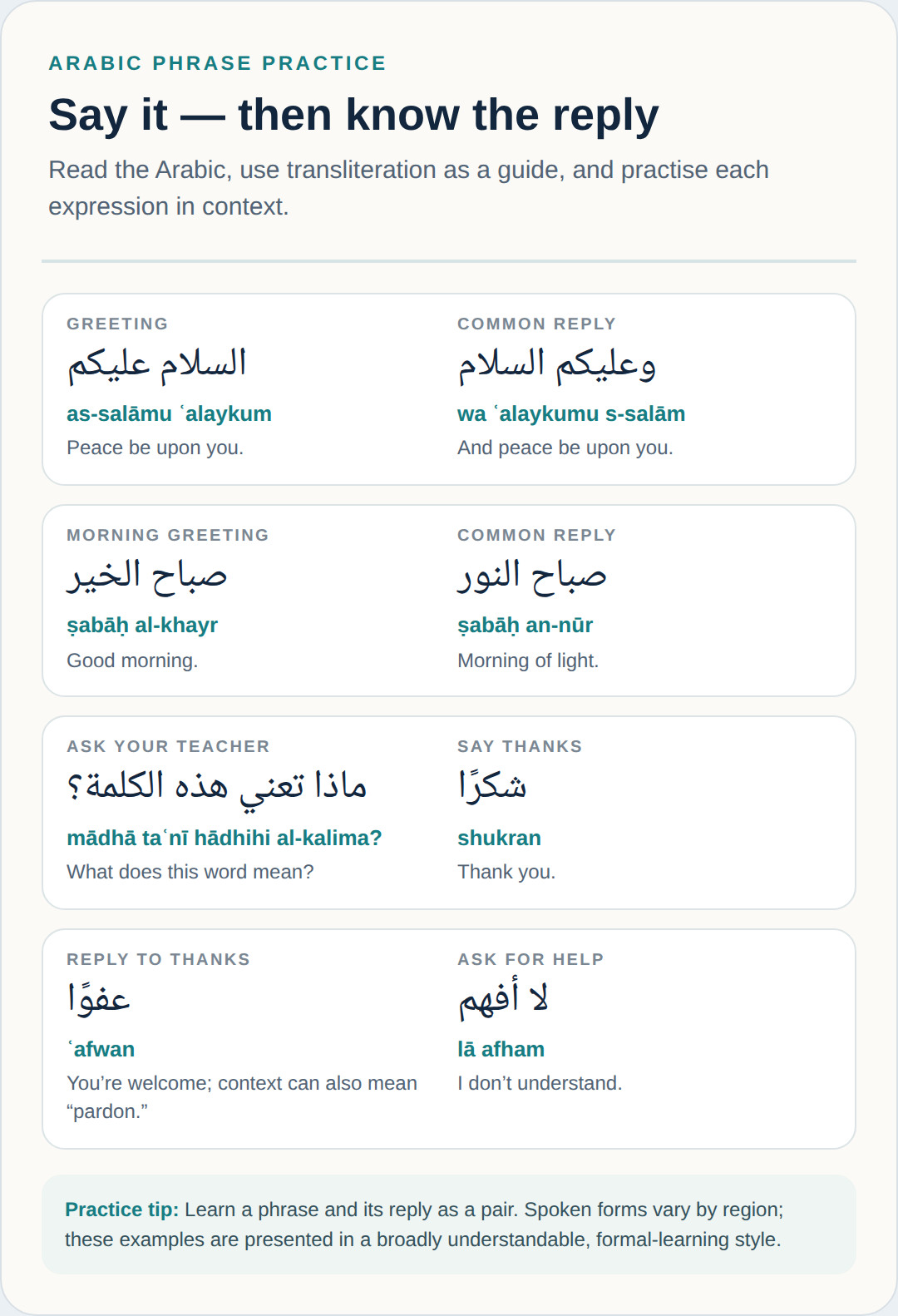
- السلام عليكم — as-salāmu ʿalaykum — “Peace be upon you.” A familiar, respectful greeting. It is common in Muslim settings and also widely recognized beyond them.
- وعليكم السلام — wa ʿalaykumu s-salām — “And peace be upon you.” The conventional reply to the greeting above. Practise the pair together rather than memorizing only the opening.
- مع السلامة — maʿa s-salāma — “Goodbye.” Literally “with peace/safety,” it is a common farewell. Learn it alongside the greeting pair so you can open and close a brief exchange politely.
- مرحبًا — marḥaban — “Hello.” A short, broadly useful greeting. The ح is a breathy throat sound; do not pronounce it like the English “h” if you can avoid it.
- صباح الخير — ṣabāḥ al-khayr — “Good morning.” This greeting is often answered with ṣabāḥ an-nūr, literally “morning of light.”
- صباح النور — ṣabāḥ an-nūr — “Morning of light.” Use it as a friendly response to “good morning,” not as a word-for-word translation exercise.
- مساء الخير — masāʾ al-khayr — “Good evening.” The matching reply is masāʾ an-nūr (“evening of light”).
- مساء النور — masāʾ an-nūr — “Evening of light.” Learning greeting-and-response pairs makes it easier to recognize what someone says back to you.
- كيف حالك؟ — kayfa ḥāluka / kayfa ḥāluki — “How are you?” In careful MSA, the ending differs when speaking to a man (ḥāluka) or a woman (ḥāluki); the Arabic spelling is often shown without short vowels.
- أنا بخير، شكرًا — anā bi-khayr, shukran — “I’m well, thank you.” A simple answer to “how are you?” You may also hear a religious expression of thanks in this response.
- ما اسمك؟ — mā ismuka / mā ismuki — “What is your name?” Address a man with ismuka and a woman with ismuki in careful MSA. In fast speech, endings may be less distinct.
- اسمي … — ismī … — “My name is …” Add your name after ismī. This pattern is useful in a class introduction or when meeting a conversation partner.
- من أين أنت؟ — min ayna anta / anti? — “Where are you from?” The pronoun is anta when speaking to a man and anti when speaking to a woman.
- أنا من … — anā min … — “I’m from …” Fill the space with a place name. When learning a country’s name, also listen for the local pronunciation instead of relying only on English spelling.
Polite words and everyday replies
- من فضلك — min faḍlika / min faḍliki — “Please.” The final vowel changes with the person you are addressing: faḍlika to a man, faḍliki to a woman. It can follow a request.
- شكرًا — shukran — “Thank you.” This is a useful everyday expression; see the separate guide to saying thank you in Arabic for pronunciation and polite replies.
- شكرًا جزيلًا — shukran jazīlan — “Thank you very much.” The long ī in jazīlan is held longer than the short vowels around it. Speak clearly rather than rushing the two words together.
- عفوًا — ʿafwan — “You’re welcome” or “Excuse me.” Context matters: it can answer thanks, and in other situations can mean pardon or excuse me. The ع at the start is a distinct Arabic consonant.
- آسف / آسفة — āsif / āsifa — “Sorry.” These forms usually agree with the speaker: āsif is commonly used by a man and āsifa by a woman. Listen for regional alternatives as well.
- نعم / لا — naʿam / lā — “Yes / no.” Short, high-value words. The ع in naʿam is not the same sound as the English vowel that follows it.
Questions for daily life and Arabic study
- أين …؟ — ayna …? — “Where is …?” Add a place after ayna. You can use the pattern to ask about a classroom, book, or familiar location.
- كم ثمن هذا؟ — kam thamanu hādhā? — “How much does this cost?” A clear, formal question to recognize in a shop. Local dialects often use a shorter alternative.
- أريد هذا، من فضلك — urīdu hādhā, min faḍlika — “I would like this, please.” Use it when pointing to a masculine noun or object; for a feminine noun, the demonstrative may change to hādhihi.
- هل تتكلم الإنجليزية؟ — hal tatakallamu al-inglīziyya? — “Do you speak English?” This is addressed to a man in careful MSA. The form addressed to a woman is hal tatakallamīna al-inglīziyya?
- لا أفهم — lā afham — “I don’t understand.” A useful classroom phrase. It is better to say this and ask for help than to pretend a sentence was clear.
- هل يمكنك أن تعيد ذلك؟ — hal yumkinuka an tuʿīda dhālik? — “Could you repeat that?” This form addresses a man. The final vowels change when you address a woman; a tutor can model the spoken form in your target variety.
- ماذا تعني هذه الكلمة؟ — mādhā taʿnī hādhihi al-kalima? — “What does this word mean?” A useful question for vocabulary notes or a reading lesson. Here, hādhihi agrees with the feminine noun kalima, “word.”
- كيف أقرأ هذا؟ — kayfa aqraʾu hādhā? — “How do I read this?” Point to a word or short passage. The hamza in aqraʾu marks a real consonant, not a pause to insert an extra syllable.
- هل قراءتي صحيحة؟ — hal qirāʾatī ṣaḥīḥa? — “Is my reading correct?” You can ask this in a lesson when practising Arabic or Quran reading. To improve gradually, see the guide to building Quran-reading fluency without rushing.
- أين الحمام؟ — ayna al-ḥammām? — “Where is the bathroom?” A practical phrase for everyday situations. The same “ayna …?” question pattern works with other places you know how to name.
What changes between MSA and spoken Arabic?
Arabic learners often meet MSA in books, news, formal writing, and structured lessons. Daily conversations use regional varieties such as Egyptian, Levantine, Gulf, and Moroccan Arabic, which differ in vocabulary, pronunciation, and some grammar. A phrase may be understood widely yet still sound formal in a casual conversation. That is why this list labels the register rather than calling every expression “universal.”
Do not try to memorize every dialect form at once. Choose one purpose: reading Arabic, speaking with a teacher, travelling in Egypt, or conversing with a Levantine speaker. Then learn the standard phrase and ask a fluent speaker how people naturally say it in that setting. If you are building a wider study plan, Quranytime’s Arabic-learning overview and online Arabic learning guide can help you connect phrases with broader study. Review basic Arabic grammar when you want to understand why endings change.
How to practise these phrases without memorizing a hundred
Pick five expressions for the week: one greeting, one reply, one polite word, one question, and one phrase connected to your current lesson. Write each phrase in Arabic, read it aloud, cover the English, and retrieve the meaning from memory. Then reverse the exercise: start from the meaning and recall the Arabic. Short, repeated recall is more useful than copying a long list once.
Next, listen and shadow: play a short audio example, pause, repeat it, and compare the rhythm. The accompanying video below is a slide-based pronunciation drill: it shows Arabic script, transliteration, and English meanings while the Arabic audio repeats each item. It has no English narration, so use it to listen and repeat, not as a spoken grammar explanation. For a steady routine, try listen–pause–check audio practice; to improve handwriting alongside vocabulary, see Arabic writing practice ideas.
Finally, keep a small “phrase bank” with four columns: Arabic, meaning, a note about who you are speaking to, and one example situation. Add a regional form only when you know which dialect it belongs to. For Arabic script practice, revisit the guided Arabic-alphabet practice resource instead of switching between several transliteration spellings.
Start with phrases you can use
You do not need a list of 100 expressions to begin. Learn a few greetings, practise asking for a repetition, and keep one polite response ready. The goal is not to sound fluent overnight; it is to recognize and use a small set accurately, then build from there. For each new phrase, check the Arabic script, say it aloud, and note whether it is MSA or a local form.