

If you know that ghunnah is a nasal sound but are unsure what to listen for, the answer is practice by contrast. Hear a short example, name the Tajweed trigger, recite it, then compare your recording for a sound that is missing, added or held too long. This guide focuses on that listening process—not on repeating a full Tajweed rules chart.
Ghunnah (الغُنّة) is the nasal resonance associated with nūn (ن) and mīm (م), articulated through the nasal passage, al-khayshūm. A common beginner convention measures the deliberate hold at about two counts in its required cases. Your teacher’s recitation and the reading tradition you follow remain the guide to your own timing.
First, know what you are listening for
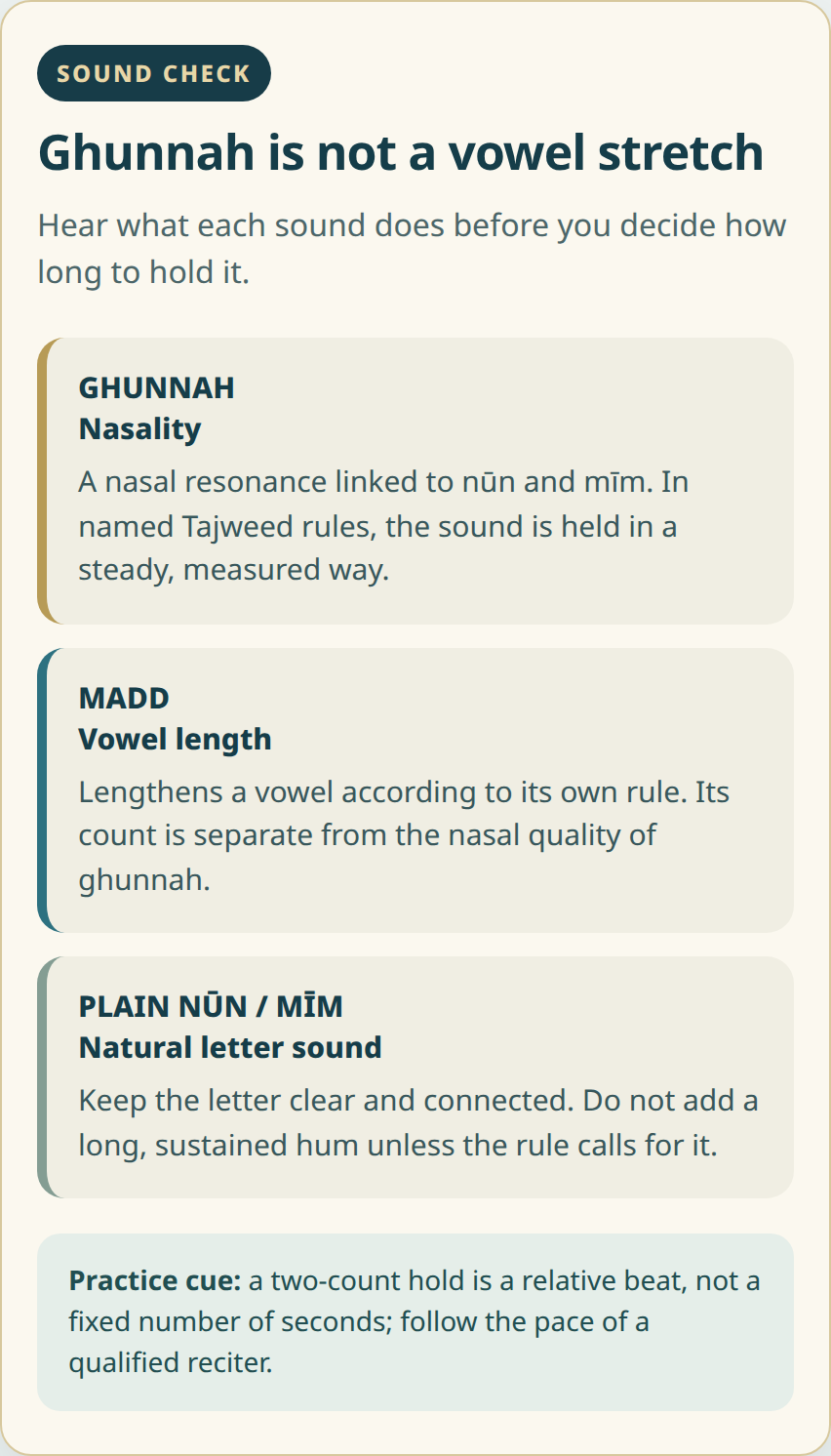
Separate three sounds that can be confused. Ghunnah is a nasal quality. Madd lengthens a vowel according to its own rule. An ordinary nūn or mīm keeps its natural letter sound, but you do not add a sustained hum unless the rule calls for one. When you listen, do not ask only, “Was it long?” Ask, “Was the nasal quality clear, and did it move into the next letter without a pause or an extra vowel?”
A two-count measure is a relative rhythm, not a fixed number of seconds. It lasts longer in a slow lesson example and shortens proportionally at a faster pace. Keep the sound connected to the word; do not create a separate beat before or after it. If you are also studying vowel duration, Quranytime’s madd guide explains why that count is a different feature.
Some teachers describe several ranks of ghunnah strength and may group the examples differently. That terminology can help later, but a new learner can begin with two questions: is a measured nasal hold required here, and what sound follows it? If you are unsure about a label, imitate the model first and ask the teacher to name the rule afterward.
Do a quick rule check before you recite
Ghunnah is not an optional flourish to add whenever you see nūn or mīm. The deliberate hold is heard with nūn or mīm carrying shaddah, and in rules such as idghām with ghunnah, iqlāb and ikhfāʾ. Meem sākinah also has a nasal hold in its relevant concealed or merged cases. By contrast, clear izhār and idghām without ghunnah should not receive the same full hold.
This page uses a few examples to train the ear; it is not a replacement for a complete rule map. Keep Quranytime’s Tajweed chart and its beginner Tajweed guide open when you need to check the letter groups. The nūn-sākinah and tanwīn examples below assume connected recitation; stopping on a word changes what you pronounce.
Five short listening drills
Use one short excerpt at a time and listen to a reliable reciter before looking closely at the spelling. These examples help you hear different transitions; they are not a substitute for learning the full rule and its conditions.
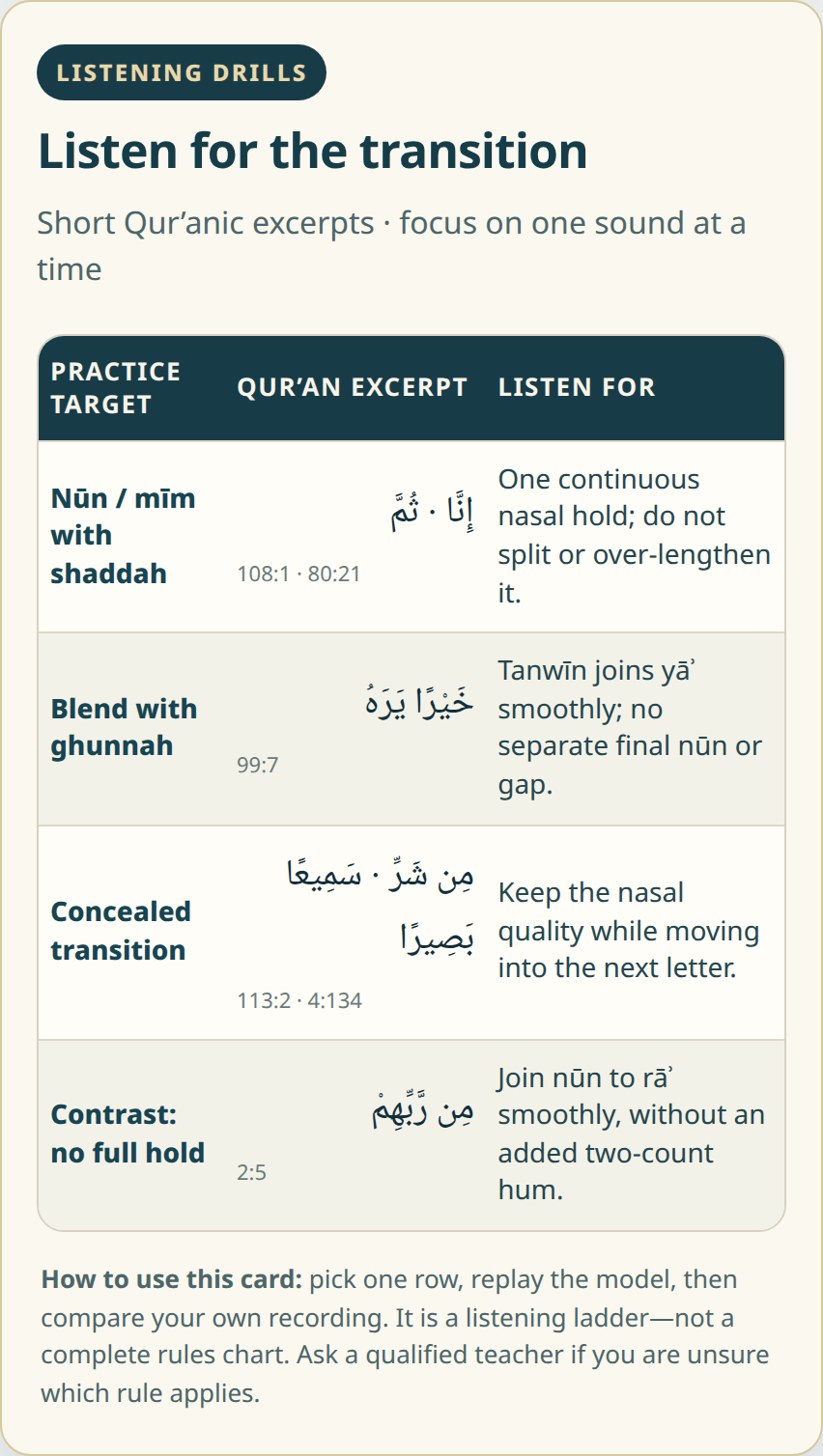
- Hear the doubled letter: listen to إِنَّا (al-Kawthar 108:1) or ثُمَّ (ʿAbasa 80:21). The nūn or mīm has shaddah, so let its nasal quality continue steadily instead of clipping the first part or turning the hold into a separate “mmm.” For how shaddah doubles a letter, see the shaddah pronunciation lesson.
- Follow the blend: in خَيْرًا يَرَهُ (al-Zalzalah 99:7), tanwīn meets yāʾ across a word boundary. Listen for a smooth joining sound with ghunnah—not a fully separate final nūn, and not a gap between the two words.
- Conceal without losing the sound: in مِن شَرِّ (al-Falaq 113:2), the nūn is not pronounced as a fully clear nūn, but it does not disappear into a hard shīn either. Practise moving from the nasal resonance into the following letter without inserting a vowel.
- Notice the changed sound: listen to سَمِيعًا بَصِيرًا (al-Nisāʾ 4:134). Before bāʾ, iqlāb changes the nūn/tanwīn sound toward a concealed mīm with ghunnah. Quranytime’s meem-before-bāʾ lesson is useful for comparing this with the separate meem-sākinah transition.
- Practise the contrast: compare the earlier held examples with مِن رَّبِّهِمْ (al-Baqarah 2:5), where nūn before rāʾ is idghām without ghunnah. Keep the connection smooth, but do not add the same measured nasal hold. This contrast often reveals whether you are following the rule or simply stretching every nūn.
Build a record-and-compare routine
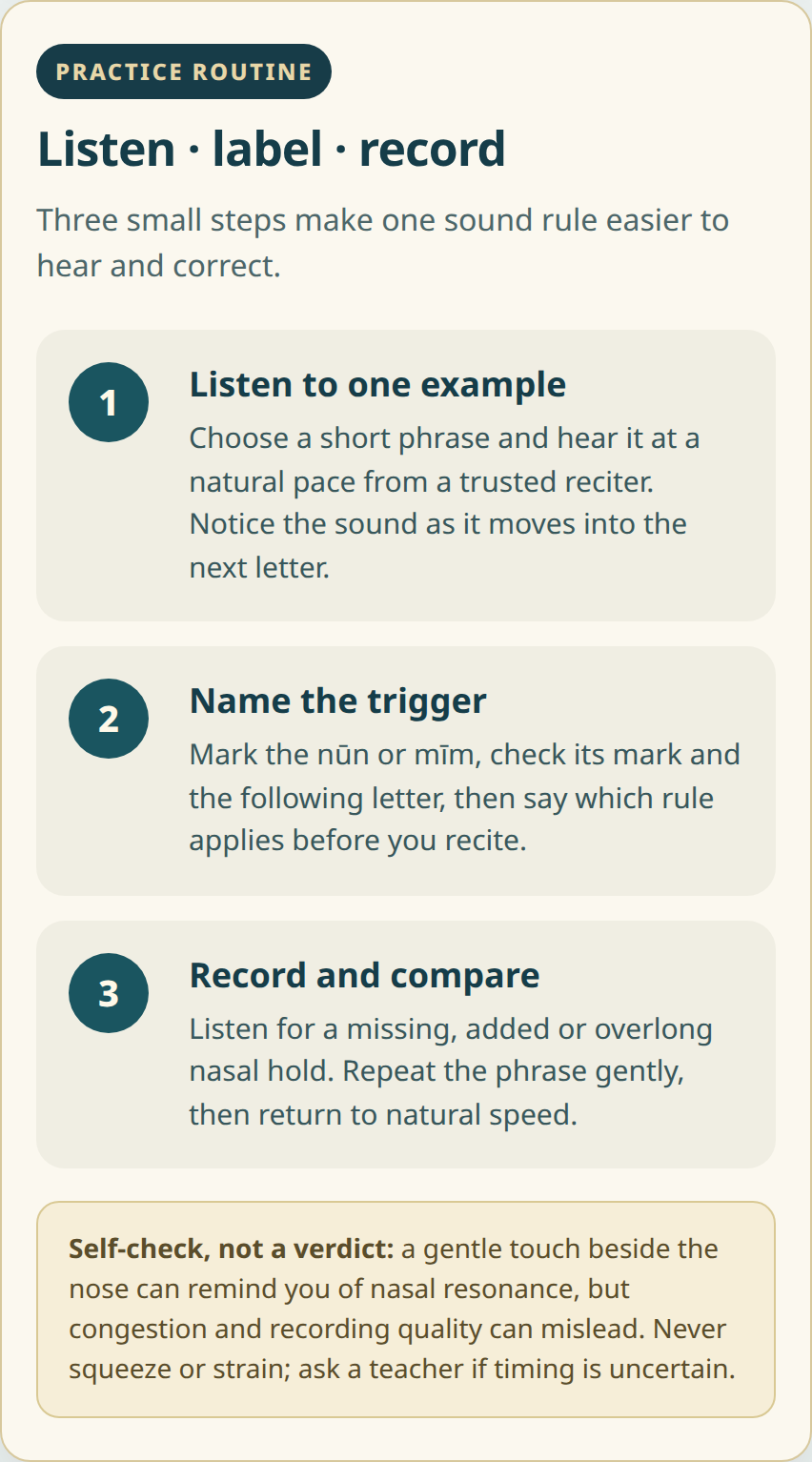
Choose a short phrase that contains only one target you are practising. Listen once without reciting. On the second listen, mark the nūn or mīm and the next letter. Before the third listen, say the rule aloud. Then recite the phrase at a calm pace and record a single attempt. Keeping the phone in the same place makes two recordings easier to compare.
Listen back for three things: did the nasal quality disappear too soon; did you hold it so long that it became a humming pause; or did you add a full hold where the rule calls for clarity or merging without ghunnah? Correct one issue at a time. Do not make the sound louder to compensate for uncertain timing, and do not stretch a nearby vowel to “make up” for a short ghunnah.
A gentle touch beside the nose can remind you that the sound has nasal resonance, but it is not a test of accuracy. Congestion, volume and recording quality can mislead you; never squeeze or strain. A teacher’s feedback is more useful than a physical self-test when you cannot tell whether the problem is timing, articulation or the rule itself.
Make your listening comparison fair
Choose one model from the reading tradition you follow and keep its playback speed unchanged while you compare. A heavily slowed clip can blur the sound or alter its pitch, making a natural nasal quality seem unusually heavy. If you need a slower example, use a teacher’s demonstration rather than stretching an app’s audio and judging your voice against altered playback.
Do not try to copy the reciter’s vocal colour, breathiness or loudness; voices differ. Compare only the target: does the nasal quality remain audible for the expected hold, and does it connect to the next letter cleanly? Record from the same distance, in a quiet room, and replay both clips at the same volume. That makes a timing difference easier to notice.
If your recording still sounds uncertain, write down the exact word or transition and ask the teacher to demonstrate it at slow and natural speeds. A focused question—“Should this nūn be clear, joined or concealed?”—is easier to answer than “Is my whole recitation right?”
A five-minute practice plan
- Minute 1 — listen: play one trusted model at natural speed and identify the target phrase.
- Minute 2 — label: mark the nūn or mīm, its sign and the next letter; name the rule before you read.
- Minutes 3–4 — practise: recite the short phrase two or three times, staying gentle and connected. Pause only to reset, not to insert a new vowel.
- Minute 5 — review: replay your recording and write one observation, such as “the hold faded early” or “I stretched the clear nūn.” Bring that question to your teacher.
Once one example feels steady, choose a second example from the same rule. Do not jump from one rule to five in the same session. When a sound improves at a slow pace, return gradually to a natural reading speed so the technique transfers to recitation rather than remaining a drill.
The home Tajweed practice guide has more ideas for fitting short drills between lessons. A separate video lesson is embedded below; listen for its demonstration, then use the text examples here to practise different transitions.
Common practice problems
Rushing: slow the excerpt, identify the trigger, then reconnect the phrase. Overholding: return to a model at natural pace and keep the nasal sound steady, not theatrical. Adding ghunnah everywhere: contrast one held example with مِن رَّبِّهِمْ and listen for the different instruction. Reading only from a table: use the written rule to choose the target, but listen to pronunciation; spelling alone cannot show how smoothly the sound travels.
A short written rule summary can help, but it cannot correct your own voice. For a concise reference to the common two-count convention and the nūn/mīm trigger rules, see Understand Quran’s Tajweed Rules manual. Pair any written notes with a trusted reciter and qualified teacher.
If you would like personal feedback on your recitation and a clear next step, you can book a free Quran and Arabic trial class.
Quick recap
To learn how to pronounce ghunnah, listen for nasal quality—not just length. Name the rule, practise one short transition, record it and compare for a missing, extra or overlong hold. Keep ghunnah separate from madd, and do not add a sustained nasal sound to every nūn or mīm. Small, careful drills and feedback are more useful than repeating a long passage without knowing what to hear.