
Arabic gives you more than one way to say “relative.” A few everyday terms tell the listener whether someone is on your father’s side or your mother’s side, while attached endings show that a person is your brother, aunt, or cousin. This guide to family members in Arabic starts with immediate family, then maps the extended-family terms that beginners most often mix up. The examples use a clear Modern Standard Arabic learning baseline; spoken forms and transliterations can vary by region.
Family members in Arabic: start with the core words
Begin with the relatives you are most likely to name when introducing your family. Arabic writing often leaves short vowels unmarked; the vowel signs below are included as a reading aid, not as a requirement for ordinary writing. When your family discussion turns to choosing a child’s name, our Muslim baby name generator lets you compare meanings, Arabic spellings, and documented Quranic or historical connections.
| English | Arabic | Pronunciation guide |
|---|---|---|
| father | أَب | ʾab |
| mother | أُمّ | ʾumm |
| brother | أَخ | ʾakh |
| sister | أُخْت | ʾukht |
| son | اِبْن | ibn |
| daughter | بِنْت | bint |
| husband / wife | زَوْج / زَوْجَة | zawj / zawja |
| grandfather / grandmother | جَدّ / جَدّة | jadd / jadda |
Two common words for family are أُسْرَة (usra) and عَائِلَة (ʿāʾila). Some beginner resources use them to contrast a nuclear family with a wider or extended family. Treat that as a helpful learning distinction, not a rule that every speaker uses identically. For a structured practice lesson, Michigan State University’s open Elementary Arabic family-vocabulary section presents core relatives and the paternal-versus-maternal distinction.
The key contrast: your father’s side or your mother’s side?
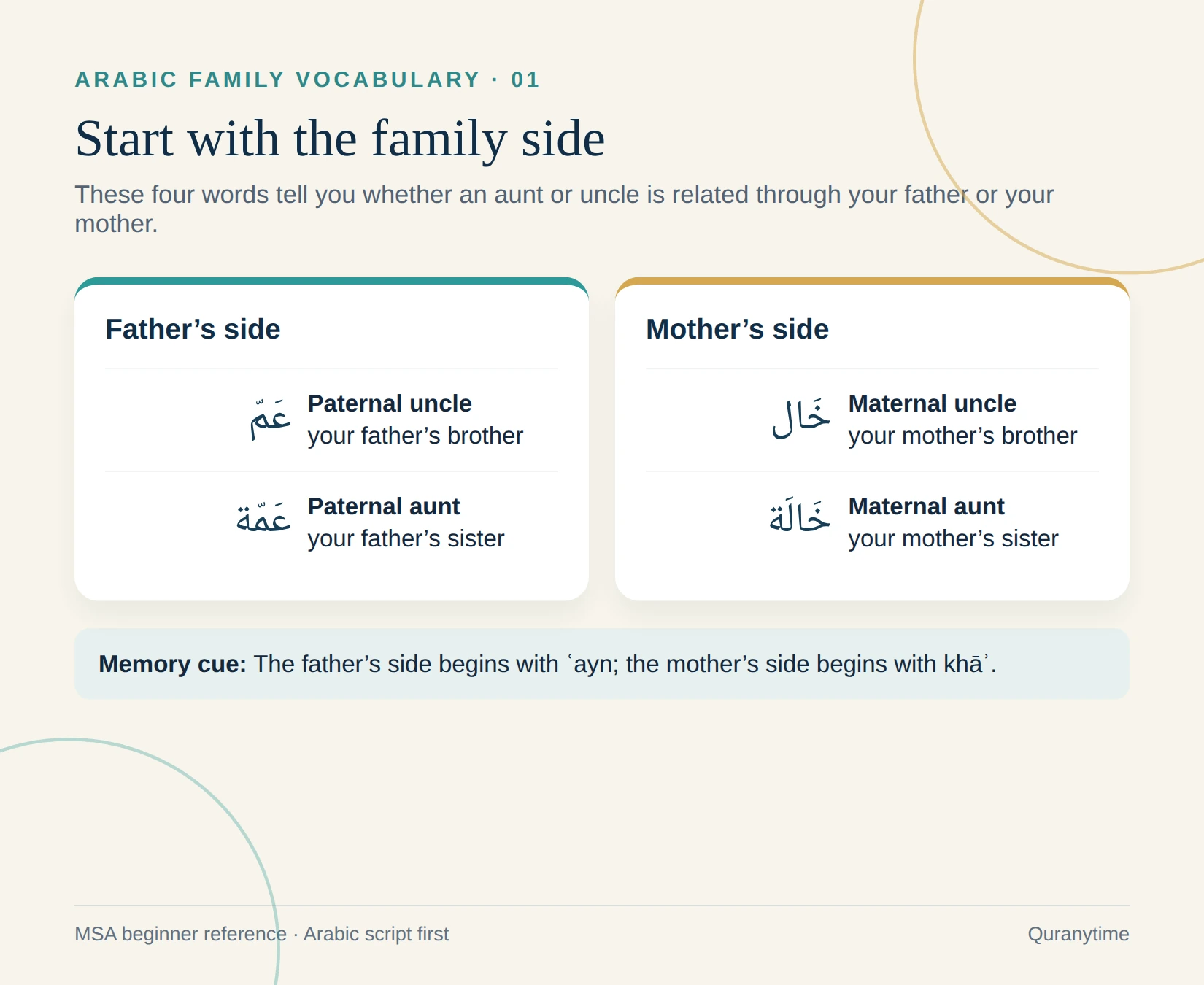
Arabic has different everyday words for an uncle or aunt depending on which parent they are related to. This is the most useful distinction to learn early:
| Relative | Arabic | Meaning |
|---|---|---|
| paternal uncle | عَمّ | your father’s brother |
| paternal aunt | عَمّة | your father’s sister |
| maternal uncle | خَال | your mother’s brother |
| maternal aunt | خَالَة | your mother’s sister |
Read the pair slowly: عَمّ begins with ʿayn (ع), while خَال begins with khāʾ (خ) and has a long ā. The throat sound in ʿayn may take practice for English speakers; Quranytime’s listening-first guide to the Arabic ʿayn sound can help you approach it gently. Don’t replace the sound with an English “a” and assume the two Arabic words are interchangeable.
Cousins: Arabic can name the exact relationship
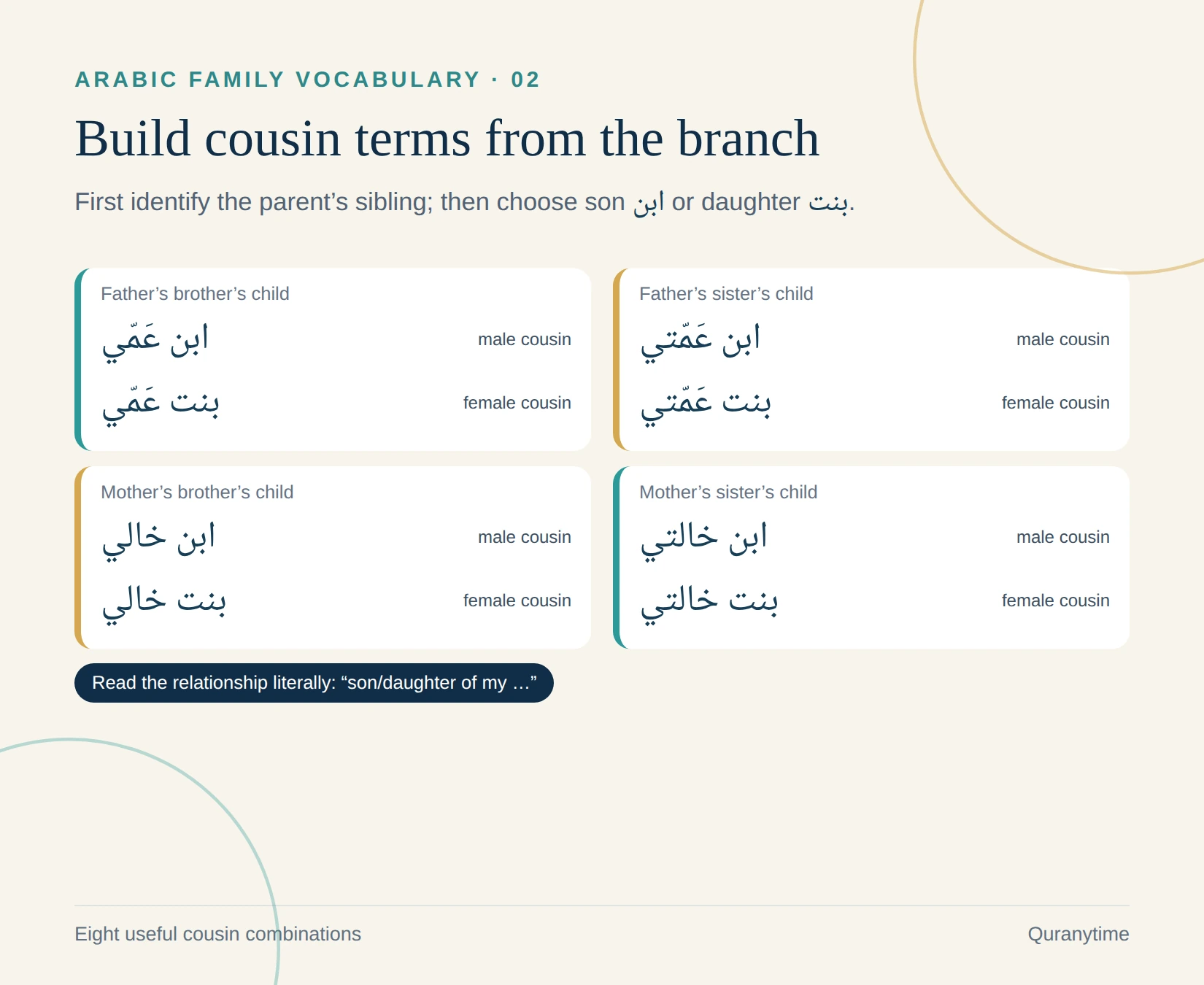
English commonly uses one word, cousin, for many relationships. A useful Arabic learning map combines the parent’s sibling with the cousin’s gender. When the relationship is to your own family, the forms below include “my” in the relative phrase:
| Relationship | Arabic | How to read it literally |
|---|---|---|
| male cousin, father’s brother’s son | ابن عَمّي | son of my paternal uncle |
| female cousin, father’s brother’s daughter | بنت عَمّي | daughter of my paternal uncle |
| male cousin, father’s sister’s son | ابن عَمّتي | son of my paternal aunt |
| female cousin, father’s sister’s daughter | بنت عَمّتي | daughter of my paternal aunt |
| male cousin, mother’s brother’s son | ابن خالي | son of my maternal uncle |
| female cousin, mother’s brother’s daughter | بنت خالي | daughter of my maternal uncle |
| male cousin, mother’s sister’s son | ابن خالتي | son of my maternal aunt |
| female cousin, mother’s sister’s daughter | بنت خالتي | daughter of my maternal aunt |
The trick is to build the phrase in parts: ابن means “son,” بنت means “daughter,” and the final family term tells you which side and branch to follow. A university textbook lesson notes that Arabic learners encounter eight cousin equivalents when they distinguish these relationships. You do not need to memorize all eight on day one: learn the four uncle/aunt words first, then use the table as a family-tree lookup.
When you meet a new cousin term, trace it outward from the speaker rather than starting with the English word. First ask whether the parent’s sibling is from the mother’s or father’s side. Then ask whether that sibling is an uncle or aunt. Finally, choose ابن for a son or بنت for a daughter. For example, if the relative is your mother’s sister’s daughter, the pieces are “daughter” plus “my maternal aunt”: بنت خالتي. This step-by-step route works like following branches on a family tree and helps you avoid guessing at a one-word English equivalent.
The same method also makes listening easier. When you hear عمي or خالتي, listen for both the relative term and the attached ending; do not let the final “my” form hide the family-side information. Start by recognizing the four base words in the side-of-family table, then practise them in full phrases. If you are learning a regional dialect, keep its everyday equivalents in a separate note so they do not blur the MSA forms shown here.
How to say “my” family members in Arabic
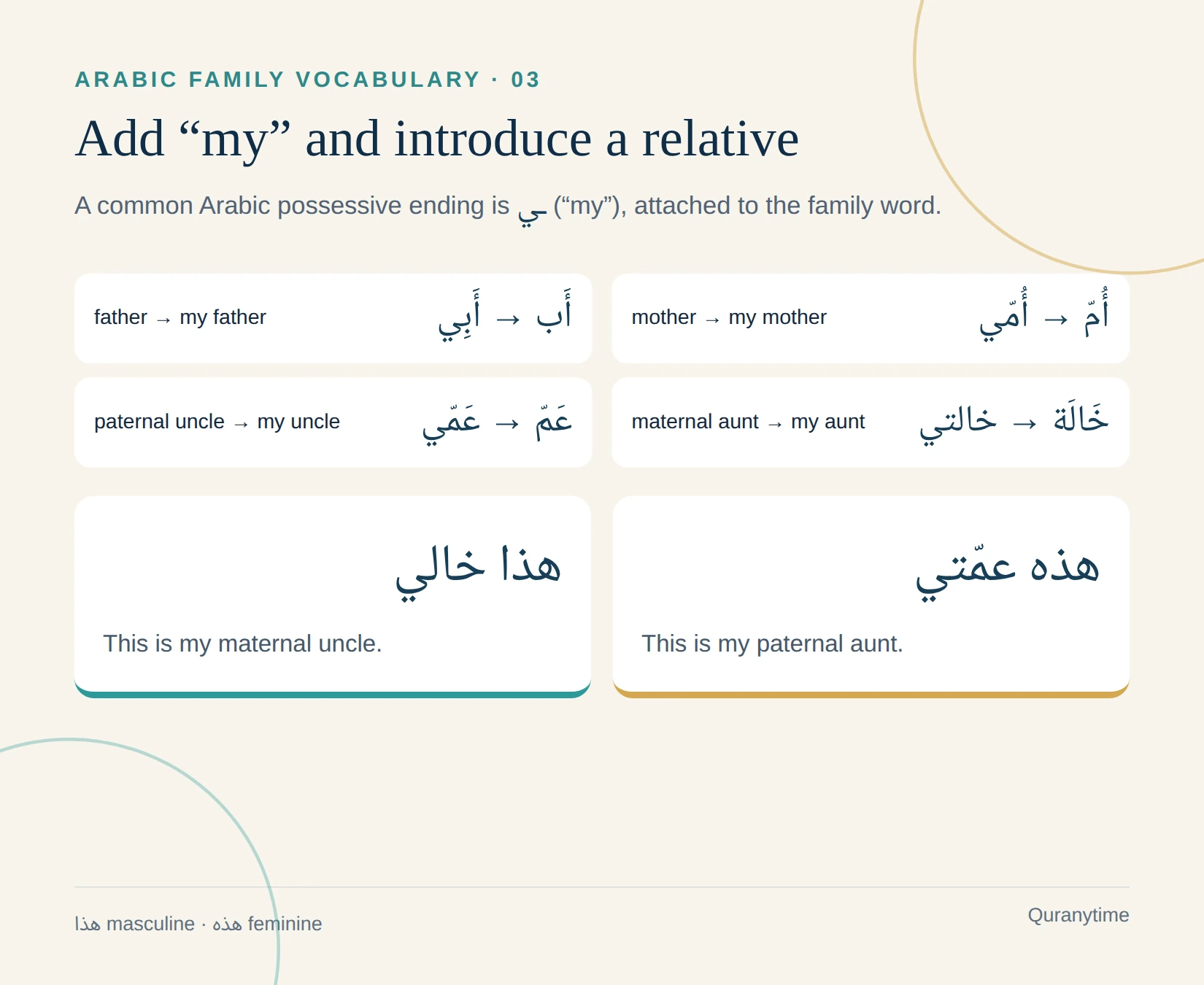
Arabic often attaches a short possessive ending directly to the noun. For the first-person singular, the ending ـي commonly means “my.” Compare the base word with the possessive form:
- أَب “father” → أَبِي “my father”
- أُمّ “mother” → أُمّي “my mother”
- أَخ “brother” → أَخِي “my brother”
- أُخْت “sister” → أُخْتِي “my sister”
- عَمّ / عَمّة “paternal uncle/aunt” → عَمّي / عَمّتي “my paternal uncle/aunt”
- خَال / خَالَة “maternal uncle/aunt” → خالي / خالتي “my maternal uncle/aunt”
These are attached pronoun suffixes rather than separate English-style words placed before the noun. If you want to study that grammar more deeply, see Quranytime’s guide to Arabic pronouns and attached forms. Cousin phrases such as ابن عمي also show how Arabic links nouns together; that pattern is called iḍāfa, explained in this beginner guide to Arabic iḍāfa.
Introduce a relative with a short sentence
Once you know the noun and the “my” ending, you can make a simple introduction:
- هذا أَبِي — hādhā abī — This is my father.
- هذه أُمّي — hādhihi ummī — This is my mother.
- هذا خالي — hādhā khālī — This is my maternal uncle.
- هذه عَمّتي — hādhihi ʿammatī — This is my paternal aunt.
هذا (hādhā, “this” for a masculine noun) and هذه (hādhihi, “this” for a feminine noun) agree with the relative being introduced. If you are unsure which one to use, review the examples in Quranytime’s lesson on Arabic demonstrative pronouns. You can also use a simple description such as عائلتي كبيرة (“My family is large”); notice the feminine adjective ending after عائلة. The site’s guide to Arabic adjective agreement explains why adjective forms change.
A short practice routine for family vocabulary
Use a few minutes to make the words active instead of rereading the list:
- Sort by side. Say عَمّ، عَمّة for your father’s side, then خَال، خَالَة for your mother’s side.
- Add “my.” Practise the four pairs عمي، عمتي، خالي، خالتي without looking at the English gloss.
- Build a cousin phrase. Choose ابن or بنت, then connect it to one uncle or aunt term.
- Introduce one person. Use هذا or هذه with the correct possessive form.
Keep the practice personal but comfortable: a fictional family tree, a book character, or a made-up example works just as well as describing your own relatives. For more short introduction patterns, Quranytime’s collection of useful beginner Arabic phrases provides additional sentence models. If you would like feedback on Arabic and Quran-reading foundations with a teacher, you can book a free Quran and Arabic trial class.
Common mistakes to avoid
- Using one uncle word for every side. عَمّ points to your father’s brother; خَال points to your mother’s brother.
- Dropping the gender distinction. عَمّ and عَمّة refer to different relatives, as do خَال and خَالَة.
- Calling every cousin the same thing. Start with the parent’s sibling and whether the cousin is a son or daughter; that gives you the components of the phrase.
- Treating transliteration as a perfect substitute for sound. Letters such as ع and خ do not map neatly to English spelling. Use Arabic script, listen to a careful model, and repeat slowly.
- Assuming one MSA form covers every spoken variety. This guide is a beginner reference, not a complete dialect dictionary. Ask a teacher or label the regional form when your goal is a specific spoken dialect.
Frequently asked questions
What is the Arabic word for “my family”?
You can say أُسْرَتي (usratī) or عَائِلَتي (ʿāʾilatī) for “my family.” Which word fits best depends on context and register; learn them as common options rather than forcing an exact one-to-one match with English.
How do I know whether an aunt or uncle is paternal or maternal?
Use the first consonants as a memory cue: عَمّ / عَمّة (ʿamm / ʿamma) belong to your father’s side, while خَال / خَالَة (khāl / khāla) belong to your mother’s side.
Does Arabic have one word for cousin?
Arabic can describe the cousin relationship more specifically than English by combining the cousin’s gender with whether the parent’s sibling is an uncle or aunt on the father’s or mother’s side. Use the eight-row table as a map; regional and everyday usage may simplify or vary.
What is the best way to learn these words?
Learn immediate relatives first, then the four paternal/maternal uncle-and-aunt terms, and finally build cousin phrases from those pieces. Say the Arabic aloud, check the written form, and revisit the terms in short introductions over several days.