
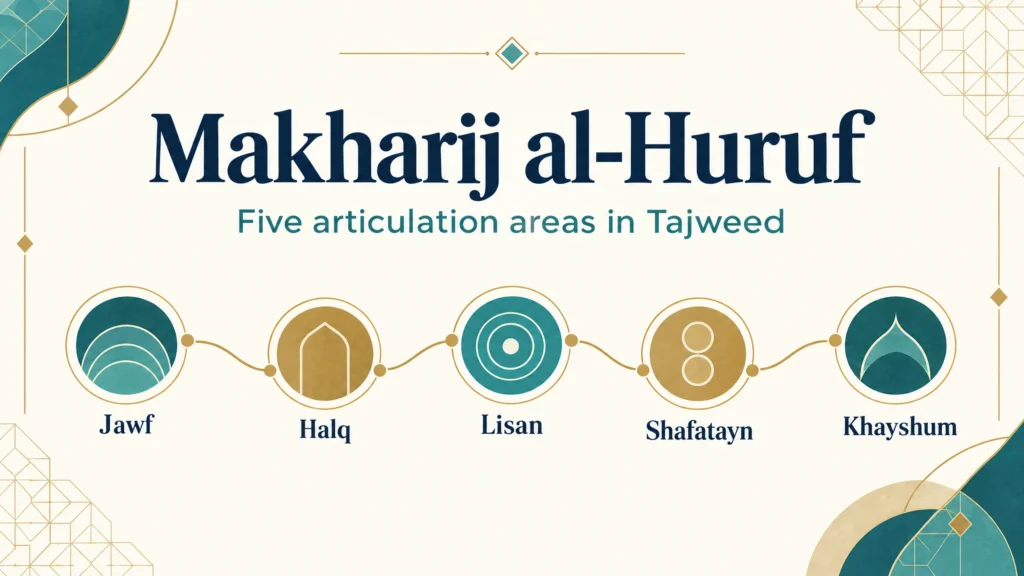
Makharij al-huruf (مَخَارِجُ الْحُرُوفِ) are the articulation points from which Arabic letters are formed. In Tajweed, learning each makhraj—the singular of makharij—helps you distinguish sounds that may seem similar when you are new to Quran recitation. A clear example is ق and ك: both use the back of the tongue, but they do not begin at the same point.
This guide introduces the commonly taught map of five main articulation areas and seventeen detailed points, then turns the chart into a short listening and practice routine.
What does makhraj mean in Tajweed?
The Arabic word makhraj means an exit or place of emergence; makharij is its plural. In this lesson, a makhraj is the place in the mouth, throat, or nasal passage that shapes a consonant sound. The word helps you ask a practical question: “Where should this sound begin?”
Do not confuse a letter’s makhraj with its sifah (quality). The point describes where the sound is made; a quality describes how it sounds, such as whether it is heavy, whispered, or accompanied by nasal resonance. For instance, ص and س are made in nearby tongue-and-teeth areas, but ص is heavy while س is light. Quranytime’s Arabic alphabet guide is a useful starting point if you are still matching letter names with their written shapes.
Many Tajweed lessons use a traditional seventeen-point count arranged under five broad regions. The translated al-Jazariyyah poem’s chapter on articulation points states the seventeen-point convention and names the letter groups. Some teaching texts count or group a point differently, so follow one qualified teacher’s map consistently rather than mixing tables.
The five main articulation areas
Learn the large area first, then narrow your attention to the particular point. The traditional map counts one point in the open cavity, three in the throat, ten across the tongue, two at the lips, and one in the nasal passage. Together, that is seventeen detailed points.
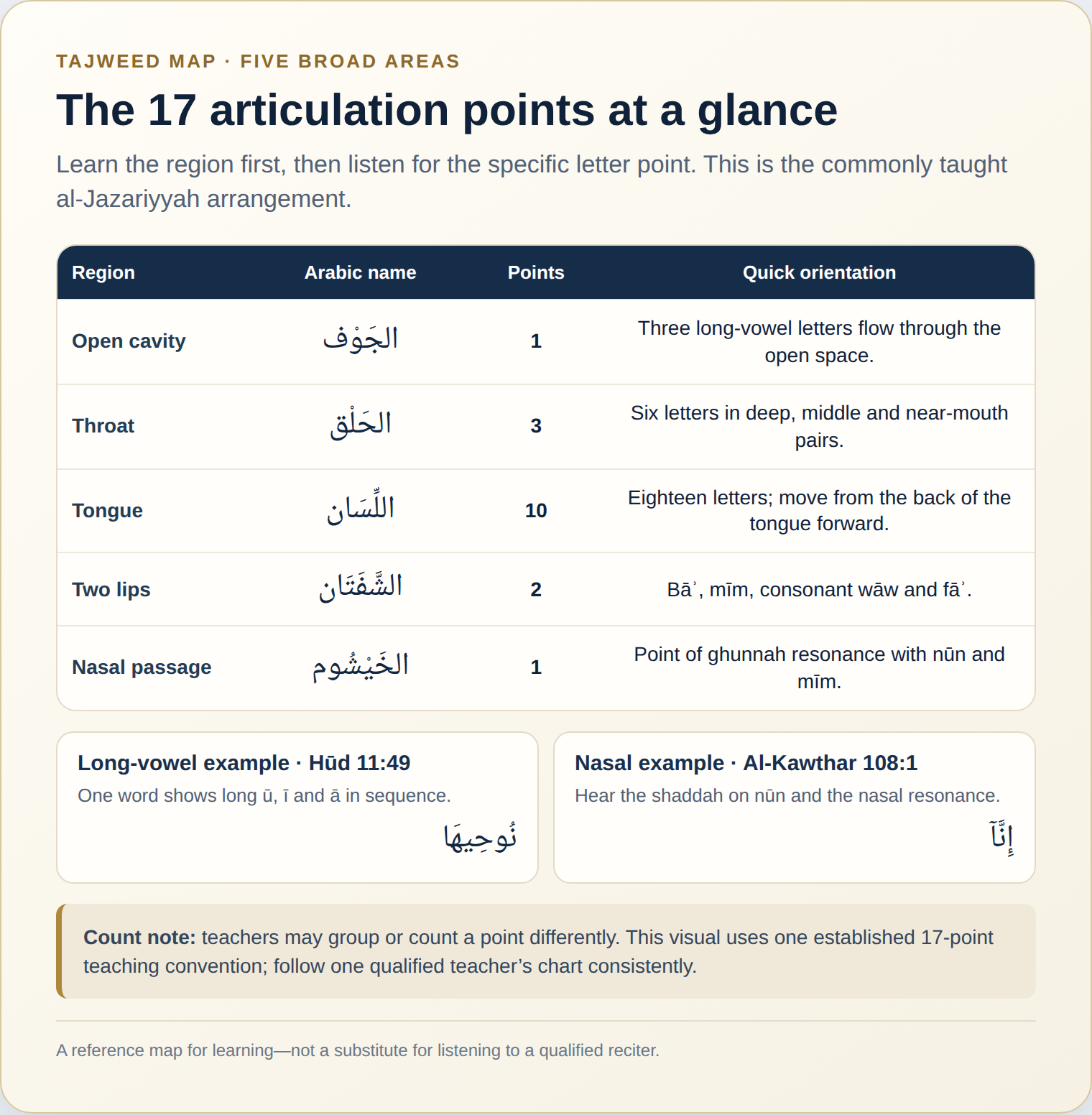
Al-Jawf is the open space through which the three long-vowel letters flow: alif preceded by fatḥah, wāw preceded by ḍammah, and yāʾ preceded by kasrah. These are the madd letters; an ordinary wāw or yāʾ used as a consonant is not produced in quite the same way. In Hūd 11:49, the word نُوحِيهَا (nūḥīhā) provides a compact example containing long ū, ī, and ā sounds.
Al-Ḥalq is the throat. Its three levels are from deepest to nearest the mouth: hamzah and hāʾ ء، هـ; ʿayn and ḥāʾ ع، ح; then ghayn and khāʾ غ، خ. In أَحَدٌ (aḥad) from Al-Ikhlāṣ 112:1, hamzah begins at the deepest level and ḥāʾ is articulated farther forward in the throat. The contrast between ع and ح is especially worth listening to; Quranytime’s listening-first guide to ʿayn gives a focused practice path.
Al-Lisān is the tongue and has the largest share of the map: ten points for eighteen letters in the traditional arrangement. Start at the back with ق and ك, move through the middle of the tongue, then notice how the sides and tip meet the palate, gums, and teeth. The word قُلْ (qul) in Al-Ikhlāṣ 112:1 gives a clear back-of-tongue qāf to hear. The downloadable Arabic Reading Guide can support the earlier step of recognizing each letter before comparing its articulation.
Al-Shafatan refers to the two lips. Bāʾ, mīm, and consonant wāw use the lips together or rounded; fāʾ uses the lower lip against the upper front teeth. In the basmalah at the start of Al-Fātiḥah, بِسْمِ (bismi) brings bāʾ and mīm into one short phrase. Keep the lips relaxed: forceful squeezing can make a clean release harder to hear.
Al-Khayshūm is the nasal passage. In this traditional chart, it is the point of ghunnah—the resonant nasal quality heard with nūn or mīm in its prescribed contexts—not an additional independent consonant. In إِنَّا (innā) in Al-Kawthar 108:1, listen for the nūn with shaddah and the nasal resonance. Quranytime’s ghunnah listening practice focuses on that sound, while the interactive Tajweed Guide organizes connected recitation skills.
The ten tongue points: move from back to front
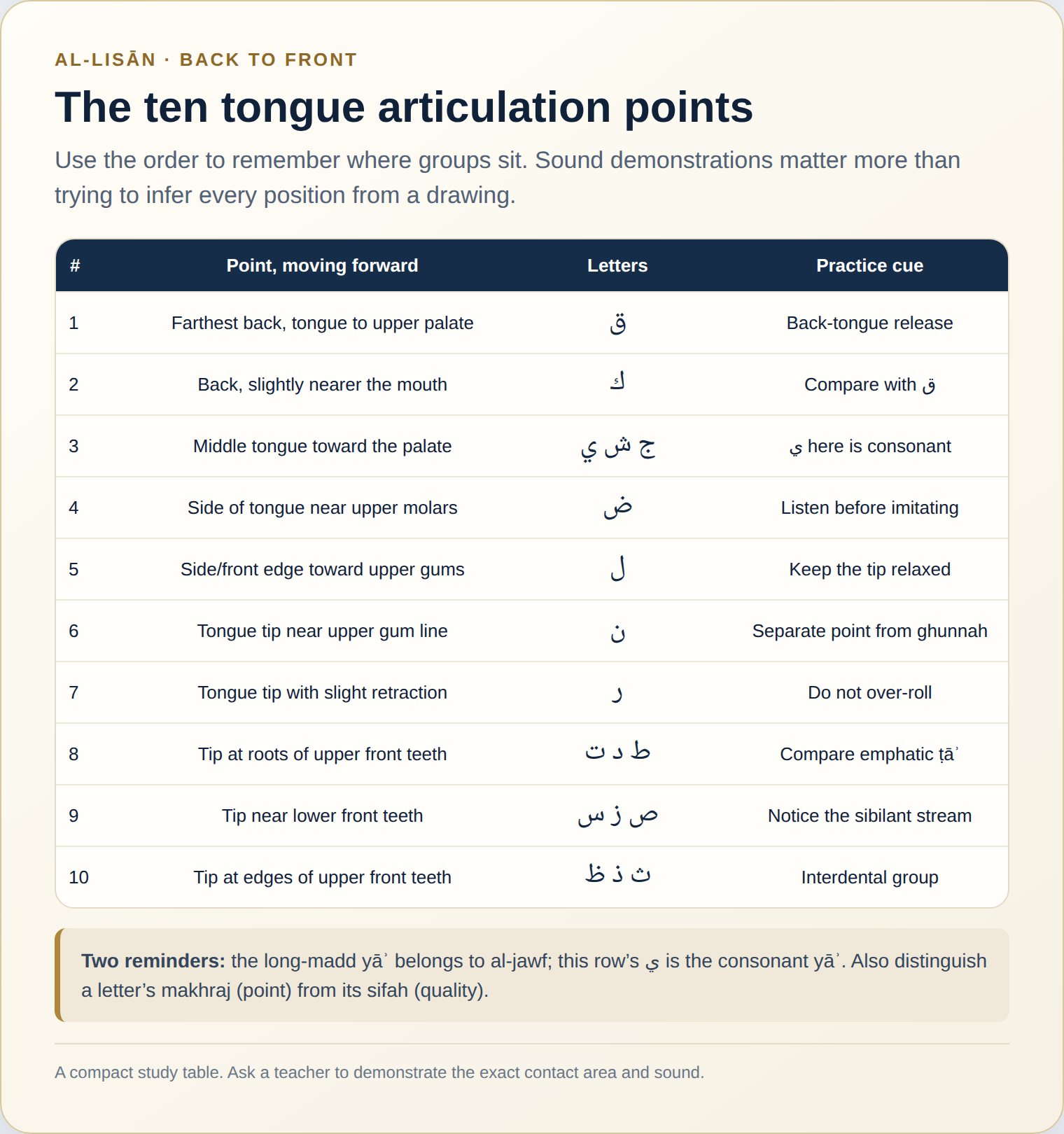
Because the tongue produces many Arabic letters, learn its points as a route rather than as a memorized pile. The table summarizes the standard teaching sequence. Exact descriptions in a diagram may differ slightly because the tongue has a broad contact surface; your teacher’s sound demonstration is the practical reference.
- Back, deepest: ق (qāf) touches the upper palate farthest back.
- Back, slightly forward: ك (kāf) is produced a little nearer the mouth than qāf.
- Middle: ج، ش، ي (jīm, shīn, and consonant yāʾ) use the middle tongue area toward the palate.
- Side: ض (ḍād) uses a side of the tongue against the upper molar area.
- Side extending forward: ل (lām) uses the side/front edge of the tongue near the upper gums.
- Tip near the gums: ن (nūn) uses the tongue tip near the upper gum line.
- Tip with a slight retraction: ر (rāʾ) is close to nūn but has its own point.
- Tip at the upper tooth roots: ط، د، ت (ṭāʾ, dāl, tāʾ) form a closely related group.
- Tip near the lower front teeth: ص، ز، س (ṣād, zāy, sīn) share the sibilant area.
- Tip at the edges of the upper front teeth: ث، ذ، ظ (thāʾ, dhāl, ẓāʾ) are the interdental group.
For sounds that combine a makhraj with a strong quality, compare the relevant skill rather than changing the point itself. Quranytime’s guide to heavy letters and their levels explains why a letter such as ص has heaviness, while its nearby partner س does not.
A beginner routine for finding a letter’s makhraj
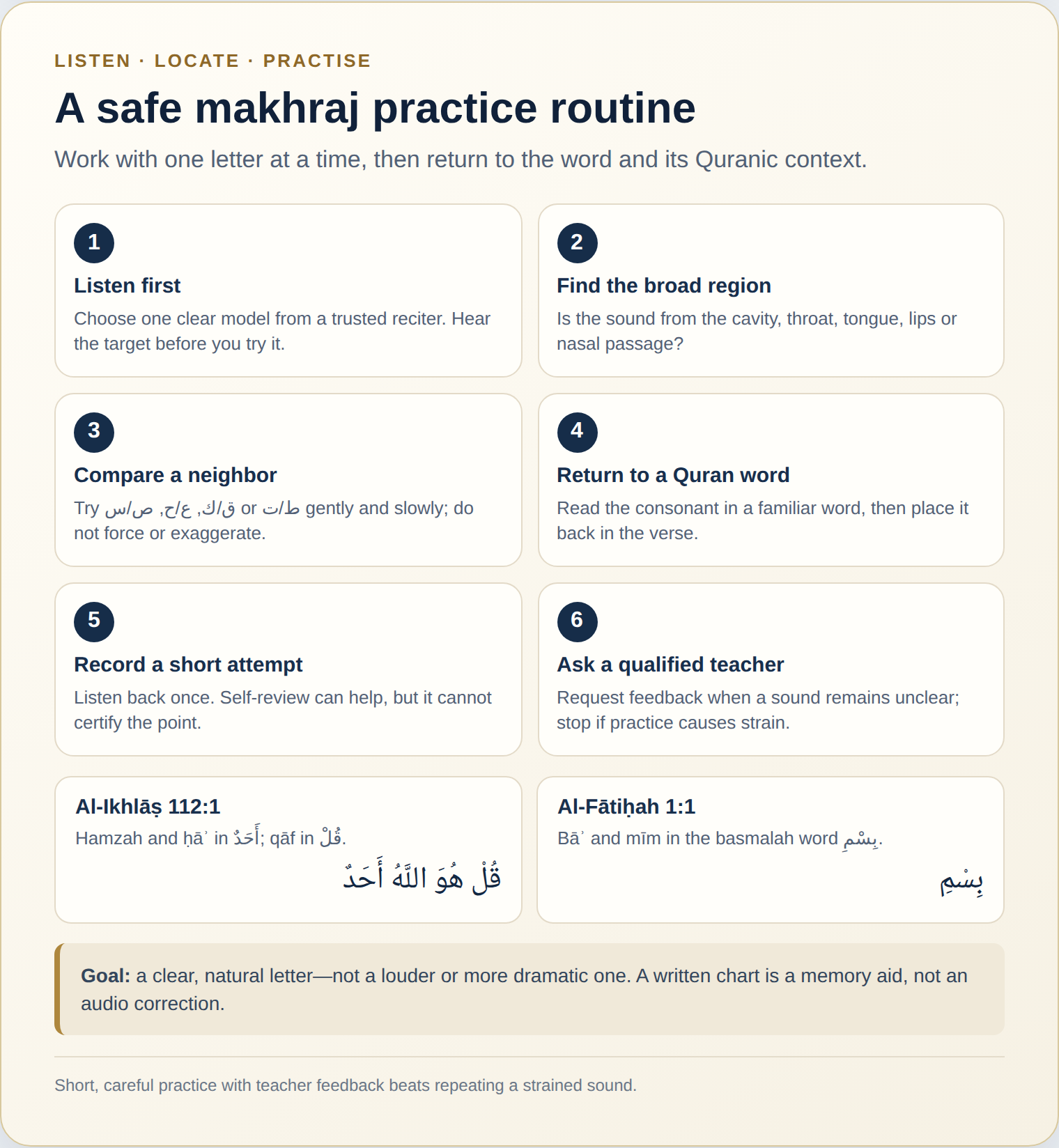
Try this routine with just one letter at a time. Keep the sound gentle and short before adding vowels or reading a full word.
- Listen first. Choose a trusted reciter or teacher’s model of the letter in a simple, clearly vowelled syllable. Listen once without speaking and notice the part of the mouth or throat involved.
- Locate the broad area. Decide whether the sound is from the open cavity, throat, tongue, lips, or nasal passage. Do not guess the most detailed point until the broad region is clear.
- Say the letter with sukūn after a vowel. A teacher may model a short preceding vowel and then the target letter at rest, so the articulation becomes easier to notice. Do not add an extra vowel after the consonant.
- Compare a nearby contrast. Practise ق/ك, ع/ح, ص/س, or ط/ت slowly. The purpose is to hear and feel the difference, not to make the contrast louder or more dramatic.
- Return to a Quran word. Read one familiar word containing the sound, then place it back into the verse. For broad practice, the Quran recitation mistake checklist helps you note what to review next.
- Record and ask for feedback. Compare a short recording with a trusted model, then ask a qualified teacher to check the sound. Self-listening can miss small placement differences.
Watch this separate, screened introduction to Makharij and Sifaat for another visual explanation:
Common mistakes to avoid
- Memorizing a chart without listening: a location label is a map, not proof that the sound is correct.
- Confusing place with quality: a heavy letter is not simply a louder letter, and ghunnah is a nasal quality with its own point in the teaching map.
- Forcing the sound: do not strain your throat, press the tongue painfully, or exaggerate a consonant to imitate a recording.
- Using transliteration as the model: English spelling can only approximate Arabic sounds. Learn the Arabic letter and listen to a reliable pronunciation.
- Changing a point to match an English sound: English approximations for ح, ع, ق, and ض can be misleading; hear these from a trained reciter.
Frequently asked questions
How many makharij are there in Tajweed?
A widely taught classical arrangement counts seventeen detailed points in five main areas. Some teachers describe a sixteen-point count or group details differently. The article uses the seventeen-point arrangement associated with the al-Jazariyyah tradition and recommends following one teacher’s framework consistently.
What is the difference between makhraj and sifah?
A makhraj is where the letter is articulated; a sifah is a feature of its sound, such as heaviness, whispering, or nasal resonance. Both matter, but they answer different questions.
Can I learn makharij from a written chart alone?
A chart can help you remember areas and letter groups, but pronunciation is auditory and physical. Listen to a qualified reciter and ask a teacher to check your attempt, especially for sounds that do not have a close English equivalent.
If you want guided feedback on Quran reading and Arabic foundations, you can book your free Quran and Arabic trial class. Bring one or two letters you find difficult and ask the teacher to listen to your articulation.
The takeaway
Start with the five broad areas, then practise one point and one letter contrast at a time. The seventeen-point chart is most useful when it leads you back to a sound you can hear, a word you can read, and feedback from a qualified teacher. Learn the map gently, and let accurate listening guide your progress.