

When you hear the Arabic letters س (sīn) and ص (ṣād), both begin near the front of the mouth, yet they should not sound identical. Knowing where a letter is made is only part of clear Quran reading. You also need to notice how the sound behaves. Tajweed calls those letter qualities Sifaat al-Huruf (صفات الحروف).
If you have already studied articulation points, this is the natural next step: learn to hear a letter’s airflow, sound closure, and tongue position without turning each quality into a complicated rule to memorize. This guide focuses on a few practical contrasts, explains common mix-ups, and gives you a short listening routine. It is a learning aid, not a substitute for listening to a qualified Quran teacher.
What does Sifaat al-Huruf mean?
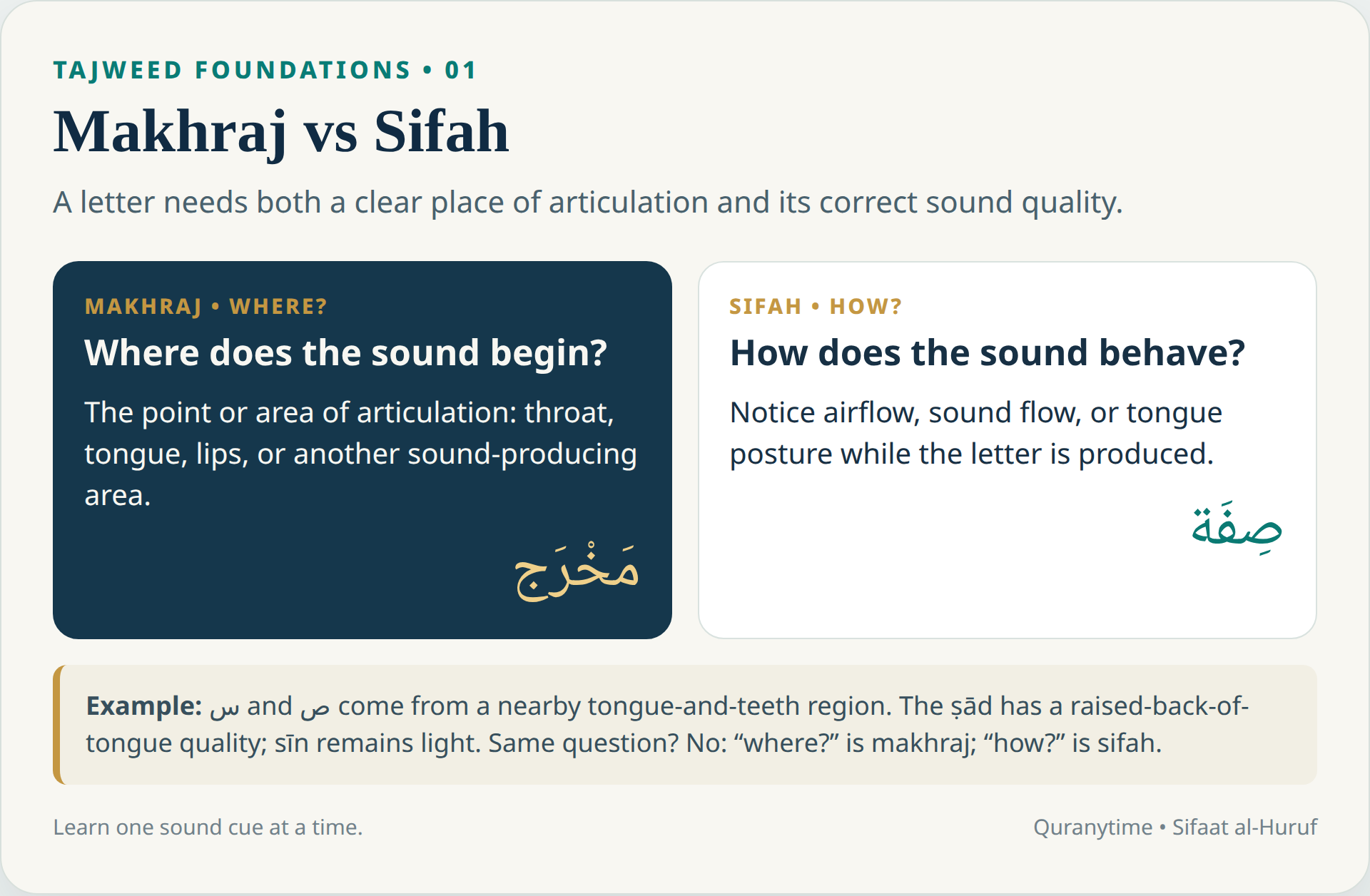
Sifaat al-Huruf means the characteristics of letters. A makhraj identifies the place from which a sound is articulated; a sifah describes a quality that distinguishes or shapes that sound. A letter can have the right place but still be unclear if its sound quality is lost. In its articulatory phonetics guide, the University of Sheffield describes consonants by voice, place, and manner.
Think of it as two listening questions:
- Makhraj: Where does the sound begin?
- Sifah: What happens to the airflow, sound, or tongue while it is being formed?
For a closer look at the first question, see Quranytime’s guide to Makharij al-Huruf and the main articulation areas. The two subjects work together: articulation gives the sound a home, and its qualities help keep it distinct.
Three useful qualities to hear first
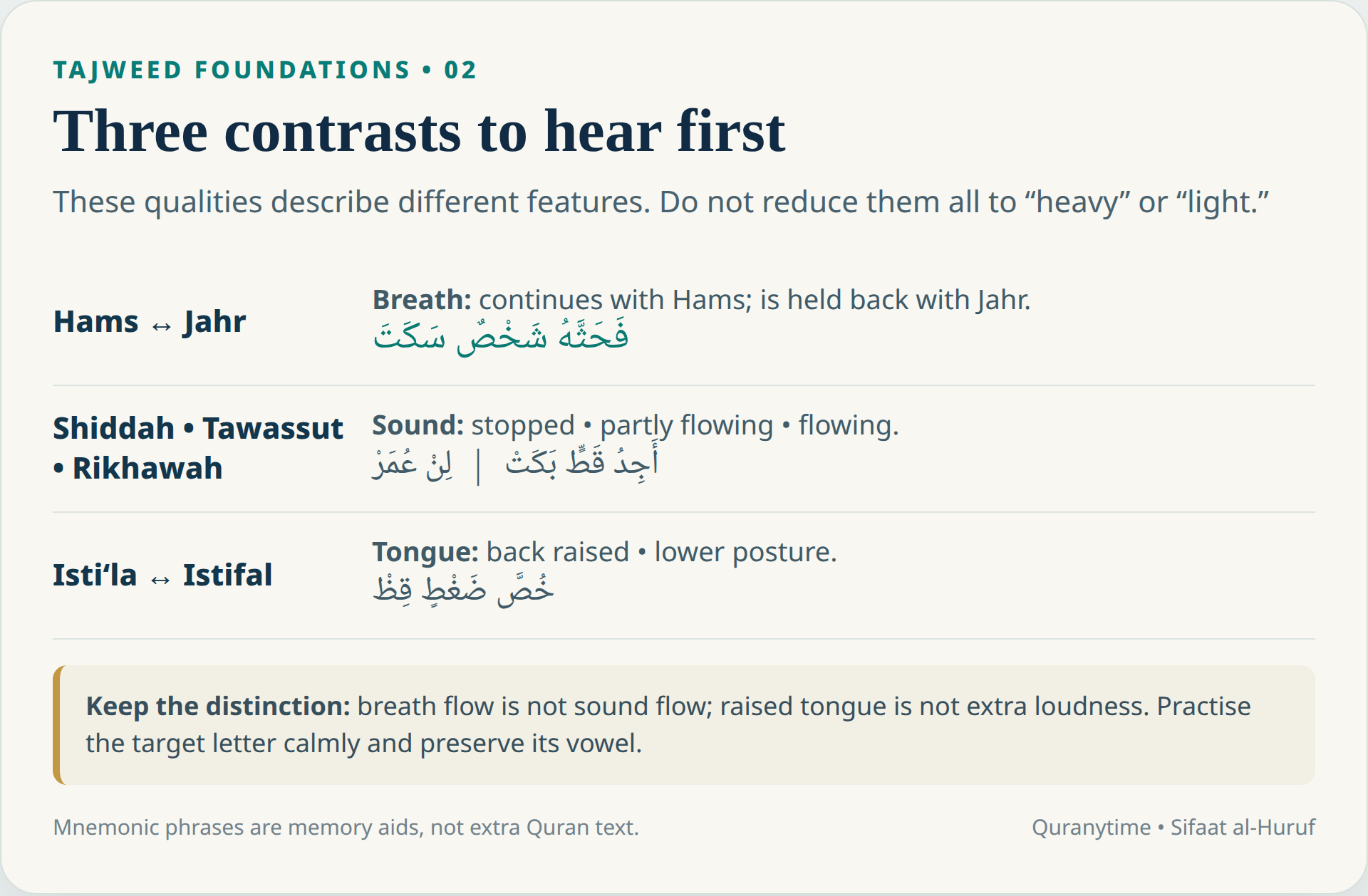
Classical Tajweed books describe several groups of qualities. Teachers may group or count some of them differently, so a beginner does not need to start by memorizing a single total. Begin with contrasts you can hear or feel on a short, unvowelled letter. Keep the following three ideas separate; they describe different features.
1. Hams and Jahr: does breath keep flowing?
Hams is the audible continuation of breath as a letter is pronounced. Jahr is its opposite: the breath is held back rather than allowed to keep running. Hams is not an instruction to whisper the whole word, and Jahr does not mean shouting. The goal is to make the letter clearly, with its own correct airflow.
The familiar Hams mnemonic is فَحَثَّهُ شَخْصٌ سَكَتَ (often transliterated faḥaththahu shakhsun sakat). It collects ten letters: ف، ح، ث، ه، ش، خ، ص، س، ك، ت. The remaining letters have Jahr. To notice the difference, say a short syllable with ف, then one with ب; feel for a continuing stream of air in front of your mouth on ف, without stretching either sound into an extra vowel.
2. Shiddah, Tawassut, and Rikhawah: does the sound stop or flow?
This group describes the flow of the sound, not the flow of breath. With Shiddah, the sound is held at its articulation point before release. Rikhawah allows the sound to flow, while Tawassut (also called Bayniyyah in some teaching) is between the two. The familiar memory phrases are أَجِدُ قَطٍّ بَكَتْ for the eight Shiddah letters and لِنْ عُمَرْ for the five middle letters.
Try listening to a final بْ and a final سْ after the same short vowel. The bāʾ closes the sound; the sīn lets a hiss continue. Do not add a vowel after either letter. This contrast is especially noticeable when the letter has sukūn.
Important distinction: Shiddah (شِدَّة) as a letter quality is not the same thing as the shaddah mark (ّ). Shiddah describes how sound is blocked at the articulation point. The written shaddah mark tells you that a consonant is doubled in the word. They sound alike in English transliteration, but they answer different questions.
3. Isti‘la and Istifal: what is the back of the tongue doing?
Isti‘la involves raising the back of the tongue during the letter; its seven letters are remembered by خُصَّ ضَغْطٍ قِظْ: خ، ص، ض، غ، ط، ق، ظ. Istifal is the contrasting lower tongue posture of the other letters. Isti‘la is closely connected with the full, heavy quality called tafkheem, but do not mistake “heavy” for “louder.” Keep the sound controlled and preserve the vowel.
Compare سَ and صَ slowly. Both are made in a nearby tongue-and-teeth region; the ص has Isti‘la and a fuller quality, while س stays light. The aim is not to make the ṣād harsh. Quranytime’s guide to heavy letters and their levels goes deeper into this distinction.
How these qualities connect to familiar Tajweed rules
Sifaat are not a replacement for the rule-by-rule study of Tajweed. They help explain why a sound needs a particular treatment. For example, the familiar light echo of Qalqalah is associated with a specific group of letters when they are sakin; it should not become a full added vowel. Review Quranytime’s Qalqalah guide and its no-extra-vowel practice when you work on that sound.
Similarly, a letter may have a stable quality while a separate rule depends on its context. The rā’ is not always heavy or always light, so learn its contextual rules in the dedicated Tajweed guide to the letter Rā’. The lām in the name of Allah also follows a specific heavy-or-light rule, explained in this guide to the Lām in “Allah”.
If you want a broader map of topics after learning one sound at a time, use the Tajweed rules chart with Quran examples. Learners who are still building confidence with unfamiliar Arabic sounds may also find the Quran pronunciation practice guide for English speakers helpful.
Do I need to memorize every quality now?
No. Start with the distinctions you can hear, and follow the sequence your teacher uses. One letter can have several qualities at the same time: س has Hams (breath continues) and Rikhawah (sound flows), while ب has Jahr (breath is held back) and Shiddah (sound is stopped at its articulation point). When ب has sukūn, its separate Qalqalah rule may also apply. This is why learning one label per letter is not enough. Connect the terms to a reliable sound model and a small practice task, rather than trying to memorize a long list before you can recognize it by ear.
A short listening routine for Sifaat
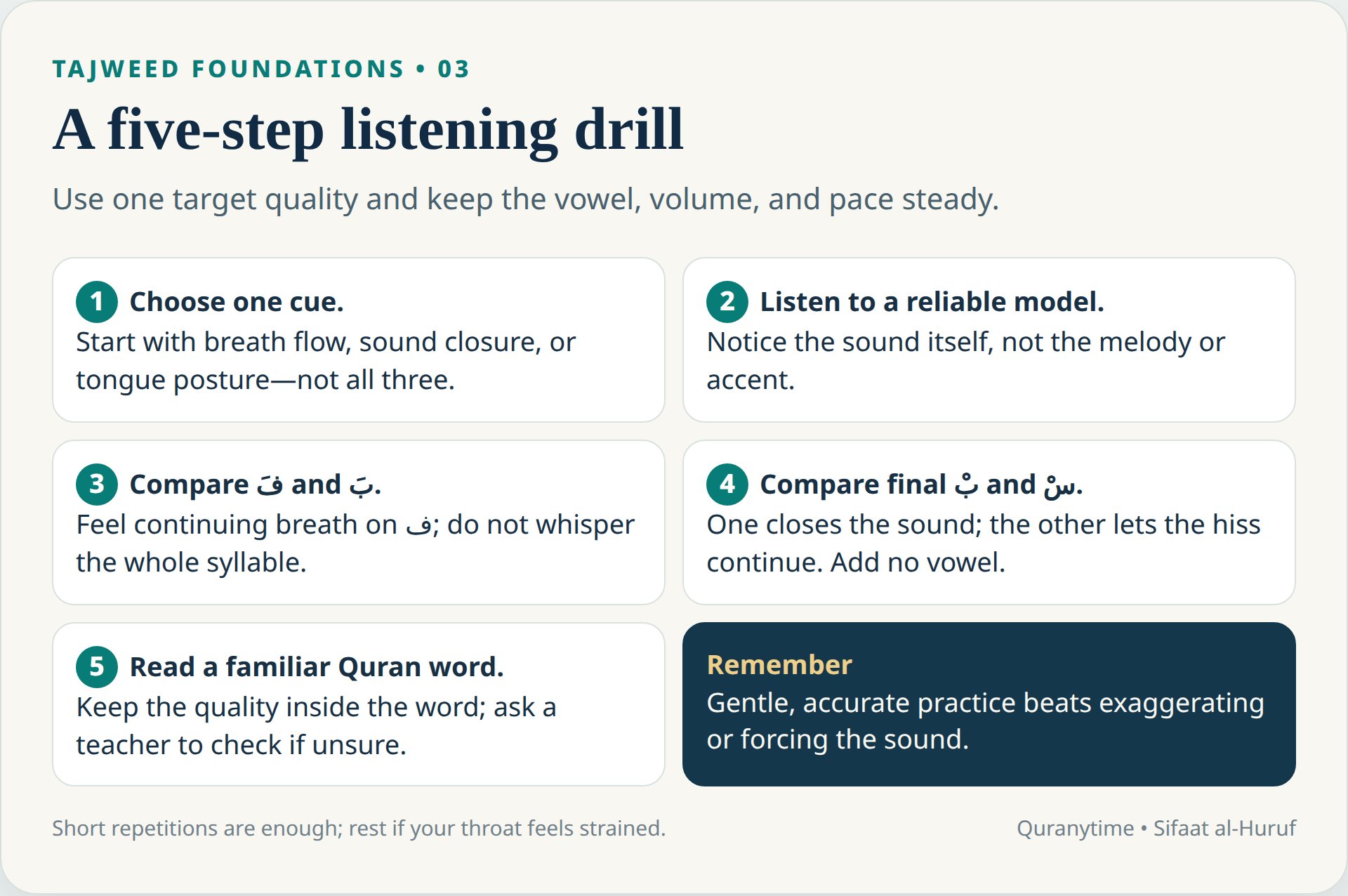
- Choose one quality. Do not try to hear every attribute at once. Start with Hams and Jahr, for example.
- Listen before repeating. Use a slow, reliable recitation or a teacher’s model. Notice the airflow or sound closure rather than copying the speaker’s accent or melody.
- Alternate a small contrast. Say the two letters with the same vowel, then compare them with sukūn if you know how to form the example correctly. Keep the vowel length and loudness steady.
- Move into a Quran word. Find the target letter in a word you already read accurately. Recite the full word and verse smoothly; do not isolate the letter so much that it stops sounding like part of the word.
- Record one attempt. Listen back for the one cue you chose. Ask a teacher to correct the sound if you are unsure, especially before practising a difficult letter repeatedly.
Common beginner mix-ups
- Calling every quality “heavy or light.” Hams and Jahr concern breath flow; Shiddah, Tawassut, and Rikhawah concern sound flow; Isti‘la and Istifal describe tongue posture. A single letter can have several qualities at once.
- Whispering a Hams letter on purpose. Hams means breath continues with the letter, not that you should lose its proper articulation or whisper the surrounding word.
- Adding a vowel after a stopped consonant. When you test a sakin letter, avoid saying “ba-uh” or “sa-uh.” The added vowel changes what you are trying to hear.
- Confusing a quality with a written sign. Shiddah is an attribute; shaddah is a mark that doubles a consonant. Learn each in its proper context.
- Overdoing the sound. A heavy letter is not a louder letter, and an echo is not an extra vowel. Keep the sound measured and follow a qualified model.
Can I learn Sifaat al-Huruf without a teacher?
You can learn the names, memory phrases, and basic listening cues through careful study, but a teacher’s feedback is valuable because the difference is often subtle. If you would like a teacher to listen to your reading and suggest a suitable next step, you can book a free Quran and Arabic trial class.
For now, choose one pair and listen for one thing: flowing breath, a held sound, or a raised back of the tongue. Practise gently in a familiar Quran word, keep its vowels intact, and let accurate listening guide your next repetition.