
Two English translations of the same Quran verse can sound different without one automatically being careless or the other automatically being exact. Arabic word order, grammar, idiom and layered meanings do not always map neatly onto a single English sentence. If you are learning Arabic, the most useful question is not simply, “Which translation is best?” It is, “What does each edition help me notice, what has it made explicit, and what should I check in the Arabic?”
If you are searching for the best Quran translation for learning Arabic, start with your goal rather than expecting a universal ranking. This guide gives you a repeatable side-by-side method for study, not a substitute for tafsir, a qualified teacher, or a scholar when a question affects belief or practice.
There is no one best translation for every learner
A translation renders the Quran’s Arabic meaning in another language, so translators choose English words, sentence structures and levels of explanation. One edition may sound natural, another may keep Arabic clause order more visible, and another may add footnotes. These differences matter when you know what you are comparing.
Choose an edition for a particular task. A new reader may prefer clear contemporary English; an Arabic student may want grammar visible, while someone investigating a word may value concise notes. Use one dependable primary translation consistently, then consult a second when a phrase is unclear. Comparing many versions at once can add noise.
Before comparing English, make sure you can locate and read the Arabic phrase you are studying. Quranytime’s guide to Arabic letter forms inside words can help with connected script. For language-learning goals, begin with the distinction between a translation, an explanatory translation and tafsir.
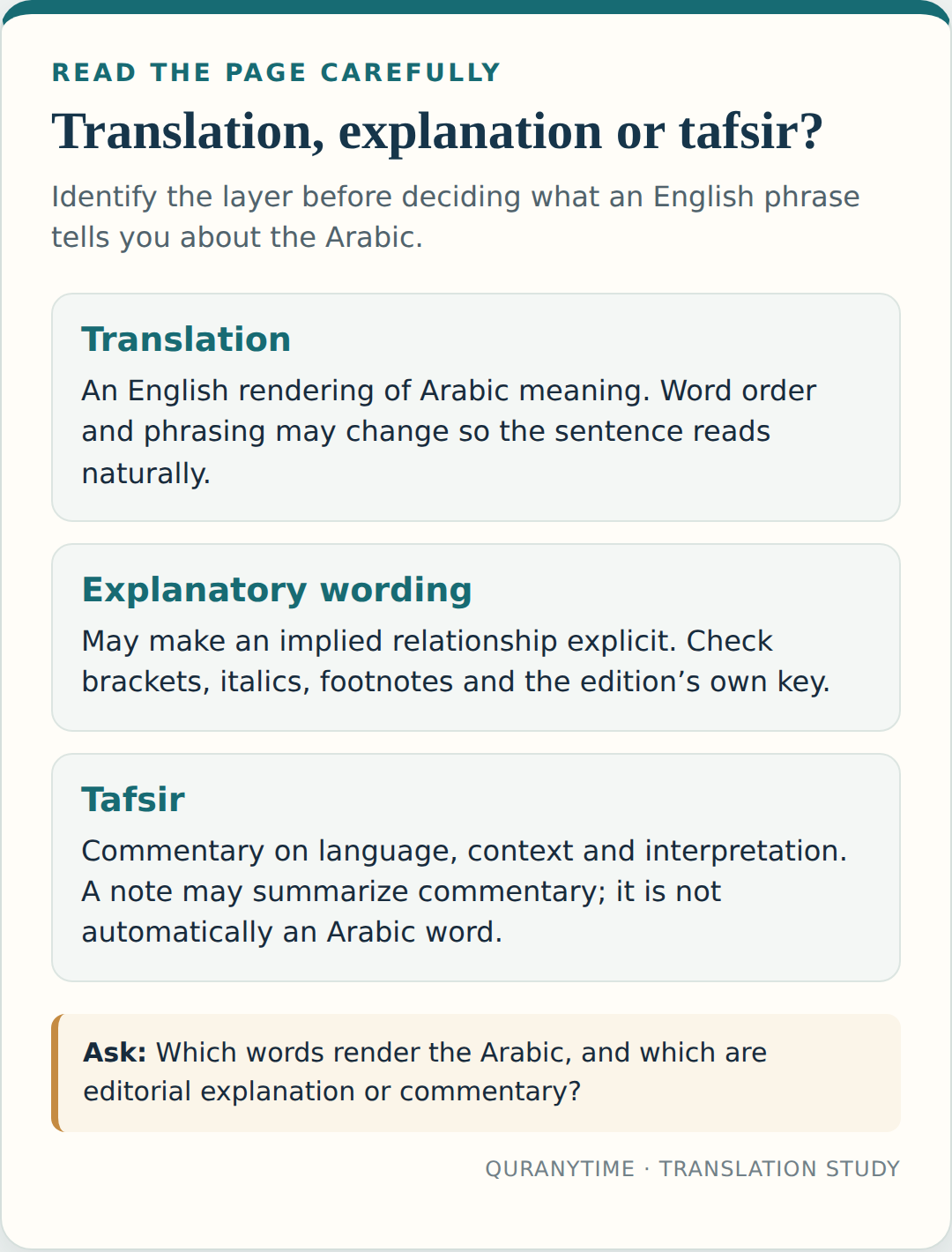
Translation, explanation and tafsir are related but not identical
A translation tries to represent the Arabic in another language. It may choose a close-to-the-wording expression or a more natural English sentence, and that choice can affect what a beginner notices. A translation can also include notes or explanatory words; check whether the edition marks additions with brackets, italics, footnotes or a preface.
An explanatory rendering may make an implied relationship explicit; check how the edition marks additions. Tafsir is commentary on language, context, reports, legal or theological questions. Some editions condense comments into notes. A note is not automatically a separate Arabic word, and one English sentence cannot carry every dimension.
Use five questions as your comparison scorecard
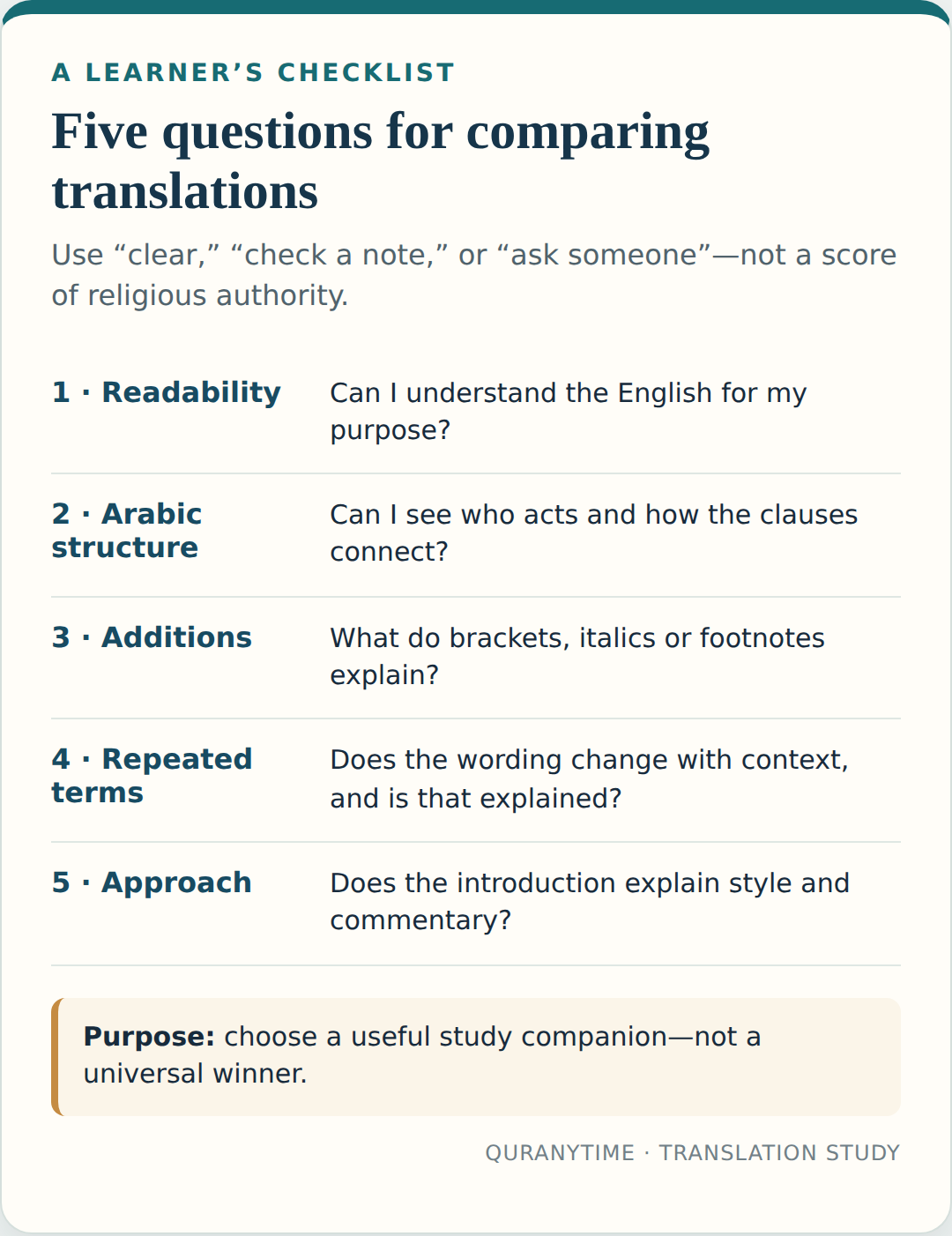
These questions are a study checklist, not a numerical grade for a sacred text or a verdict about a translator’s faithfulness. You can mark “clear,” “needs a note,” or “ask someone” for each one.
- Can I understand the English? Read a sample aloud. Is its vocabulary workable for your purpose? Smooth English alone does not prove the Arabic structure is exact.
- Can I still see the Arabic relationship? Notice who acts and how clauses connect. A translator may rearrange a sentence for natural English; compare with the Arabic first. Quranytime’s introduction to Quranic Arabic roots and patterns helps with language clues, but a root is not a complete verse translation.
- What is inside brackets or a footnote? Check the edition’s key: brackets may mark supplied words, but conventions vary. Notes may explain grammar, alternatives, names or interpretive views; distinguish clarification from commentary.
- Are recurring terms handled consistently? A term may be rendered differently by context. Compare a few occurrences and ask whether nearby wording or a note explains the choice.
- Does the edition explain its approach? Read its introduction: does it explain style, additions, repeated terms or use of commentary? This sets expectations but does not settle each verse.
Match your primary translation to your learning goal
If you are beginning to read independently, choose English you can understand without stopping every sentence; a short note explaining unfamiliar terms may help. If your goal is Arabic study, select a translation whose introduction is transparent about style and whose notes let you check grammar, wording or alternatives. If you are reading for reflection, consider whether the edition’s notes clearly separate translation from commentary. These are practical preferences, not rankings of religious authority.
Before making an edition your regular companion, sample more than one passage. Read a narrative section, a passage with unfamiliar vocabulary and a verse whose structure you already know. Ask whether the English remains readable across all three, whether recurring terms are treated clearly, and whether notes answer questions or distract from the reading. You do not need to settle every difference before continuing. Mark a question, keep your main edition consistent for a while, and return to unresolved wording when you have enough Arabic or teacher guidance to investigate it.
For a cross-check, choose a translation with a different editorial style rather than a second version that makes the same choices. Compare only the phrase that raised your question. If the versions differ, classify the difference first: English register, rearranged syntax, explanatory wording, a lexical choice, or commentary. Then decide whether your question can be answered with language evidence or needs tafsir. This keeps comparison purposeful and prevents the notebook from becoming a collection of disconnected English alternatives.
Try a four-step Arabic-first reading routine
- Read the Arabic first. Listen to a trusted recitation if helpful. Mark the phrase you do not understand before opening several translations.
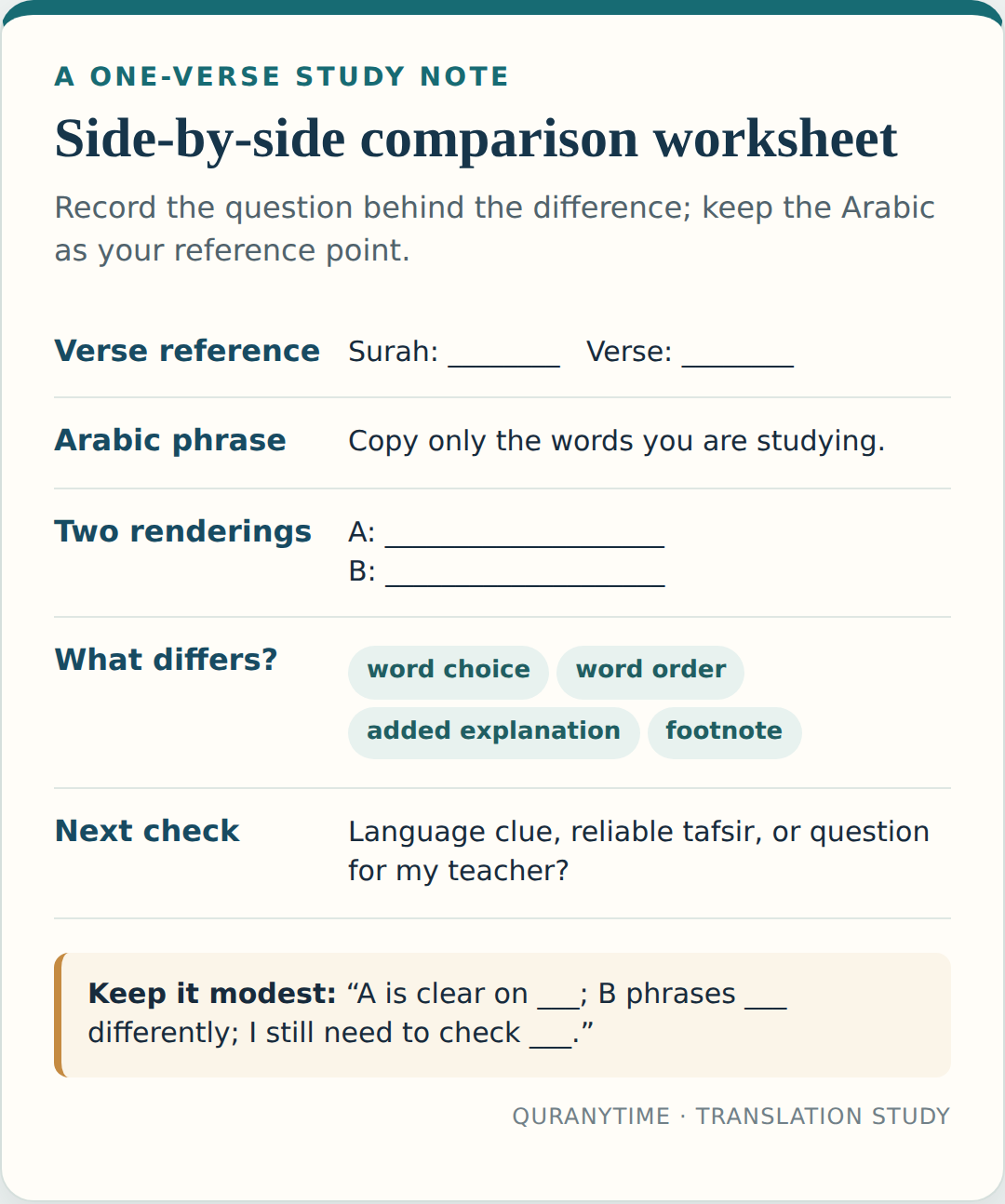
- Compare two renderings. Read one primary version and one cross-check. Circle the difference—order, synonym, addition or note—and summarize it in your own words.
- Check language evidence. Look at the clause, not just a root or gloss. Quranytime’s Quran dictionary workflow returns a lookup to context. For relevant grammar, review Arabic verb patterns in Quranic reading or Arabic case endings. These tools frame questions; they do not replace interpretation.
- Write one cautious note. Record: “A is clear on ___; B phrases ___ differently; I still need to check ___.” Ask a qualified teacher or consult reliable tafsir for syntax or theology.
A recent open-access study compared sentiment labels across the Arabic Quran and seven English translations. Its findings illustrate one limited point: even a specific feature can be difficult to preserve or measure across languages. The study evaluates sentiment-analysis agreement, not the overall quality, correctness or religious authority of any translation, so its results should not be used to rank editions. Read the study on sentiment preservation in Quran translation.
A short example: compare the task, not a winner
For al-Fatihah 1:2, anchor your note to الْحَمْدُ لِلَّهِ. Compare these illustrative phrasings, not quotations attributed to named editions: “Praise belongs to Allah” and “All praise is for Allah.” A useful note is: “Both link praise to Allah. One says ‘belongs to’; the other uses ‘is for’ and ‘all.’ I will check how the notes explain الْحَمْدُ and لِ, rather than assume each English word has its own Arabic token.”
For a grammatical difference, identify the feature first. A particle may add emphasis, a verb form may affect who acts, or a case ending may show how a noun connects. Quranytime’s guide to emphasis particles in the Quran shows why small words matter. A Quranic Arabic vocabulary study plan helps revisit terms; if you remember a phrase but not its location, see how to find a Quran verse from remembered words or meaning.
Keep your conclusion modest: one edition may be easier for your level, or a note may explain a grammatical option. If you cannot verify the difference, write “question for teacher” rather than turning a guess into a definition.
Common comparison mistakes to avoid
- Calling the smoothest English the most accurate. Natural English is valuable, but its fluency cannot by itself settle a language question.
- Calling a more literal line the complete meaning. Close wording can help you see structure, while idiom and context may need explanation.
- Treating brackets as a universal code. Each publisher may use punctuation differently; read that edition’s key.
- Using a translation as a substitute for tafsir. When a question is interpretive, check a reliable commentary and ask a qualified person.
- Comparing too many editions at once. Start with one consistent primary translation and one purposeful cross-check.
Choose a study setup you can sustain
Choose a primary edition with readable English and transparent notes; keep a second for specific questions. A four-column notebook—verse, Arabic phrase, wording difference, open question—helps distinguish style from a point needing closer grammatical or interpretive review.
If you would like a teacher to help you assess your Arabic reading and choose an appropriate next step, you can book your free Quran and Arabic trial class. Bring one short passage and one comparison question; the purpose is to identify what you can already read and what kind of guidance would help.
Compare with a question, not as a contest: keep Arabic as your reference point, identify what each English edition is doing, and mark uncertainty honestly. A primary translation, one cross-check and qualified guidance can clarify study without pretending any English rendering carries every nuance.
Related video
In this discussion, Quran researcher and translator Dr Sohaib Saeed talks through approaches to English translations of the Quran. Use it as a starting conversation about translation choices, not as a replacement for studying a verse with the Arabic and a reliable tafsir.