
Quranic Arabic grammar · beginner guide
Arabic often uses the imperfect verb to talk about the present, but a time word or the situation can also point it toward the future. To make that future meaning explicit, Modern Standard Arabic commonly places the attached marker سـ or the separate word سوف before an imperfect verb. Both are usually translated “will.” Neither requires you to learn a whole new set of verb endings.
This guide shows where each marker belongs, why “سـ means soon and سوف means far away” is not a dependable rule, and how to recognize both forms in Quranic examples.
What does the Arabic future marker do?
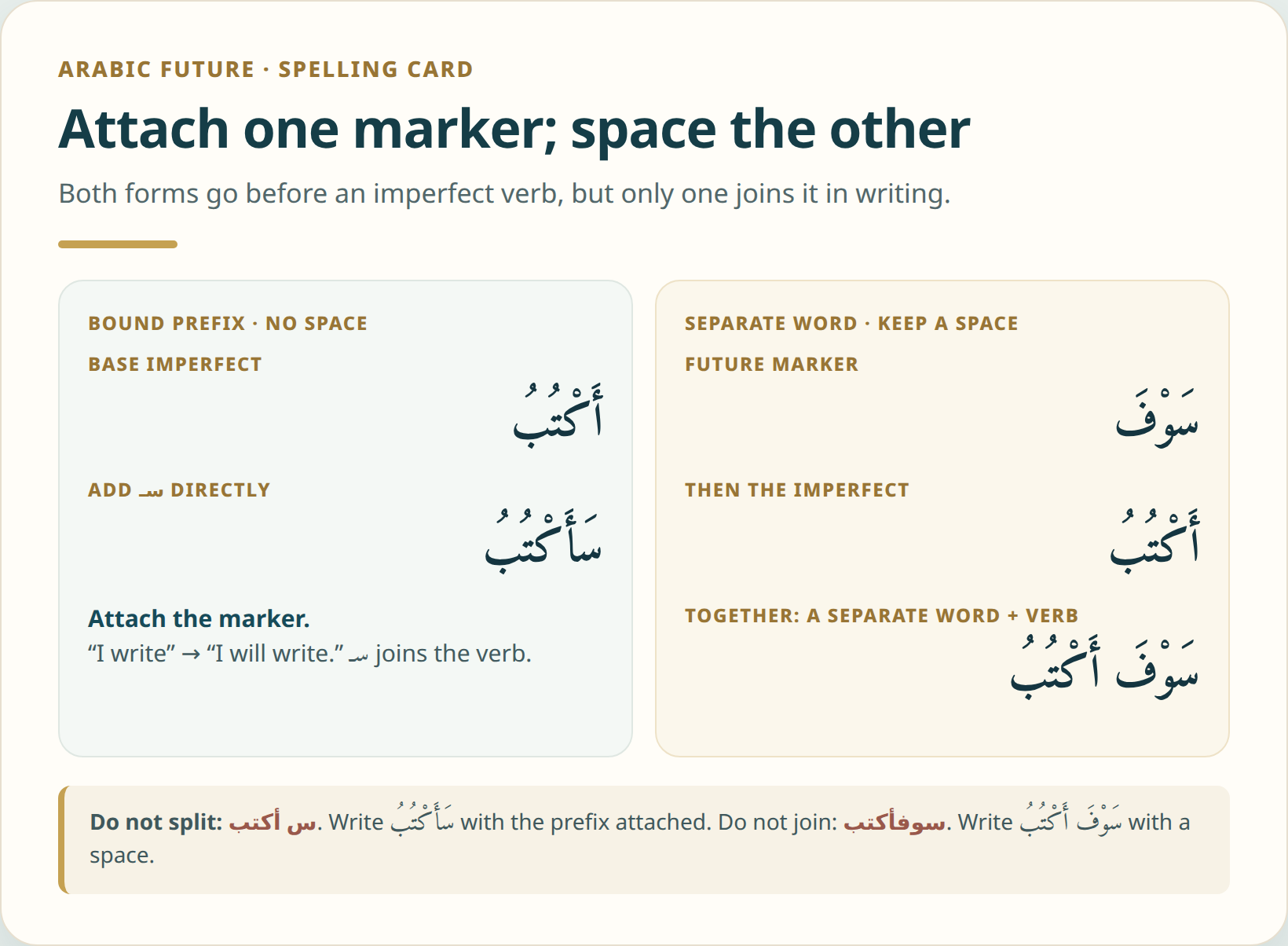
In this lesson, “future marker” means a short form that gives an imperfect verb a future orientation. For example, أَكْتُبُ (ʾaktubu) means “I write” or “I am writing” in a present-time context. Add a future marker and it can mean “I will write”: سَأَكْتُبُ (saʾaktubu) or سَوْفَ أَكْتُبُ (sawfa ʾaktubu).
The verb itself is still an imperfect form. The marker goes before it; it does not replace the verb’s person prefix. If you need a refresher on how Arabic verbs change for different subjects, start with the site’s beginner guide to Arabic verb conjugation. For root-and-pattern forms in Quranic Arabic, see the guide to Arabic verb forms.
سـ attaches; سوف stands alone
The quickest way to choose the spelling is to check whether the marker has a space after it.
- Attach سـ directly to the complete imperfect form. Examples: أَكْتُبُ ← سَأَكْتُبُ (“I write” → “I will write”), نَكْتُبُ ← سَنَكْتُبُ (“we write” → “we will write”), and يَكْتُبُ ← سَيَكْتُبُ (“he writes” → “he will write”).
- Write سوف as a separate word. Examples: سَوْفَ أَكْتُبُ, سَوْفَ نَكْتُبُ, and سَوْفَ يَكْتُبُ.
In سَأَكْتُبُ, the attached سـ comes before the imperfect form أَكْتُبُ; it does not replace its initial hamza. In connected speech, the result sounds like sa-ʾaktubu. By contrast, pronounce سوف as its own word, then say the verb. A sentence still follows ordinary Arabic clause structure; review Arabic verbal sentences and word order if you are also working out how the subject and object fit around a verb.
Do not treat either marker as a verb pattern. A pattern changes the verb stem; سـ and سوف add a future-oriented particle before the imperfect. If you are unsure where a root ends and a pattern begins, a step-by-step guide to using a Quran dictionary can help you check the form.
Does سـ mean “soon” and سوف mean “later”?
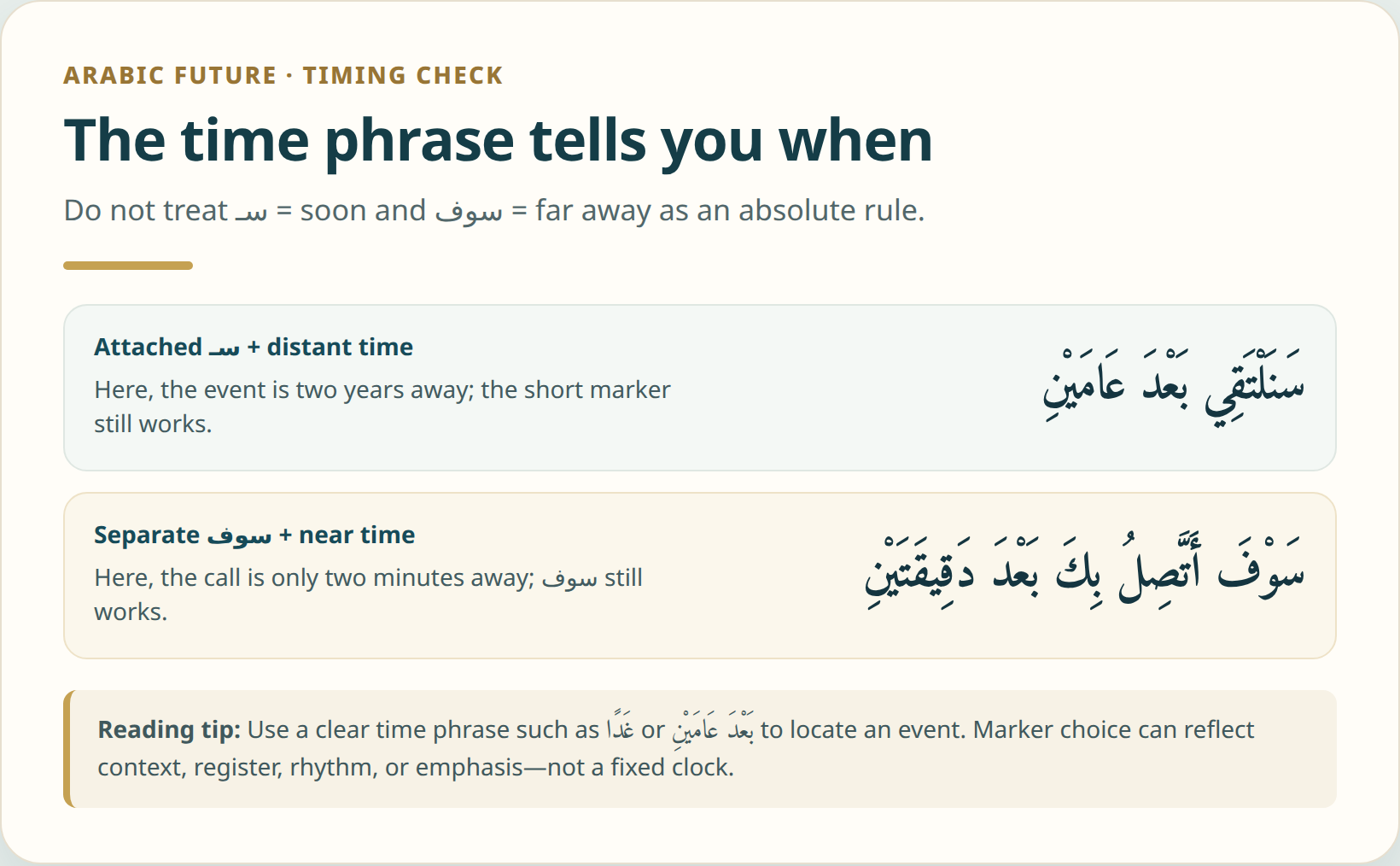
You may see beginner charts that assign سـ to the near future and سوف to a more distant future. Treat that as a rough teaching tendency at most, not a fixed clock. Both forms can appear with time expressions that make an event soon or much later. Writers may also choose between them for rhythm, register, emphasis, or the flow of a sentence.
When the timing matters, state it with a clear time phrase. The examples سَنَلْتَقِي بَعْدَ عَامَيْنِ (“We will meet in two years”) and سَوْفَ أَتَّصِلُ بِكَ بَعْدَ دَقِيقَتَيْنِ (“I will call you in two minutes”) deliberately cross the expected pattern: the attached سـ appears with a distant plan, while سوف appears with a near one. The time phrases بَعْدَ عَامَيْنِ and بَعْدَ دَقِيقَتَيْنِ make the timing clear.
Future meaning can come from context
Arabic does not need سـ or سوف in every sentence about the future. A clear time expression can make the imperfect future-oriented on its own. Compare غَدًا نَلْتَقِي (“Tomorrow we meet / will meet”) with غَدًا سَنَلْتَقِي (“Tomorrow we will meet”). The second version marks the future more explicitly, but the first can be understood from its time phrase and context.
For a reader, this means the verb form alone may not answer “present or future?” Read the whole phrase: look for a time word, a preceding marker, and the surrounding sentence. That broader approach is useful in Quranic reading, where the verb’s form and the surrounding words work together. The site’s guide to Arabic imperative verbs also helps distinguish a future statement from a direct command such as اُكْتُبْ (“write!”).
Recognize the markers in Quranic examples
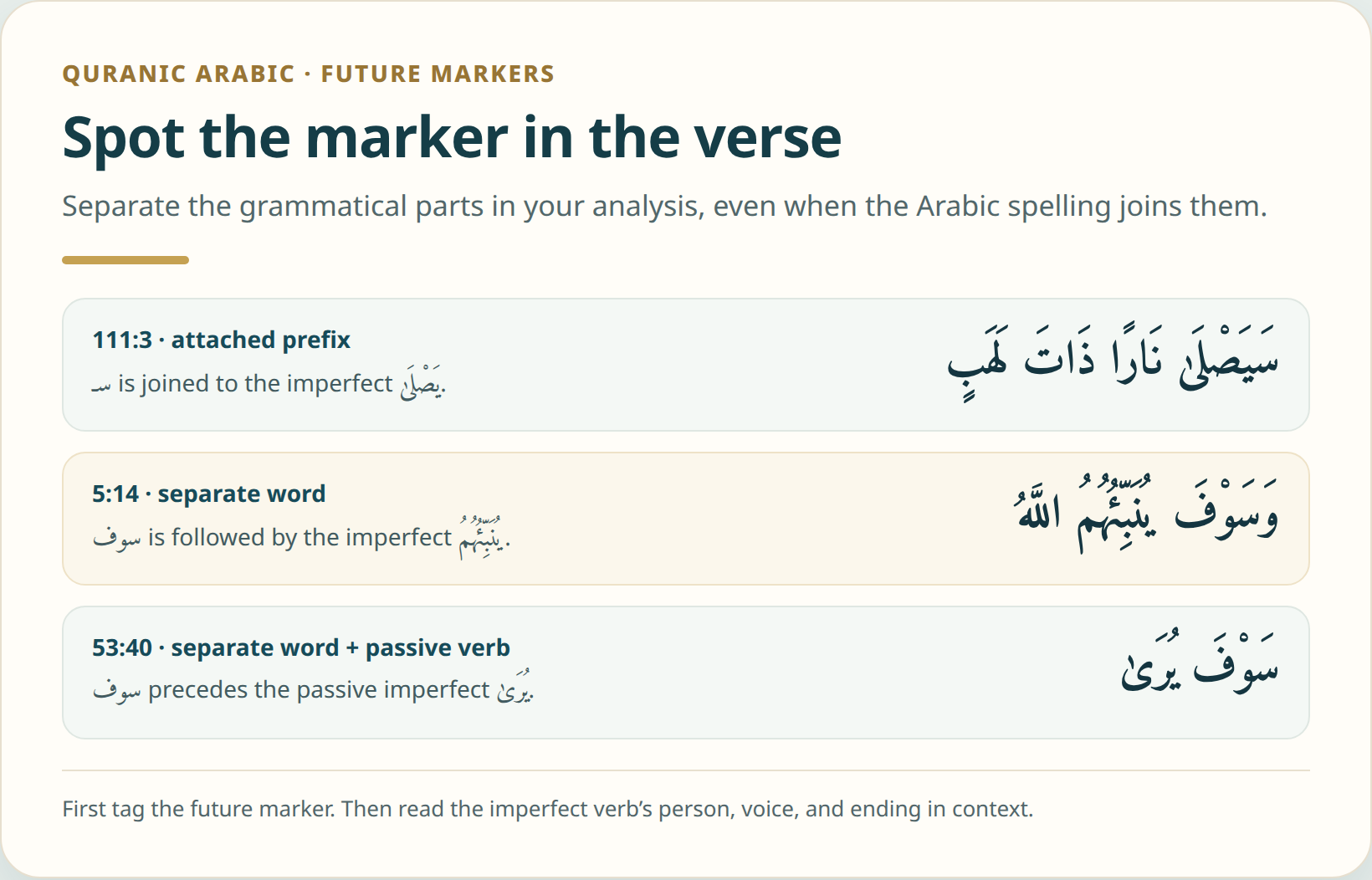
In Quran 111:3, the phrase سَيَصْلَىٰ نَارًا ذَاتَ لَهَبٍ includes سَيَصْلَىٰ. Here, the short marker سـ is joined to the imperfect verb يَصْلَىٰ. A common English rendering is “He will burn in a flaming Fire.” When reading the Arabic, do not split the written word into two separate tokens, even though it is helpful to identify the marker and verb parts for grammar practice.
Quran 5:14 gives a clear example of the other spelling: وَسَوْفَ يُنَبِّئُهُمُ اللَّهُ بِمَا كَانُوا يَصْنَعُونَ. The word سَوْفَ stands apart from يُنَبِّئُهُمُ. The clause means that Allah will inform them of what they used to do. For a neutral word-by-word grammatical analysis of the clause, see the Quranic Arabic Corpus entry for verse 5:14.
A second سوف example appears in Quran 53:40: وَأَنَّ سَعْيَهُۥ سَوْفَ يُرَىٰ, “and that their striving will be seen.” Again, سَوْفَ is a separate word and يُرَىٰ is the imperfect verb. It is passive here, so the marker indicates future orientation while the verb’s passive form carries its own grammatical information. For a focused explanation of that voice contrast, see the Quranic Arabic passive-voice guide.
Watch this short lesson and pause after each example to mark the future particle separately from the imperfect verb. The video uses a live instructor and on-screen Arabic examples.
Do the markers change the verb’s mood?
In ordinary fully inflected Modern Standard Arabic, سـ and سوف are not themselves subjunctive or jussive governors. They normally introduce the imperfect without causing the mood changes associated with other particles. That distinction matters when you hear or read the final vowel, or when you see the special endings of the five verbs. For a deeper account of those endings, review Arabic jussive and subjunctive moods.
Compare a positive future, سَأَكْتُبُ (“I will write”), with the common negative-future pattern لَنْ أَكْتُبَ (“I will not write”). لَنْ is a separate negative particle and typically places the following imperfect in the subjunctive; it does not combine with a future marker as in the incorrect form لَنْ سَأَكْتُبَ. See the site’s Quranic Arabic negation guide for more on لَنْ and other negative particles.
Quick practice: read, write, and explain
- Correct the spacing: س أراجعُ الدرسَ غدًا.
- Correct the spacing: سوفأعودُ بعدَ قليلٍ.
- In سَيَصْلَىٰ, which letters show the marker and which are the imperfect verb?
- Is سـ always the near-future choice and سوف always the distant-future choice?
- Which form expresses negative future: سَأَتَأَخَّرُ or لَنْ أَتَأَخَّرَ?
Answers: Write سَأُرَاجِعُ الدَّرْسَ غَدًا with سـ attached; write سَوْفَ أَعُودُ بَعْدَ قَلِيلٍ with a space; in سَيَصْلَىٰ, سـ is attached to the imperfect يَصْلَىٰ; there is no absolute near/far boundary; and لَنْ أَتَأَخَّرَ is the negative-future form.
Five checks before you read or write
- Identify the target variety. This article uses formal Modern Standard and Quranic Arabic examples, not dialect-specific markers.
- Find the imperfect verb. Look for the subject prefix and stem before deciding what the future marker contributes.
- Check the spacing. Join سـ; leave a space after سوف.
- Use context for timing. Read time expressions such as غدًا and the full sentence, rather than assigning a fixed date to the marker.
- Keep mood and voice separate. Ask whether another particle affects mood and whether the verb is active or passive. A marker of future orientation does not answer those questions by itself.
Want help reading a future-marked verb in context? Bring a verse or sentence to a teacher when you book a free Quran and Arabic trial class. You can practise identifying the marker, the imperfect verb, and any ending that changes its role in the sentence.