
Arabic ordinal numbers tell a reader which person, lesson, verse, or item comes first, second, or third. They are not simply another way to count. Recognizing the difference helps you read Quranic expressions accurately, describe a sequence, and talk about dates or class order. In this guide, you will learn the core forms from “first” to “tenth,” how the ordinal agrees with the noun it describes, and how to distinguish it from a cardinal number in real sentences. The key idea is simple: count with a cardinal; identify position with an ordinal.
Cardinal numbers count; ordinal numbers order
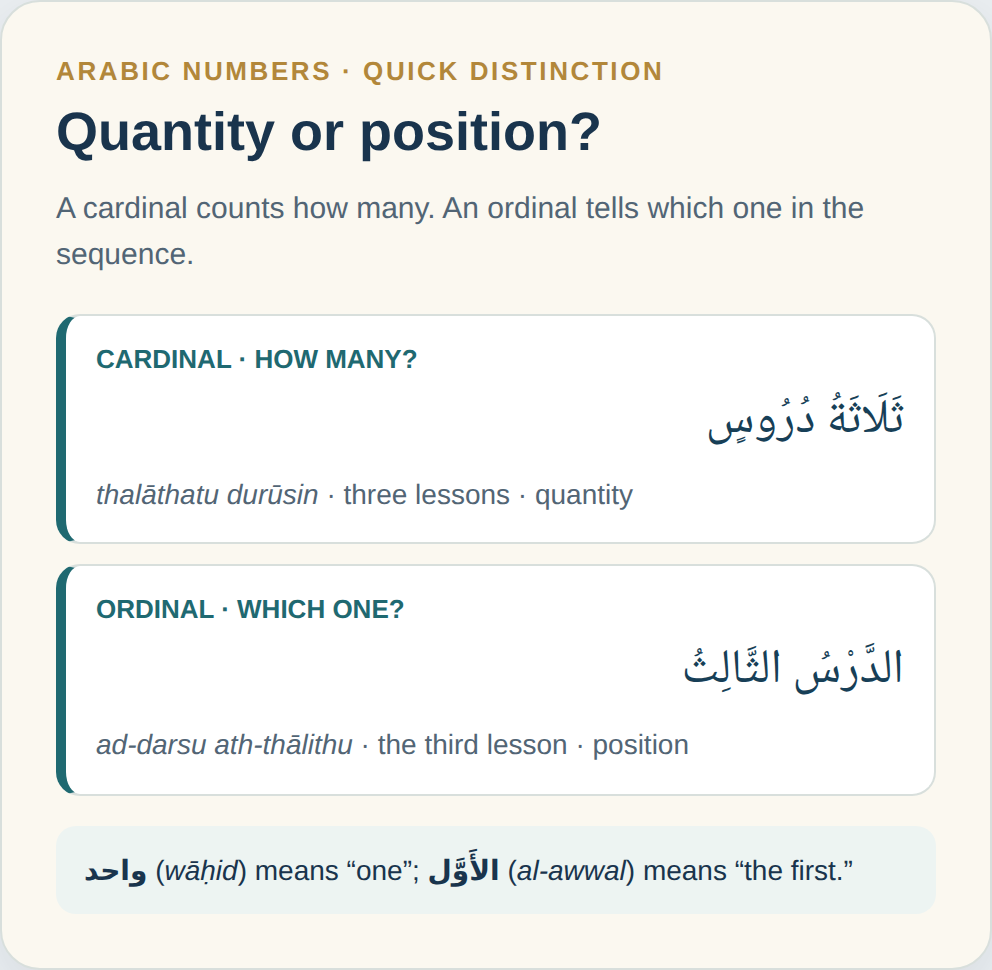
A cardinal answers “how many?” An ordinal answers “which one in the sequence?” In English, three lessons gives a quantity; the third lesson identifies a position. Arabic makes the same distinction. For example, ثَلَاثَةُ دُرُوسٍ (thalāthatu durūsin) means “three lessons,” while الدَّرْسُ الثَّالِثُ (ad-darsu ath-thālithu) means “the third lesson.” The word ثَلَاثَة is a cardinal form; الثَّالِث is an ordinal adjective.
Use the question كَمْ؟ (kam?, “how many?”) to look for a count, and أَيُّ وَاحِدٍ؟ (ayyu wāḥidin?, “which one?”) to look for an order or rank. The noun وَاحِد (wāḥid, “one”) is not the usual ordinal for “first”; the common ordinal is الأَوَّل (al-awwal). If you need a refresher on counting forms, see the Quranytime guide to Arabic numbers from 1 to 100.
Common Arabic ordinal forms: first through tenth
Here are frequently used masculine and feminine forms. The definite article الـ appears in the examples because ordinal adjectives often identify a specific position: “the first,” “the second,” and so on.
| Order | Masculine | Feminine |
|---|---|---|
| 1st | الأَوَّلُ al-awwalu | الأُولَى al-ūlā |
| 2nd | الثَّانِي ath-thānī | الثَّانِيَةُ ath-thāniyatu |
| 3rd | الثَّالِثُ ath-thālithu | الثَّالِثَةُ ath-thālithatu |
| 4th | الرَّابِعُ ar-rābiʿu | الرَّابِعَةُ ar-rābiʿatu |
| 5th | الخَامِسُ al-khāmisu | الخَامِسَةُ al-khāmisatu |
| 6th | السَّادِسُ as-sādisu | السَّادِسَةُ as-sādisatu |
| 7th | السَّابِعُ as-sābiʿu | السَّابِعَةُ as-sābiʿatu |
| 8th | الثَّامِنُ ath-thāminu | الثَّامِنَةُ ath-thāminatu |
| 9th | التَّاسِعُ at-tāsiʿu | التَّاسِعَةُ at-tāsiʿatu |
| 10th | العَاشِرُ al-ʿāshiru | العَاشِرَةُ al-ʿāshiratu |
These are learning forms, not a substitute for reading a fully vocalized sentence. Endings can change with grammatical case, and some forms have spelling or pronunciation details worth learning carefully. For a structured reference, see LibreTexts’ Arabic II section on ordinal numbers, which presents ordinal forms through the twelfth and explains their use as adjectives, including gender agreement and telling time.
After tenth, you will often meet compound forms. A useful pair is الحادي عشر (“the eleventh,” masculine) and الحادية عشرة (“the eleventh,” feminine), as in الدرس الحادي عشر (“the eleventh lesson”) and الصفحة الحادية عشرة (“the eleventh page”). The forms for thirteenth through nineteenth combine an ordinal unit with عشر or عشرة. Learn them attached to a noun, because gender and grammatical position affect the phrase.
You may also see أَوَّلًا، ثَانِيًا، ثَالِثًا when someone lists steps: “firstly, secondly, thirdly.” These are sequence markers in the discourse, not adjectives describing a noun. Compare ثَالِثًا (“thirdly”) with الدَّرْسُ الثَّالِثُ (“the third lesson”); the surrounding words reveal the role.
Make the ordinal agree with its noun
In a basic noun phrase, the ordinal follows the noun and agrees with it in gender. Compare الدَّرْسُ الأَوَّلُ (ad-darsu al-awwalu, “the first lesson”) with السُّورَةُ الأُولَى (as-sūratu al-ūlā, “the first surah”). Since دَرْس is masculine and سُورَة is feminine, the ordinal takes the matching form. A second pair is الفَصْلُ الثَّانِي (“the second chapter/classroom”) and المَرَّةُ الثَّانِيَةُ (“the second time”).
The feminine form of “first,” الأُولَى, is especially useful to notice because it ends in alif maqṣūrah rather than the familiar ة. Do not assume that every feminine word must end in tāʾ marbūṭah. If you want a fuller explanation of noun gender, see Quranytime’s guide to masculine and feminine nouns in Quranic Arabic; for the next step—matching adjectives to nouns—read the guide to Arabic adjective agreement.
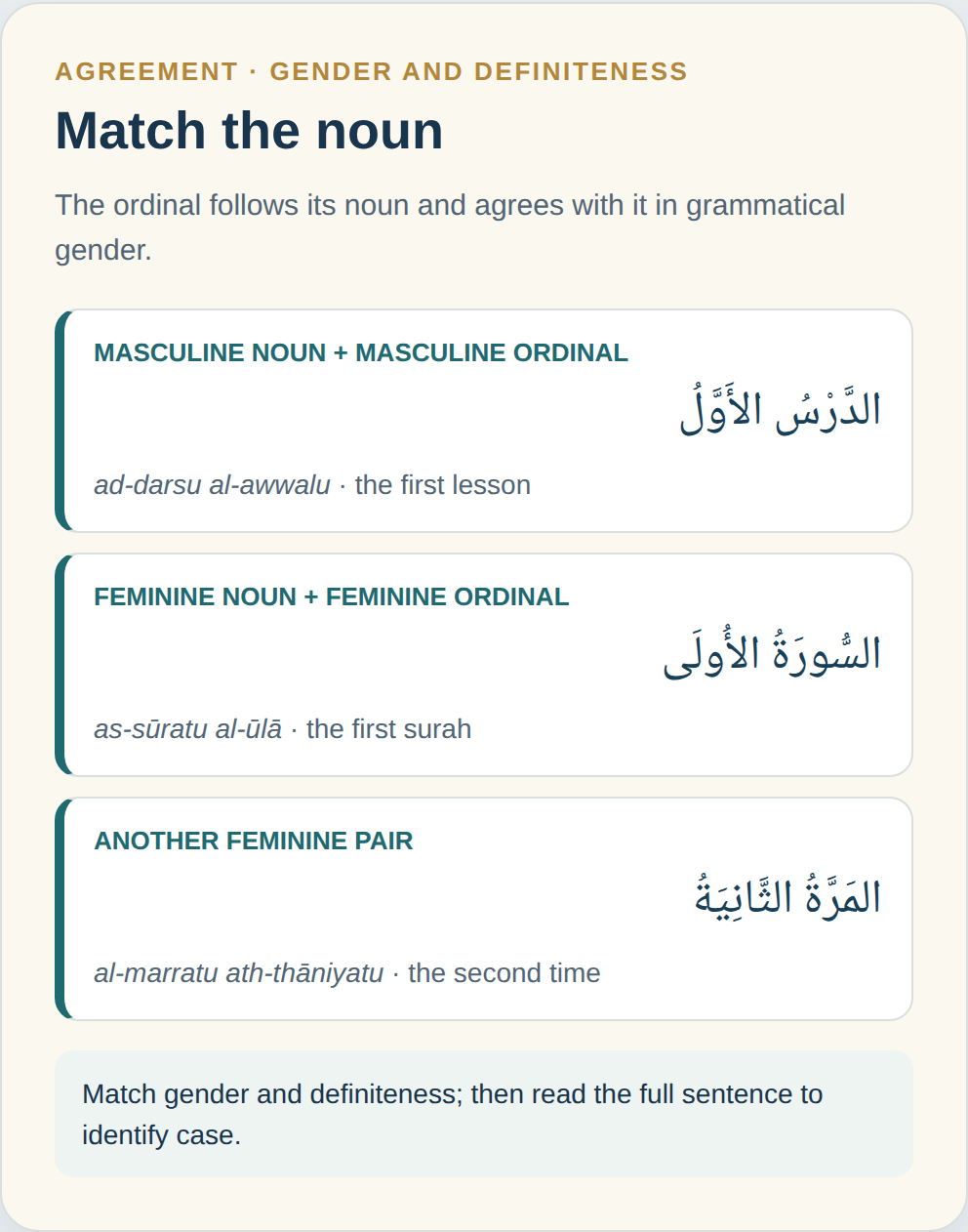
Ordinal adjectives also follow the noun’s definiteness. In الدَّرْسُ الثَّالِثُ (“the third lesson”), both words are definite with الـ. In an indefinite description, the adjective is likewise indefinite: دَرْسٌ ثَالِثٌ can mean “a third lesson” in a suitable context. The exact phrase depends on what you mean: “the third lesson” in a fixed sequence is not the same as “another lesson.” For more practice with definite and indefinite nouns, see maʿrifah and nakirah in Arabic.
Read ordinals in Quranic context
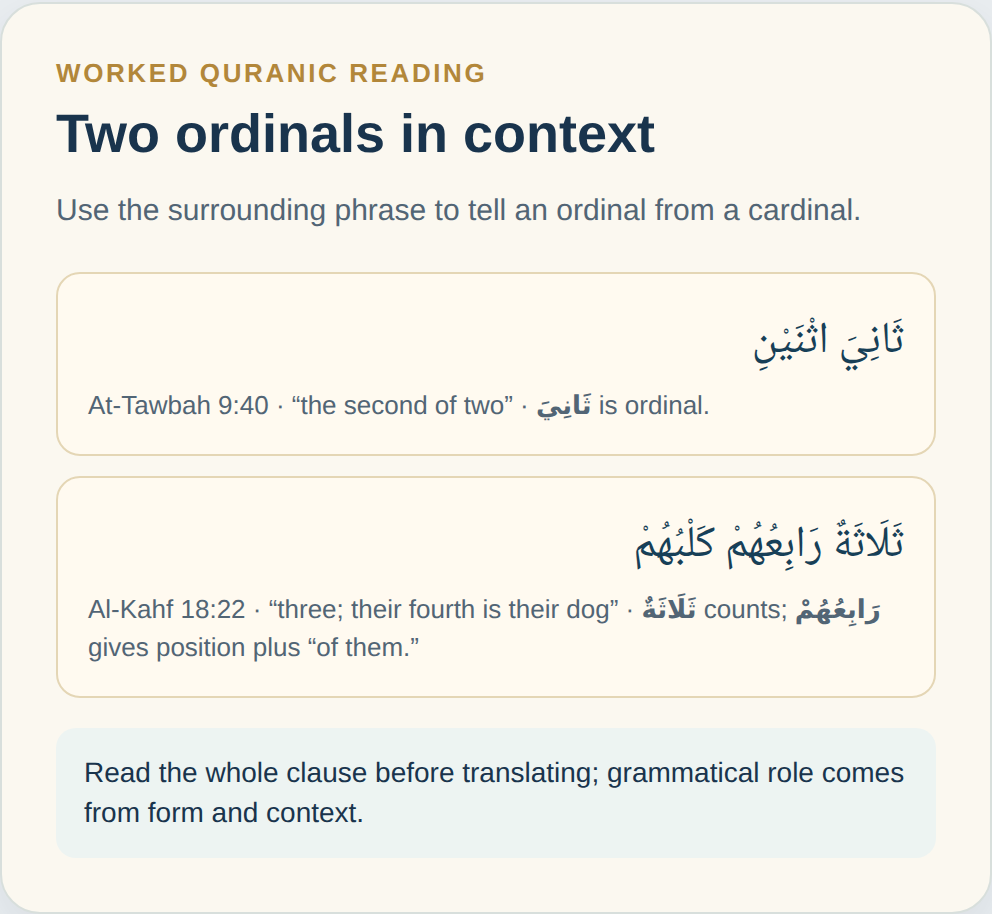
Quranic Arabic gives compact examples in which a number word’s role is clear from its sentence. In At-Tawbah 9:40, the expression ثَانِيَ اثْنَيْنِ (thāniya ithnayn) describes “the second of two.” Here ثَانِيَ is an ordinal form (“second”), while اثْنَيْنِ is the dual form of “two.” The phrase is a useful reminder that an ordinal can identify one member’s position within a pair. Quranytime’s lessons on Arabic dual nouns and Quranic case endings can help you unpack the attached grammar.
Another clear example appears in Al-Kahf 18:22: ثَلَاثَةٌ رَابِعُهُمْ كَلْبُهُمْ (thalāthatun rābiʿuhum kalbuhum), part of a verse reporting what people say about the sleepers of the cave. The first word, ثَلَاثَةٌ, is a cardinal (“three”); رَابِعُهُمْ means “their fourth” or “the fourth of them.” Its base, رَابِع, is an ordinal, and ـهُمْ (-hum, “their/of them”) is an attached pronoun. The verse records differing reports; here we are looking only at the grammar of the expression, not treating the reported count as a lesson in arithmetic.
When you read an ordinal in a verse, first locate the noun or group it describes, then check its form and case in the full clause. A final vowel alone does not tell you whether a word is a noun, adjective, or part of a larger construction. If you are tracing the sentence structure, Quranytime’s overview of Arabic nominal sentences is a useful companion.
Using ordinals in everyday Arabic
Ordinals appear in lessons, pages, floors, turns, and dates. For example, الدَّرْسُ الرَّابِعُ means “the fourth lesson,” and الصَّفْحَةُ الخَامِسَةُ means “the fifth page.” In telling time, an ordinal can name the hour: السَّاعَةُ الثَّالِثَةُ is “three o’clock,” literally “the third hour.” See the Quranytime guide to telling time in Arabic for clock questions and time expressions.
For dates, Arabic usage depends on the date format and whether you are naming a day, month, or sequence. Learn the phrase as a whole rather than mechanically converting every English “-th.” When an ordinal modifies a noun, check the noun’s gender and definiteness. When it appears with a pronoun suffix—as in رَابِعُهُمْ—identify the group the suffix refers to. Then inspect its case ending if the sentence is fully vocalized. These small checks prevent the ordinal from blending into a nearby cardinal number or pronoun.
A quick method for reading an ordinal
When you meet a number word, first underline the noun or group it describes. Next ask, “How many?” or “Which one in order?” to separate a cardinal from an ordinal. Check the noun’s gender and definiteness, then read the full clause to identify case; do not decide from one ending alone. Translate only after you see how the words fit together. In Al-Kahf 18:22, this method marks ثَلَاثَةٌ as a quantity and رَابِعُهُمْ as position plus “of them.”
Common mistakes to avoid
- Using a cardinal for an ordinal: thalātha durūs counts three lessons; ad-darsu ath-thālith identifies the third lesson.
- Using wāḥid for “first” in every situation: وَاحِد means “one”; الأَوَّل is the ordinary ordinal “first.”
- Forgetting feminine agreement: match الثَّانِي with a masculine noun and الثَّانِيَة with a feminine noun.
- Ignoring the noun phrase: ordinals normally follow the noun they describe, and their article/ending reflects the sentence’s grammar.
- Guessing from a suffix alone: in رَابِعُهُمْ, the suffix means “of them/their”; the ordinal meaning comes from the whole word and context.
Arabic ordinals above ten combine familiar parts, but their exact forms can be affected by gender, case, and whether the number is used as an adjective or in a conventional date/time expression. Start with first through tenth, listen to examples, and add larger forms only when you need them. This is more reliable than memorizing a long list without seeing the words attached to nouns.
Quick practice
Identify the highlighted form in each example as cardinal or ordinal, then check the answer.
- الدَّرْسُ الرَّابِعُ — Is ar-rābiʿ a quantity or a position?
- خَمْسَةُ كُتُبٍ — Does khamsatu mean “five” or “fifth”?
- السُّورَةُ الثَّانِيَةُ — Why is the ordinal feminine?
- ثَلَاثَةٌ رَابِعُهُمْ كَلْبُهُمْ — Which word is the cardinal, and which is the ordinal?
Answers: 1) Position: “the fourth lesson.” 2) Quantity: “five books.” 3) سُورَة is grammatically feminine, so its ordinal agrees. 4) ثَلَاثَةٌ is “three,” a cardinal; رَابِعُهُمْ is “their fourth,” an ordinal with an attached pronoun. For structured feedback on your Quranic Arabic reading, you can book a free trial class.
Watch a short Arabic ordinal-number lesson
This concise screen-recorded tutorial, linked from the LibreTexts Arabic II chapter above, demonstrates how Arabic ordinal numbers are formed from cardinal numbers. Follow the on-screen Arabic and digital-whiteboard example, then compare the pattern with the Quranic phrases in this guide.
Ordinal workshop: rebuild the phrase instead of guessing the ending
The useful next step after recognising an ordinal is producing it with a noun. Use this workshop with the first five ordinal forms before attempting large compound numbers. All exercises below are ordinary language examples, not Quran quotations. Read each phrase as a complete unit so that word order, definiteness, and gender remain connected.
Round one: identify what is being ordered
Write three labels on separate cards: lesson, page, and time or occasion. Under each, write its Arabic noun from the examples above. A lesson uses the masculine form دَرْس; a page uses the feminine صَفْحَة; an occasion uses مَرَّة. The English number does not choose the ending. The noun being described helps determine the Arabic form.
Now place the number 1, 2, or 3 beside each noun. Say what the label would mean before writing Arabic. Is the instruction asking for three pages, or page three? If you cannot explain that distinction in plain language, pause before selecting a number form. Otherwise you may produce a grammatically shaped phrase with the wrong meaning.
Round two: fill the gap
- The first page: الصَّفْحَةُ ____
- The third lesson: الدَّرْسُ ____
- The second time: الْمَرَّةُ ____
- The fourth page: الصَّفْحَةُ ____
- The fifth lesson: الدَّرْسُ ____
Answers: 1) الأُولَى. 2) الثَّالِثُ. 3) الثَّانِيَةُ. 4) الرَّابِعَةُ. 5) الْخَامِسُ. These isolated learning phrases use nominative forms where visible; a phrase inside a complete sentence may require another case. Do not treat this answer key as an instruction to keep the same final vowel in every sentence.
Round three: transfer the pattern
Change “the third lesson” to “the third page.” The position remains third, but the noun and ordinal become feminine. Next, change “the first page” to “the first lesson.” Notice the particularly different first forms: الأُولَى and الأَوَّل. Write both changes beside the original phrases rather than erasing the original. Seeing the contrast makes the reason for the change easier to explain.
Use an error label that tells you what to fix
Mark each error as meaning, gender, article, spelling, or case. A learner who chooses “three” instead of “third” needs a meaning distinction. A learner who chooses a masculine ordinal with “page” needs agreement practice. Those are different problems and should not receive the same correction. Ask your teacher to check one complete sentence after you can manage the short phrases; this tests whether the ordinal remains accurate when you must also understand a verb or preposition.
Return to the exercise after a day without rereading the answer key first. Explain one answer aloud. Being able to say why the form fits is a better sign of understanding than recognising a familiar-looking word from yesterday.