
A recipe is a compact reading puzzle: ingredients appear as a list, actions arrive in sequence, and small words tell you how much, how long, and what to do next. You may recognize every food noun and still combine the steps in the wrong order. Reading a recipe therefore gives an Arabic learner a useful goal beyond memorizing vocabulary: reconstruct a process accurately.
This lesson uses a simple invented fruit-salad instruction text in Modern Standard Arabic. It is a language exercise rather than individualized food or dietary advice. Follow normal hygiene, allergy precautions, and age-appropriate supervision in any real kitchen. You can complete the entire lesson with picture cards and an empty bowl if you prefer.
Inspect the page before reading line by line
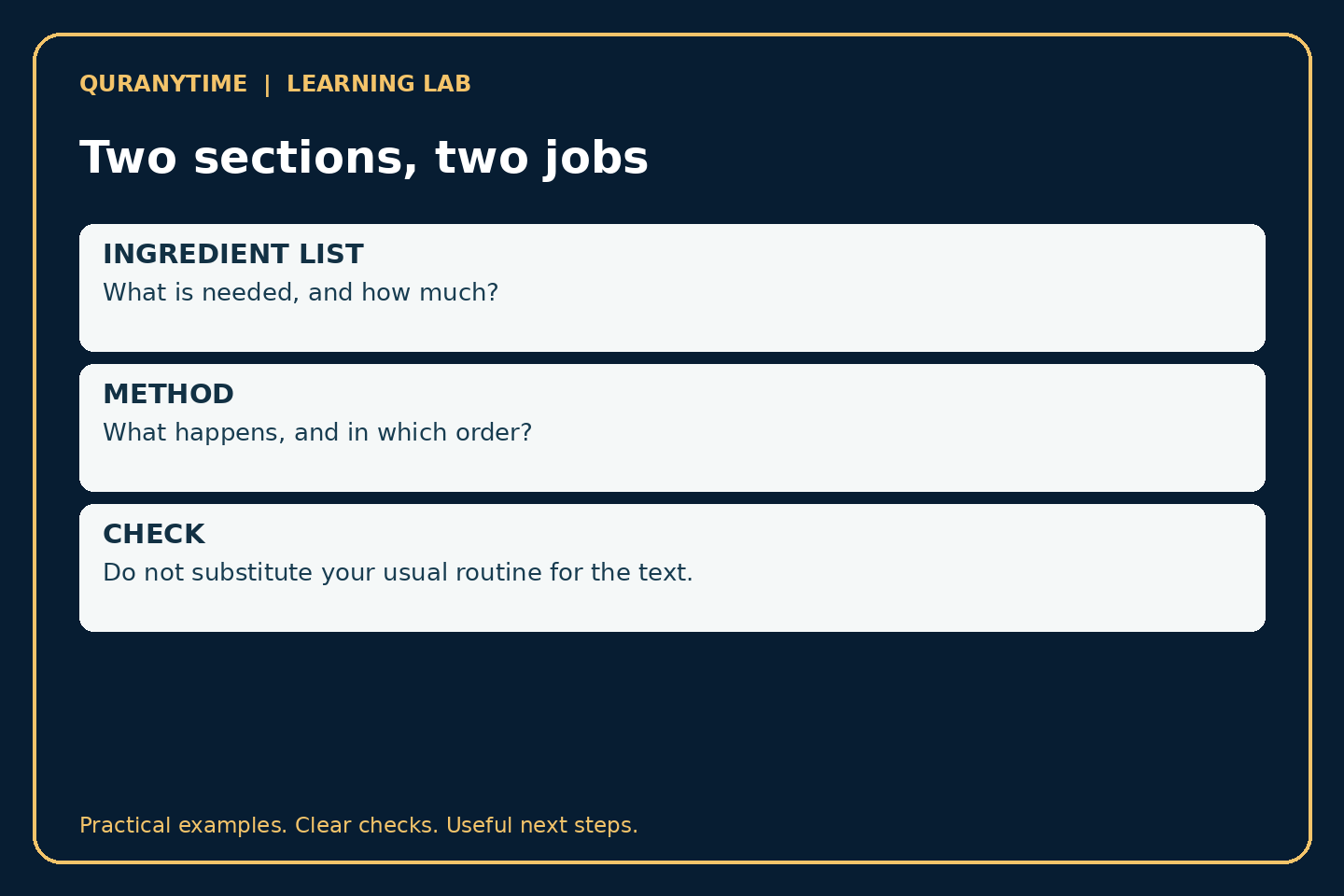
Look for two kinds of information: what is needed and what happens. المكونات means ingredients; الطريقة can introduce the method. A list under the first heading does not usually tell you the action order. A numbered section under the second does. First label those sections, then translate individual items.
Ask yourself what the finished result should be and what tools the instructions assume. Does the text mention a bowl, knife, spoon, or serving dish? A missing tool is a practical comprehension issue even when the vocabulary is familiar. In a classroom, use drawings rather than real sharp tools to discuss the process.
Our food and drinks vocabulary guide supports ingredient recognition. This lesson takes the next step: connecting those nouns to quantities, actions, and sequence. Keep a small vocabulary list beside the recipe, but do not let translating one unfamiliar food word distract you from the overall procedure.
Read the ingredient list as a checklist
Here is the teaching text:
تفاحة واحدة
موزة واحدة
برتقالة واحدة
Meaning: ingredients: one apple, one banana, one orange. These quantities are deliberately simple. The adjective واحدة follows each singular feminine noun in these phrases. Do not generalize this arrangement to every Arabic number expression; larger numbers introduce different agreement patterns.
For broader number work, use our Arabic numbers guide. For the present task, check each ingredient against the list. If you have two apples, you have changed the quantity; the recipe did not suddenly say “two” because your bowl contains two. Reading accurately includes noticing a difference between the text and your materials.
Make three ingredient cards and three quantity cards. Pair them, cover the English labels, and explain each pair. Then remove one item and ask what is missing. This forces you to read the complete list rather than recall the pictures in their original order. You can perform the task without preparing any food.
Identify the action before the object
The method uses these teaching instructions, addressed in the masculine singular imperative:
قشّر الموزة والبرتقالة.
قطّع الفاكهة إلى قطع صغيرة.
ضع الفاكهة في وعاء.
اخلط الفاكهة برفق.
قدّم سلطة الفاكهة.
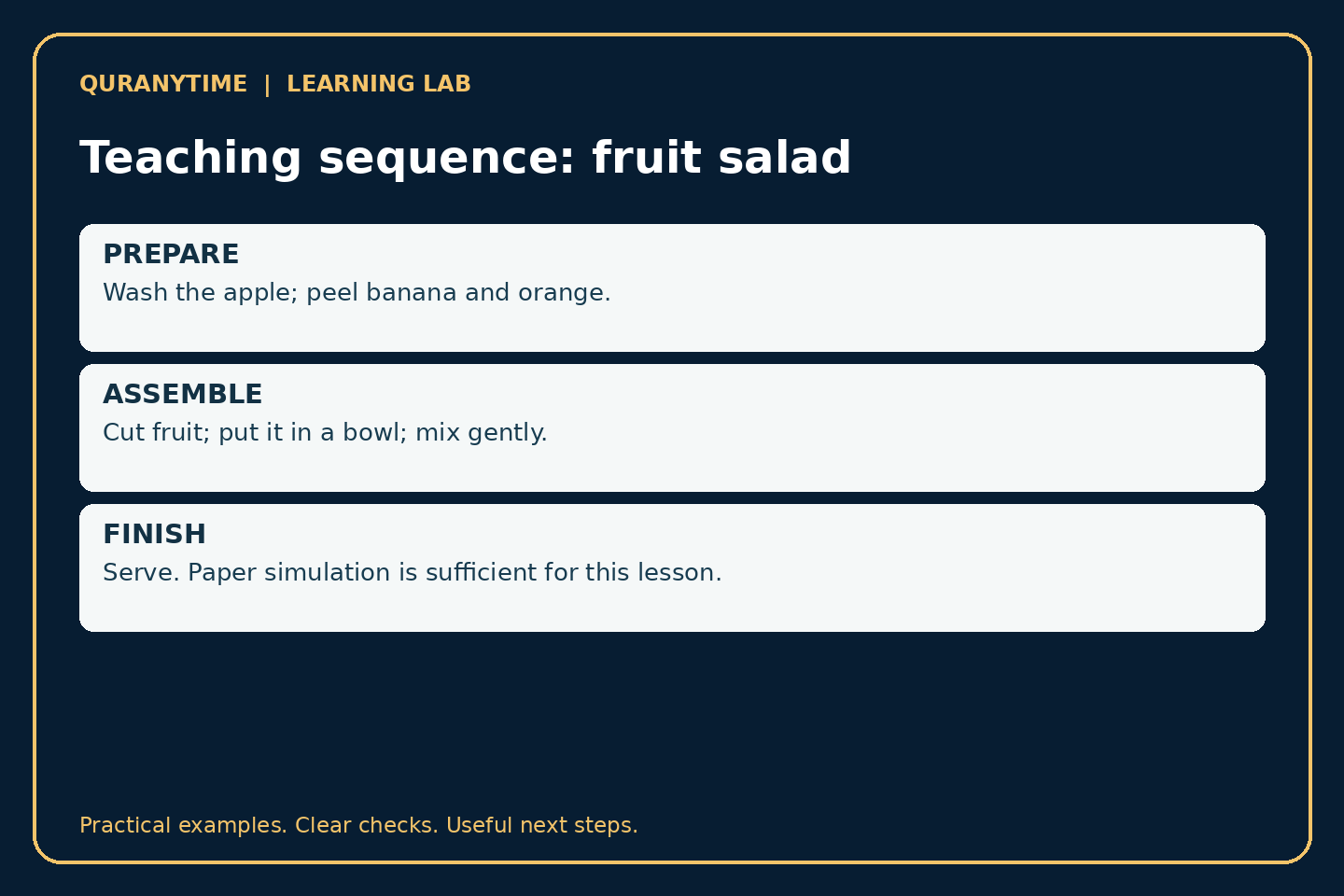
Meaning: Wash the apple. Peel the banana and orange. Cut the fruit into small pieces. Put the fruit in a bowl. Mix the fruit gently. Serve the fruit salad. The model is intentionally short and omits detailed kitchen technique; use appropriate adult supervision and established safe practice if doing it physically.
Circle the first word of each instruction. These are the action words. Then underline the object: what is washed, peeled, cut, placed, mixed, or served? Our Arabic imperative lesson explains the instruction form. Address forms change when speaking to a female learner or a group, so do not treat this one version as a universal command form.
Action-card check
Give a learner the six action cards in a shuffled order. Ask them to match each to a sketch. Washing is not peeling, and mixing is not serving. If two cards are confused, compare those actions directly before returning to the full sequence. A smaller accurate contrast is more useful than racing through six uncertain guesses.
Follow sequence words rather than the pictures alone
Now expand the method with sequence signals: أولًا — first; ثم — then; أخيرًا — finally. أولًا، اغسل التفاحة. ثم قشّر الموزة والبرتقالة. أخيرًا، قدّم سلطة الفاكهة. These signals organize a text, but they do not replace the missing middle steps. A shortened demonstration should be labeled as a summary rather than presented as a complete recipe.
Our Arabic conjunctions lesson helps you distinguish connectors. For this task, pay special attention to whether the writer is joining items or moving the process forward. The و in الموزة والبرتقالة joins two objects; it does not mean you have reached a separate numbered stage.
Ask a partner to reorder the steps deliberately. Can you explain which order becomes awkward and why? Putting uncut fruit in a bowl is possible, but serving before preparing the fruit does not match this method. Reason from the actual text and process rather than claiming every kitchen action has only one possible sequence.
Catch details in prepositional phrases
في وعاء means in a bowl. إلى قطع صغيرة means into small pieces. These short phrases carry practical information beyond the action verb. If you stop reading after ضع الفاكهة — put the fruit — you still do not know where the fruit should go.
Our Arabic prepositions guide gives further examples. Create a two-column annotation: action plus detail. For ضع الفاكهة في وعاء, write “put the fruit” in the first column and “in a bowl” in the second. For اخلط الفاكهة برفق, the detail is “gently.” Not every detail is a place; some describe manner, amount, or duration.
Later recipes may include حتى — until — followed by a result or condition. Do not guess that any such phrase means “for five minutes.” A time and a condition are different instructions. If the vocabulary or technique is unfamiliar, use a beginner text with a clear checked translation rather than improvising a real preparation.
Understand reference words
A longer method may mention an ingredient once and then refer to it with a pronoun. Beginners often look for the full noun in every sentence and become lost when it disappears. Start by drawing an arrow from each pronoun to the item it refers to, with teacher help.
Our Arabic attached-pronouns guide provides a foundation for recognizing attached forms, though a pronoun’s function depends on its grammatical setting. Do not label every attached pronoun “possessive” when it is serving another role. Ask what the form refers to and what job it is doing in that sentence.
For an early recipe lesson, repeated nouns are acceptable. The aim is not to make every beginner text stylistically elegant. Once the process is secure, compare the repeated-noun version with a teacher-checked pronoun version. You can then see what becomes shorter and what new tracking work the reader must do.
Try a reconstruction exercise
Read these English action summaries, then number them according to the Arabic method above: serve; wash the apple; put the fruit in a bowl; peel the banana and orange; mix gently; cut into small pieces. The correct sequence is wash, peel, cut, put, mix, serve.
Next answer without looking at the English: Which fruit is explicitly washed in this simplified text? Which two are peeled? Where does the fruit go? How is it mixed? Answers: the apple; banana and orange; into a bowl; gently. This exercise checks details rather than rewarding a general memory that the page is about fruit salad.
Finally, identify one thing the teaching text does not specify. Possible answers include serving size, exact piece dimensions, storage instructions, and a complete hygiene procedure. Recognizing missing information is part of careful reading. Do not invent those details and attribute them to the Arabic.
A false-friend exercise about familiarity
Imagine you already make fruit salad a different way. Read the method again and list only what this text says, even when your usual method differs. Familiar tasks can tempt readers to substitute prior habits for written instructions. Comparing “my routine” and “this text” makes that tendency visible.
Now create a harmless paper-only process, such as arranging colored cards. Write three Arabic instructions with known verbs and have a partner follow them. If the partner must ask where a card goes, revise the missing place phrase. This transfers the reading lesson into a writing test of your own clarity.
Teach the lesson to a child without making it a vocabulary test
Give the child one role: ingredient checker, step organizer, or instruction reader. Change roles on another day. Asking a young learner to manage new vocabulary, reading aloud, spelling, quantities, and real kitchen actions simultaneously can hide what they actually understand.
Use picture cards first, then reveal the Arabic. Ask the child to justify a choice by pointing to a word. “Because I remember the picture” is a useful starting point, but the next goal is “because this word says bowl.” Keep the language target small enough that the child experiences a real, identifiable success.
If reading aloud is slow, separate silent comprehension from oral performance. A learner may understand the action before being able to pronounce the sentence fluently. Our Arabic letter forms guide can support decoding, while a teacher can check pronunciation. Do not treat speed as the sole measure of comprehension.
Use a missing-step test
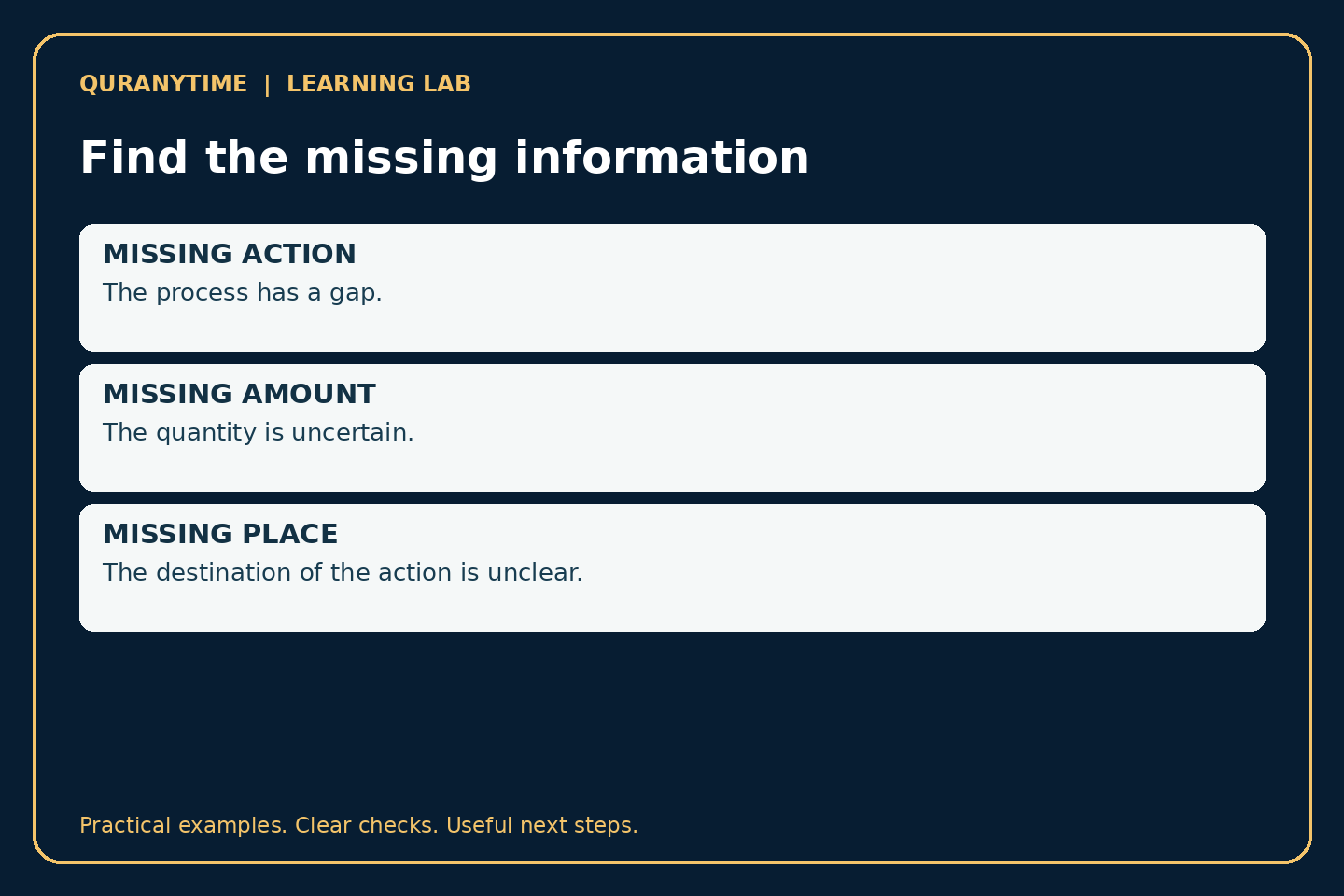
Remove one instruction from the method and ask the learner what gap appears. If the cutting step disappears, the text moves from whole peeled fruit to placing it in a bowl without specifying the smaller pieces. The learner should identify the missing action rather than supply an elaborate new recipe. Return the original checked sentence and read the sequence again.
Now remove a quantity instead. The process remains understandable, but the ingredient amount becomes uncertain. This comparison shows that different omissions create different problems. A missing action affects the procedure; a missing amount affects preparation; a missing place phrase affects where an action happens.
For a writing extension, give the learner three picture cards and ask for one instruction per card. A partner should follow only what is written in a paper simulation. If the partner asks a reasonable clarification, treat that as feedback on the text rather than disobedience. Revise the instruction and try again. The exercise turns reading awareness into clearer Arabic writing without requiring advanced vocabulary or a real kitchen.
Build your next reading challenge deliberately
Choose a second procedural text that adds only one new feature: a short duration, one new quantity, or a pronoun reference. Keep the other language familiar. If every ingredient and verb is new, it becomes difficult to tell what caused the misunderstanding. A controlled progression gives you better evidence about what to practise.
Keep a process notebook with the original text, your ordered action list, and two questions. Ask a teacher to check the questions before attempting unfamiliar real-world instructions. Recipes can be enjoyable reading material, but the underlying skill is broader: accurately following a sequence with objects, quantities, and conditions.
For a lesson built around your level, Book a Free Trial Class. Bring this short text or a simple recipe you have permission to use. Ask to work on the parts you find hardest—action words, order, quantities, or pronoun reference—so the lesson produces a skill you can apply to the next set of instructions.