
A Quranic Arabic corpus is a searchable language resource that helps you investigate words in the Quran: where a form appears, what grammatical tags are attached to it, and how related forms may be grouped. It is not a translation engine, a dictionary of final meanings, or a substitute for tafsir. The useful habit is to begin with a precise question, search the field that matches it, and return to the complete verse before writing a gloss.
This guide shows a careful, beginner-friendly way to use corpus tools without turning a root, a search count, or one English gloss into a claim about every occurrence. It focuses on the workflow—choosing a query, comparing results, and recording what is still uncertain—rather than on any one translation.
What can a Quranic Arabic corpus help you answer?
A printed dictionary usually starts from a headword and explains a range of meanings. A corpus lets you examine language in its texts: a word in its verse, its morphological analysis, or other occurrences that match a chosen feature. The Quranic Arabic Corpus, for example, separates word-by-word analysis, a Quran dictionary, verb concordance, lemma frequency, morphological search, and syntactic treebank tools. Each view answers a different question.
Use a word-by-word view when you are trying to understand one token in one ayah. Use a concordance or occurrence list when you want to compare a form or lemma across passages. Use a morphology search when your question is about a root, lemma, stem, part of speech, or verb form. For a lexical lookup, a Quran dictionary guide can help you understand why a headword and a verse-specific sense are not always the same thing.
A corpus label is evidence to inspect, not a complete interpretation. If the result marks a word as a noun or a particular verb form, that tells you something about its grammatical analysis; it does not automatically settle how the whole phrase should be translated. Keep your question narrow, and read the surrounding words.
Choose the question before choosing a search
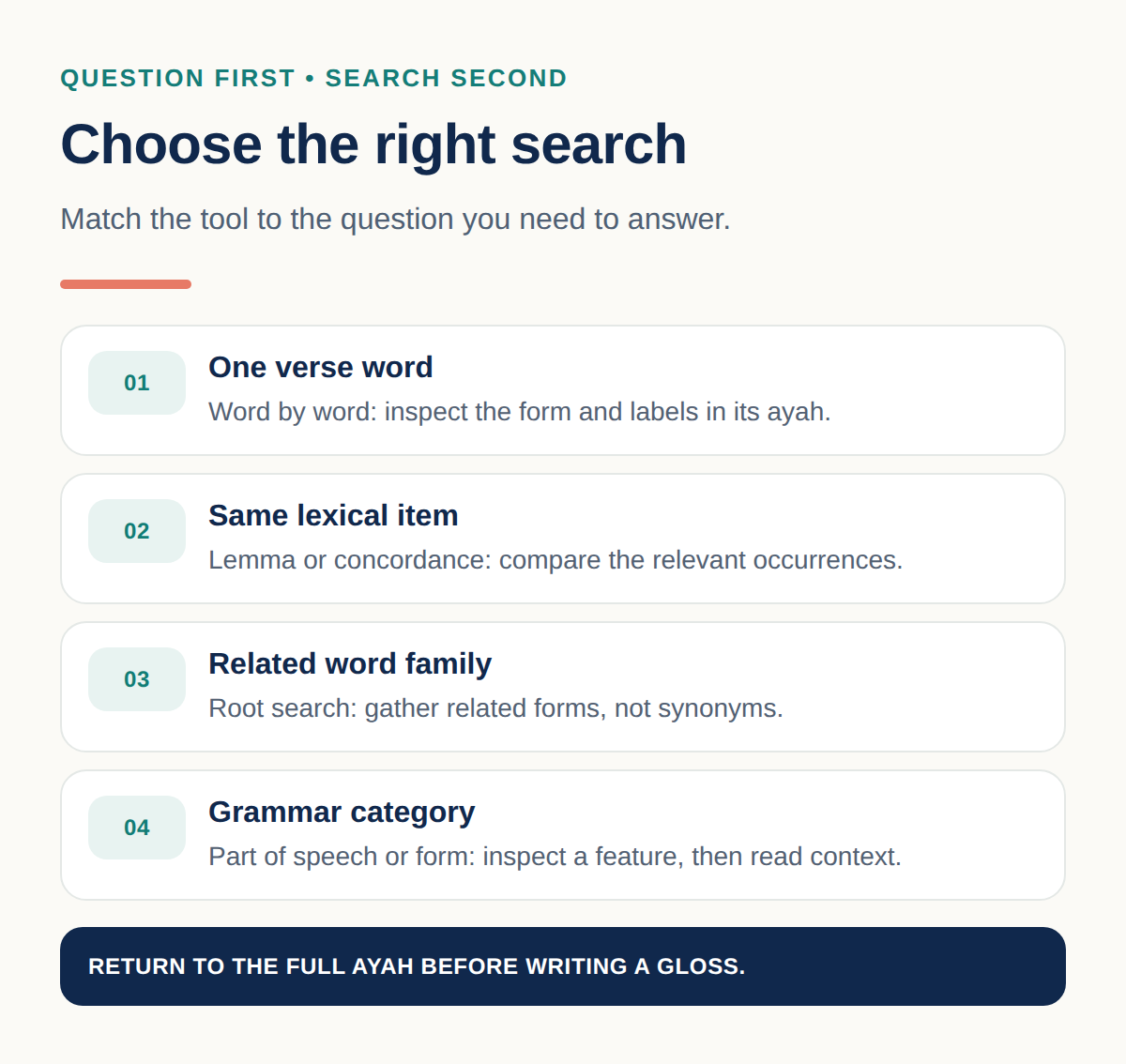
Before entering Arabic letters, finish this sentence: “I want to find…” If you want to inspect one word where you are reading now, go to that verse’s word-by-word analysis. If you want to see all occurrences of a lexical item, choose a lemma-oriented search or frequency/concordance view. If you want related derived forms, a root query is more appropriate. If you are studying a grammatical pattern, filter by part of speech or a morphology feature.
These are not interchangeable searches. A root query can gather forms that share a consonantal root but differ in pattern and function. A lemma query aims at one lexical item and may require the correct vowelization. A stem query can find an unvowelled base, but may return forms whose endings or context differ. Decide whether you need one verse, one headword, a root family, or a grammar pattern before you interpret a result.
Root, lemma, stem, and grammar are different fields
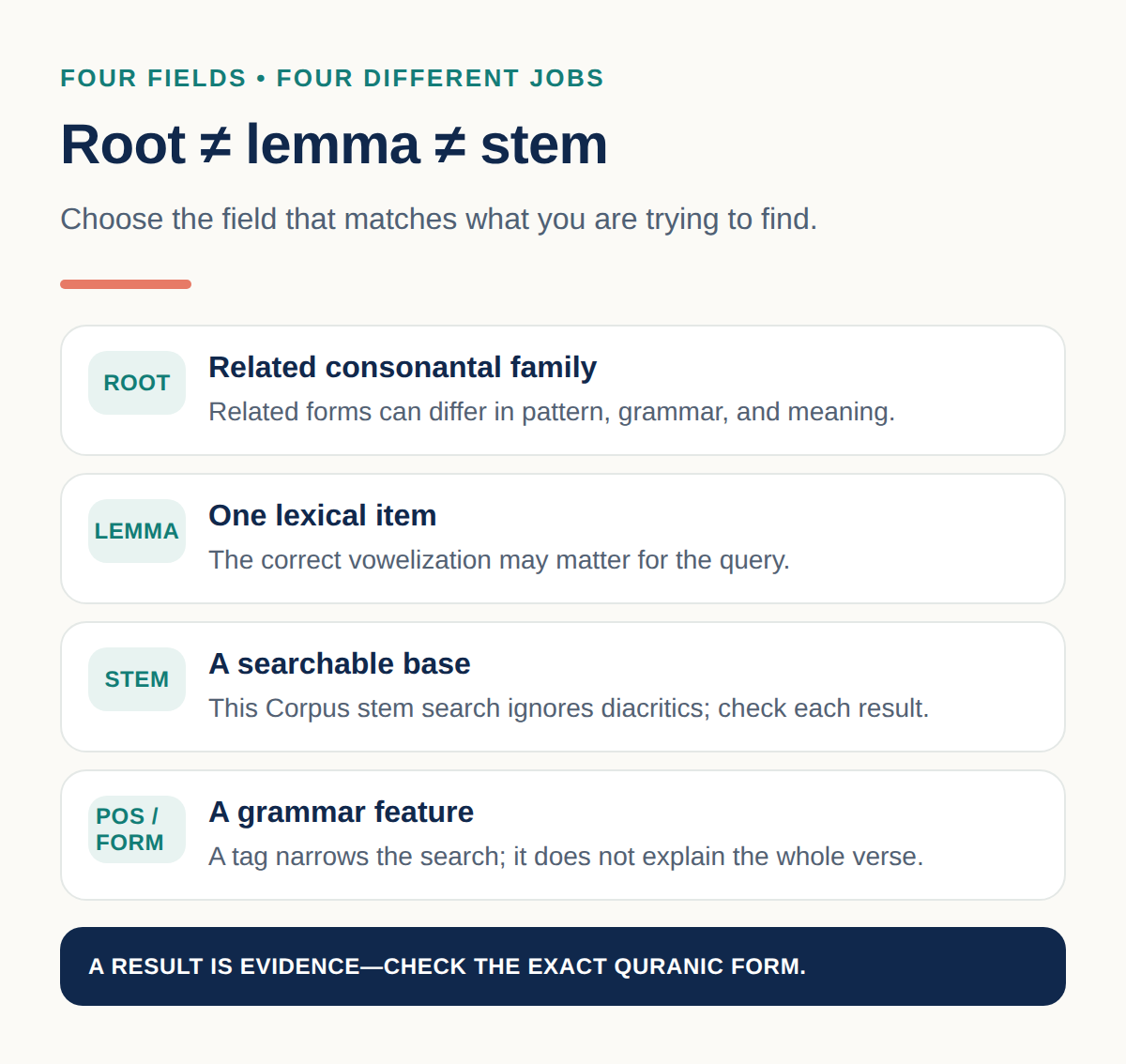
Root: a root groups words built from a shared consonantal base. It is useful for exploring a word family, but related words are not automatically synonyms. A root can help you ask a better question; it cannot replace checking the exact form and its sentence.
Lemma: a lemma is the corpus’s lexical headword for a form. It can help gather occurrences of the same lexical item even when the surface form changes. The Quranic Arabic Corpus notes that a lemma search requires knowing its correct vowelization, so do not copy a guessed spelling into that field and treat a blank result as proof the word is absent.
Stem: a stem query is useful when you want to search a base without typing every diacritic. The Corpus’s example says its stem search ignores diacritics. That can widen your results, so check the Arabic form returned for each occurrence. Part of speech and verb form are different again: they narrow a search by grammatical category or pattern rather than by meaning.
The Corpus’s Morphological Search page lists filters for part of speech, verb form, root, lemma, and stem, with examples of root, lemma, and stem queries. It notes that roots can be entered in Arabic or Buckwalter transliteration and gives “ktAb” as a stem example. For a wider foundation in how roots and patterns work, see Quranytime’s guide to Quranic Arabic roots and patterns.
A five-step routine for one Quranic Arabic word
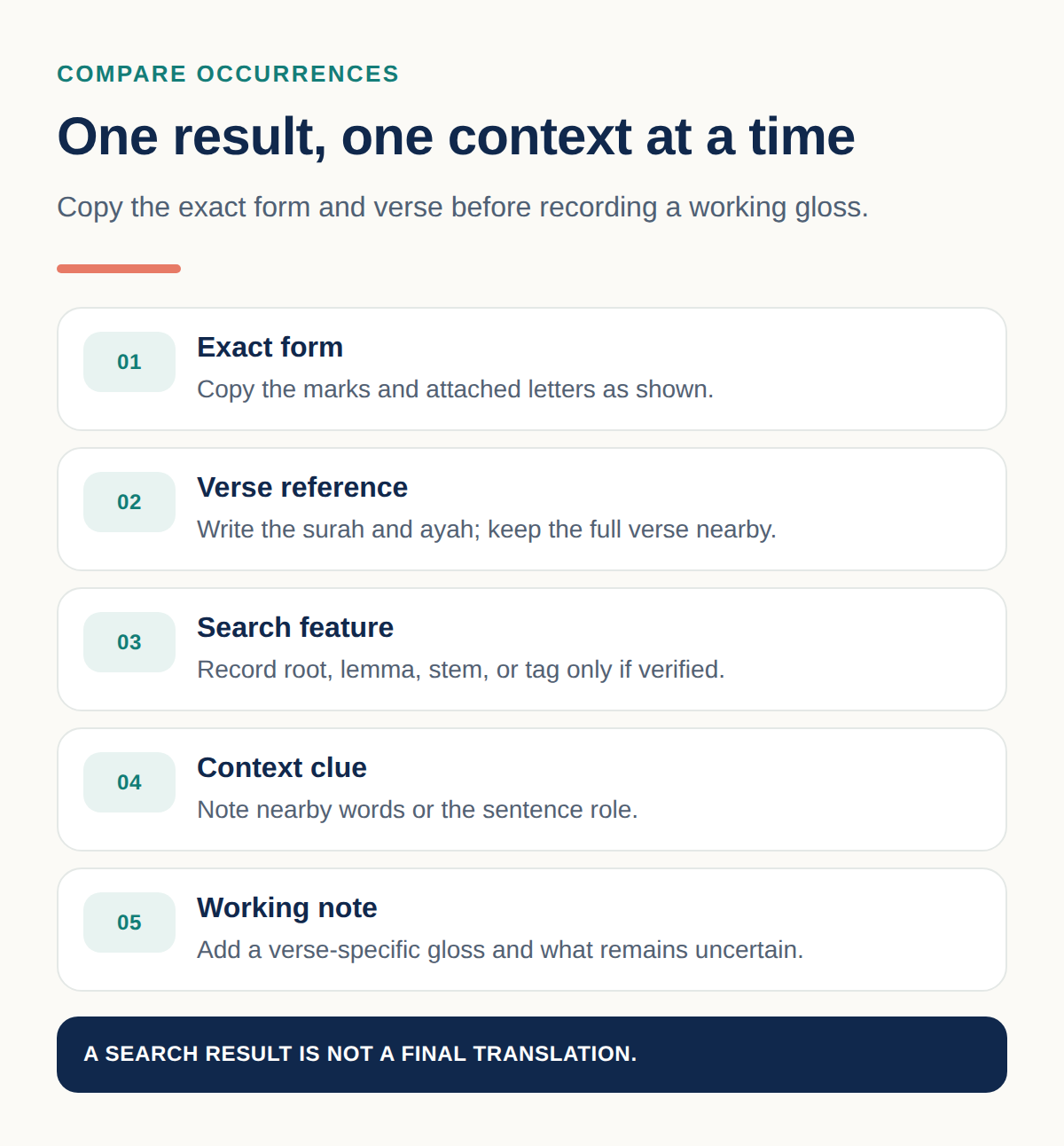
- Write the question. For example: “What grammatical label is attached to this token?” “Where else does this lemma occur?” or “Which forms share this root?” A specific question keeps you from browsing without a purpose.
- Record the location and exact form. Copy the surah and ayah, then copy the word as printed, including visible marks and attached prefixes or suffixes. Do not replace it with a root before recording what you actually saw. A verse-first word-by-word approach helps you keep the phrase intact.
- Choose the matching view. Use word-by-word analysis for the token in its ayah. Use a lemma or occurrence view for repeated lexical items. Use a root query for a family of derived forms. Use part of speech or a verb-form filter when the grammatical category is the question.
- Compare more than one result. Open a small set of occurrences and read each complete verse, not just the highlighted word or one-line gloss. Notice changes in endings, attached material, nearby prepositions, and the phrase’s role. If the sentence structure is still unclear, use a separate step-by-step sentence parsing method rather than asking a root search to explain syntax.
- Write a cautious result. Note the verified form or tag, the verse-specific working gloss, the clue that supports it, and one question you have not resolved. If you are unsure, mark it “to verify” and ask a qualified teacher or consult reliable tafsir; uncertainty is better than inventing an answer.
See the corpus display in action
The short screen recording below shows how the Corpus’s word-by-word view, syntax graph, concordance, Quran dictionary, search, and frequency tools fit together. It is an English-language interface tour, not a substitute for the careful query-and-context steps above; pause on the panel that matches your question.
Compare occurrences without forcing one gloss
Suppose you search a form connected to the stem “ktAb.” The next step is not to write “this word always means X.” Copy each exact result, its ayah, and the surrounding phrase. Then ask what stays similar and what changes: is the grammatical label the same? Is the form inflected or attached to another element? Does a nearby word change the relationship? Does the translation use a different English phrase?
Choose a few occurrences that help answer your question, not every result in a long list. Keep the original context visible; a word’s relation to the rest of the sentence may matter more than its frequency count. If two forms share a root but differ in pattern, treat them as related evidence—not as identical words. The goal is a better-supported reading of this verse, not a universal gloss that erases context.
Use this small comparison record: exact Arabic form; surah and ayah; root, lemma, or stem only if verified; part-of-speech or morphology tag; a few surrounding words; your working gloss for this occurrence; and the clue that supports it. Add “not sure” beside anything you have not checked. A verse-first vocabulary notebook can help you keep that record separate from a final translation or interpretation.
After the search, read the whole passage again without staring at the result table. Try to explain what you can now recognize, and what remains uncertain. Then test comprehension in context using Quranytime’s Arabic reading-comprehension practice; keep the corpus as a reference tool, not a replacement for reading.
A simple ten-minute corpus practice session
- Minute 1: choose one ayah you are already studying and write one concrete question.
- Minutes 2–4: inspect the word in the verse and select the matching corpus view or morphology field.
- Minutes 5–7: compare a few results, checking exact forms and full verse contexts.
- Minutes 8–9: write one cautious, verse-specific note and one unresolved question.
- Minute 10: close the reference and say what you learned; mark what you need to verify next.
Keep the session small. If you collect a long list of forms, choose only one or two to revisit and schedule the rest for later. Quranytime’s beginner Quranic Arabic vocabulary study plan can help organize that longer routine. If you need a guided path that connects vocabulary, morphology, and reading, see the Quranic Arabic learning path.
Common mistakes to avoid
- Searching the wrong field: a root search is not the same as a lemma search, and neither is the same as inspecting one token in one verse.
- Assuming a shared root means a shared translation: related forms can have different patterns, grammar, and context.
- Ignoring vowel marks: some searches depend on exact vowelization; check the reference’s instructions instead of guessing.
- Reading only a count or gloss: use the occurrence list to return to full ayahs and compare what is actually there.
- Treating corpus labels as tafsir: morphology supports grammatical study, but it does not independently settle every interpretive question.
Use a corpus to make your questions more precise: identify a form, compare contexts, and record evidence without claiming more than the search shows. If you would like a teacher to help you choose a level and check your next steps, book your free trial class.