
The dua for entering the masjid is short and easy to carry into daily life. In the wording recorded in Sahih Muslim, the Prophet Muhammad ﷺ taught a person entering the mosque to say: Allahumma iftah li abwaba rahmatik—“O Allah, open for me the doors of Your mercy.” The same report gives a separate supplication for leaving. The Arabic, transliteration, translation and hadith context are set out below, followed by practical memorization guidance and answers to common questions.
The dua for entering the masjid
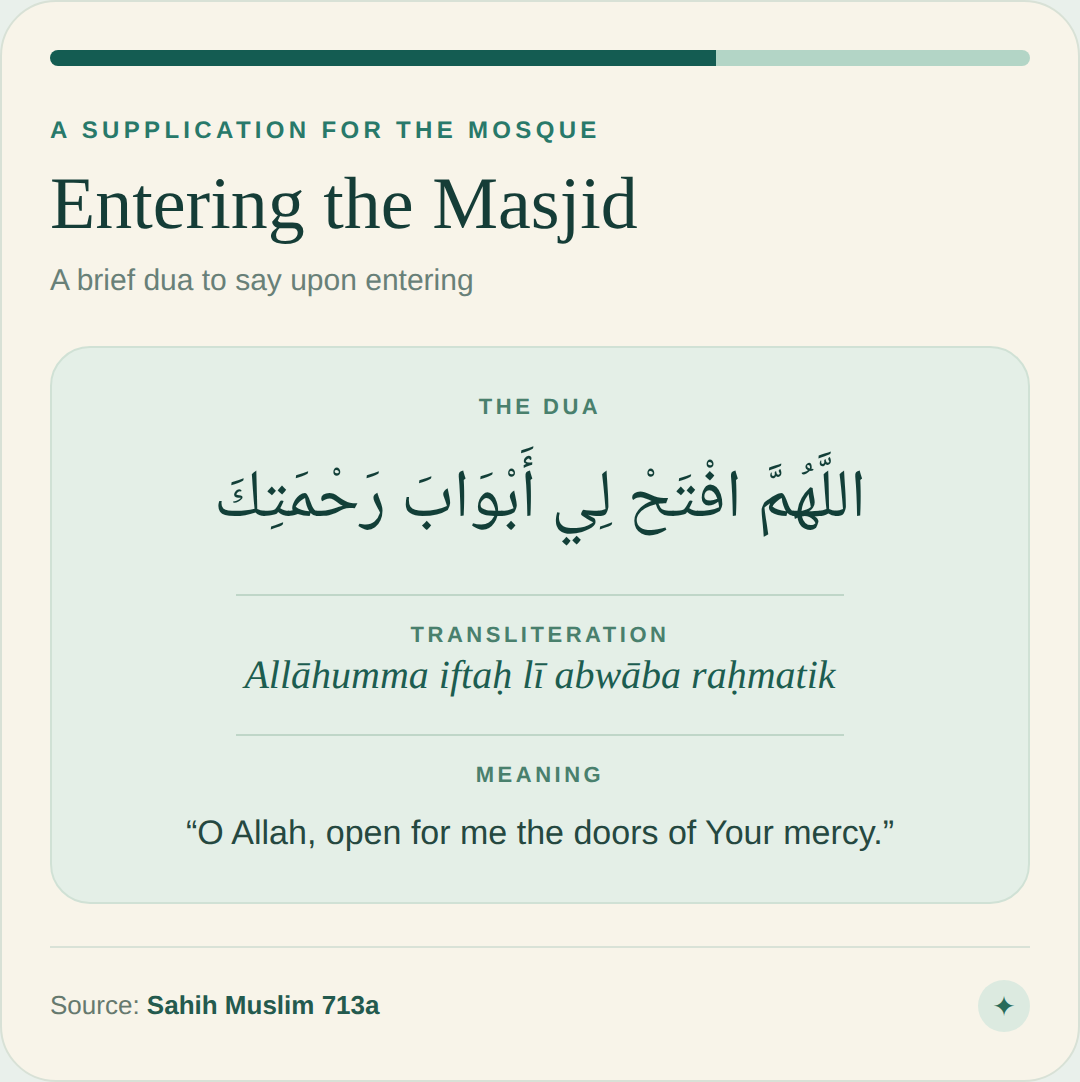
اللَّهُمَّ افْتَحْ لِي أَبْوَابَ رَحْمَتِكَ
Transliteration: Allāhumma iftaḥ lī abwāba raḥmatika.
Simple pronunciation: Al-laa-hum-maf-tah lee ab-waa-ba rah-ma-ti-ka.
Meaning: “O Allah, open for me the doors of Your mercy.”
This is the entry wording in Sahih Muslim 713a. Its Arabic verb is iftaḥ (“open”), followed by lī (“for me”), abwāba (“doors/gates”), and raḥmatika (“Your mercy”). Transliterations vary in how they mark long vowels and the emphatic consonant ḥ; those spelling differences do not create a different supplication. [1]
Hadith context: what is narrated, and what is a separate version?
Sahih Muslim places the report in “The Book of Prayer – Travellers,” under the chapter “What to say when entering the masjid.” Abu Usaid reports the Prophet ﷺ saying that when one enters the mosque, one should say, “O Allah, open for me the doors of Your mercy,” and when one steps out, “O Allah, I beg of Thee Thy Grace.” Muslim’s Arabic text identifies the entry supplication as اللَّهُمَّ افْتَحْ لِي أَبْوَابَ رَحْمَتِكَ and the exit wording as اللَّهُمَّ إِنِّي أَسْأَلُكَ مِنْ فَضْلِكَ. This is a concise report about what to say at the two thresholds, not a long prescribed ceremony. [1]
The Arabic chains in both Muslim 713a and its parallel report 713b indicate uncertainty between Abu Humayd and Abu Usaid, although the English renderings name Abu Usaid. The report’s point remains the separate entry and exit words. [1] [2]
A separate report in Sunan Ibn Majah 772 says: when entering, send peace and blessings upon the Prophet ﷺ, then say “Allahumma iftah li abwaba rahmatika.” The report’s sequence includes an added phrase that is not part of the short wording quoted in Sahih Muslim 713a. IslamQA also notes reports that add “Bismillah” and blessings upon the Prophet ﷺ, citing al-Tirmidhi and Ibn Majah and noting al-Albani’s grading in Sahih Ibn Majah. These are additional reported formulations; do not merge them into a single quotation and label the whole combined text “the wording of Sahih Muslim.” [3] [4]
For a simple practice grounded in the primary Sahih Muslim text, learn that report’s short wording first. If you follow an expanded narration, keep its extra words clearly identified as that narration. The important distinction is source accuracy, not turning one permissible wording into a test of someone else’s practice.
Meaning: asking for mercy at the mosque’s entrance
The dua asks Allah to open “the doors of Your mercy” for the person entering. It is a request for divine mercy, not a claim that the physical doorway itself has a guaranteed special effect, nor a promise that reciting the words produces a particular worldly outcome. The wording directs attention toward Allah as the giver of mercy as one enters a place of worship.
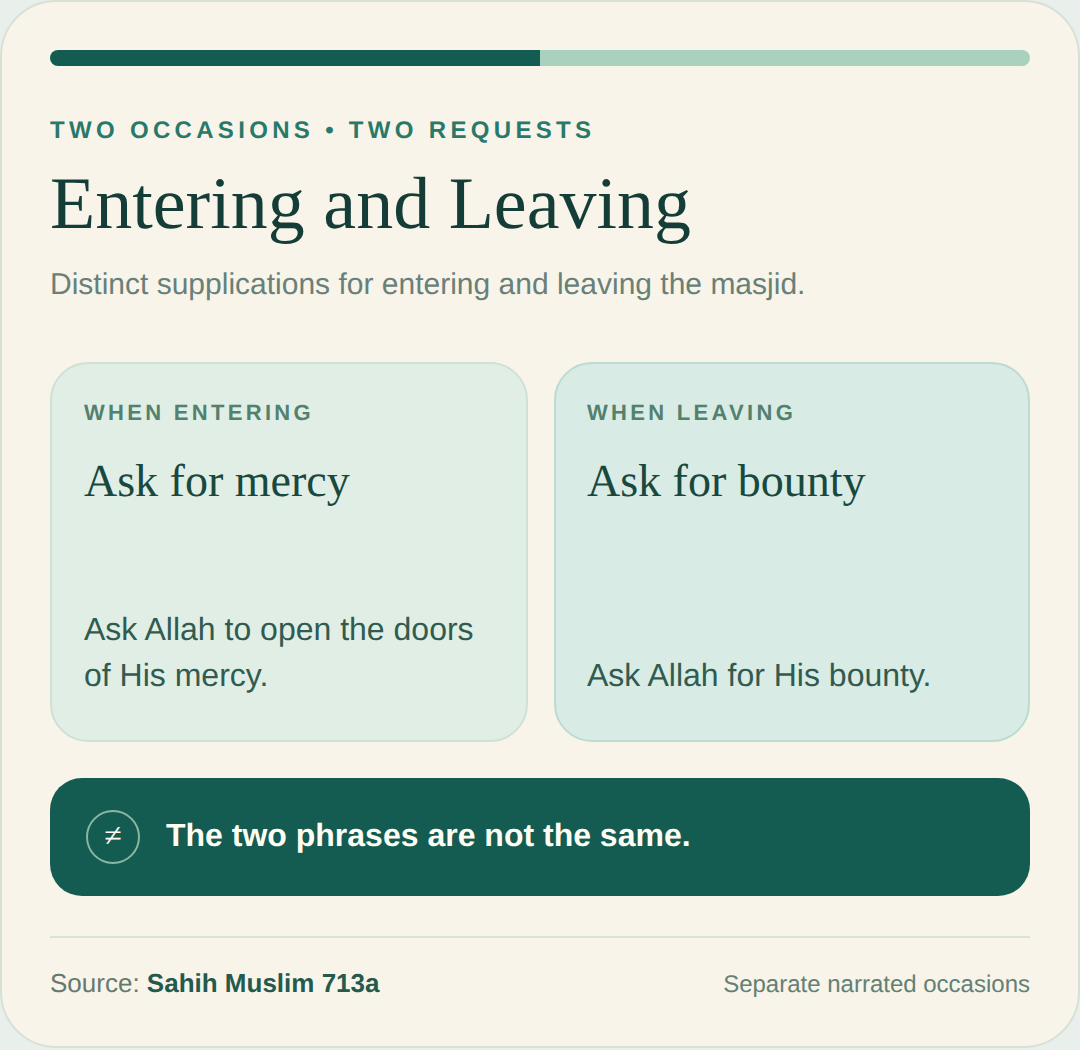
Muslim’s same narration pairs the entry request with a request for Allah’s bounty on departure: Allahumma inni as’aluka min faḍlika—“O Allah, I ask You for Your bounty.” The contrast is memorable: mercy at entry and bounty when leaving. That association can help recall the pair, but it should not obscure that the two phrases are distinct and each belongs to its own moment. [1]
How to memorize it without rushing
Break the Arabic into four spoken units: Allāhumma | iftaḥ lī | abwāba | raḥmatika. Read the Arabic while listening to a reliable reciter or teacher, then repeat one unit at a time. Join two units, and finally say the complete dua from memory. The phrase is brief, but careful repetition is more useful than racing through it or relying only on a romanized spelling.
Connect each unit to its meaning: “O Allah | open for me | the doors | of Your mercy.” That way, remembering the words also recalls what you are asking. If you are learning Arabic script, review the letter forms and vowel marks with Quranytime’s guide to the Arabic writing system. For guided repetition, its listen–pause–check audio practice offers a useful general method; it is a study technique, not a prescribed devotional sequence.
Try recalling the phrase once before arriving at the mosque, then again at the door. A small cue—seeing the entrance—can help build recall. If you stumble, pause and try again calmly. The point is to learn and say the supplication, not to make the entrance stressful. For other approaches to building steady recall, see Quranytime’s chunking guide and its practical article on memorizing Arabic letters.
Entering with respect: relevant etiquette without inventing rules
IslamQA’s answer on mosque etiquette cites the Sunnah of entering with the right foot first and mentions the dua reported in Muslim 713. The same answer discusses other matters—including a greeting prayer, voice level and conduct—but those are separate topics, not words inside this dua. Its broad answer also addresses a particular question about women; readers should not mistake every point in that answer for a universal condition attached to reciting the supplication. [4]
In a shared prayer space, ordinary consideration matters: avoid disturbing people who are praying or listening, and follow the mosque’s posted arrangements. If you have a specific question about what to do when the congregational prayer is starting, or about a particular circumstance, consult a qualified local scholar rather than inferring a ruling from a short devotional text. This article does not make the dua a condition of entering, prayer, or acceptance.
The supplication should not be confused with wudu rules. If you are unsure about ablution before prayer, Quranytime’s overview of common cases that break wudu addresses that separate question.
Small pronunciation notes
For readers who do not yet read Arabic, transliteration is a bridge rather than a perfect substitute for the script. In Allāhumma, the doubled “m” represents a held consonant; in iftaḥ, the final letter is ḥāʾ, a breathy sound made deeper in the throat than English “h.” In raḥmatika, the same letter appears again. It is fine to work on these sounds over time instead of expecting a new learner to produce them flawlessly at once.
The written phrase is continuous: Allāhumma iftaḥ lī abwāba raḥmatika. When spoken, words may link smoothly, especially around Allāhumma iftaḥ, but learners can first pronounce each part clearly. A teacher can help refine articulation; avoid inventing a melodic tune or treating one English approximation as a sacred, uniquely correct accent. Quranytime’s pronunciation guide for English speakers is a broader learning resource, not a source for the hadith wording.
When the entrance is busy
People often enter a mosque while someone else is praying, while the congregational prayer is beginning, or while carrying children or belongings. The hadith gives a concise verbal remembrance, not a requirement to stop in a doorway or obstruct other worshippers. Make room for people to pass, observe the local entrance arrangement, and say the dua quietly in a way that does not disrupt others. If you remember the words only after stepping inside, there is no reason in the cited report to turn the moment into a source of anxiety.
Some mosques have separate entrances or particular procedures for footwear and prayer areas. Those arrangements vary by building; follow clear signs and ask the mosque’s staff if uncertain. These practical courtesies are not additional clauses in the prophetic dua. Keeping the difference clear helps answer the question readers actually have—what to recite—without presenting local customs as universal religious wording.
How the exit phrase differs
The departure supplication is sometimes printed beside the entry words on a small card, which can make them easy to mix up. The key contrast in Muslim’s report is raḥmatika (“Your mercy”) on entering and faḍlika (“Your bounty”) when leaving. One asks Allah for His mercy at the beginning of the visit; the other asks His bounty on departure. Practising them as a pair may help recall the sequence, but do not substitute one for the other or attach the exit words to the entry text.
There is also a distinction between this brief threshold remembrance and longer prayers said at other times. The dua is not the prayer for setting out from home, and it is not the congregational prayer itself. IslamQA’s answer cites a narration about a supplication for going out toward the mosque, and separately cites the entry and exit words from Muslim. A reader looking for the travel supplication should consult that distinct report rather than expanding the short mosque-entry text with unrelated phrases. [4]
Sharing the dua with a new learner
If a child or a new Muslim asks what the words mean, begin with the request rather than a long list of rules: “We are asking Allah to open the doors of His mercy.” Read the Arabic together, then let the learner repeat a short part at a comfortable pace. An adult can model the phrase without correcting every sound at once. A small card with Arabic on one side and the meaning on the other can make review easier between visits.
As confidence grows, ask the learner to explain the meaning in their own words and distinguish it from the request made when leaving. Listen together to a reliable teacher if possible; a transliteration can help at first, but different spellings cannot convey every Arabic sound. These are learning suggestions, not a required method, special number of repetitions, or additional words in the hadith. A welcoming, patient approach helps the mosque feel like a place to learn as well as worship.
Frequently asked questions
What is the exact dua for entering the masjid?
The Sahih Muslim 713a wording is اللَّهُمَّ افْتَحْ لِي أَبْوَابَ رَحْمَتِكَ — Allāhumma iftaḥ lī abwāba raḥmatika — “O Allah, open for me the doors of Your mercy.” [1]
Is it “abwāba rahmatika” or “abwāb rahmatika”?
In a connected pronunciation, the Arabic text is commonly transliterated abwāba raḥmatika: the long vowel is in wā, while the final a in abwāba is short. Roman spellings vary, and casual transliterations may omit vowel marks. Use the Arabic text as your reference rather than treating every transliteration style as a separate hadith wording. [1]
Should I say “Bismillah” and send blessings before the dua?
Those additions appear in other reported formulations, including the version IslamQA mentions from al-Tirmidhi and Ibn Majah. Sunan Ibn Majah 772 explicitly says to send blessings upon the Prophet ﷺ and then say the entry dua. Sahih Muslim 713a gives the shorter entry-and-exit pair without those words in its quoted text. Keep the source versions distinct; do not present additions as part of Muslim’s exact quotation. [1] [3] [4]
What should I say when leaving the mosque?
Sahih Muslim 713a gives a different supplication for leaving: اللَّهُمَّ إِنِّي أَسْأَلُكَ مِنْ فَضْلِكَ, Allāhumma innī as’aluka min faḍlika—“O Allah, I ask You for Your bounty.” It is the exit phrase, not an alternate ending to the entry dua. [1]
Is saying the dua obligatory?
The cited hadith says what the entrant should say, and IslamQA describes the words as narrated from the Prophet ﷺ. This article does not claim that omission invalidates prayer or makes entry impermissible. For a formal legal ruling about obligation in a school of law or a particular circumstance, ask a qualified scholar.
Must I memorize it before visiting a mosque?
No claim of a precondition follows from the hadith. You can learn it gradually; use the Arabic and meaning together, and consult a teacher if pronunciation is difficult. Do not let fear of a mistake prevent you from attending or asking questions.
Sources
- Sahih Muslim 713a — primary wording, translation and entry/exit context.
- Sahih Muslim 713b — parallel report.
- Sunan Ibn Majah 772 — separate wording that adds sending blessings before the entry dua; Sunnah.com displays Darussalam grade Sahih.
- IslamQA, “Etiquettes of Entering the Mosque” — cites Muslim 713 and discusses other etiquette and additional reports, including attribution and grading distinctions.