

Arabic classroom phrases help learners ask for clarification, follow an instruction, and take part even before they can hold a full conversation. This guide gives practical Modern Standard Arabic (MSA) for students and teachers, with script, transliteration, and a short dialogue. Use it as a shared starting point, then adapt the examples to the age, level, and dialect background of the class.
Begin with a welcoming exchange
A lesson can begin with السَّلَامُ عَلَيْكُمْ (as-salāmu ʿalaykum, “peace be upon you”) and the reply وَعَلَيْكُمُ السَّلَامُ (wa ʿalaykumu s-salām). Learners who want to practise greetings, introductions, and first questions can continue with Quranytime’s guide to Arabic greetings and introductions.
Keep the opening short and repeatable. Greet the group, invite everyone to answer together, then let individuals respond. Learners often understand a phrase before they feel ready to use it; a familiar greeting gives them a low-pressure first turn.
Choose a clear Arabic register
The examples below use MSA, which is widely taught in books and formal lessons. Everyday Arabic varies by region: an Egyptian expression may differ from one heard in the Levant, Gulf, or Morocco. Name the variety being practised and welcome learners’ familiar forms when the goal is everyday conversation.
Classroom Arabic also differs from Quran recitation language. A learner may say “read the sentence” in a language exercise, while a Quran lesson may use more specific terms for recitation, pronunciation, or memorization. Keep the purposes clear, and follow the teacher’s model for each task. For more everyday expressions, browse the collection of useful Arabic phrases.
Agree which variety the class will practise. Labels help learners see why MSA and a familiar spoken form may differ; a home dialect is not “wrong” because a lesson is modelling MSA.
Useful phrases for students
One respectful question can keep a lesson moving. Transliteration is a reading aid; students should also listen to a teacher model the sounds.
- هَلْ يُمْكِنُكَ أَنْ تُعِيدَ؟ (hal yumkinuka an tuʿīda?) — “Could you repeat?” to a male teacher. To a female teacher, say هَلْ يُمْكِنُكِ أَنْ تُعِيدِي؟ (hal yumkinuki an tuʿīdi?).
- مَاذَا تَعْنِي هَذِهِ الْكَلِمَةُ؟ (mādhā taʿnī hādhihi al-kalimah?) — “What does this word mean?” The question word mādhā means “what”; see more Arabic question words.
- لَمْ أَفْهَمْ. (lam afham) — “I did not understand.”
- كَيْفَ أَقُولُ … بِالْعَرَبِيَّةِ؟ (kayfa aqūlu … bi-l-ʿarabiyyah?) — “How do I say … in Arabic?” Insert a word such as “book,” “page,” or “answer.”
- هَلْ هَذَا صَحِيحٌ؟ (hal hādhā ṣaḥīḥ?) — “Is this correct?” Use it after trying an answer or reading aloud.
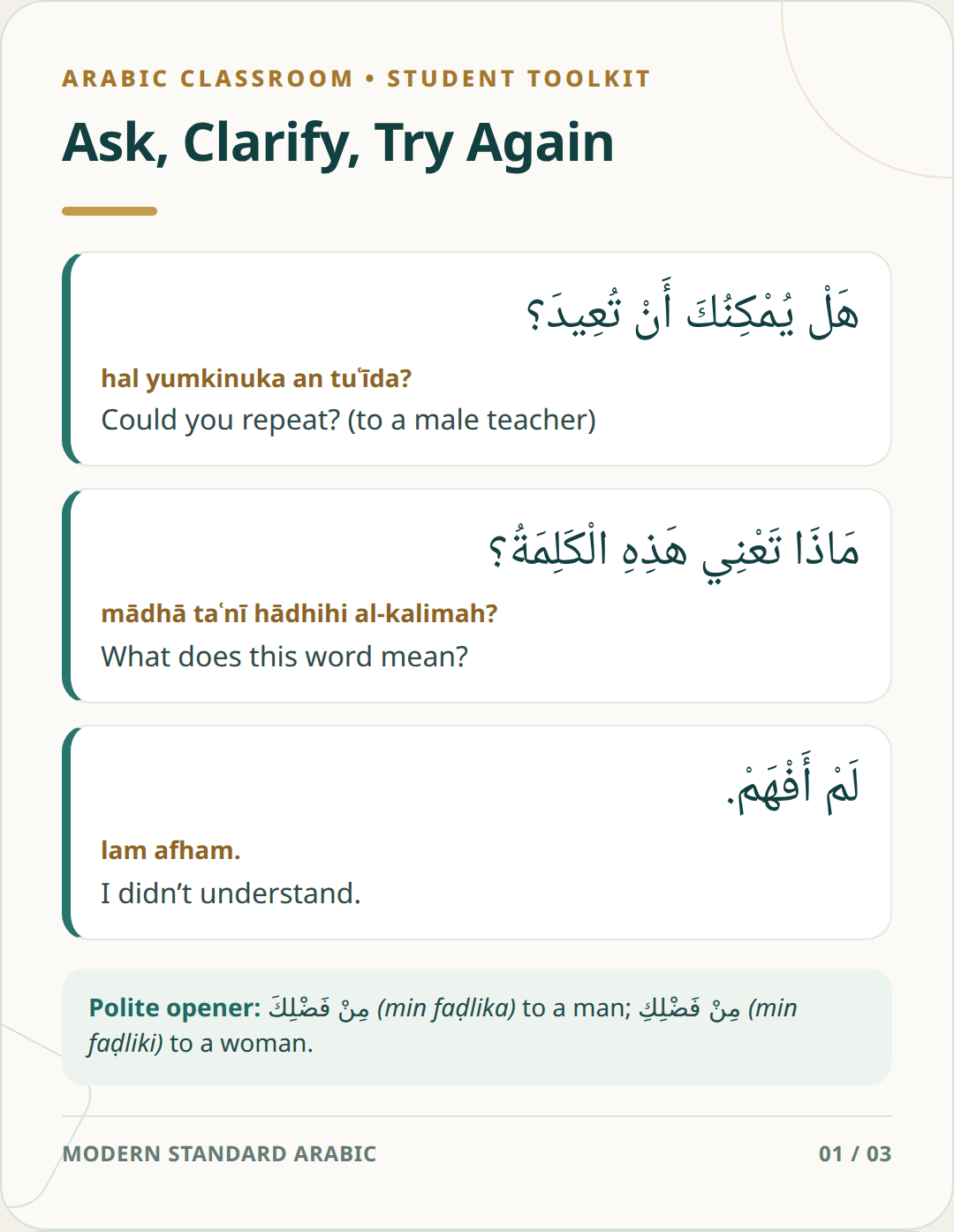
For a softer request, add مِنْ فَضْلِكَ (min faḍlika) to a man or مِنْ فَضْلِكِ (min faḍliki) to a woman. Arabic often marks the person being addressed in pronouns and verbs. Students do not need every form at once, but should hear and practise the version their teacher uses.
Encourage learners to combine a question with an attempt: say “I did not understand,” point to a word, and ask what it means. That gives the teacher a clear next step and lets the student practise a complete exchange rather than memorizing disconnected translations.
Two other short turns help learners participate: هَلْ أَسْتَطِيعُ أَنْ أَسْأَلَ؟ (hal astaṭīʿu an asʾal?, “May I ask?”) and مَتَى نَبْدَأُ؟ (matā nabdaʾu?, “When do we start?”). Practise them with a pause after the question so the learner has time to hear and respond to the answer.
Teacher phrases for guiding a lesson
Use a short instruction, pause, and show the page or action. These MSA commands address a group:
- اِسْمَعُوا جَيِّدًا. (ismaʿū jayyidan) — “Listen carefully.”
- اِفْتَحُوا الْكِتَابَ. (iftaḥū al-kitāb) — “Open the book.”
- اِقْرَؤُوا الْجُمْلَةَ. (iqraʾū al-jumlah) — “Read the sentence.”
- أَجِيبُوا عَنِ السُّؤَالِ. (ajībū ʿani s-suʾāl) — “Answer the question.”
- تَكَلَّمُوا بِالْعَرَبِيَّةِ. (takallamū bi-l-ʿarabiyyah) — “Speak in Arabic.”
Commands change with the person addressed. To one male learner, “listen” can be اِسْمَعْ (ismaʿ); to one female learner, اِسْمَعِي (ismaʿī). Group forms often end in وا (-ū), but the pattern is not identical for every verb. The guide to Arabic imperative verbs offers more examples.
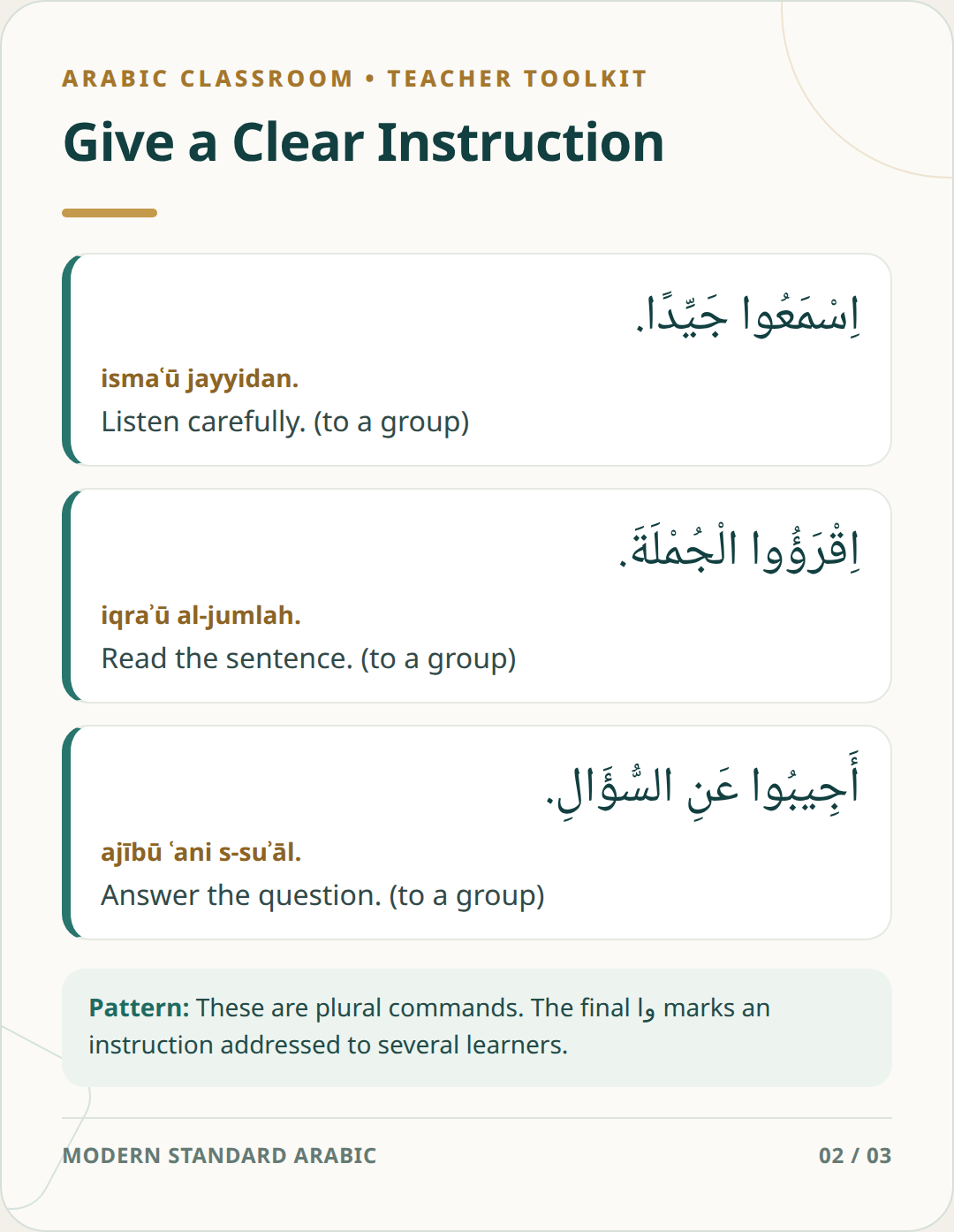
Pairing an instruction with a visible action helps beginners follow without translating every word. Many commands also introduce simple Arabic sentence structure: a verb gives the action and a noun names the object. For a grammar connection, see Arabic verbal sentences and word order. When a learner meets “your book” or “our lesson,” the guide to Arabic pronouns and attached suffixes is useful.
Give one instruction at a time when introducing a new activity. A long string of commands is hard to process, even when each word is familiar. Once the group knows the routine, connect steps with a simple sequence: listen first, read next, then answer. Keep the same order for a few lessons before changing it.
Model dialogue: open, ask, read
Read this exchange once, then practise it in pairs and switch roles. The goal is to recognize the instruction, ask one question, and respond—not to perform perfectly.
- Teacher: اِفْتَحُوا الْكِتَابَ. — “Open the book.”
- Student: أَيَّ صَفْحَةٍ نَقْرَأُ؟ — “Which page are we reading?”
- Teacher: الصَّفْحَةَ الْعَاشِرَةَ. اِقْرَؤُوا الْجُمْلَةَ الْأُولَى. — “Page ten. Read the first sentence.”
- Student: هَلْ أَقْرَأُ الْآنَ؟ — “Shall I read now?”
- Teacher: نَعَمْ، تَفَضَّلْ. — “Yes, go ahead.”
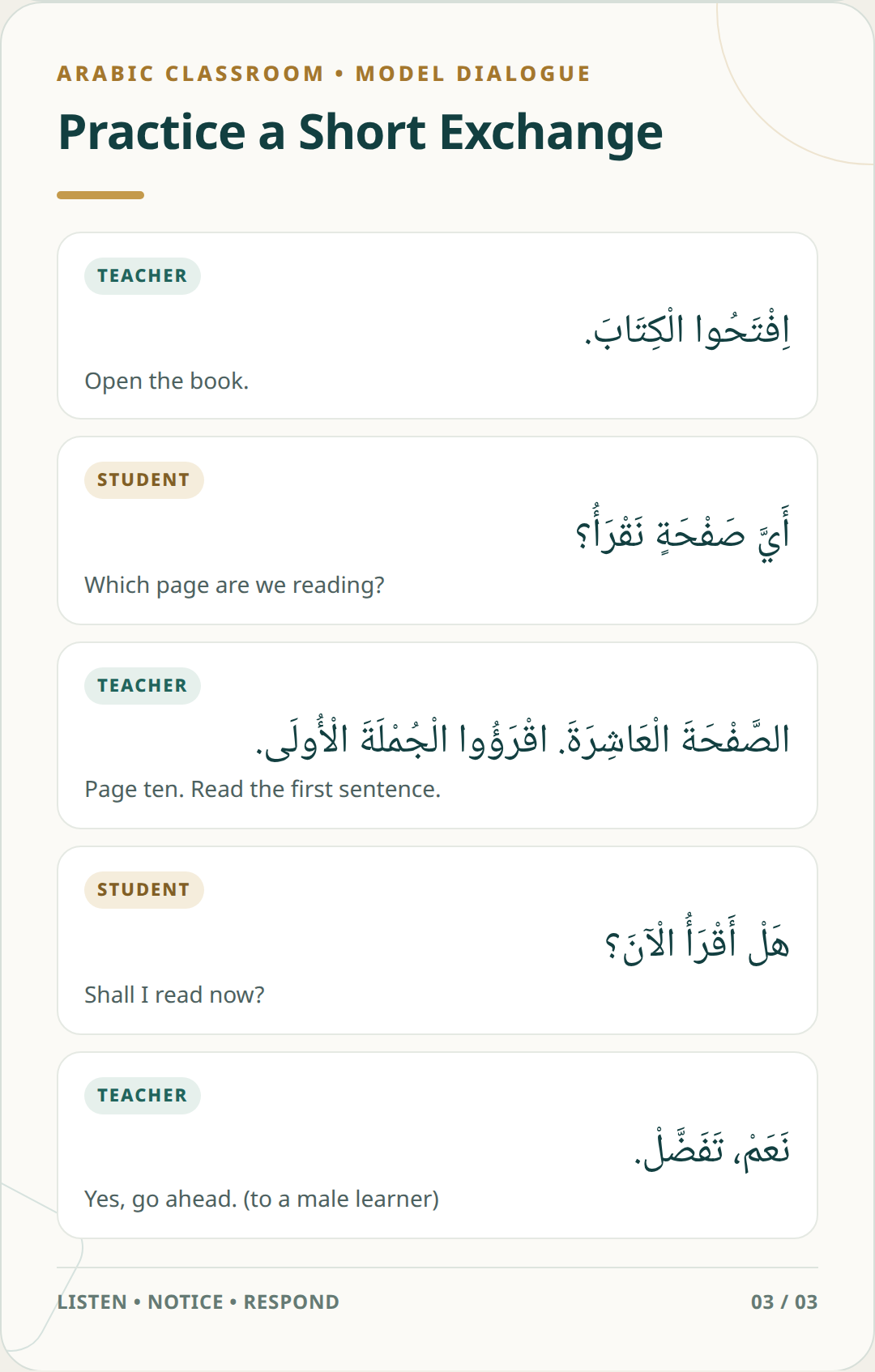
Notice that the student asks instead of guessing. The teacher gives the page and another instruction; the student checks whether it is time to read. This turns vocabulary into a real interaction and provides a concrete example of Arabic word order.
To repeat the activity, change just one detail: use another page number, substitute a word for “sentence,” or invite a second student to read. The familiar structure lowers the memory load while the new detail gives learners a reason to listen closely. Afterward, let pairs choose one line to perform again without looking at the English.
Use listening to make phrases feel natural
Transliteration helps a beginner start, but classroom phrases are spoken. Listen for pauses, stress, and how words connect; then repeat the whole expression once slowly and once at natural speed. For reading practice, review short and long vowels in Arabic, because vowel length can distinguish sounds that look similar to a new learner.
The video presents dialogue text on a plain background, so learners can focus on the words and voices. Pause after a line, repeat it aloud, then cover the English meaning and recall it. A short daily Arabic listening-practice routine can make this a repeatable habit.
Do not try to correct every sound during the first listen. Choose one focus, such as hearing the beginning of a question or noticing the final vowel, and replay only that line. Then listen once more for meaning. This sequence keeps pronunciation practice connected to communication instead of turning it into a spelling test.
A five-minute practice routine
Try a small routine instead of memorizing the whole page at once:
- Choose three phrases: one student question, one teacher instruction, and one response.
- Listen and echo: repeat each phrase after a teacher or the video, keeping the rhythm.
- Hide the translation: look at the Arabic and recall the meaning; uncover the English only if needed.
- Change one detail: replace “sentence” with “word,” or ask about another useful item.
- Use one phrase in class: ask for repetition or respond to an instruction during the next lesson.
Before a difficult task, model the phrase and pause before inviting a learner to answer. For mixed dialect backgrounds, ask which form students recognize, then connect it to the MSA example. A predictable exchange can feel more welcoming than an unexpected long answer.
In a one-to-one lesson, switch roles: the tutor gives a command, the student follows it and asks a question, then the student chooses the next instruction. This reveals which phrases the learner can understand and produce independently.
Bring the phrases into your learning plan
Once learners can greet the teacher, ask a question, follow a command, and try again after confusion, the lesson becomes more interactive. A tutor can adjust the examples to the learner’s level and decide whether the next step should focus on speaking, reading, or Quranic Arabic.
For a broader academic example of language in an inclusive classroom, the University of Arizona Center for Middle Eastern Studies describes a 2024 teacher workshop on Arabic language and cultures that included basic conversation for connecting with Arabic-speaking students and families. The page describes a past professional-development offering, not a current course listing; it shows how practical phrases can sit alongside cultural context.
To choose a level and practise these phrases aloud with a teacher, book a free assessment trial class. Explain what you already know, ask which variety or learning goal to prioritize, and leave with one phrase set to practise before your next lesson.
Communication repair challenge: finish the task after a misunderstanding
A useful classroom test is whether you can recover when the first instruction is unclear. Fluent communication does not mean understanding everything immediately. It means noticing what is missing and asking a question that helps the lesson continue. The following challenge uses the phrases above in an activity with an outcome: finding and reading the correct line.
Prepare two different role cards
The teacher card says: choose a page and a sentence, then ask the learner to read it. The student card says: you know the book but do not yet know the page or sentence. Keep the cards separate. If both partners already know the answer, the questions become a performance from memory. With different information, each question has a real purpose. Use a familiar book so that difficult vocabulary does not obscure the communication task.
Begin with the instruction to open the book. The learner asks which page to read. The teacher answers slowly but does not point yet. The learner then identifies the page and asks whether the first sentence is intended. Finally, read the agreed sentence. Switch roles after completing the task. The learner is practising understanding, requesting clarification, and acting on the answer rather than simply reciting a list.
Choose the best response
- You heard an instruction but missed its words. Would you ask for its meaning or ask the teacher to repeat?
- You heard a word clearly but do not know its meaning. Which question from the student list would help?
- You know the sentence and have attempted an answer. How would you check whether your answer is correct?
- You are unsure whether the teacher is addressing you or the whole group. What should you clarify before starting?
Answer guide: 1) Ask for repetition. 2) Ask what the word means. 3) Use the question meaning “Is this correct?” 4) Ask who should respond or whether it is your turn. There is no need to invent a long Arabic explanation: use an established short phrase, gesture to the relevant line, and let your teacher supply an appropriate model.
Keep a small independence record
| Task | First attempt | Next lesson |
|---|---|---|
| Ask for repetition without an English prompt | Independent / needed a cue | Try again with a different instruction |
| Ask the meaning of one word | Independent / needed a cue | Choose a new word |
| Use the answer to complete the task | Completed / still uncertain | Clarify the missing detail |
Do not reward only speed. A thoughtful clarification that leads to the correct page is more useful than a fast guess. Repeat this activity with a new instruction on another day; if the learner succeeds only with the original page, keep practising the exchange rather than adding many new phrases.