
Arabic greetings and introductions become easier when you learn a conversation, not a disconnected list of words. Start with a greeting and its reply, exchange names, ask one friendly question, and close politely. That sequence gives you something useful to say in an Arabic lesson, a community gathering, or a first meeting.
This guide uses mostly Modern Standard Arabic, with familiar greetings that also travel across many Arabic-speaking communities. Everyday pronunciation varies by country. The transliteration is a temporary reading aid: ā, ī, and ū mark long vowels, while ʿ represents the Arabic letter ع. Aim for a clear, considerate exchange rather than an imitation of every regional accent.
1. Choose a greeting and learn its response
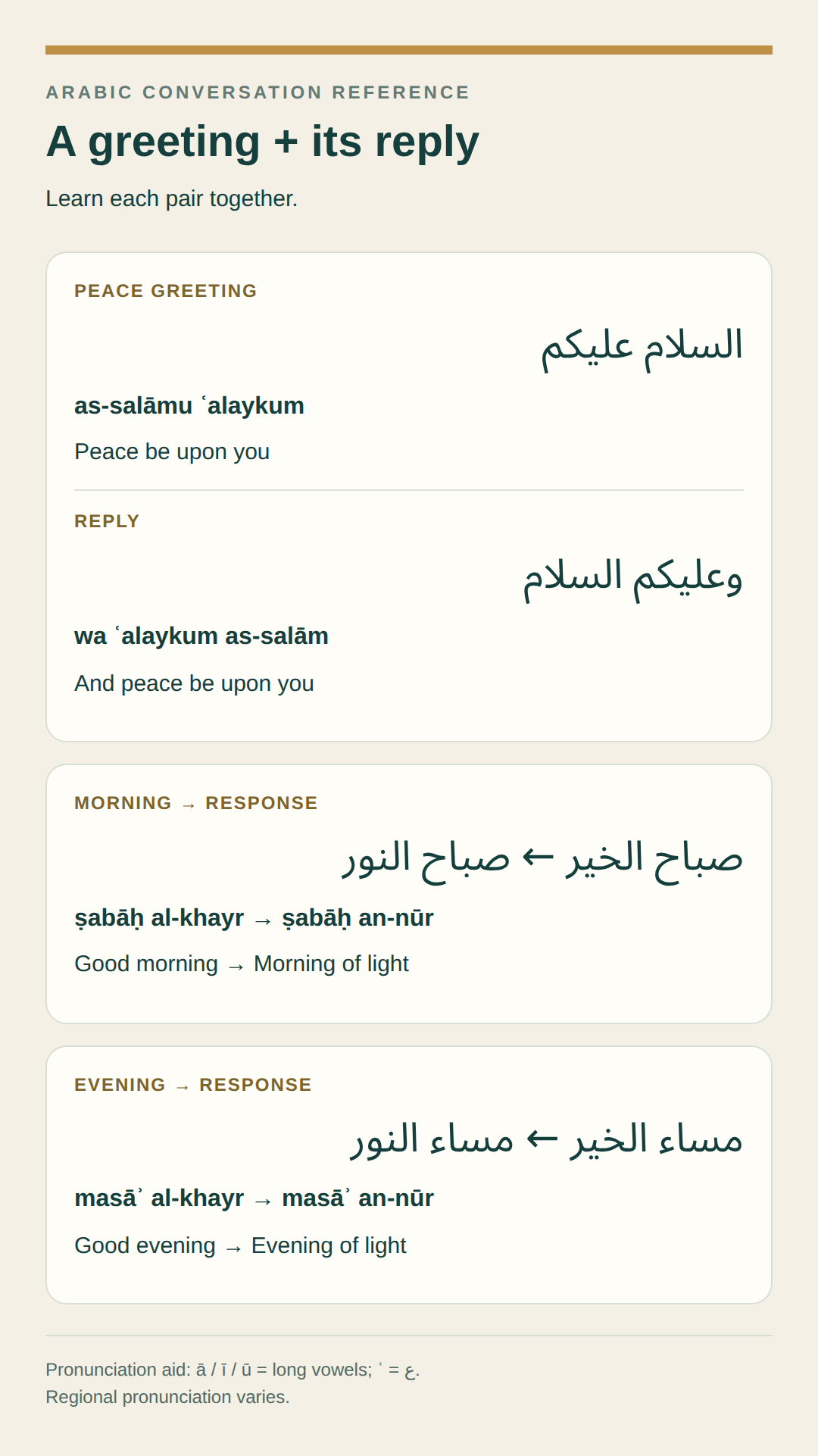
The most useful starting pair is السلام عليكم (as-salāmu ʿalaykum), “peace be upon you,” and وعليكم السلام (wa ʿalaykum as-salām), “and peace be upon you.” Learn both together so you can initiate the greeting and recognize what someone says back.
You will hear this greeting frequently in Muslim communities, including before Quran lessons. For a simple general hello, مرحباً (marḥaban) and أهلاً (ahlan) are useful alternatives. Neither requires a long answer: returning the same greeting is a straightforward beginner response.
| Purpose | Arabic | Pronunciation | Meaning |
|---|---|---|---|
| Start a greeting | السلام عليكم | as-salāmu ʿalaykum | Peace be upon you |
| Return it | وعليكم السلام | wa ʿalaykum as-salām | And peace be upon you |
| Say hello | مرحباً | marḥaban | Hello |
| Say a friendly hello | أهلاً | ahlan | Hello / hi |
Do not try to memorize thirty openings at once. Choose one pair, practise it aloud, and then add another. Our broader collection of useful Arabic phrases can extend your vocabulary after this short exchange feels comfortable.
2. Match morning and evening greetings
صباح الخير (ṣabāḥ al-khayr) means “good morning.” Its familiar response is صباح النور (ṣabāḥ an-nūr), literally “morning of light.” In the evening, use مساء الخير (masāʾ al-khayr) and answer مساء النور (masāʾ an-nūr).
Local habits determine exactly when morning gives way to evening language; there is no single clock rule shared by every Arabic-speaking community. Listen to your teacher or conversation partner. You may also hear el-kheir instead of al-khayr in regional speech. Those differences do not make the standard written form wrong.
3. Introduce yourself and ask a name
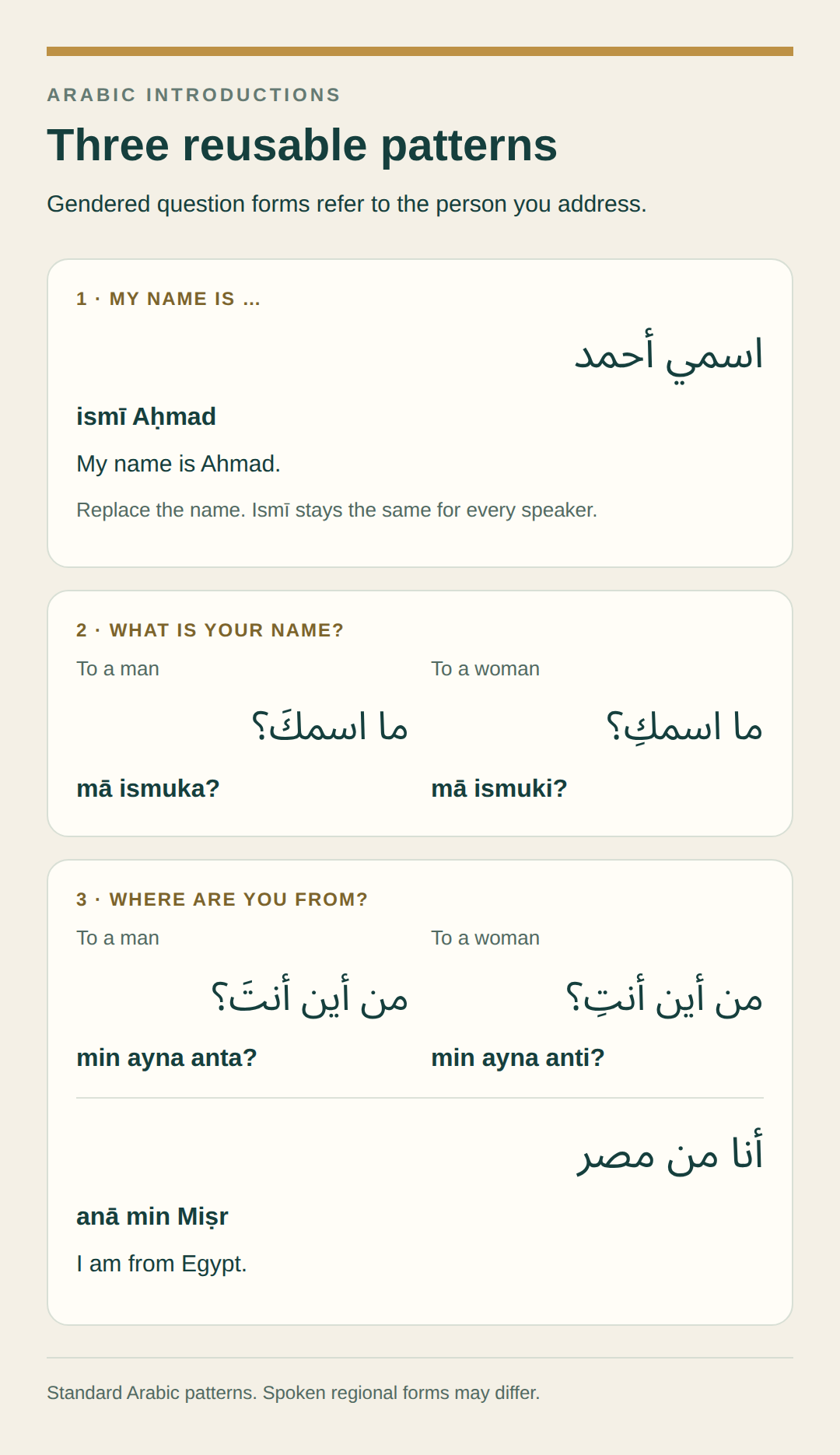
The reusable pattern اسمي … (ismī …) means “my name is …”. For example, اسمي أحمد (ismī Aḥmad) means “my name is Ahmad.” You can also say أنا أحمد (anā Aḥmad), “I am Ahmad.” Replace the name without changing the rest of the pattern.
To ask a man his name, say ما اسمكَ؟ (mā ismuka?). To ask a woman, say ما اسمكِ؟ (mā ismuki?). The distinction concerns the person you address, not your own gender. A male and a female speaker both say ismī when introducing themselves.
The open textbook LibreTexts’ greeting-and-introduction dialogue presents these greeting, name-question, and masculine/feminine patterns in a beginner conversation. Use the pattern to build your own exchange rather than copying a script without understanding it.
If the script is new, begin with our Arabic alphabet guide. Reading a small phrase accurately is more useful than guessing a long transliteration from memory.
4. Ask how someone is and where they are from
In standard Arabic, “how are you?” is كيف حالكَ؟ (kayfa ḥāluka?) to a man and كيف حالكِ؟ (kayfa ḥāluki?) to a woman. A simple answer is أنا بخير (anā bikhayr), “I am well.” Add وأنتَ؟ (wa anta?) or وأنتِ؟ (wa anti?) to return the question.
“Where are you from?” is من أين أنتَ؟ (min ayna anta?) to a man or من أين أنتِ؟ (min ayna anti?) to a woman. Answer أنا من … (anā min …), “I am from …”. For example, أنا من مصر means “I am from Egypt.”
Keep the two “you” forms distinct. Our Arabic personal-pronoun chart explains anta and anti, while our guide to Arabic question words helps you recognize mā, kayfa, and ayna in other questions.
5. Add courtesy and a clear goodbye
شكراً (shukran) means “thank you.” After someone welcomes or helps you, it is a useful way to make the exchange warmer. For more expressions and appropriate replies, see our guide to saying thank you in Arabic.
For “nice to meet you,” you may hear تشرفنا (tasharrafnā). To finish, مع السلامة (maʿa as-salāma) is a widely familiar goodbye. إلى اللقاء (ilā al-liqāʾ), “until we meet,” is another option, particularly in more formal standard Arabic.
Do not turn etiquette into a rigid checklist. Follow the other person’s pace, avoid personal questions they seem uncomfortable answering, and remember that greeting customs vary between families, countries, and situations.
6. Practise one complete first conversation
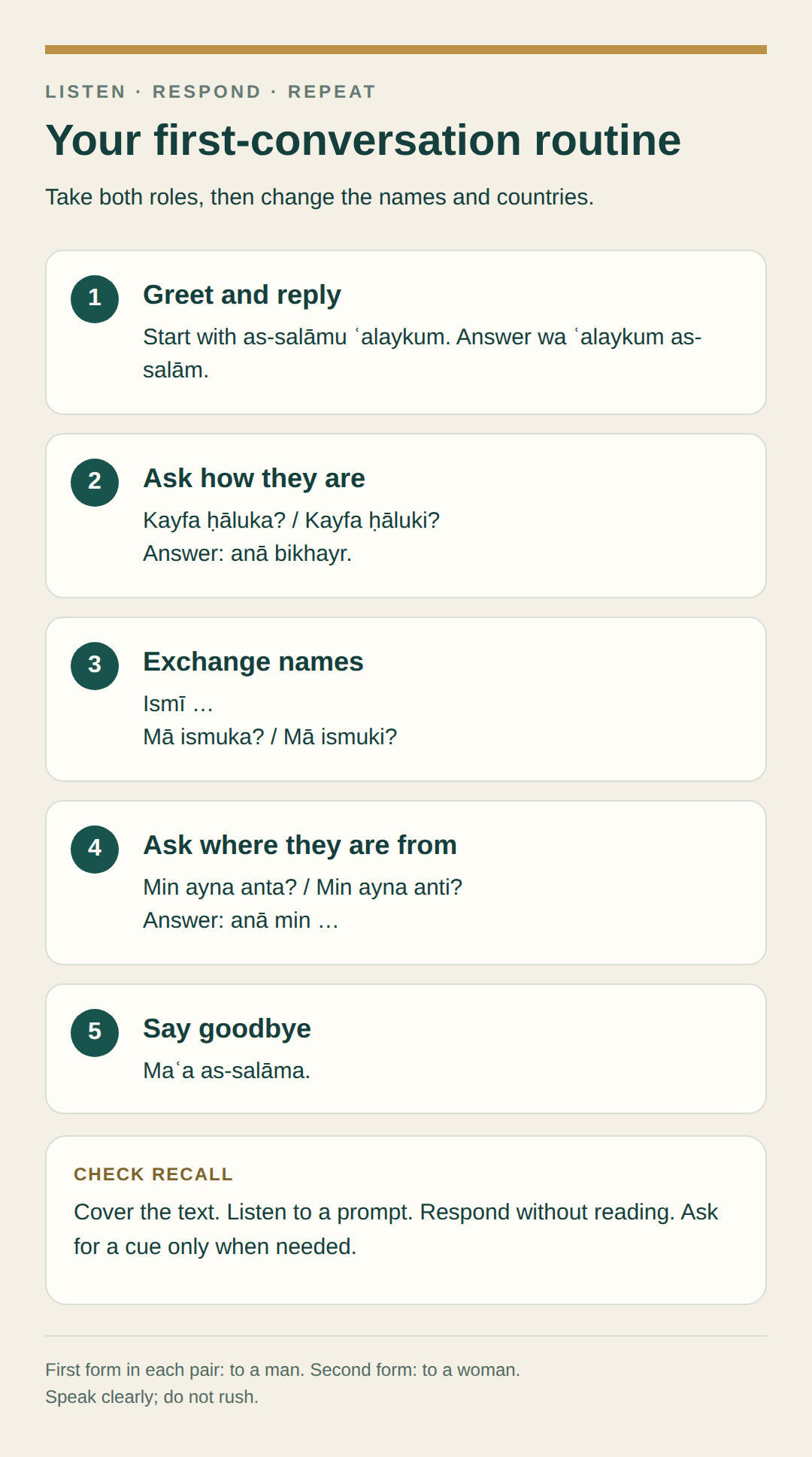
This short exchange is between two men, so it uses -ka and anta. When addressing a woman, change those forms to -ki and anti; your own name and the phrase anā min stay unchanged.
- Ahmad: السلام عليكم. — As-salāmu ʿalaykum. — Peace be upon you.
- Yusuf: وعليكم السلام. كيف حالكَ؟ — Wa ʿalaykum as-salām. Kayfa ḥāluka? — And peace be upon you. How are you?
- Ahmad: أنا بخير. وأنتَ؟ — Anā bikhayr. Wa anta? — I am well. And you?
- Yusuf: أنا بخير. اسمي يوسف. ما اسمكَ؟ — Anā bikhayr. Ismī Yūsuf. Mā ismuka? — I am well. My name is Yusuf. What is your name?
- Ahmad: اسمي أحمد. أنا من مصر. — Ismī Aḥmad. Anā min Miṣr. — My name is Ahmad. I am from Egypt.
- Yusuf: تشرفنا. — Tasharrafnā. — Nice to meet you.
- Ahmad: مع السلامة. — Maʿa as-salāma. — Goodbye.
Read both roles once, then cover the English and answer only the Arabic prompts. Next, substitute your own name and country. That small change tests understanding better than repeating the same names indefinitely.
7. Listen, then check your pronunciation
The short text-led video below demonstrates the familiar “Salam Alaikum” greeting. Listen before repeating. Then practise the full greeting and its reply from the table above, keeping a natural pace rather than reading every English letter separately.
English spelling cannot fully represent Arabic sounds. In ʿalaykum, the mark ʿ stands for ع, not an extra English vowel; our listening-first guide to Arabic ʿayn provides focused practice. Do not force your throat or invent a harsh sound.
Common questions before your first Arabic conversation
Should I learn standard Arabic or a dialect first?
For this small lesson, keep one consistent set of standard forms. They are useful for reading, structured lessons, and understanding how a question is built. If your main goal is speaking with relatives or neighbours from one country, ask your teacher for that community’s everyday equivalents. Write the regional version beside the standard version and label it clearly, rather than mixing several dialects into one memorized sentence.
A greeting can remain familiar while the following question sounds quite different. Recognizing that difference prevents a common beginner mistake: assuming a speaker used the wrong Arabic because their wording differs from a textbook.
Does every greeting need a long answer?
No. A short, relevant response is enough. If someone says hello while passing, returning the greeting may be the entire exchange. In a first lesson, you may continue with names and a brief personal introduction. Let the setting guide the length; a conversation is not an exam in which you must recite every phrase you know.
Why do the written endings seem to disappear?
Careful standard-Arabic pronunciation and everyday speech are not identical. Short vowels may be less audible in casual conversation, and dialects have their own patterns. First learn which ending identifies the person addressed. Then listen to a teacher model a complete sentence naturally. Do not conclude that the masculine and feminine forms are interchangeable simply because unvowelled Arabic often writes them with the same letters.
What if I forget the reply?
Pause and ask for help instead of rushing into a different memorized phrase. During practice, have your partner repeat the greeting once, then give you the first sound of the reply if needed. Gradually remove that cue. This makes the exercise a listening-and-response task, not just a reading exercise. Keep your first introduction truthful and simple; there is no need to share private details to practise Arabic.
8. Make the conversation a five-minute routine
Spend one minute listening, two minutes alternating the two roles, one minute changing names and countries, and one minute recalling the exchange without looking. On the next day, add a morning or evening greeting rather than collecting unrelated new phrases.
Copy two Arabic lines as well. Our explanation of connected Arabic letter forms helps you recognize changing shapes, and these Arabic writing-practice ideas can make the copying purposeful.
If you can recognize the phrases but cannot answer comfortably, bring that exact difficulty to a free Quran and Arabic assessment trial class. A teacher can identify whether script recognition, a particular sound, or recalling the response needs attention. Your first goal is simple: greet someone, understand their answer, and introduce yourself clearly.