
If you want to talk about what you wear, shop for a shirt, or ask whether a size is available, start with a small, useful set of clothes in Arabic. This guide uses clear Modern Standard Arabic (MSA), gives simple pronunciation cues, and builds from garment names to colors, fit, sizes, and a short shop conversation. You will also see one Quranic use of the word for clothing, kept separate from everyday shopping speech.
First, know the everyday word for clothes
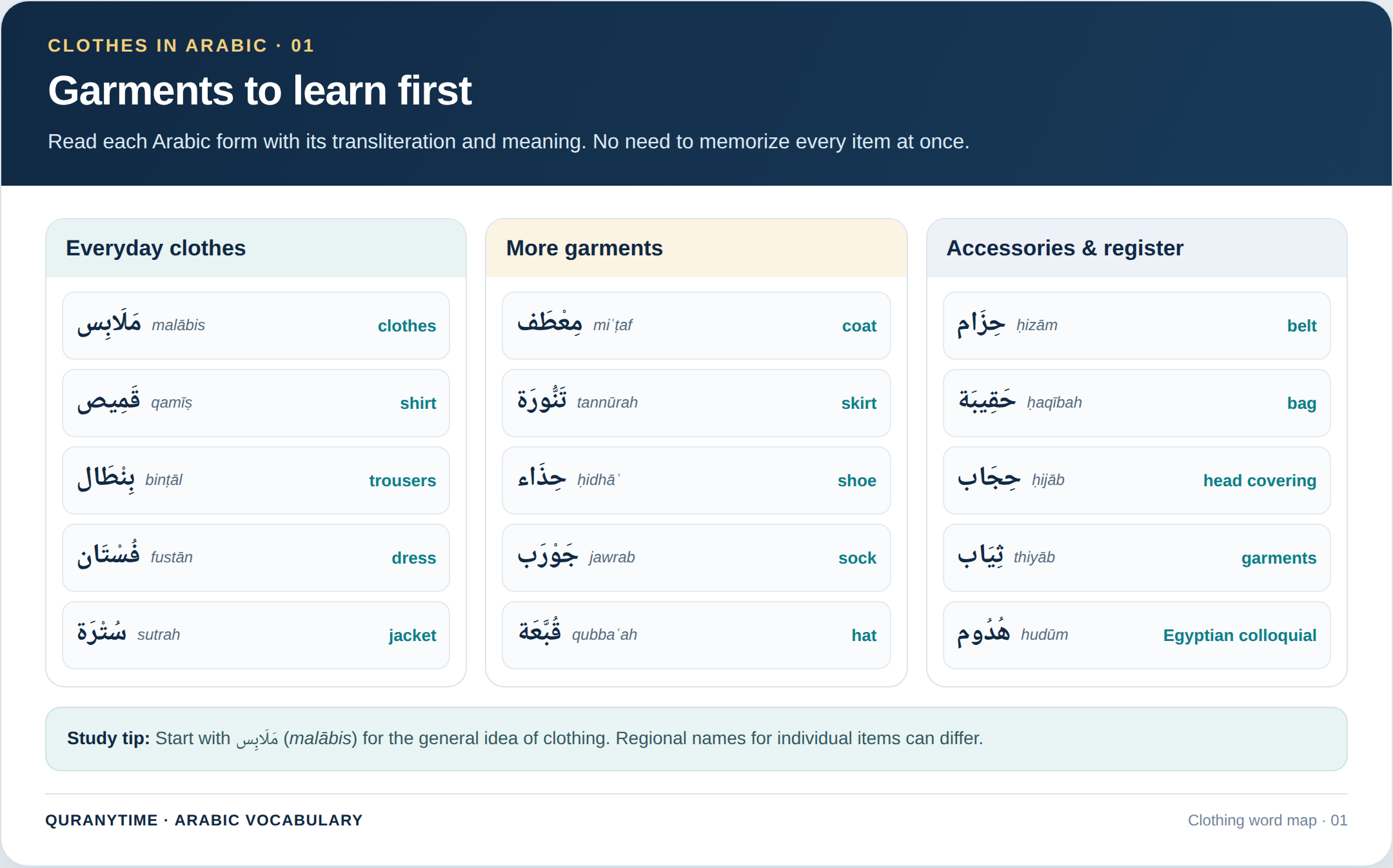
مَلَابِس (malābis) is a common word for “clothes” or “clothing.” You may also meet ثِيَاب (thiyāb), a word for garments or clothing that is especially familiar in formal and Quranic contexts. For a beginner, learn malābis as the general category, then learn the individual item you need. In Egyptian conversation, you may also hear هُدُوم (hudūm) or لِبْس (libs); these are colloquial, while malābis works well in standard writing and cross-regional study.
Arabic clothing words have grammatical gender, even when the object itself has no human gender. That matters when you add “this,” “white,” “large,” or “comfortable.” Learn the noun together with one useful phrase rather than memorizing a long list without context.
Useful clothing vocabulary in Arabic
These common MSA-first terms will help you recognize garments in a shop or describe what you are wearing. Pronunciation is approximate; long vowels are shown with macrons, and ḥ represents a deeper “h” sound than English h.
- قَمِيص (qamīṣ) — shirt
- بِنْطَال (binṭāl) — trousers or pants; سِرْوَال (sirwāl) is another established word
- فُسْتَان (fustān) — dress
- تَنُّورَة (tannūrah) — skirt
- سُتْرَة (sutrah) — jacket; مِعْطَف (miʿṭaf) — coat
- حِذَاء (ḥidhāʾ) — shoe; جَوْرَب (jawrab) — sock
- قُبَّعَة (qubbaʿah) — hat or cap
- حِزَام (ḥizām) — belt; حَقِيبَة (ḥaqībah) — bag
- حِجَاب (ḥijāb) — head covering / hijab; its use depends on the context
Some words vary by region, and borrowed words such as jākīt for “jacket” are common in speech. If you are learning for travel or conversation, ask which local term people use, but keep one standard form in your notes. You can extend this list by reviewing Quranytime’s Arabic phrases for beginners and adding one clothing example of your own.
Describe color, fit, and material
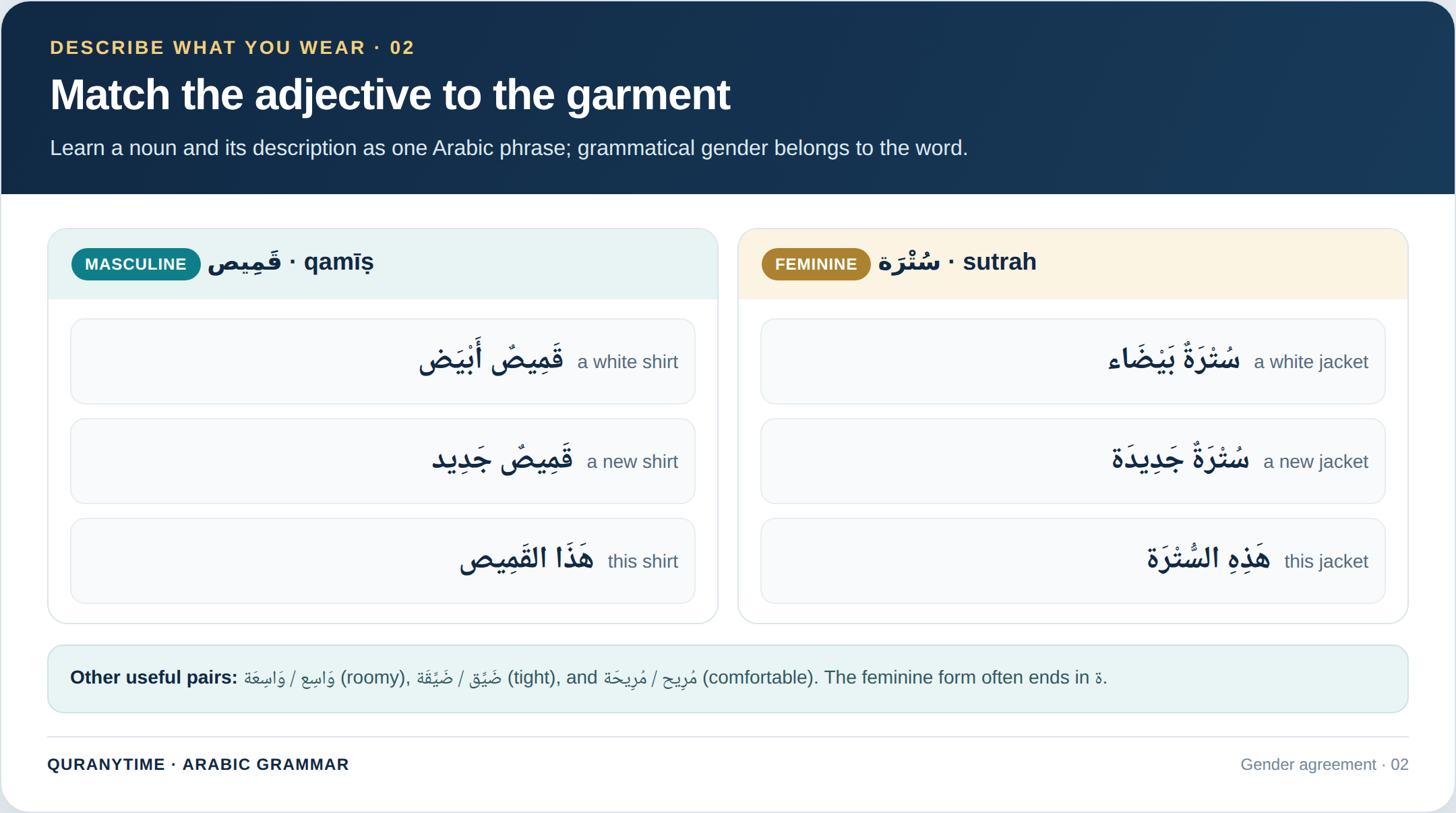
Once you know the garment, add a color or a simple description. Arabic adjectives usually agree with the noun they describe in gender and number. For example, قَمِيصٌ أَبْيَض (qamīṣun abyaḍ) means “a white shirt,” while سُتْرَةٌ بَيْضَاء (sutratun bayḍāʾ) means “a white jacket.” The adjective changes because qamīṣ is masculine and sutrah is feminine. For a quick reminder, see our guide to Arabic noun gender and the examples in Arabic adjective agreement.
Here are useful descriptions to learn as pairs:
- جَدِيد / جَدِيدَة (jadīd / jadīdah) — new, masculine / feminine
- وَاسِع / وَاسِعَة (wāsiʿ / wāsiʿah) — loose or roomy
- ضَيِّق / ضَيِّقَة (ḍayyiq / ḍayyiqah) — tight or narrow
- مُرِيح / مُرِيحَة (murīḥ / murīḥah) — comfortable
- غَالٍ / غَالِيَة (ghālin / ghāliyah) — expensive
Color words follow the same basic idea: قَمِيصٌ أَزْرَق (qamīṣun azraq) is “a blue shirt,” and حَقِيبَةٌ زَرْقَاء (ḥaqībatun zarqāʾ) is “a blue bag.” You can practise more color names in our Arabic colors guide. To describe fabric, use مِنْ (min, “made of/from”) plus the material: مِنَ القُطْن (mina al-quṭn, “of cotton”) or مِنَ الصُّوف (mina aṣ-ṣūf, “of wool”).
Ask about size, price, and trying something on
The word for “size” is مَقَاس (maqās). Common size descriptions include صَغِير (ṣaghīr, small), مُتَوَسِّط (mutawassiṭ, medium), and كَبِير (kabīr, large). For “larger” and “smaller,” use أَكْبَر (akbar) and أَصْغَر (aṣghar). Labels and numbered size charts differ between countries and brands, so treat these words as conversation tools—not as a universal sizing system. Numbers are useful when a shop gives a number rather than S, M, or L; practise with Arabic numbers from 1 to 100.
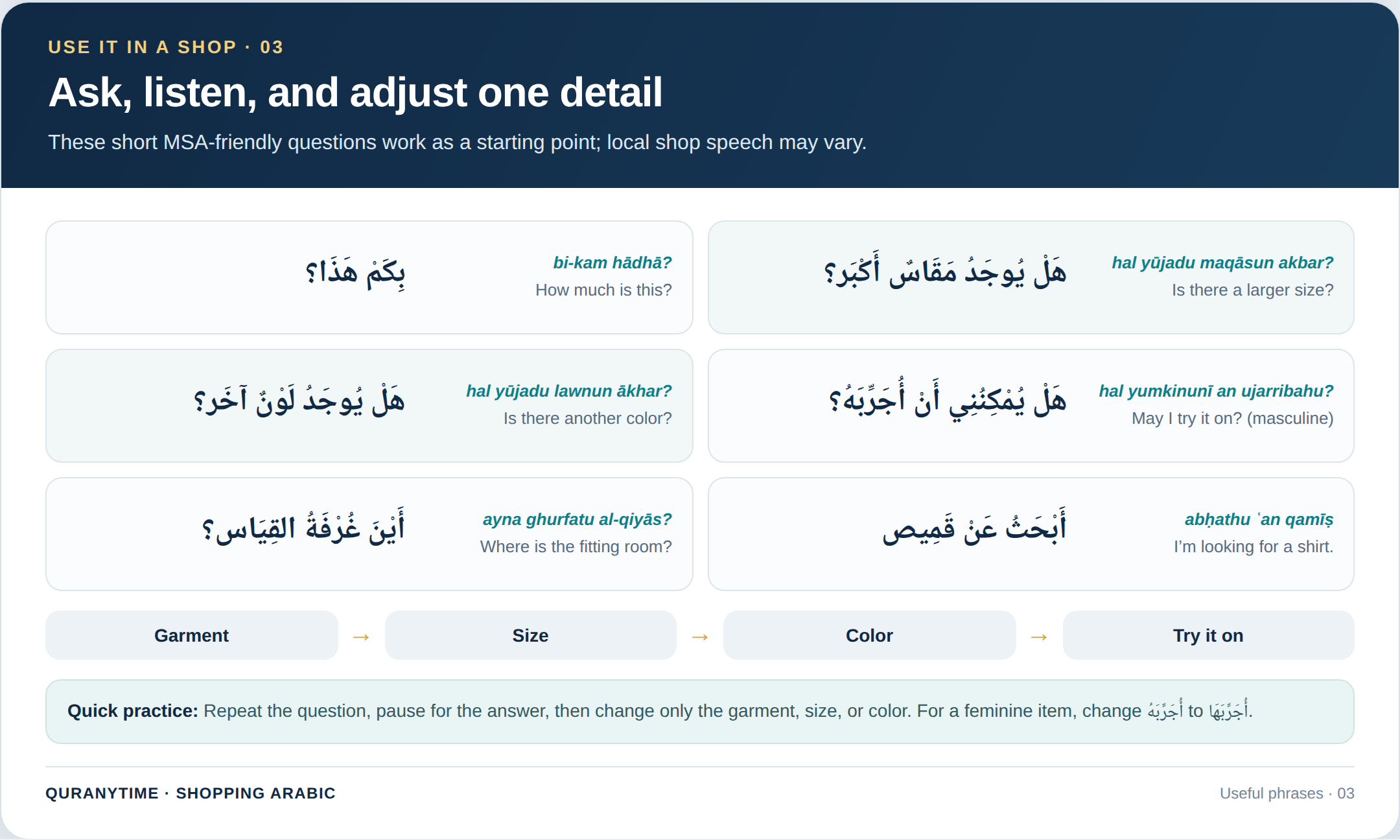
Useful questions include بِكَمْ هَذَا؟ (bi-kam hādhā?, “How much is this?”), هَلْ يُوجَدُ مَقَاسٌ أَكْبَر؟ (hal yūjadu maqāsun akbar?, “Is there a larger size?”), and هَلْ يُوجَدُ لَوْنٌ آخَر؟ (hal yūjadu lawnun ākhar?, “Is there another color?”). For more ways to form questions, review these essential Arabic question words.
To ask to try an item, say هَلْ يُمْكِنُنِي أَنْ أُجَرِّبَهُ؟ (hal yumkinunī an ujarribahu?, “May I try it?”) for a masculine noun, or change the ending to أُجَرِّبَهَا (ujarribahā) when referring to a feminine noun. You can ask أَيْنَ غُرْفَةُ القِيَاس؟ (ayna ghurfatu al-qiyās?, “Where is the fitting room?”). Here, “this” changes with the noun too: هَذَا القَمِيص (hādhā al-qamīṣ, this shirt) but هَذِهِ السُّتْرَة (hādhihi as-sutrah, this jacket). See Arabic demonstratives: this and that for more examples.
If you need to say “in the shop,” “from cotton,” or “with a belt,” small connecting words help. The guide to Arabic prepositions can help you review forms such as fī (“in”) and min (“from/of”) in short phrases.
A short clothing-shop conversation
Customer: السَّلَامُ عَلَيْكُمْ. أَبْحَثُ عَنْ قَمِيصٍ. (as-salāmu ʿalaykum. Abḥathu ʿan qamīṣ.) — “Peace be upon you. I’m looking for a shirt.”
Shop assistant: تَفَضَّل. هَذَا قَمِيصٌ أَبْيَض. (tafaḍḍal. Hādhā qamīṣun abyaḍ.) — “Here you are. This is a white shirt.”
Customer: هَلْ يُوجَدُ مَقَاسٌ أَكْبَر؟ وَبِكَمْ هُوَ؟ (hal yūjadu maqāsun akbar? Wa-bi-kam huwa?) — “Is there a larger size? And how much is it?”
Shop assistant: نَعَمْ. هَذَا المَقَاسُ أَكْبَر. (naʿam. Hādhā al-maqāsu akbar.) — “Yes. This size is larger.”
Customer: هَلْ يُمْكِنُنِي أَنْ أُجَرِّبَهُ؟ (hal yumkinunī an ujarribahu?) — “May I try it on?”
This dialogue is an MSA-friendly model, not a script that every shop in every Arabic-speaking country will use. If you want a different color, replace the description; if you want a different item, replace qamīṣ. Asking one short question at a time makes it easier to hear the answer and adjust your request. You can build a few more practical exchanges from a beginner Arabic phrases collection.
A Quranic clothing word: keep the context clear
The Quran uses clothing vocabulary in a different register from a shop conversation. In Al-Aʿrāf 7:26, لِبَاسًا (libāsan) is a word for clothing or a garment. The Quranic Arabic Corpus word-by-word analysis of 7:26 labels it an accusative masculine indefinite noun. The verse speaks of clothing that covers and adorns, then mentions “the clothing of taqwā.” This is a useful encounter with Quranic vocabulary, but the verse is not a modern shopping dialogue and the phrase about taqwā should be understood in its religious context, not reduced to a clothing label.
Listen to the recitation below while following the verse text. Notice libāsan in the verse, then return to the everyday word malābis when you practise describing clothes or asking for a size.
A five-minute practice routine
First, choose five clothing nouns and read them aloud with the Arabic script visible. Next, add one adjective to each noun and check whether the adjective matches the noun: “a new shirt,” “a comfortable jacket,” or “a blue bag.” Then rehearse the shop questions in the dialogue, changing only one item or size each time. Finally, review the vocabulary the next day without looking at the English first. If you cannot remember a word, return to the whole phrase rather than copying the spelling repeatedly.
A small notebook entry can have four fields: Arabic noun, pronunciation cue, one description, and one real question. For example: sutrah → jacket → jadīdah (new) → “Do you have another color?” This connects reading, speaking, and grammar in a manageable way. Keep regional alternatives in a separate note so you can recognize them without mixing them into your first MSA practice list.
Common questions about clothes in Arabic
What is the most common word for clothes in Arabic?
Malābis is a useful general word for clothes in standard Arabic. Thiyāb also means garments or clothing and appears in formal and Quranic contexts. Local spoken terms can differ.
How do I say “I’m looking for a shirt”?
Say أَبْحَثُ عَنْ قَمِيص (abḥathu ʿan qamīṣ). The preposition ʿan follows the verb “look for,” so learn them together as a phrase.
Does Arabic have one universal clothing-size chart?
No. Numeric and letter sizes differ by manufacturer and country. Ask whether a larger or smaller size is available, and use the shop’s own chart when exact fit matters.
Keep learning with real examples
Clothes in Arabic become easier when you learn a noun, a matching description, and one practical question as a unit. Start with five words, practise a short exchange, and add new items only when you can use the first set confidently. If you would like structured feedback on your Arabic reading or conversation, you can book a free trial class with Quranytime.
The wardrobe mission: choose an item that meets three conditions
A shopping dialogue becomes more useful when the learner has to make a choice. For this activity, create four imaginary product cards using garments and descriptions from this article. No real purchase is involved. Give each item a garment name, a colour, and a size label. Use the same simple size system on all four cards, because real clothing sizes are not interchangeable between brands.
Give the customer a reason to ask questions
The customer needs a shirt in a particular colour and size. The shop assistant sees all the product cards, but the customer sees only the task. Begin by asking for a shirt. The assistant offers a card that meets two conditions but misses the third. The customer must notice the mismatch and request the change. If the colour is wrong, ask whether another colour is available; if the size is wrong, ask about a larger or smaller one.
Do not show the customer every card immediately. The missing information creates a reason to listen. After receiving a suitable option, the customer asks to try it on and checks the price. Switch roles and choose a different garment. Keep price arithmetic separate from the first round so that counting does not distract from forming the request.
Fix these three messages
- A learner points to a jacket but uses the masculine “this.” Which demonstrative from the article fits the feminine noun?
- A learner says that a size is unsuitable but never explains what change is needed. Which question helps the assistant offer a different size?
- A learner memorises “May I try it?” with a masculine suffix and applies it to every garment. What should change when the noun is feminine?
Answer guide: 1) Use هَذِهِ with the jacket noun used here. 2) Ask whether a larger or smaller size is available, choosing the one you need. 3) Use the feminine object suffix in أُجَرِّبَهَا. The change follows the grammatical gender of the item, not the gender of the person buying it.
Make a personal phrase card
Choose one garment you often discuss and write four lines: its Arabic name, one matching description, one size question, and one request involving it. Leave space for a regional alternative, clearly labelled. Ask your teacher to model the whole exchange, then practise with the Arabic visible and the English covered. On the next attempt, hide the card and let a partner change the offered item unexpectedly.
Check success by the outcome: did the customer obtain the requested combination, recognise an unsuitable option, and ask a useful follow-up? A perfect recital of the original script does not demonstrate that flexibility. Add a fifth product only after the learner can handle one unexpected answer without returning to English immediately.