
Quranic Arabic grammar · beginner guide
English marks comparison with endings such as -er and -est, or with more and most. Arabic often uses one special adjective form for both jobs. That is why أَكْبَرُ can mean “greater” in one sentence and “greatest” in another. The words around it—not an English ending hidden in the Arabic—tell you which meaning fits.
This guide explains the comparative and superlative in Arabic through the pattern أَفْعَل, the word مِنْ (“than”), and two common superlative structures. We will read a clear Quran example and practise distinguishing the patterns.
One Arabic form can mean “more” or “most”
The grammar term for this form is ism al-tafḍīl (اِسْمُ التَّفْضِيل), often called the elative. A familiar example is كَبِيرٌ (kabīr, big) becoming أَكْبَرُ (akbar, bigger/greatest). The same word has no fixed English degree: read its sentence pattern and context. Arabic words are built from roots and patterns; review how Quranic Arabic roots and patterns work if that idea is new.
Here, أَكْبَرُ is an adjective, not a verb. The similar-looking أَفْعَل label can also refer to a derived verb pattern, so identify a word by its role in the sentence; our guide to Arabic verb forms covers that separate topic.
Common forms to recognize
These familiar examples help you spot frequent elatives. The English gloss gives more than one option where context can change the translation.
| Basic adjective | Elative form | Possible meanings |
|---|---|---|
| كَبِير (kabīr) | أَكْبَر (akbar) | bigger; greatest |
| صَغِير (ṣaghīr) | أَصْغَر (aṣghar) | smaller; smallest |
| طَوِيل (ṭawīl) | أَطْوَل (aṭwal) | longer; longest |
| جَمِيل (jamīl) | أَجْمَل (ajmal) | more beautiful; most beautiful |
| كَثِير (kathīr) | أَكْثَر (akthar) | more; most |
Do not mechanically transform every adjective. Some forms are lexical, and some qualities use أَكْثَرُ or أَقَلُّ with another word. For example, “redder” may be expressed as أَكْثَرُ اِحْمِرَارًا (aktharu iḥmirāran, more red). Learn frequent forms and check unfamiliar ones in context.
Pattern 1: أَفْعَلُ مِنْ means “more … than”
When an elative is followed by مِنْ (min, than), you have a clear comparison. The frame is:
thing being described + elative + مِنْ + comparison standard
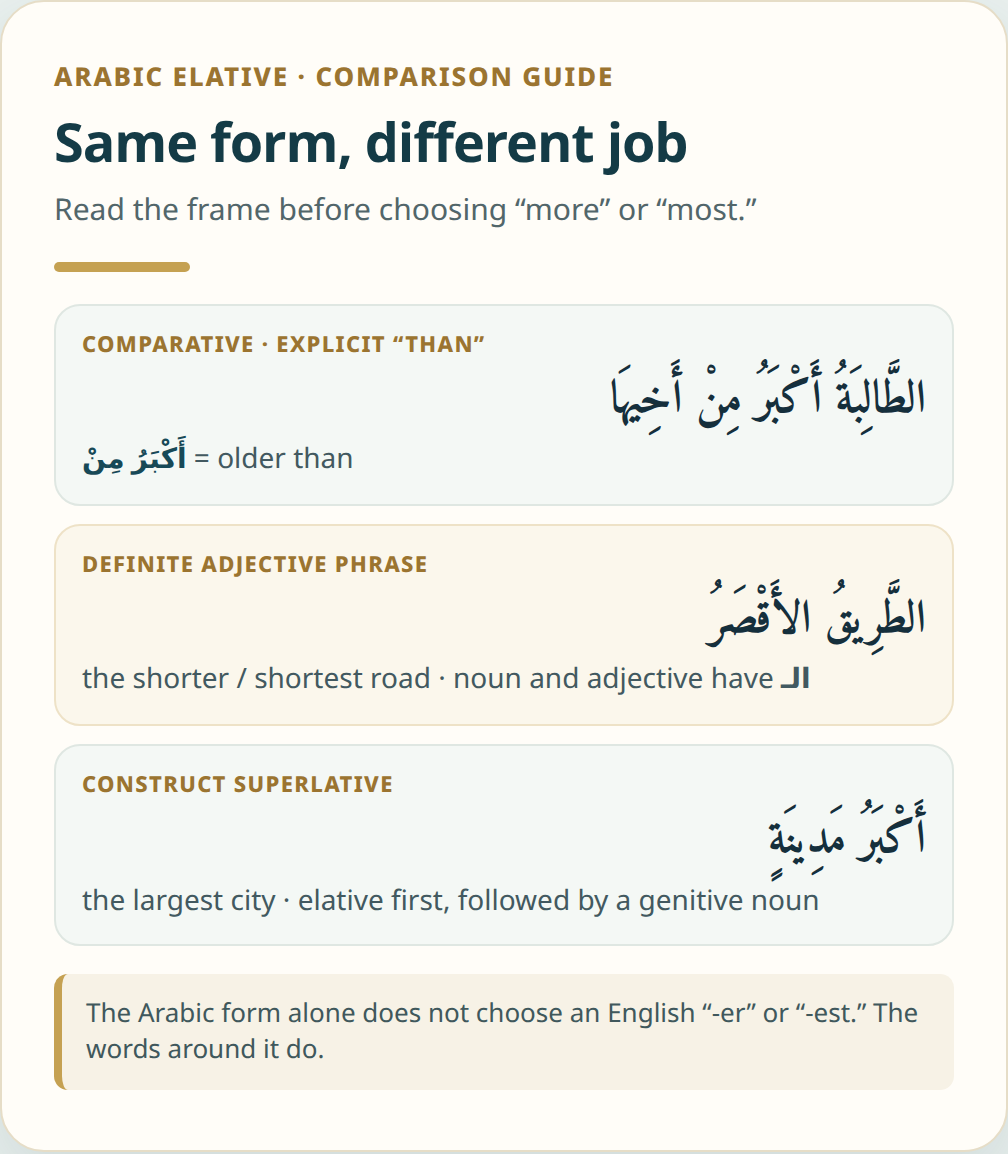
الطَّالِبَةُ أَكْبَرُ مِنْ أَخِيهَا
al-ṭālibatu akbaru min akhīhā
“The female student is older than her brother.”
The clue is the Arabic sequence أَكْبَرُ مِنْ. The first noun is being compared, أَكْبَرُ names the higher degree, and مِنْ أَخِيهَا gives the comparison standard. Because مِنْ is a preposition, the phrase after it is in a genitive relationship. See Arabic case endings in Quranic reading if you want to review how these endings work.
A Quran example: “greater than” in Ghafir 40:57
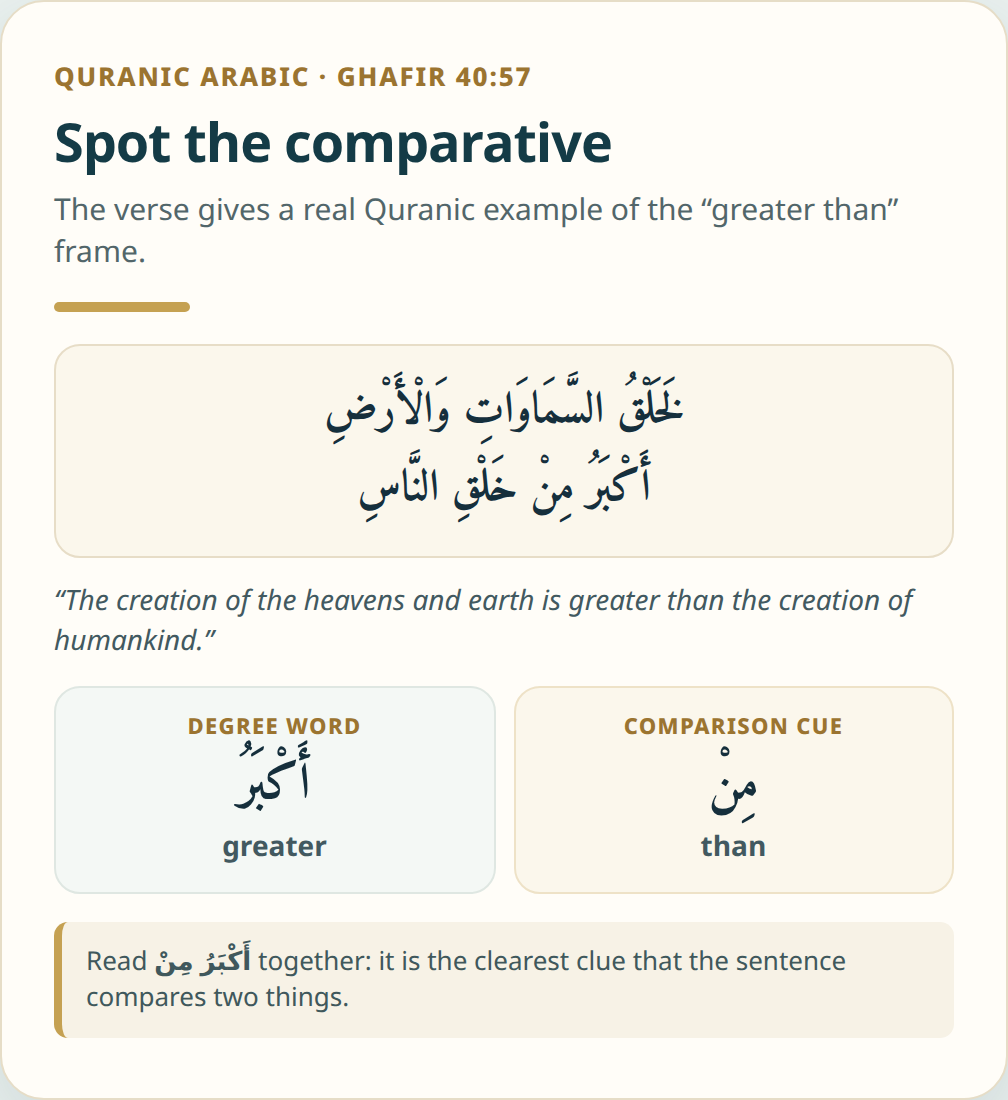
Ghafir 40:57 says that the creation of the heavens and earth is greater than the creation of humankind:
لَخَلْقُ السَّمَاوَاتِ وَالْأَرْضِ أَكْبَرُ مِنْ خَلْقِ النَّاسِ
أَكْبَرُ مِنْ (akbaru min) means “greater than.” The phrase before it names what is greater; the مِنْ phrase supplies the comparison. The guide to Arabic nominal sentences explains how a description can complete a subject without a separate Arabic word for English “is.” The Quranic Arabic Corpus’s word-by-word analysis of Ghafir 40:57 labels أَكْبَرُ as a nominative adjective and مِنْ as a preposition.
Listen for the two-part clue أَكْبَرُ مِنْ in the recitation below. Try to recognize the comparison before translating each word on its own.
Two common ways to express “the most”
A superlative reading often appears in a noun phrase. Learn these two shapes; they are related, but not identical.
1. A definite noun followed by a definite elative
الطَّرِيقُ الأَقْصَرُ (al-ṭarīqu al-aqṣaru) means “the shorter/shortest road.” The noun comes first, and the adjective follows with الـ. Context tells you whether one road is shorter than a mentioned road or shortest among the relevant choices. A feminine form can differ, as in الْمَدِينَةُ الْكُبْرَى (al-madīnatu al-kubrā, the largest/major city). For a refresher on adjective placement and agreement, see the Arabic adjective-agreement guide.
2. An elative followed by a noun in an iḍāfa
أَكْبَرُ مَدِينَةٍ فِي الْمِنْطَقَةِ (akbaru madīnatin fī al-minṭaqah) means “the largest city in the region.” The elative comes first without الـ; the next noun belongs to an iḍāfa (construct) phrase. In this productive pattern, the elative is usually masculine singular even when the described noun is feminine or plural. Review iḍāfa phrases in Quranic Arabic to recognize the noun relationship.
Compare: الْمَدِينَةُ أَكْبَرُ مِنْ قَرْيَتِنَا, “The city is bigger than our village”; الْمَدِينَةُ الْكُبْرَى, “the larger/largest city”; and أَكْبَرُ مَدِينَةٍ, “the largest city.” The first is a sentence with an explicit “than” phrase. The other two are noun phrases; context settles the natural English translation.
Does the elative change for feminine or plural subjects?
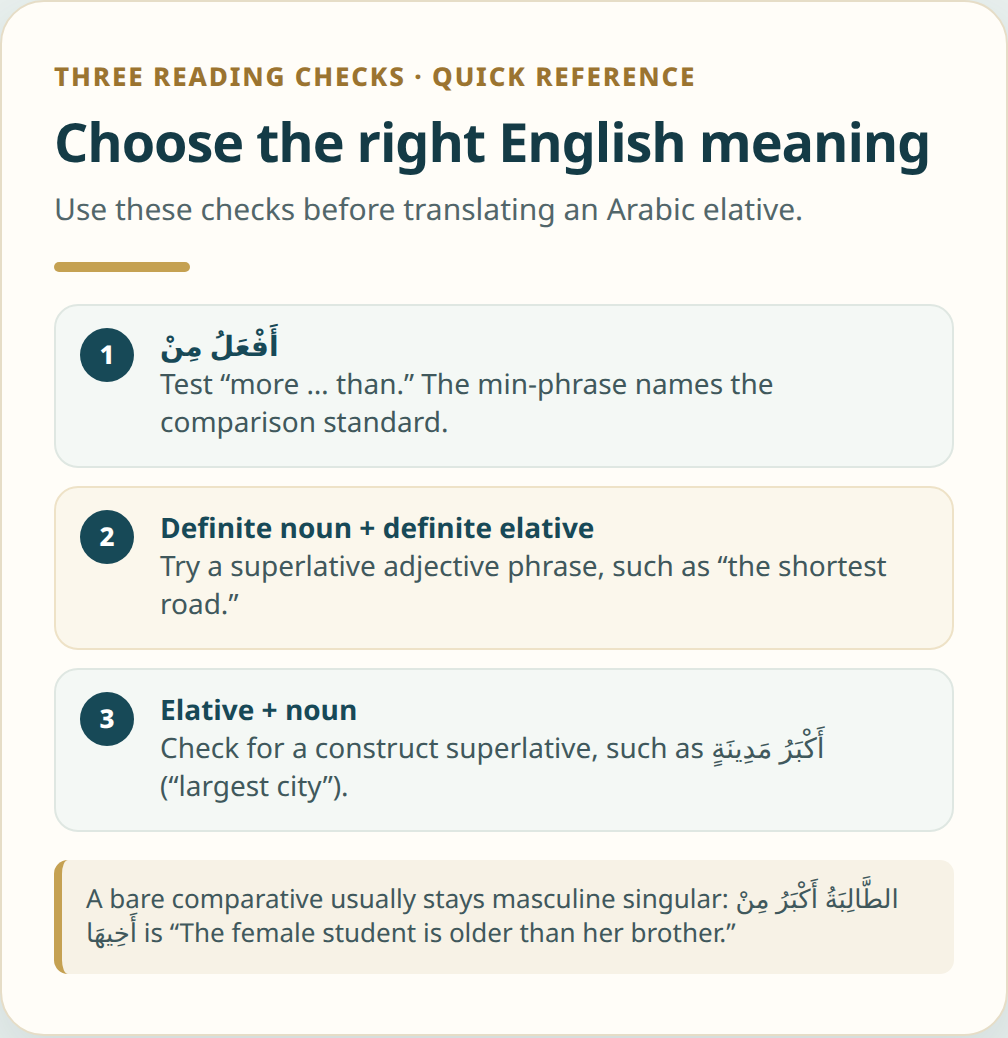
In a plain comparison with مِنْ, the bare elative generally stays masculine singular. So الطَّالِبَةُ أَكْبَرُ مِنْ أَخِيهَا is correct: the subject is feminine, but the comparative predicate remains أَكْبَرُ. Do not mechanically replace it with كُبْرَى just because the subject is feminine.
That does not mean Arabic adjectives never agree. In a definite adjective phrase, an elative may take an agreeing feminine form such as الْكُبْرَى. Agreement depends on whether a word is a predicate, an attributive adjective, or part of an iḍāfa. Treat these as patterns to recognize, not endings to guess. The site’s diptote guide explains why some bare أَفْعَل forms have no tanwīn. The Arabic demonstrative-pronoun guide can help with examples beginning with “this” or “that.”
A quick method for reading a comparison
- Find the degree word. Look for an elative such as أَكْبَر, أَصْغَر, or أَفْضَل.
- Check what follows. With مِنْ, first test “more … than.” With a definite noun or an iḍāfa, test a superlative reading.
- Read the whole phrase. Identify what is compared and the comparison set, then choose natural English. Do not translate أَكْبَر as “bigger” every time.
In a fully vocalized Quranic page, case endings can add clues, but focus on the sentence frame first. If you want more practice reading a word’s role, revisit the case-ending lesson after you understand the comparison.
Practice: comparative or superlative?
Try each line before reading the answer. Is it a complete comparison, a definite adjective phrase, or a construct phrase?
- هَذَا الطَّرِيقُ أَقْصَرُ مِنْ ذَاكَ
- الطَّرِيقُ الأَقْصَرُ
- أَفْضَلُ الطُّلَّابِ
Answers: (1) “This road is shorter than that one.” The explicit مِنْ marks a comparison. (2) “The shorter/shortest road,” a definite noun followed by a definite elative adjective. (3) “The best of the students,” an iḍāfa phrase with the elative first. English the is inferred from the phrase and context; it is not a separate word before أَفْضَلُ.
Common questions
Does أَكْبَر always mean “biggest”?
No. With مِنْ, it normally means “bigger/greater than.” In a superlative noun phrase it may mean “biggest” or “greatest.” Context decides which English wording fits.
Is every comparative made with أَفْعَل?
No. Many comparisons use an elative, but some qualities use أَكْثَرُ or أَقَلُّ with another adjective or verbal noun. Learn frequent expressions and check unfamiliar forms in context.
How should I understand اللَّهُ أَكْبَرُ?
In devotional use, the established English rendering is “Allah is the Greatest.” The Arabic phrase has no explicit مِنْ-phrase naming a comparison standard, so it is not a sentence like أَكْبَرُ مِنْ (“greater than”). Translate the whole expression in its familiar religious context.
Build confidence with real reading practice. Bring an example such as أَكْبَرُ مِنْ to a free Quran and Arabic trial class; a teacher can help you distinguish a comparative frame from a superlative phrase.